Peter Christopherson Photography & The Art of John Balance Collected

coil1.jpg

Look at it this way / In ten years’ time / Who’ll care? / Who’ll even remember?

Coil, The Dreamer Is Still Asleep

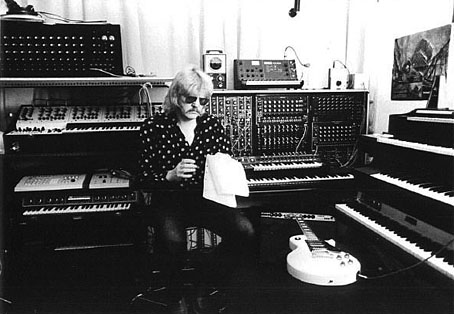
Coil’s John Balance died ten years ago today, bringing an end to two decades of a project that, in its earliest stages, was his own solo musical venture. Ten years on, Coil and Balance have hardly been forgotten: in addition to Coil’s continuing influence in the music world, Jeremy Reed & Karolina Urbaniak recently announced Altered Balance: A Tribute to Coil, a memorial volume whose publication is followed this week by two Coil-related art books from Timeless Editions:

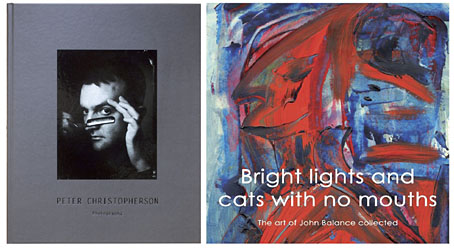
Peter Christopherson: Photography

The legendary unpublished photographic work of Peter Christopherson. The b/w photos featured in the book run the gamut from personal fetishes to social commentary on 1970s UK, portraits of bands, friends and strangers. There are both snapshots and highly staged scenarios. Approximately 95% of this material is published here for the first time ever. Foreword by Claus Laufenburg and a short personal reminiscence by Thighpaulsandra. B/W hardbound, 27 x 33.5 cm, 284 pages.

Bright Lights And Cats With No Mouths: The Art of John Balance Collected

The first ever extensive overview of art (drawings, paintings and sketches) created by John Balance. The artworks featured in the book are both finished elaborate hallucinatory pieces as well as quick sketches with a good sprinkling of Balance’s often underestimated humour. Homages to idols and inspirations next to idiosyncratic magical dreamscapes executed in a wide variety of styles and mediums Compiled by Liam Thomas and Thighpaulsandra. With text by Val Denham and Jeremy Reed. Full colour throughout. 29 x 29 cm, 248 pages.

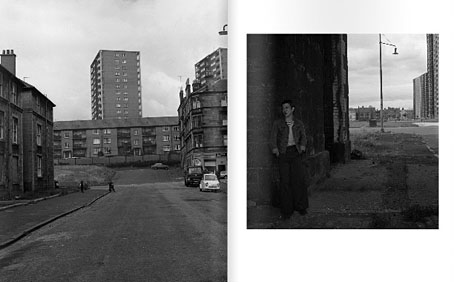
Both books are limited editions, and given the obsessive nature of Coil collectors they’ll probably sell out very quickly. Both volumes are significant, albeit for very different reasons. Peter Christopherson had a long career as a photographer, famously as one-third of the Hipgnosis design partnership, but outside his professional work, and publicity shots for Throbbing Gristle, Psychic TV and Coil, his personal work was always more alluded to than seen. One of the Hipgnosis books mentions his involvement with a group who staged realistic accident and trauma scenes for medical workers but little of this material has been seen until now. Elsewhere in the collection there are shots that resemble some of those that did surface occasionally, also some recurrent obsessions: thuggish youths, violent death, urban dereliction and male bodies. Still no sign of the photos of the Sex Pistols that (we’re told) Malcolm McLaren deemed too heavy.

The John Balance book fascinates simply for showing work that was even more hidden, and hardly alluded to at all. John and I did talk about his artistic endeavours once during our sporadic communications—the 3D scenes on the Musick To Play In The Dark albums were his creations using some PC program whose name I forget—but there was never a hint that he’d produced so much. The publisher sent me a link to their preview pages (here & here) so a few samples follow.

pc1.jpg

Continue reading “Peter Christopherson Photography & The Art of John Balance Collected”

Weekend links 233

casas.jpg

Alchemical Stone (2014) by Daniel Lasso Casas. Via full fathom five.

• “I am unsure if this reality is an everyday one. We don’t know if the universe belongs to a realist genre or a fantastic one, because if, as idealists believe, everything is a dream, then what we call reality is essentially oneiric.” Jorge Luis Borges in 1984 in conversation with Argentinian poet and essayist Osvaldo Ferrari.

• “I am transgender, so ‘he’ is not appropriate and ‘she’ is problematic. I’m what I think of as pure transgender.” Antony Hegarty talks to Cian Traynor about Turning, a new DVD and album project.

Unearthing Forgotten Horrors 2014 is a weekend festival of rural weirdness at the Star and Shadow Cinema, Newcastle-upon-Tyne.

Henry Darger, one of the most celebrated examples of an outsider artist (see: Vivian Girls), has been uniformly ignored by the literary firmament. Despite the success of his artwork, none of his fiction manuscripts have seen print. The language of literature is the language of privilege, in which even the stories of the working class are regularly clad in a bourgeois prose. The language of literature cannot be extricated from its white, genteel roots. Those of us without access to education are welcome to practice, but we must come in from the cold, adopt the house language. We must be civilized, scrubbed clean. Naiveté has no place in the colosseum of words.

Ravi Mangla on Coming in from the Cold: Outsider Art in Literature

Carel de Nerée tot Babberich en Henri van Booven, a collection of Beardsley-like drawings by a neglected Dutch artist.

Forever Butt is a new collection of the best of recent issues of BUTT magazine, still the best print mag for gay men.

Anne Billson’s guide to Brussels, another European city I’d like to visit some day.

• At BibliOdyssey: Schönschreibmeister, a calligraphy master’s album.

Third Ear Band live (and in colour!) on French TV in 1970.

• Mix of the week: Secret Thirteen mix 132 by Spatial.

• The Internet Archive now has an Internet Arcade.

Crazy Cat Lady Clothing

The Pattern Library

Stone Circle (1969) by Third Ear Band | Sacred Stones (1992) by Sheila Chandra | Stoned Circular I (1996) by Coil

The White People by Arthur Machen

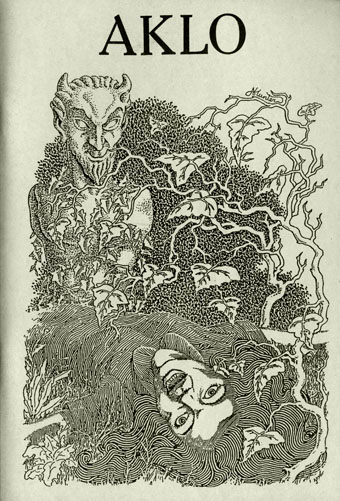
aklo.jpg

Aklo: A Journal of the Fantastic, Spring 1988 edition, edited by Mark Valentine & Roger Dobson. Illustration by Alan Hunter.

1: The White People

The White People by Arthur Machen was written in 1899 but not published until it appeared in Horlick’s Magazine, January 1904. The magazine, which ran for just over a year, was edited by Machen’s Golden Dawn colleague AE Waite which no doubt explains the unlikely venue. HP Lovecraft enthused about the story in Supernatural Horror in Literature (1927):

Less famous and less complex in plot than The Great God Pan, but definitely finer in atmosphere and general artistic value, is the curious and dimly disquieting chronicle called The White People, whose central portion purports to be the diary or notes of a little girl whose nurse has introduced her to some of the forbidden magic and soul-blasting traditions of the noxious witch-cult — the cult whose whispered lore was handed down long lines of peasantry throughout Western Europe, and whose members sometimes stole forth at night, one by one, to meet in black woods and lonely places for the revolting orgies of the Witches’ Sabbath. Mr. Machen’s narrative, a triumph of skilful selectiveness and restraint, accumulates enormous power as it flows on in a stream of innocent childish prattle, introducing allusions to strange “nymphs,” “Dols,” “voolas,” “white, green, and scarlet ceremonies,” “Aklo letters,” “Chian language,” “Mao games,” and the like. The rites learned by the nurse from her witch grandmother are taught to the child by the time she is three years old, and her artless accounts of the dangerous secret revelations possess a lurking terror generously mixed with pathos. Evil charms well known to anthropologists are described with juvenile naiveté, and finally there comes a winter afternoon journey into the old Welsh hills, performed under an imaginative spell which lends to the wild scenery an added weirdness, strangeness, and suggestion of grotesque sentience. The details of this journey are given with marvellous vividness, and form to the keen critic a masterpiece of fantastic writing, with almost unlimited power in the intimation of potent hideousness and cosmic aberration.

Lovecraft borrowed Machen’s naive narrator a year later for The Dunwich Horror: Wilbur Whateley’s diary is written “by a child of three-and-a-half who looked like a lad of twelve or thirteen”, and makes reference to “Aklo”, “the Dho formula” and “the Voorish sign”. (The journal in The White People refers to “a wicked voorish dome”.)

Lovecraft wasn’t alone in being impressed by the story, it’s long been regarded as Machen’s greatest piece of short fiction with good reason:

…it remains the purest and most powerful expression of what Jack Sullivan has called the “transcendental” or “visionary” supernatural tradition. Most other tales in that tradition, Blackwood’s The Wendigo, EF Benson’s The Man Who Went Too Far, and Machen’s own The Great God Pan, merely describe encounters with the dark primeval forces that reign beyond the edge of civilisation; The White People seems an actual product of such an encounter, an authentic pagan artefact…

TED Klein, The Penguin Encyclopedia of Horror and the Supernatural (1986)


2: The House of Souls

sime.jpg

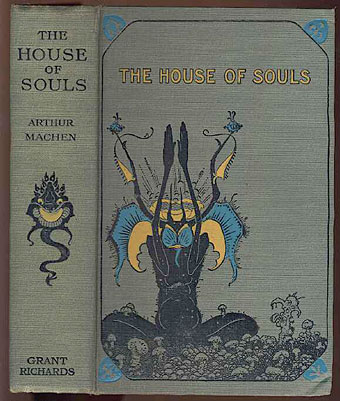
The House of Souls (1906). Cover illustrations by Sidney Sime.

The story was first collected in The House of Souls in 1906, a book that features a splendidly weird cover illustration by Sidney Sime. Inside there’s some of Machen’s finest supernatural writing including The Great God Pan, The Inmost Light and The Three Imposters. Also included is A Fragment of Life, a visionary piece that begins as a domestic drama but by the end has almost intersected with The White People.

And by coincidence (or is it?), I’ve just noticed that Tartarus Press are publishing a facsimile edition of the 1906 volume later this month.


3: The Ceremonies

ceremonies.jpg

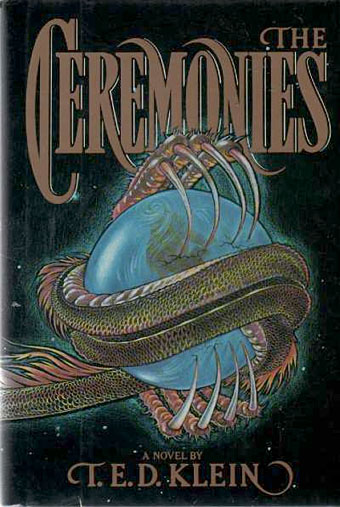
The Ceremonies (1984). Illustration by David Palladini.

TED Klein’s debut novel is also his only novel to date. Klein was editor of The Twilight Zone Magazine at this time, and he used the publication’s popularity to promote the weird fiction of the past; writers like Machen and Algernon Blackwood weren’t as visible in the mid-80s as they are today. The Ceremonies was expanded from a 1972 novella, The Events at Poroth Farm, and borrows much from The White People: the ceremonies of the title refers to those in the story, and the story itself—which a character is instructed to read by moonlight—is described as a key to occult mysteries. There’s a lot about the novel to recommend—Klein’s prose for a start—but I felt it could have been much weirder than it was. The book reads like a typical King/Straub narrative that’s aiming for more without quite getting there, and placing something as unique as Machen’s story at its heart only makes its eventual shortcomings all the more apparent.


4: A drawing

whitepeople.jpg

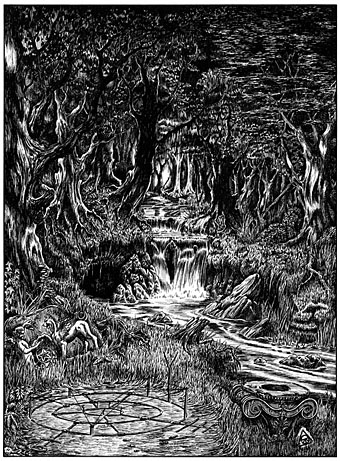
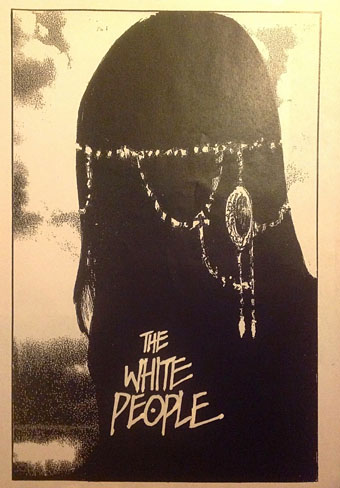
The White People (1990) by John Coulthart.

And speaking of aiming for more without quite getting there, my drawing from 1990. This was going to be one of a series based on Machen’s story but I ran out of steam, feeling that the usual approach of drawing separate scenes wasn’t going to deliver the essence of the piece. If I tried this today I’d probably go for a more surreal approach the way Sätty did with Poe.


5: Roses

roses.jpg

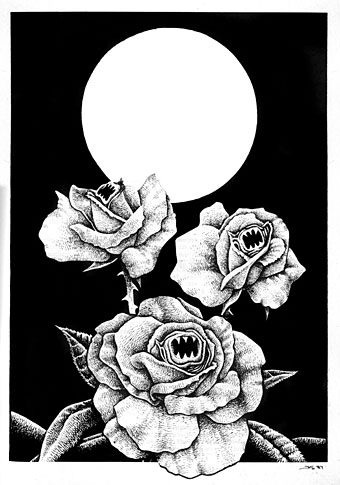
The Singing Roses (1987) by Jeffrey Salmon. From Dagon magazine no. 18/19, July–October, 1987.

“And what is sin?” said Cotgrave.

“I think I must reply to your question by another. What would your feelings be, seriously, if your cat or your dog began to talk to you, and to dispute with you in human accents? You would be overwhelmed with horror. I am sure of it. And if the roses in your garden sang a weird song, you would go mad. And suppose the stones in the road began to swell and grow before your eyes, and if the pebble that you noticed at night had shot out stony blossoms in the morning?

The White People

*

Sweet tortures fly on mystery wings / Pure evil is when flowers sing / My heart / My heart is a rose

Love’s Secret Domain (1991) by Coil


6: Ghost Box

zann.jpg

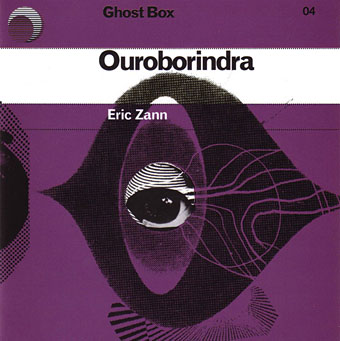
Ouroborindra (2005) by Eric Zann. Design by Julian House.

Track 4: Dôls
Track 6: Voolas

belbury.jpg

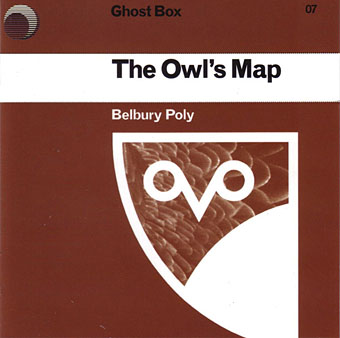
The Owl’s Map (2006) by Belbury Poly. Design by Julian House.

Track 11: Scarlet Ceremony

Among the sleeve notes there’s this:

And the noise and the singing would go on and on for a long time, and the people who were in a ring swayed a little to and fro; and the song was in an old, old language that nobody knows now, and the tune was queer.

Arthur Machen, The White People


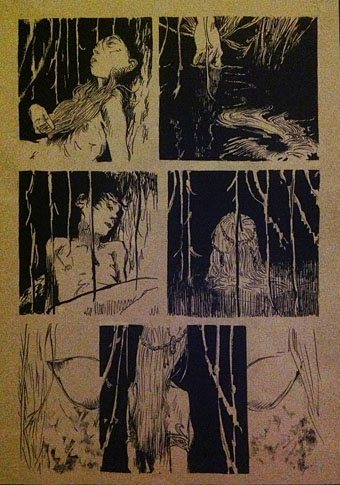
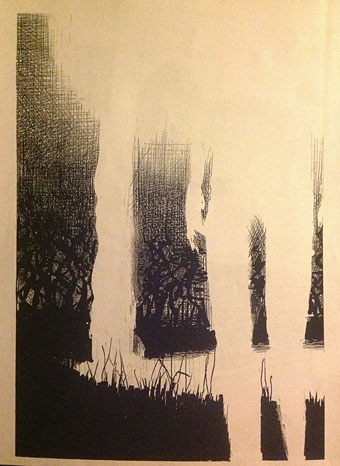
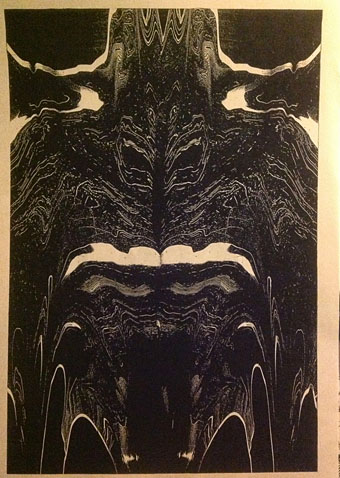
7: The White People by Ibrahim R. Ineke

ineke1.jpg

A very impressive comic-strip adaptation, the first of its kind, as far as I’m aware. See the full run of pages here. (And thanks to Ibrahim for getting in touch!)

ineke2.jpg

ineke3.jpg

ineke4.jpg

For those who can’t afford a limited edition from Tartarus Press, Machen’s story may currently be found in Penguin’s The White People and Other Weird Stories. The perfect thing now the nights are drawing in.

Update: See also The Forbidden Forest, a short animation based on the story. (Thanks, Richard!)

Elsewhere on { feuilleton }
The Lovecraft archive

Previously on { feuilleton }
The Bowmen by Arthur Machen
Rex Ingram’s The Magician
The Great God Pan

Weekend links 231

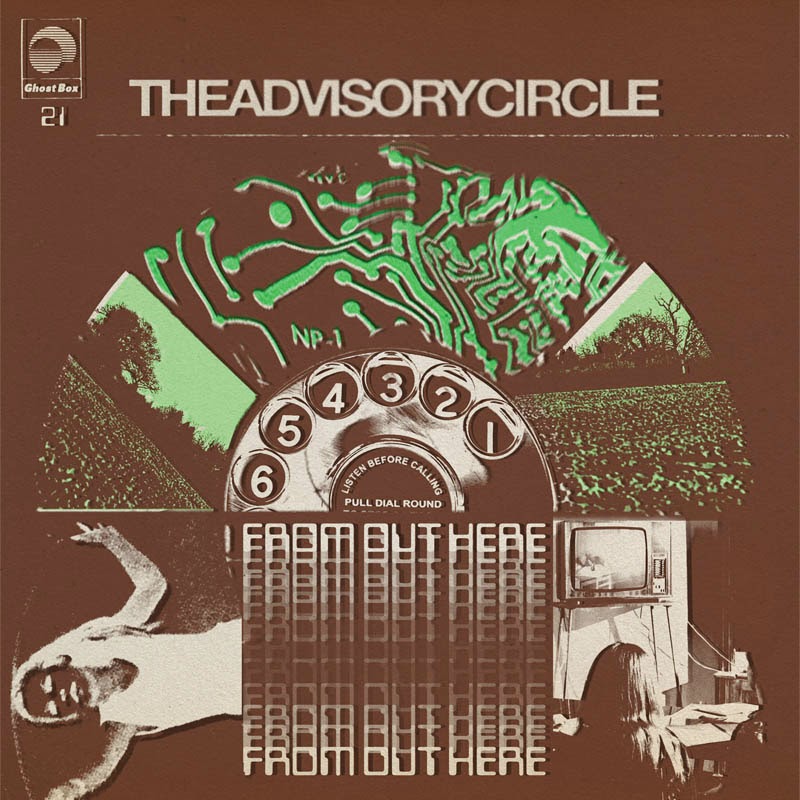
advisory.jpg

Design by Julian House.

Always good to hear of a new release on the Ghost Box label, and a new album by The Advisory Circle (due on 5th December) is especially welcome. From Out Here is described thus: “Exploring darker territory than 2012’s more pastoral As The Crow Flies, The Advisory Circle hint at a Wyndham-esque science fiction story, where bucolic English scenery is being manipulated and maybe even artificially generated by bizarre multi-dimensional computer technology.” The Belbury Parish Magazine has extracts.

• Jon Hassell’s Fourth World Music Vol. I: Possible Musics receives a long-overdue reissue next month. Possible Musics was a collaboration with Brian Eno, and Eno has some of his own albums reissued again in expanded editions. Most notable is the first official release of My Squelchy Life, an album that was withdrawn in 1991 to be replaced by Nerve Net.

• Some Halloween theatre on Friday (the 31st) at the Museum of Bath at Work with a dramatisation of Ringing the Changes by Robert Aickman. There’s a repeat performance the following week (8th November) with added spectral atmospherics from the Electric Pentangle. Free admission.

The value of these books wasn’t anything wholesome they contained, or any moral instruction they offered. Rather, it was the process of finding them, the thrill of reading them, the way the books themselves, like the men they depicted, detached you from the familiar moral landscape. They gave a name to the palpable, physical loneliness of sexual solitude, but they also greatly increased your intellectual and emotional solitude. Until very recently, the canon of literature for a gay kid was discovered entirely alone, by threads of connection that linked authors from intertwined demimondes. It was smuggling, but also scavenging. There was no internet, no “customers who bought this item also bought,” no helpful librarians steeped in the discourse of tolerance and diversity, and certainly no one in the adult world who could be trusted to give advice and advance the project of limning this still mostly forbidden body of work.

Smuggler: A Memoir of Gay Male Literature by Philip Kennicott

• Getting in before the Mixcloud Halloween rush, mix of the week is Samhain Seance 3: Better Dead Than Never by The Ephemeral Man. My Halloween mix for this year is almost finished; watch the skies.

• For those who can’t wait until December for From Out Here, there’s a new Howlround album, Torridon Gate, out this week from A Year In The Country.

• Last week, Yello’s Boris Blank was choosing favourite electronic albums, this week he runs through a list of thirteen favourite albums.

Altered Balance: A Tribute to Coil by Jeremy Reed & Karolina Urbaniak. Richard Fontenoy reviewed the book for The Quietus.

Cut-Ups: William S. Burroughs 1914–2014, an exhibition of Burroughs’ typescripts at Boo-Hooray, NYC, from 7th November.

Brando, a film by Gisèle Vienne for the song by Scott Walker & Sunn O))).

NASA has a Soundcloud page

The art of leaves

Cobra Moon (1979) by Jon Hassell | Moon On Ice (1987) by Yello feat. Billy MacKenzie | Moon’s Milk Or Under An Unquiet Skull Pt. I (1998) by Coil

Weekend links 220

waliszewska.jpg

Untitled painting by Aleksandra Waliszewska.

• Ben Wheatley’s forthcoming film of High-Rise by JG Ballard now has its own Tumblr. This will no doubt be spoilerific so I won’t keep on visiting but it’s there if you require it. More Ballardianism: “Worshipping the Crash” at BLDGBLOG.

• “Aickman wandered through the sixties fantasy landscape like some curmudgeonly fetch, returning from the fin de siècle heyday of the ghost story.” Boyd Tonkin profiles Robert Aickman, writer of peerless “strange stories”.

• At Dangerous Minds: “Raise a glass to Cthulhu at the Lovecraft Bar”. Looks more like a Captain Nemo bar to me (not that there’s anything wrong with that) but I appreciate the gesture.

But to demand that a work be “relatable” expresses a different expectation: that the work itself be somehow accommodating to, or reflective of, the experience of the reader or viewer. The reader or viewer remains passive in the face of the book or movie or play: she expects the work to be done for her.

Rebecca Mead on The Scourge of Relatability

• “Space as a paranoid, static rumble featuring: 20jfg, Ben Frost & Daníel Bjarnason, Coil & Eduard Artemiev”. 20 Jazz Funk Greats on the pleasures of the Solaris soundtrack.

• What do Hawkwind, Harry Nilsson, Stereolab and The Supremes have in common? David Stubbs examines the legacy of Neu! and Klaus Dinger’s “Dingerbeat”.

• A reminder that A Year in the Country features a host of worthwhile links and associations for the Hauntologically persuaded.

Rouge Louboutin, an ad by David Lynch. Related: An improptu biscuit ad by the Eccentronic Research Council.

• Mix of the week (a year old but no matter): JG Ballard Zoom Lens Mix by Bernholz.

• At 50 Watts: More illustrated sheet music covers by Einar Nerman.

Five book cover designers and the books that inspire them.

Tove Jansson would have been 100 this week.

Pangaea with modern borders

Solaris: Dream (1990) by Edward Artemyev [sic] | Solaris (2000) by Photek | Simulacra I (2011) by Ben Frost & Daníel Bjarnason