Weekend links 502

wilson.jpg

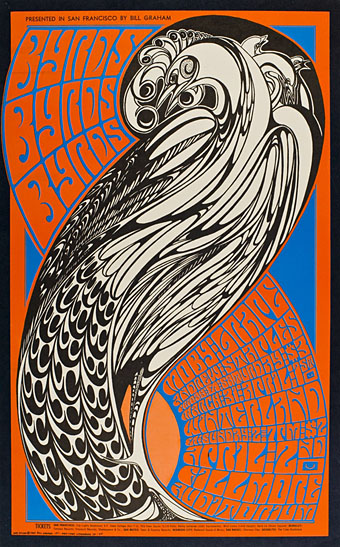
The Byrds (1967) by Wes Wilson.

• RIP Wes Wilson, one of the first of the San Francisco psychedelic poster artists of the 1960s, and also one of the more visible thanks to the popularity of his compressed type designs, some of which were derived from a style developed by Alfred Roller for the Vienna Secession circa 1900. When Playboy magazine wanted a cover that reflected the psychedelic art trend in late 1967 it was Wilson they called. Related: Wes Wilson’s posters at Wolfgang’s.

• “In the ’70s, New Age music offered listeners, trapped in the urban rat-race, audio capsules of pastoral peace to transform their homes into havens. Today the Internet and social media form a kind of post-geographic urban space, an immaterial city of information whose hustle ‘n bustle is even more wearing and deleterious to our equilibrium.” 2010–19: Back To The Garden: The Return Of Ambient And New Age by Simon Reynolds.

• “This pointed-finger symbol goes by many names: mutton fist, printer’s fist, bishop’s fist, pointer, hand director, indicule, or most unimaginatively as ‘a hand’. Scholarly consensus has pretty much settled on the word ‘manicule’, from the Latin maniculum, meaning ‘little hand’.” John Boardley on the typographic history of the pointing hand.

Tales Of Purple Sally (1973) by Alex. All instruments by Alex Wiska apart from bass by Holger Czukay, and drums by Jaki Liebzeit. The latter pair also produced the album. Related: Jah Wobble talking to Duncan Seaman about working with Czukay and Liebeziet.

• “On Jan 25, 2020, tired of negative film lists on Twitter, I asked people for ‘obscure [or] underseen films you adore and think more people should know about.’ This was the result.”

Flash Of The Spirit by Jon Hassell & Farafina “hails from a time when the possibilities of music seemed less well-defined, and borders felt more open,” says Geeta Dayal.

The Art Of Computer Designing: A Black and White Approach (1993) by Osamu Sato. There’s more of Sato’s print work at the Internet Archive.

• At the Morgan Library: Jean-Jacques Lequeu: Visionary Architect. Drawings from the Bibliothèque nationale de France.

• New from Strange Attractor: Inferno: The Trash Project: Volume One by Ken Hollings.

• At Dennis Cooper’s: Storm de Hirsch Day.

Celeste by Roger Eno & Brian Eno.

Ben Watt‘s favourite music.

The Inferno (1968) by The Inferno | Inferno (1990) by Jah Wobble’s Invaders Of The Heart | Inferno (1993) by Miranda Sex Garden
Weekend links 498

mead.jpg

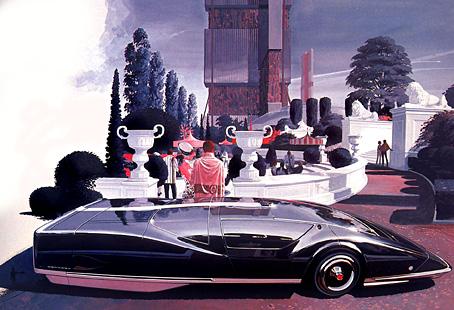
The Sentinel 280, a car design by Syd Mead from 1964.

• “Boris Dolgov did not exist. The man who bore that name may have existed, but there never was a man in the United States with that name until 1956, too late for Weird Tales.” Teller of Weird Tales on the mysterious identity of a magazine artist.

• Saying goodbye to 2019 also meant saying farewell to Vaughan Oliver, Neil Innes and Syd Mead. Related: Vaughan Oliver at Discogs; I’m The Urban Spaceman; a look back at Syd Mead’s vehicle designs.

Lanre Bakare on how ambient music became cool. (Again. This begs the question of when it became uncool, especially when a ten-year-old Brian Eno piece about “the death of uncool” is being quoted.)

Westerners interpreted the peyote experience very differently from the practitioners of the peyote religion, where the focus was “ritual, song and prayer, and to dissect one’s private sensations was to miss the point”. Writers such as Havelock Ellis, who published an essay on his peyote experiences in the Lancet in 1897 (it’s likely that he also administered the substance to his friends W.B. Yeats and Arthur Symons), instead tended to focus on its visual effects. Ellis described “the brilliance, delicacy and variety of the colours” and “their lovely and various textures”. Peyote reached Europe in tandem with the X-ray, cinema and electric lights, Jay notes, and “nothing delighted the eye of the mescal eater so much as the new electrical sublime”.

Emily Witt reviewing Mescaline: A Global History of the First Psychedelic by Mike Jay

Peter Bradshaw takes on the thankless task of ranking Federico Fellini’s feature films.

Geoff Manaugh on when Russia and America coöperated to avert a Y2K apocalypse.

• “Music is an ideal medium for interstellar communication,” says Daniel Oberhaus.

Keith Allison on Karel Zeman, a creator of remarkable cinematic fantasies.

•  Japanese Designer New Year’s Cards of 2020.

• At Dennis Cooper’s: Vera Chytilová Day.

2020 in public domain.

Sentinel (1992) by Mike Oldfield | Sentinels (2001) by Cyclobe | Sentinel (2004) by Transglobal Underground

Weekend links 494

church.jpg

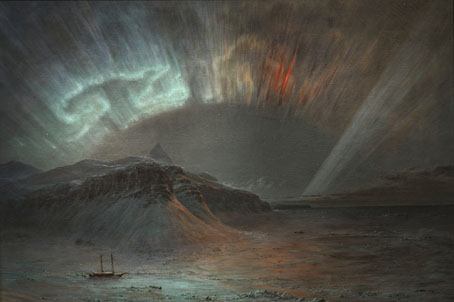
Aurora Borealis (1865) by Frederic Edwin Church.

• December is over-stuffed with enervating cultural lists, most of them reminding you of things which received enough attention earlier in the year. Better value than these—and always unpredictable—is John Waters‘ choice of favourite films; unpredictable and enlightening are the Secret Satan selections at Strange Flowers which come in two flavours: books originally published in English and books translated from other languages.

Flash Of The Spirit (1988), a collaboration between Jon Hassell and African group Farafina (with production by Hassell plus Brian Eno & Daniel Lanois), receives its first ever reissue on double-vinyl and CD next year. The last piece on the album is the 11-minute Masque (Strength).

• “In 1968, Federico Fellini decided he was going make the greatest homosexual movie ever made. What he meant by a homosexual movie, no one was quite sure, but it was going to be great.” Paul Gallagher on Federico Fellini’s delirious (and distinctly homosexual) Satyricon.

• “Here’s the typography of the next decade; the age of font minimalism is coming to a close,” says Rachel Hawley. I’ve been using Didones for the past decade so I’ll carry on happily ignoring the trends.

• More obituaries for comic artist Howard Cruse: Justin Hall at The Comics Journal; Trudy Ring at The Advocate; and Richard Sandomir at the New York Times.

• “Cowley records a kind of utopian sleaze that’s breathtaking.” Brett Josef Grubisic reviews Patrick Cowley’s sex journal of the 1970s, Mechanical Fantasy Box.

• At the BFI: Carmen Gray on where to begin with Sergei Parajanov, and Matthew Thrift on 10 essential Fritz Lang films.

A promo video by Julian House for Paul Weller’s In Another Room EP which is released in January by Ghost Box.

• At Aquarium Drunkard: San Francisco Radical Laboratory and the Mysterious Moogist of Altamont.

• Mix of the week: Through A Landscape Of Mirrors Vol. V – France III by David Colohan.

Aurora Australis (2005) by Émilie Simon | Iceblink (Aurora Borealis Mix) (2011) by Netherworld | Aurora Liminalis (2013) by William Basinski & Richard Chartier

Weekend links 476

kimura.jpg

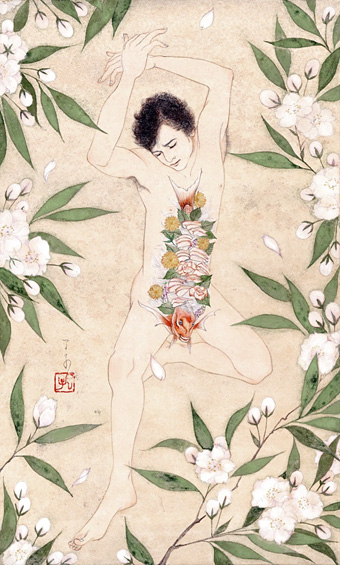
Man’s body dish for Sashimi under the cherry blossom (2005) by Ryoko Kimura.

• Godley & Creme’s Consequences (1977) is reissued this month on CD and vinyl. Originally a three-disc concept album with a theme of climate disaster and the natural world’s revenge on humanity, Consequences was released at a time when punk and prog rock were fighting for the attention of music listeners. 1977 wasn’t the end of prog by any means (many of the vilified bands had some of their greatest successes at this time) but Godley & Creme’s transition from the smart pop songs of 10cc to extended instrumental suites was abrupt, and their concept, such as it was, lacked the drama and accessibility of Jeff Wayne’s The War of the Worlds, even with the addition of Peter Cook providing a multi-voice comic narrative between the musical pieces. (Kevin Godley ruefully referred to the album in later years as Con Sequences.) The album flopped, and has been a cult item ever since.

• “A word of caution, though. Once you do read it, it’s hard to let it go.” Philip Hoare on Herman Melville and Moby-Dick. Related: William T. Vollmann on how a voyage to French Polynesia set Herman Melville on the course to write Moby-Dick.

Samm Deighan on The “Faraway Forest” in Peter Strickland’s Katalin Varga, The Duke of Burgundy, and The Cobbler’s Lot.

Brian Eno, Roger Eno, and Daniel Lanois discuss the recording of Apollo: Atmospheres & Soundtracks.

John Boardley on the first fashion books, Renaissance pixel fonts and the invention of graph paper.

Melanie Xulu looks back at a time where major labels were releasing witchcraft rituals.

• “Tom Phillips’ A Humument is a completely novel project,” says Rachel Hawley.

John Foster on the evolution of Stereolab’s analogue-inspired record sleeves.

• At Dennis Cooper’s: a history of le Grand Guignol by Agnes Peirron.

Casey Rae on William S. Burroughs and the cult of rock’n’roll.

• An Austin Osman Spare image archive.

Consequences (1965) by John Coltrane | Moby Dick (1969) by Led Zeppelin | Consequence (1995) by Paul Schütze

Weekend links 475

brooks.jpg

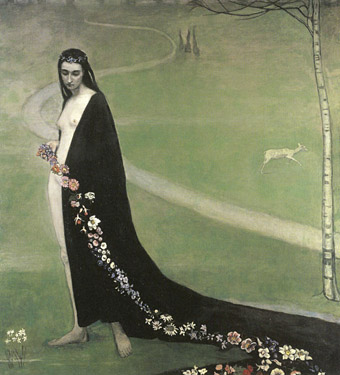
Femme avec des fleurs (c. 1912) by Romaine Brooks.

• “Boring people tend not to exile themselves to rocky islands, but even among the intriguing personalities we encounter in Capri, some individuals prove more extravagantly memorable than others.” Steve Susoyev reviews Pagan Light: Dreams of Freedom and Beauty in Capri by Jamie James.

• “The Mad “idiots” subverted the comic form into a mainstream ideological weapon, aimed at icons of the left and the right—attacking both McCarthyism and the Beat Generation, Nixon and Kennedy, Hollywood and Madison Avenue.” Jordan Orlando on a world without Mad Magazine.

• RIP Sam Gafford, Paul Krassner and Rutger Hauer. Related to the latter: Hauer’s first role as Floris, the hero of a Dutch TV series directed by Paul Verhoeven.

I cannot tell you what it does to me to hear pre-Stonewall. And even in our literature, even in the art, pre-Stonewall, post-Stonewall. I wrote three books pre-Stonewall and a dozen more post-Stonewall. There’s no demarcation. Gay history is centuries and centuries from the Romans to the Greeks to Oscar Wilde to all kinds of outrages. And those seem to be put back and pre-Stonewall is passive. Post-Stonewall is brave and dignified. I actually have heard things like that. I’ve talked, I’ve lectured and I’ve been invited all the way from Harvard to USC. And I talk about what it was like, what we had to survive.

Look, pre-Stonewall produced Allen Ginsberg, William Burroughs, Oscar Wilde, and I could go on. Post-Stonewall produced Bret Easton Ellis, who jumps out of the closet only now and then and then rushes back in, and Queer Eye for the Straight Guy, where we’re reduced to clowns for straight people. The husband of Mr. Buttigieg, he is so darling talking about the silver he’s going to be choosing for the White House. It embarrasses me, it embarrasses me very much because that’s what people expect a gay man to do, to be very precious, and that’s not what we are. A good solid queen I will protect forever, they are heroes.

A lot of people think that everything stopped, everything, all harassment stopped. Look, it’s still going on. It’s still going on, for god’s sake. The same tactics are often used in a different way.

John Rechy talking to Jason McGahan

• The genius of Barry Adamson: An exclusive interview by Paul Gallagher at Dangerous Minds.

Three hours of the Prophecy Theme from Dune (by Brian Eno with Daniel Lanois & Roger Eno).

Ed Sanders on why pop culture still can’t get enough of Charles Manson.

• Havelock Ellis takes a trip: Mike Jay on peyote among the Aesthetes.

Darren Anderson on why little works of architecture deserve respect.

• Mix of the week: Stephen O’Malley presents / Java / Apr 27 2017.

Phil Hine reviews Folk Horror Revival: Urban Wyrd 1 & 2.

John Waters revisits “The Golden Age of Monkey Art”.

I Must Be Mad (1966) by The Craig | The Day My Pad Went Mad (1982) by John Cooper Clarke | Yesterday, When I Was Mad (1993) by Pet Shop Boys