Reversible men and Lipský’s Happy End

overloaded.jpg

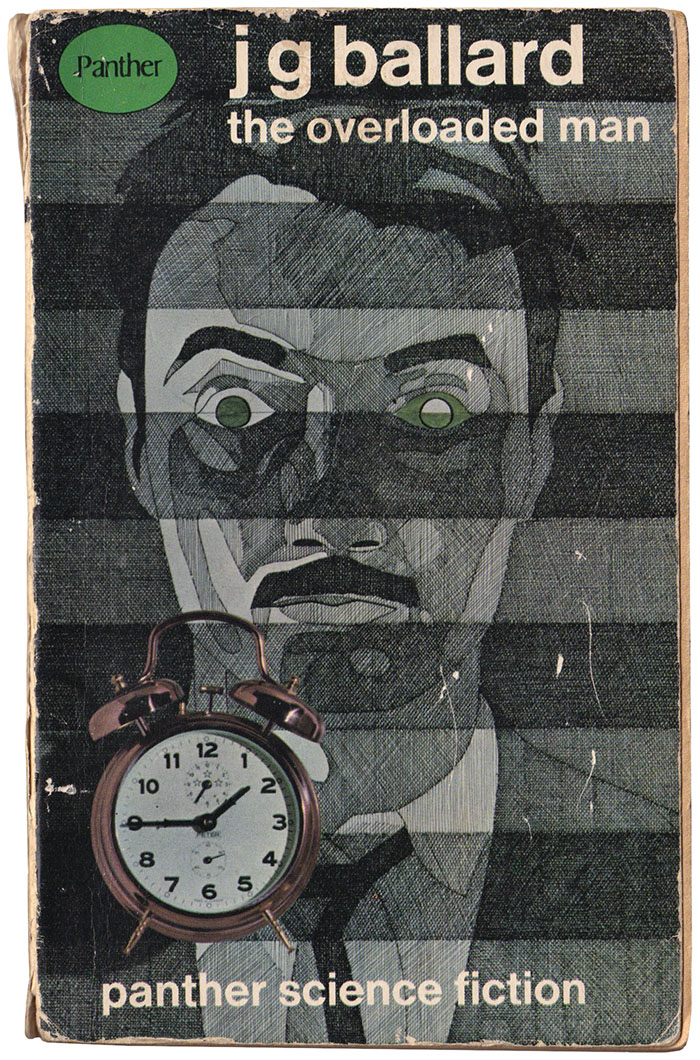
A paperback ravaged by the passage of time. Art by Ray Ginghofer.

Time of Passage, a piece of short fiction by JG Ballard, received its first publication in Science Fantasy magazine in February, 1964. The piece was subsequently collected in two paperbacks, The Impossible Man and Other Stories (Berkley Medallion, 1966), and The Overloaded Man (Panther, 1967). Time of Passage is more of a biographical sketch than a story, describing in reverse the life of a stockbroker, James Falkman, a man “born” in 1963 by being dug out of a grave while surrounded by tearful relatives. Ballard goes on to describe the major events of Falkman’s life, from retirement to career to marriage, charting the man’s gradual descent into youth and eventual infant helplessness. The story ends with Falkman bheing taken to a hospital in 1900 for a final encounter with his mother, his “death” in Ballard’s words.
venus.jpg

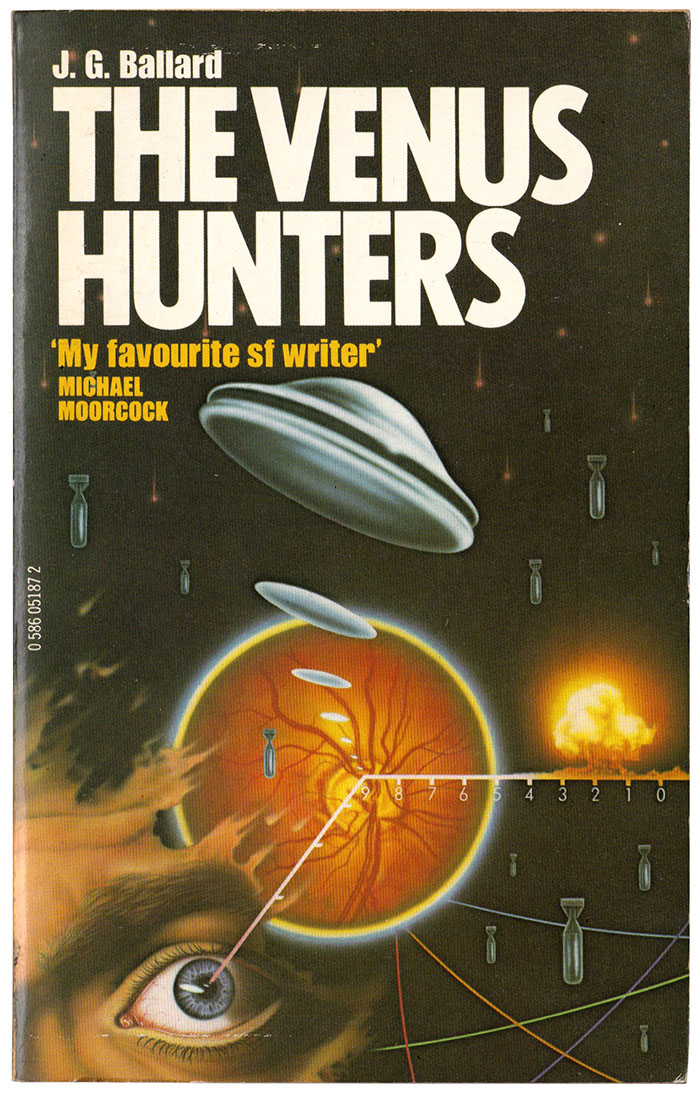
A revised reprint of The Overloaded Man, 1980. The artwork by Peter Gudynas may be the only Ballard cover to feature flying saucers.

There may be earlier literary examples of the life described in reverse but Ballard’s is the earliest one I know of. I’m thinking here of explicit reversals of human circumstance, as opposed to the more common reverse chronology whereby an otherwise forward-flowing story is chopped into episodes which are then presented in a reversed order. Philip K. Dick’s Counter-Clock World (1967) is a novel-length extrapolation of Ballard’s concept, set in a future where time has started to run backwards, and the dead are being born again in cemeteries. The 1960s saw a peculiar spate of fiction along these lines; to paraphrase Charles Fort, it must have been time-reversal time. In an earlier Ballard story, Mr. F is Mr. F, the titular character finds himself aging in reverse while time continues to run forward for his wife and the world outside their home; in An Age (1967) by Brian Aldiss scientific experiments reveal that time is actually moving in reverse despite our perceptions to the contrary.
reversible.jpg

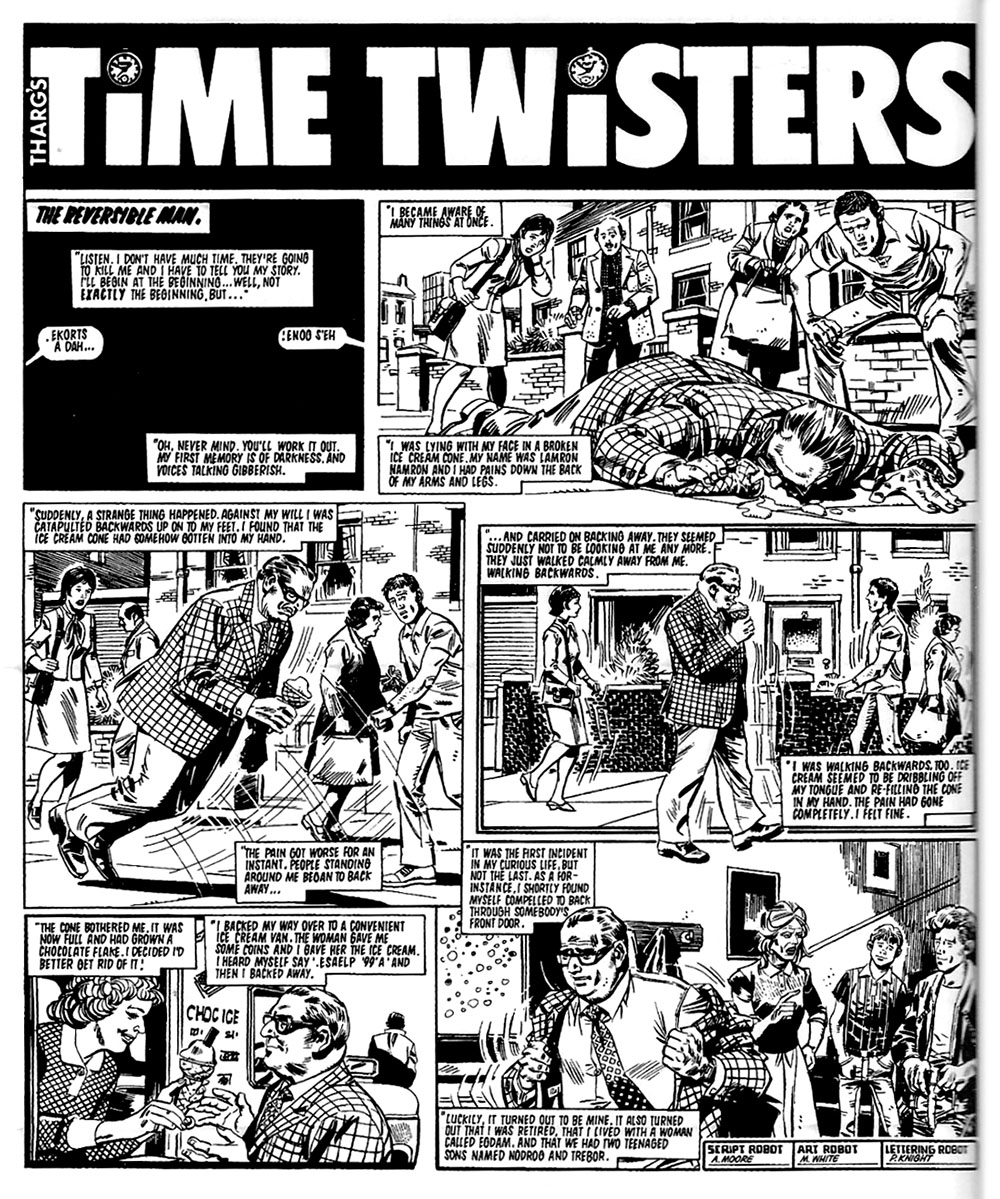
Art by Mike White.

Alan Moore would no doubt have been familiar with one or more of these stories when he wrote The Reversible Man for 2000 AD in 1983, a four-page strip which shows the life of an ordinary man from death to birth. Moore freshens the concept a little by the use of first-person narration. The most well-known treatment of the idea is Time’s Arrow by Martin Amis, a novel whose structure was taken by some reviewers as wholly original even though Amis said he was inspired by a passage in Kurt Vonnegut’s Slaughterhouse-Five. I’ve always felt Amis was being evasive on this point; he was very familiar with Ballard’s fiction, he interviewed Ballard and reviewed his novels on several occasions. Anyone with this much interest in Ballard’s work would have read Time of Passage in one of its many reprintings.
happy-end.jpg

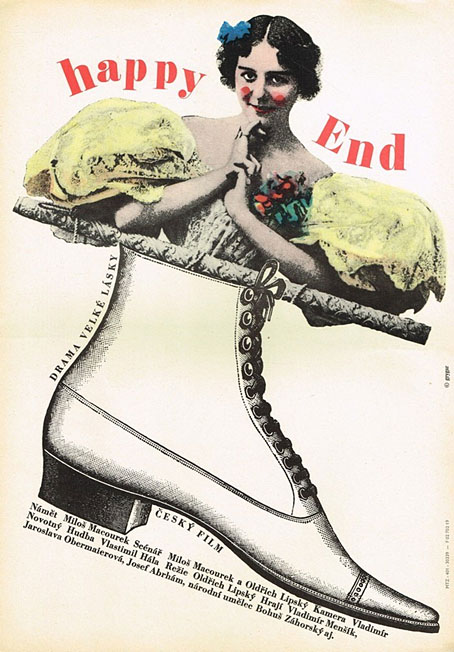
Design by Milan Grygar.

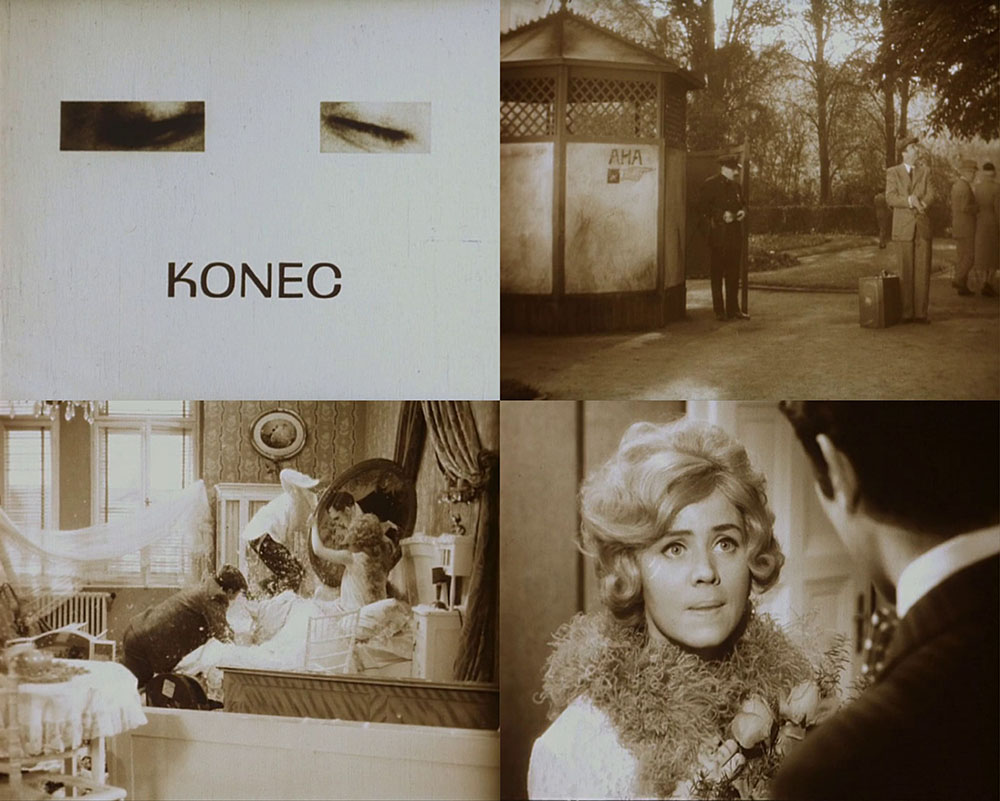
When it comes to authorial influence it seems unlikely that Czech film-maker Oldřich Lipský could have been influenced by Ballard or Dick’s time-reversals, which makes the appearance of Happy End in 1967 all the more remarkable. Lipský’s feature film, which I watched last week, is essentially Ballard’s death-to-life narrative played for its comic potential, with the film itself running in reverse for much of the time. Happy End opens with a title card in Czech—”Konec” (“The End”)—before presenting the “birth” of its protagonist by means of a guillotine. The decapitated head of Bedřich Frydrych (Vladimír Menšík) is attached to his body, after which the guards lead him (backwards) to the place described by his cheerful voiceover as a school (aka prison) where he says he’s being prepared for life in the outside world. Before he sets off to his waiting apartment the police give him a suitcase containing the body of his wife, Julie (Jaroslava Obermaierová), the pieces of which he assembles in the bath in his apartment. Julie is “revived” when Frydrych pulls an axe from her forehead, after which Julie’s lover, Ptáček (Josef Abrhám), makes his first arrival, jumping backwards into the bedroom through the window.
he1.jpg

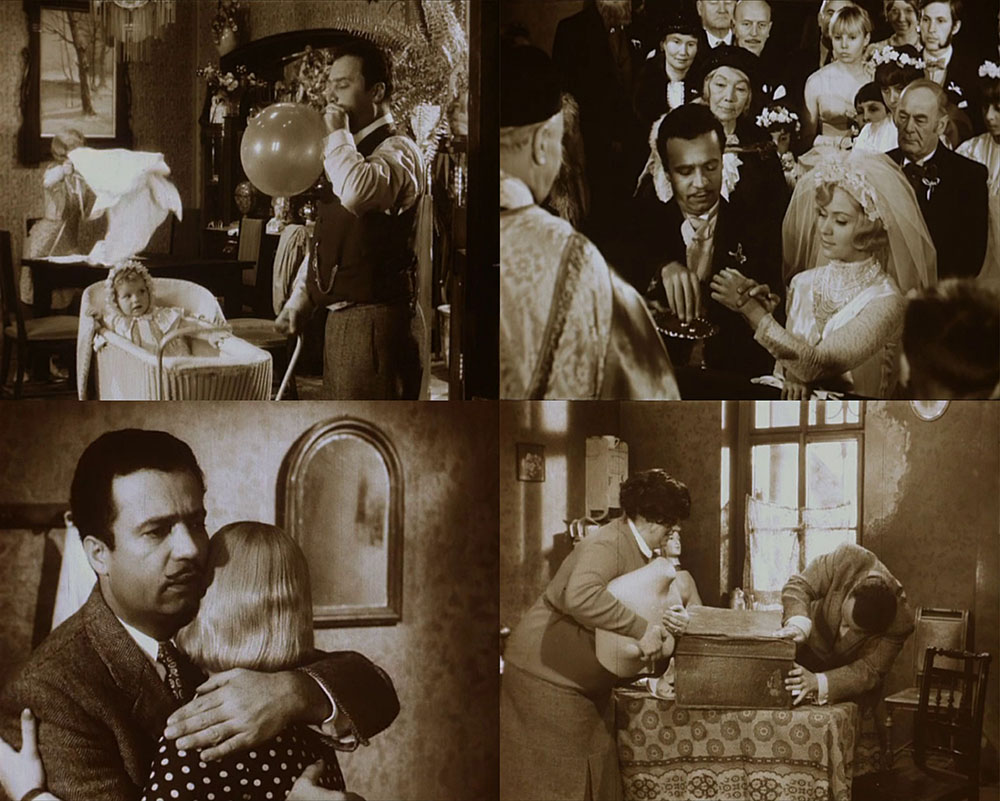
The love-triangle between Frydrych, Julie and Ptáček forms the bulk of the story, and also the basis for much of the film’s black humour. One of the hallmarks of the reversed biography is ironic reinterpretation, something that Amis makes a substantial meal of in his novel. In many cases it’s easier to do this with film than it is with words: a fight between Frydrych and Ptáček becomes an energetic “tidying up” of the apartment, with the cuckolded husband and the wife’s lover reassembling broken furniture and clearing away all the signs of destruction. Happy End is a long procession of these reversals, accompanied by Frydrych’s voiceover narration which persists in giving any tragic and difficult moments a positive gloss. Most of them, anyway. A substantial win at the racetrack becomes a negative incident when the events are played in reverse. But the loss of money is offset by Frydrych and Julie’s young daughter who pulls fresh banknotes out of an impromptu fire on the kitchen floor.
he2.jpg

For non-Czech speakers the humour and invention of Happy End is undermined by the effort required to keep up with the film’s frenetic pace (many of the scenes are speeded-up as well as running in reverse) while reading subtitles which reinterpret everything you’re seeing on the screen. My own viewing was further compromised by amateurish subtitles, but this is all the more reason to watch it again. Second Run have recently released Happy End as a region-free blu-ray with “new and improved English subtitle translation”. This is the second Lipský film I’ve watched to date (thanks, Jay!). I’ll be looking for more.

Previously on { feuilleton }
Art on film: Je t’aime, Je t’aime
New Wave Strangeness: Hawkwind’s Calvert years

days.jpg

Antique badges not included.

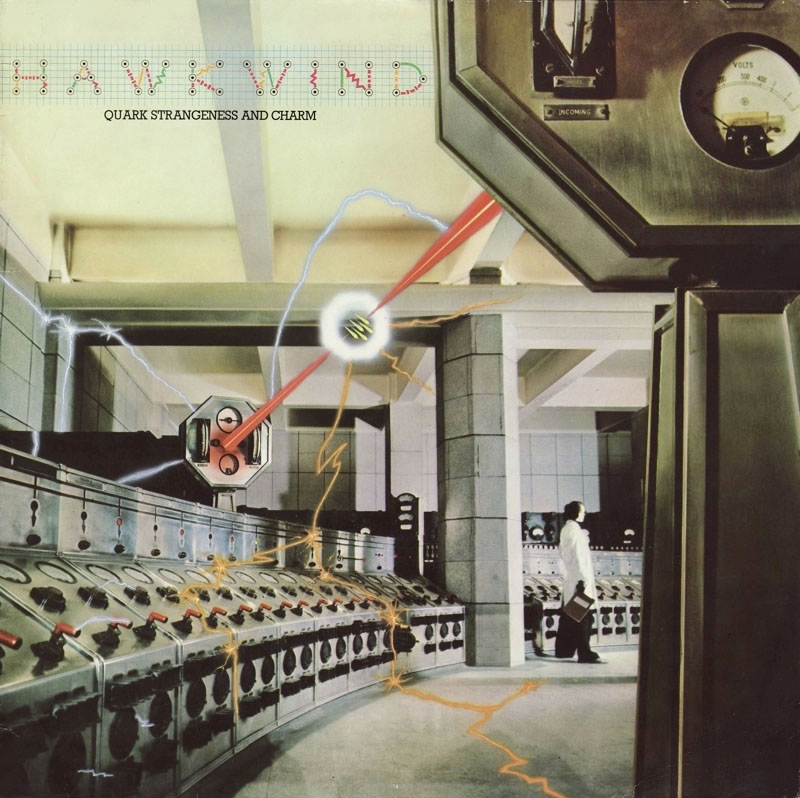
My weekend has been spent immersed in Days Of The Underground, the latest box of Hawkwind albums from Cherry Red Records. I’d avoided many of the earlier sets but this one was irresistible for being a 10-disc collection (8 CDs and 2 blu-rays), the core of which is three of the four albums recorded by the group for the Charisma label–Quark, Strangeness And Charm (1977), 25 Years On (credited to Hawklords, 1978), and PXR 5 (1979)–with all three albums being given the Steven Wilson remix treatment. The studio material is complemented by further Wilson mixes of live recordings and alternate takes, plus demo tracks (previously available but I didn’t have them). You also get three bonus video clips: Hawkwind (minus Dave Brock) playing the Quark single on Marc Bolan’s TV show in 1977, together with two promo films from the 1978 Hawklords concert at Brunel University. Absent from the set is the group’s first album for Charisma, Astounding Sounds, Amazing Music (1976), also the two singles that were released that year. I’ve not seen any explanation for these omissions but reasons may include the uneven quality of the music (recorded shortly before the group imploded), and Dave Brock’s lasting dislike of the album.

quark.jpg

Cover design by Hipgnosis; photography by Peter Christopherson with graphics by Geoff Halpin. Aubrey Powell says that Robert Calvert commissioned this one after the pair met each other at a party. The photography made use of the interior of Battersea Power Station in the same year that Hipgnosis used the building for a rather more famous album cover.

Steven Wilson did a great job of remixing the Warrior On The Edge Of Time album so I had high hopes for this set, hopes that have been substantially fulfilled. Many of the adjustments are individually minor–boosted bass, more prominent keyboards, some extended intros–but taken together they offer a refreshed experience of three very familiar albums. The packaging has been well-designed by the estimable Phil Smee with a booklet that presents a snapshot of the graphics produced for the group during this period, not only album artwork but also posters, ads and pages from the tour programmes. As a bonus there’s a small reproduction of the 1977 tour poster, a welcome inclusion since I used to own an original one of these which I’ve either misplaced or lost altogether. The attention to detail extends to the animated graphics of the blu-ray interface; when the Quark album is playing you can watch sparks dancing around the control room. The Marc Bolan TV appearance was something I’d seen many times before (including its original broadcast) but the live Hawklords films are revelatory when there’s so little footage of the band from the 1970s with synched sound. The performances of PSI Power and 25 Years offer a frustratingly brief taste of Robert Calvert’s magnetic stage presence, and make me hope that a video of the entire concert may be released eventually.

pxr5.jpg

Cover art by Philip Tonkyn.

Robert Calvert is the key figure here, to a degree that Hawkwind’s Charisma years are also known as the Calvert years, this being the period when the group’s part-time lyricist, occasional singer and conceptual contributor graduated to lead vocalist and songwriter. Calvert’s new role as front man changed Hawkwind from an ensemble of underground freaks into a more typical rock group, albeit one with a very theatrical singer prone to changing outfits to suit the songs, and with props that included a loudhailer, a machine-gun (fake) and a sabre (real). The songs became shorter and, in places, poppier, although none of the singles managed to repeat the chart success of the Calvert-penned Silver Machine. Nevertheless, Brock and Calvert were a great song-writing team, and the lyrics that Calvert wrote from 1976 to 1978 are better than anything else in the discography: witty, alliterative, and filled with clever rhymes that range widely in their subject matter, from the usual science-fiction fare to Calvert’s own obsessions, especially aircraft and flying. Calvert’s approach to science fiction was more sophisticated than the freaks-in-space approach of the group’s UA years. You get a sense of this from his contributions to the Space Ritual album (only Calvert would have known what an orgone accumulator was), but his Charisma songs go much further, condensing whole novels—Roger Zelazny’s Damnation Alley and Jack of Shadows, Ray Bradbury’s Fahrenheit 451—while maintaining the spirit of the New Wave of SF, where the emphasis was as much on inner as outer space.

Continue reading “New Wave Strangeness: Hawkwind’s Calvert years”

Zen-Gun and The Zen Gun

zen1.jpg

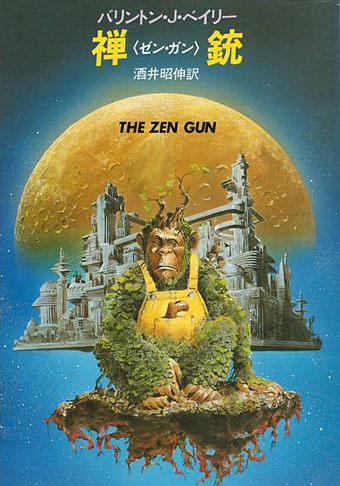
Japanese edition, 1984. Cover artist unknown.

At last, kosho Hako Ikematsu permitted himself to exult, at last he held the zen gun in his hands.

Zen in the art of electronics…

He knew its age: more than three Earth centuries. He knew its provenance: the zen master who made it had been a member of the order from which his own had originally sprung. The external appearance of the gun was a testament to certain cultural concepts: it seemed improvised, unfinished, crude, yet in its lack of polish was a feeling of supreme skill…in the Nipponese language of the time it had wabi, the quality of artless simplicity, the rustic quality of leaves strewn on a path, of a gate mended roughly with a nailed-on piece of wood and yet whose repair was a quiet triumph of adequacy and conscious balance. It had shibusa, the merit of imperfection. Only incompleteness could express the infinite, could convey the essence of reality. Hence, the unvarnished wood bore the marks of the carver’s chisel…

These qualities were themselves but superficial excrescences of the principles on which the gun acted, principles so abstruse in character that one dictum alone succeeded in hinting at them: Nothing moves. Where would it go? Pout the chimera had succeeded in using the gun as an electric beam to hurt or kill, without regard to location. But that was the most trivial of its capabilities. Only a kosho could unlock its real, dreadful purpose…

I read a novel recently that was unapologetic space opera. This isn’t something I do very often. Ryuichi Sakamoto is to blame, strange as this may seem, as a result of my spending a day or two listening to my old Sakamoto CDs. One of these, Illustrated Musical Encyclopedia, contains a short instrumental titled Zen-Gun, a piece which almost shares a title with the space opera in question, The Zen Gun by Barrington J. Bayley. I bought the Sakamoto disc in 1990, and I’ve known about the novel, which was published in 1983, for almost as long as I’ve been listening to the album. Every now and then I’ve wondered whether the two works might be connected, or at least whether Sakamoto borrowed Bayley’s title, but I’d never considered reading the novel until now.

zen2.jpg

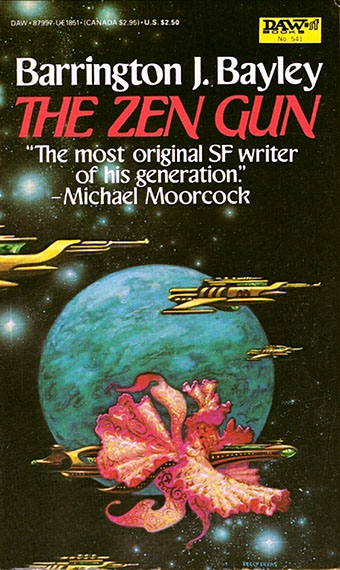
US edition, 1983. Cover art by Kelly Freas.

Barrington Bayley (1937–2008) is a writer whose works I’d mostly avoided while he was alive. This despite the continual praise he received from Michael Moorcock, and the acknowledgement by William Burroughs in Nova Express for an idea borrowed from a Bayley story with a Burroughs-like title, The Star Virus. (Samples of Burroughs’ voice happen to turn up on an album that Ryuichi Sakamoto recorded after Illustrated Musical Encyclopedia, the Bill Laswell-produced Neo Geo. Make of this what you will.) Bayley was the odd man out among the British writers of science fiction’s New Wave for persevering with hard SF, a sub-genre I don’t enjoy reading very much unless it’s by a trustworthy writer. All genres have their share of bad writers but science fiction, especially the variety concerned with space-faring and futuristic technology, has historically been home to more than most. I already knew that Bayley could write a decent story—he appeared regularly in the pages of New Worlds magazine—but I feel I’ve been doing him a disservice by ignoring his novels for so long.

The thing that really pushed me towards The Zen Gun was reading the Wikipedia entry for the novel which includes the following praise from Bruce Sterling:

Yet Bayley’s elemental energy, his mastery of the sense of wonder, cannot be denied. His work is the very antithesis of tired hackdom. To invent an entire self-consistent cosmology and physics for a $2.50 DAW paperback…is one of those noble acts of selfless altruism that keep SF alive.

Then there’s this comment about the mysterious Zen Gun itself, a piece of wood carved into the shape of a pistol which is capable of destroying entire suns: “Powerful as the weapon is, its existence is a paradox, as only those who have attained inner peace can use it.” After reading this I knew I had to read the novel.

Continue reading “Zen-Gun and The Zen Gun”

Weekend links 567

dean-osibisa.jpg

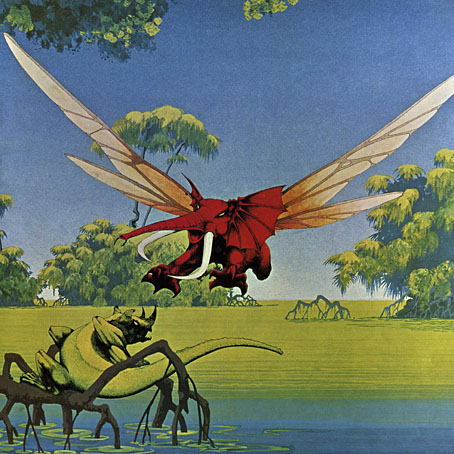
Cover art by Roger Dean for Woyaya (1971), the second album by Osibisa. Dean’s flying elephants made their first appearance on the group’s debut album, and have been an Osibisa emblem ever since.

• Many of Roger Dean’s early album covers are better creations than the music on the albums they decorate. This isn’t the case with Osibisa, however, a Ghanaian group based in London whose discography includes (uniquely, I think) two covers by Dean together with one by Mati Klarwein. The group’s first two albums, Osibisa and Woyaya, are exceptional blends of Ghanaian music with rock, funk and jazz whose omission from the generally reliable Kozmigroov list is a serious error. Garth Cartwright talked to Teddy Osei and Lord Eric Sugumugu about Osibisa past and present.

• “The antiheroes of Angry Young Men cinema railed against the limited life opportunities available to them. Wired and frustrated, they especially chafed against girlfriends, wives, domesticity. Yet they never questioned heterosexuality itself. Not, at least, until The Leather Boys (1964), a relatively little-known film directed by Canadian expatriate Sidney J. Furie.” Sukhdev Sandhu on a film about gay life in pre-decriminalisation Britain that offered a slightly more positive view of its subject than the justifiably angst-ridden Victim (1961).

• “Brian Aldiss once confided to me that the big problem with American science fiction writers was that they loved to write about Mars but knew nothing about Indonesia.” Bruce Sterling on the attractions of being an expatriate writer who adopts a foreign persona, as he did for the stories collected in Robot Artists and Black Swans.

• New music: Fire Tower by The Grid / Fripp. Dave Ball, Richard Norris and Robert Fripp have been collaborating on and off since The Grid’s 456 album in 1992. Fire Tower is a preview of Leviathan, a new album out in June on CD/DVD and double vinyl.

• RIP Michael Collins, the astronaut who orbited the Moon alone, listening to Symphonie Fantastique by Berlioz in the Command Module of Apollo 11 while Neil Armstrong and Buzz Aldrin were walking on the satellite’s surface.

• “‘Walking with a thesis’ could easily function as the subtitle for a significant number of Iain Sinclair’s books.” Tobias Carroll on Iain Sinclair and the radical act of walking through a city.

• “‘Plain speaking, like plain food, is a puritan virtue and thus no virtue at all,’ Meades pronounces.” Steven Poole reviews Pedro and Ricky Come Again by Jonathan Meades.

• Building a panorama: Clive Hicks-Jenkins‘ latest progress report on his Cocteau-inspired illustrated edition of Beauty and the Beast.

• At Unquiet Things: Groovy Goddesses From Dimension X: Gene Szafrans’ Kaleidoscopic Book Covers.

• From leather boys to leather men: Miss Rosen on the little-known photography of Tom of Finland.

Alexis Petridis attempts the impossible again, with a list of Grace Jones’ best songs.

• At Dennis Cooper‘s: Cars.

I’m A Leather Boy (1967) by The Leather Boy | Warm Leatherette (1980) by Grace Jones | Leather Bound (2017) by Patrick Cowley

Weekend links 375

kanemaki.jpg

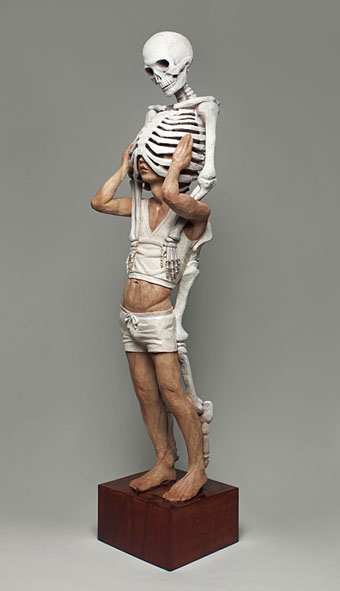
Memento Mori (2012) by Yoshitoshi Kanemaki.

Greydogtales, home to “weird fiction, weird art and even weirder lurchers”, is two years old this month. An essential resource for interviews, reviews and art features.

Kim Morgan on the paranoia at the heart of John Carpenter’s The Thing. The film will receive a welcome Blu-ray reissue by Arrow Films (UK) in November.

• A third and final collection of Patrick Cowley’s soundtracks for gay porn films, Afternooners, will be released in October by Dark Entries.

Photos of the exceptional eldritch art on display until the end of the month at the Ars Necronomica show in Providence, RI.

• Barney Bubbles, Optics & Semantics: an exhibition at Rob Tufnell, London, from 31st August.

Dimitra Fimi and Adam Scovell on 50 years of The Owl Service by Alan Garner.

• The Duality of Yoshitoshi Kanemaki’s Wooden Sculptures.

• Tristan Bath on The Strange World of Keiji Haino.

• Mix of the week: XLR8R Podcast 504 by Curses.

Photos of René Magritte.

• RIP Brian Aldiss

Grey Promenade (1985) by Roger Eno | Grey Stripe (1994) by Aphex Twin | Greyscale (2008) by 2562