Weekend links 58

delpozo1.jpg

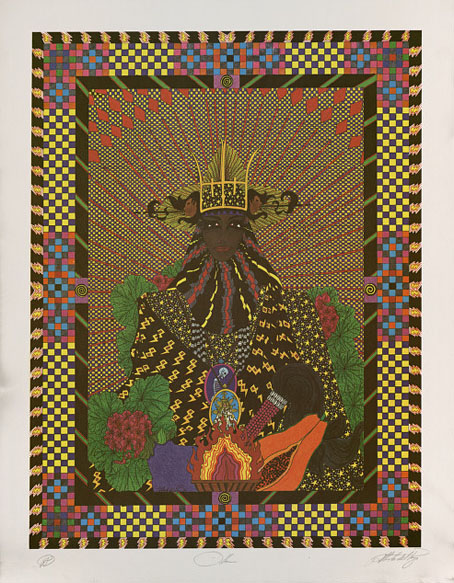
Oya by Alberto del Pozo (1945–1992). Also known as Yansa, Oya is Changó’s third wife. She is the goddess of the winds and of lightning and is mistress of the cemetery gates. Passionate and brave she fights by her husband’s side if needed. Her favorite offerings are papaya, eggplant and geraniums. From Santeria at BibliOdyssey.

Austin Osman Spare is a good example of the dictum that quality will out in the end, no matter how long it remains buried. Overlooked by the art establishment after he retreated into his private mythologies, a substantial portion of his output was equally ignored by occultists who wanted to preserve him as a weird and scary working-class magus. One group dismissed his deeply-felt spiritual interests in a manner they wouldn’t dare employ if he’d been a follower of Santeria, say (or even a devout Christian), while the other group seemed to regard his superb portraits as too mundane to be worthy of attention. Now that Phil Baker’s Spare biography has been published by Strange Attractor we might have reached the end of such short-sighted appraisals and can finally see a more rounded picture of the man and his work:

[Kenneth] Grant preserved and magnified Spare’s own tendency to confabulation, giving him the starring role in stories further influenced by Grant’s own reading of visionary and pulp writers such as Arthur Machen, HP Lovecraft, and Fu Manchu creator Sax Rohmer. Grant’s Spare seems to inhabit a parallel London; a city with an alchemist in Islington, a mysterious Chinese dream-control cult in Stockwell, and a small shop with a labyrinthine basement complex, its grottoes decorated by Spare, where a magical lodge holds meetings. This shop – then a furrier, now an Islamic bookshop, near Baker Street – really existed, and part of the fascination of Grant’s version of Spare’s London is its misty overlap with reality.

Austin Osman Spare: Cockney visionary by Phil Baker.

Austin Osman Spare: The man art history left behind | A Flickr set: Austin Osman Spare at the Cuming Museum | HV Morton meets Austin Spare (1927).

• More quality rising from obscurity: Jerzy Skolimowski’s Deep End. Skolimowski’s drama is one of unpleasant characters behaving badly towards each other. Anglo-American cinema featured a great deal of this in the 1970s when filmmakers disregarded the sympathies of their audience in a manner that would be difficult today. John Patterson looks at another example which is also given a re-release this month, the “feral, minatory and menacing masterwork” that is Taxi Driver.
delpozo2.jpg

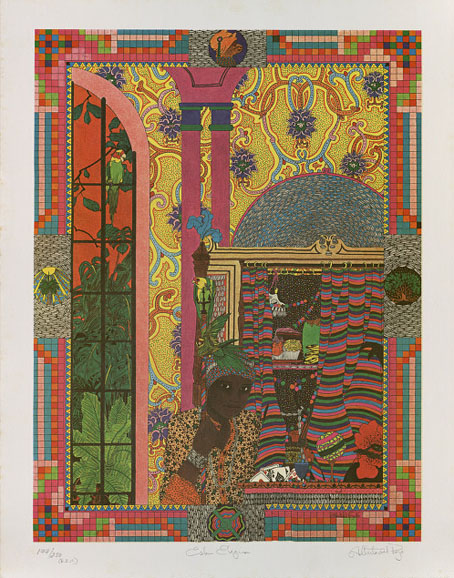
Echú Eleguá by Alberto del Pozo. Among the most ancient of the orishas Echú Eleguá is the messenger of the gods, who forges roads, protects the house, and is heaven’s gate-keeper. In any ceremony he is invoked first. He owns all cowrie shells and is the god of luck. A prankster, Echú Eleguá frequently has a monkey and a black rooster by his side. Like a mischievous boy he enjoys gossip and must be pampered with offerings of toys, fruit, and candy.

Minutes, a compilation on the LTM label from 1987: William Burroughs, Jean Cocteau, Tuxedomoon, Jacques Derrida, The Monochrome Set, and er…Richard Jobson. Thomi Wroblewski designed covers for a number of Burroughs titles in the 1980s, and he also provided the cover art for this release.

Mikel Marton Photography: a Tumblr of erotic photography and self-portraits.

From Death Factory To Norfolk Fens: Chris & Cosey interviewed.

NASA announces results of epic space-time experiment.

Oritsunagumono by Takayuki Hori: origami x-rays.

Plexus magazine at 50 Watts.

Mother Sky (1970) by Can | Late For The Sky (1974) by Jackson Browne.
Weekend links 55

shah1.jpg

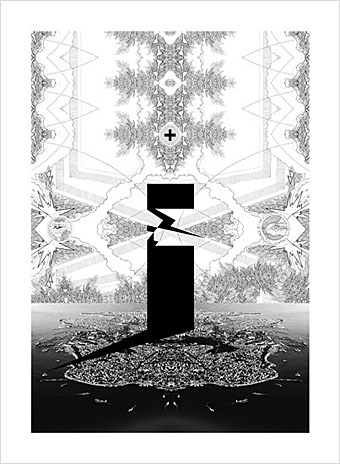
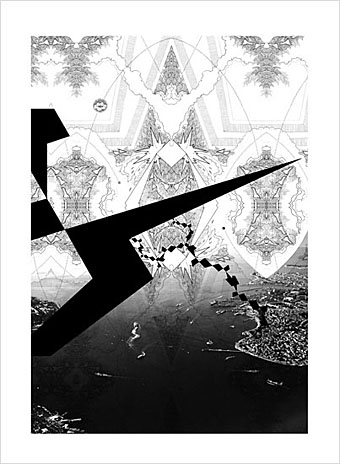
From the Ornamental Age series (2009) by Seher Shah.

Seher Shah has recently updated her website giving us a better view of her extraordinary art.

The Demon Regent Asmodeus, my short film of Alan Moore’s reading from the first Moon & Serpent CD, has been posted to YouTube. In other self-promotion news, Mahakala, a drawing of mine from 1984, finds an audience on Tumblr.

• Yet more Moore: Alan Moore & Iain Sinclair “explore psychogeography” at the Cheltenham Festival in June. Alan will also be discussing science and fiction with Robin Ince. Then in July he’s performing with fine fellow Stephen O’Malley at Alexandra Palace as part of Portishead’s I’ll Be Your Mirror festival. They’ll be providing text and music for Harry Smith’s Heaven and Earth Magic.

In most countries, parents can tell their kids that if they work hard and do everything right, they could grow up to be the head of state and symbol of their nation. Not us. Our head of state is decided by one factor, and one factor alone: did he pass through the womb of one aristocratic Windsor woman living in a golden palace? The US head of state grew up with a mother on food stamps. The British head of state grew up with a mother on postage stamps. Is that a contrast that fills you with pride? (…) Earlier this month, David Cameron lamented that too many people in Britain get ahead because of who their parents are. A few minutes later, without missing a beat, he praised the monarchy as the best of British. Nobody laughed.

Johann Hari kicks the royals.

• Related to the above: Lydia Leith’s royal wedding sick bag.

Beautiful Century relates a dispiriting (and very common) encounter with Google’s blog prudery. The new Beautiful Century is now at Tumblr.

• In the future, everything will be on Tumblr for fifteen minutes. Among this week’s discoveries there’s Writers and Kitties, attractive men and vintage photos at Stuff Doer, and all manner of things at Maggs Counterculture including a picture by Jim Leon I hadn’t seen before.

shah2.jpg

From the Ornamental Age series (2009) by Seher Shah.

“Sidewalk cafés, free from conservative business attire…” Film of groovy Greenwich Village in the late 1960s. Related: groovier fashions in Art Nouveau Barcelona.

Ai Weiwei’s Blog: Writings, Interviews, and Digital Rants, 2006-2009, a book from MIT Press.

The Delian Mode, a film about electronic musician Delia Derbyshire by Kara Blake.

Austin Osman Spare, a biography of the artist and occultist by Phil Baker.

• Lando Jones is giving away three limited edition prints of his artwork.

Plano Creativo, a blog (in Spanish) by Alejandro Jodorowsky.

B Magazine is a new publication for gay Americans.

Diaghilev gets his due at Coilhouse.

Baby’s On Fire (1973) by Brian Eno | Baby’s On Fire (1976) by 801 | Baby’s On Fire (from Velvet Goldmine) (1998) by The Venus In Furs.

Kenneth Grant, 1924–2011

grant.jpg

Kenneth Grant by Austin Spare (c. 1951).

Kenneth Grant, writer and occultist, died last month but the event was only announced this week. He’ll be remembered for the nine fascinating occult treatises he wrote from 1972 to 2002, and for continuing the work of Aleister Crowley as head of the Ordo Templi Orientis, a position which became fraught in later years as various occult factions disputed his authority. Having collected occult books for much of the 1980s I find his name calls out from the shelves more than many other writers; as well as authoring his own works he edited all the major Crowley texts with Crowley’s executor John Symonds, presenting them in authoritative editions for a new readership.

Grant proved a very loyal champion of people he admired, significantly so in the case of Austin Osman Spare whose work he collected, exhibited and republished from the 1950s on. It was Grant’s position as one of the many advisors for Man, Myth & Magic in 1970 which resulted in the part-work encyclopedia using one of Spare’s stunning drawings as the cover picture for its first issue. That effort alone gave Spare an audience far beyond anything he received during his lifetime, and Grant ensured the magazine featured Spare’s work in subsequent issues. Grant’s occult works made liberal use of unique illustrations by his wife, Steffi Grant, Austin Spare and others. The books were singular enough even without their pages of curious artwork, a beguiling and sometimes incoherent blend of western occult tradition, tantric sex magick and hints of cosmic horror which were nevertheless always well-written, annotated and crammed with technical detail. Alan Moore in 2002 examined the experience of an immersion in Grant’s mythos with a wonderful review he called “Beyond our Ken“. He notes there the influence of HP Lovecraft, another of the visionary figures who Grant championed throughout his life.

between.jpg

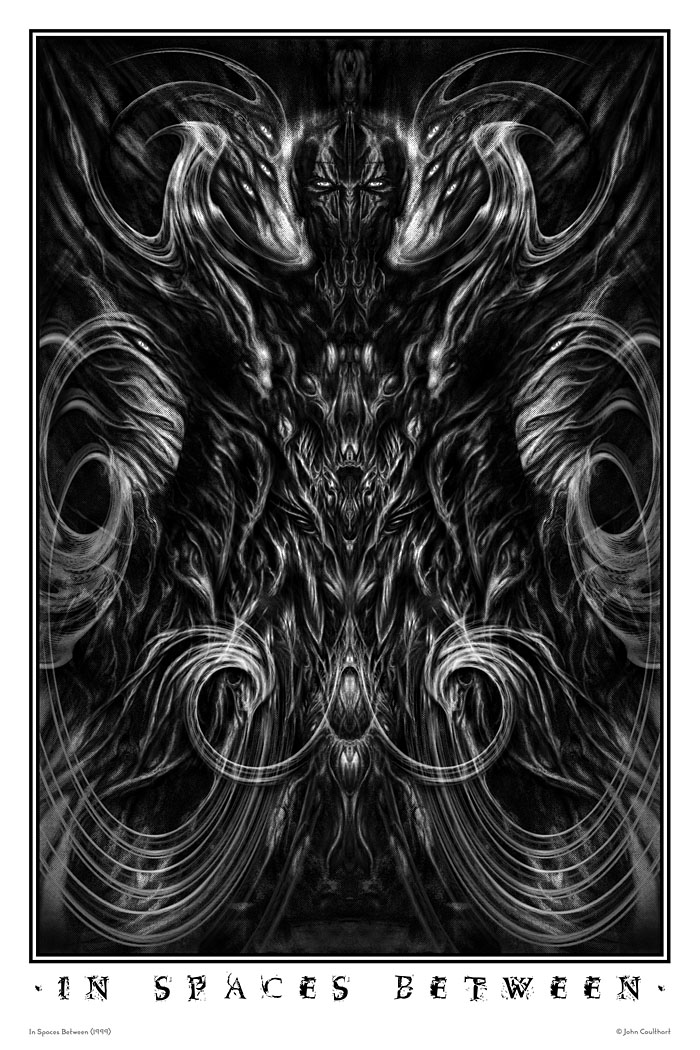
In Spaces Between from The Great Old Ones (1999).

And speaking of Lovecraft, I’ve often wondered whether Kenneth Grant ever saw a copy of my Haunter of the Dark collection. For the opening of the Great Old Ones Kabbalah sequence which Alan Moore and I created for the book I added an extra piece of art entitled In Spaces Between, a reference to Coil via an epigraph from Grant’s Outside the Circles of Time (1980) which I borrowed for the facing page:

For there are Thrones under ground
And the Monarchs upon them
Reign over Space and Beyond

Invoke Them in Darkness, Outside
The Circles of Time

In Silence, in Sleep, in Conjurations
Of Chaos, the Deep will respond…

Coil aficionados will recognise those words as the origin of some lines from Titan Arch (1991):

There are Thrones under ground
And Monarchs upon them
They walk serene
In spaces between

Grant followed his epigraph with another quote, from Lovecraft’s Necronomicon.

In addition to Alan Moore’s Grant review, Fulgur have a detailed Kenneth Grant bibliography on their pages. They were also the publishers in 1998 of Zos Speaks! Encounters with Austin Osman Spare by Kenneth and Steffi Grant, a memoir and celebration of Spare’s work which revealed this trio of remote astral voyagers to be human beings after all. The book is currently out of print but it’s essential for anyone interested in Austin Spare or, for that matter, Mr and Mrs Grant.

Previously on { feuilleton }
New Austin Spare grimoires
Austin Spare absinthe
Aleister Crowley on vinyl
Austin Spare’s Behind the Veil
Austin Osman Spare

Weekend links 36

high_society.jpg

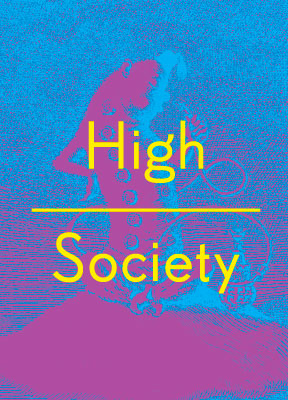
Mervyn Peake’s Caterpillar from Alice’s Adventures in Wonderland finds itself used to promote High Society, an exhibition at the Wellcome Collection devoted to the long history of human drug-taking. There’s more about the exhibition here and also an accompanying book by Mike Jay from Thames & Hudson. Related: The Most Dangerous Drug:

A group of British drug experts gathered by the Independent Scientific Committee on Drugs (ISCD) rated alcohol higher than most or all of the other drugs for health damage, mortality, impairment of mental functioning, accidental injury, economic cost, loss of relationships, and negative impact on community.

• Unless the magazine Man, Myth & Magic was advertised on TV in 1970 (and I suspect it would have been) Austin Osman Spare’s work has never been seen on British television, certainly not in any detail or with a credit to the artist. This week the BBC finally paid him some attention with a brief spot on The Culture Show as a result of the Fallen Visionary exhibition which is still running (until November 14) in London. Alan Moore, Fulgur‘s Robert Ansell and others attempt to summarise Spare’s career in seven minutes.

fujita.jpg

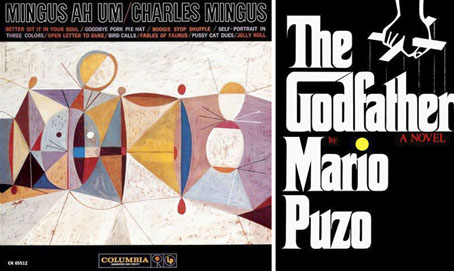
Neil Fujita designs: Mingus Ah Um (1959) and The Godfather (1969).

• RIP graphic designer Neil Fujita. Related:

“By taking the “G” and extending it to the “D,” I created a house for “God.” The way the word was designed was part of the logo and so was the type design. So when Paramount Pictures does a film version or Random House, which bought out the book from Putnam, does another Godfather book, I still get a design credit. In fact, before the first Godfather film opened in New York I saw a huge billboard going up in Times Square with my design on it. I actually got them to stop work on it until we were able to come to an agreement.” Waxing Chromatic: An Interview with S. Neil Fujita

French SF illustration. Related: Where did science fiction come from? A primer on the pulps, a feature by Jess Nevins with some of the craziest covers you’ll see this month.

• Gay-bashers in 1970s San Francisco had to beware the wrath of the Lavender Panthers.

• More Marian Bantjes as she discusses her work in an audio interview.

Music from Saharan cellphones.

Origami Beauty Shots.

Krautrock.com

Better Git It In Your Soul (1959) by Charles Mingus.

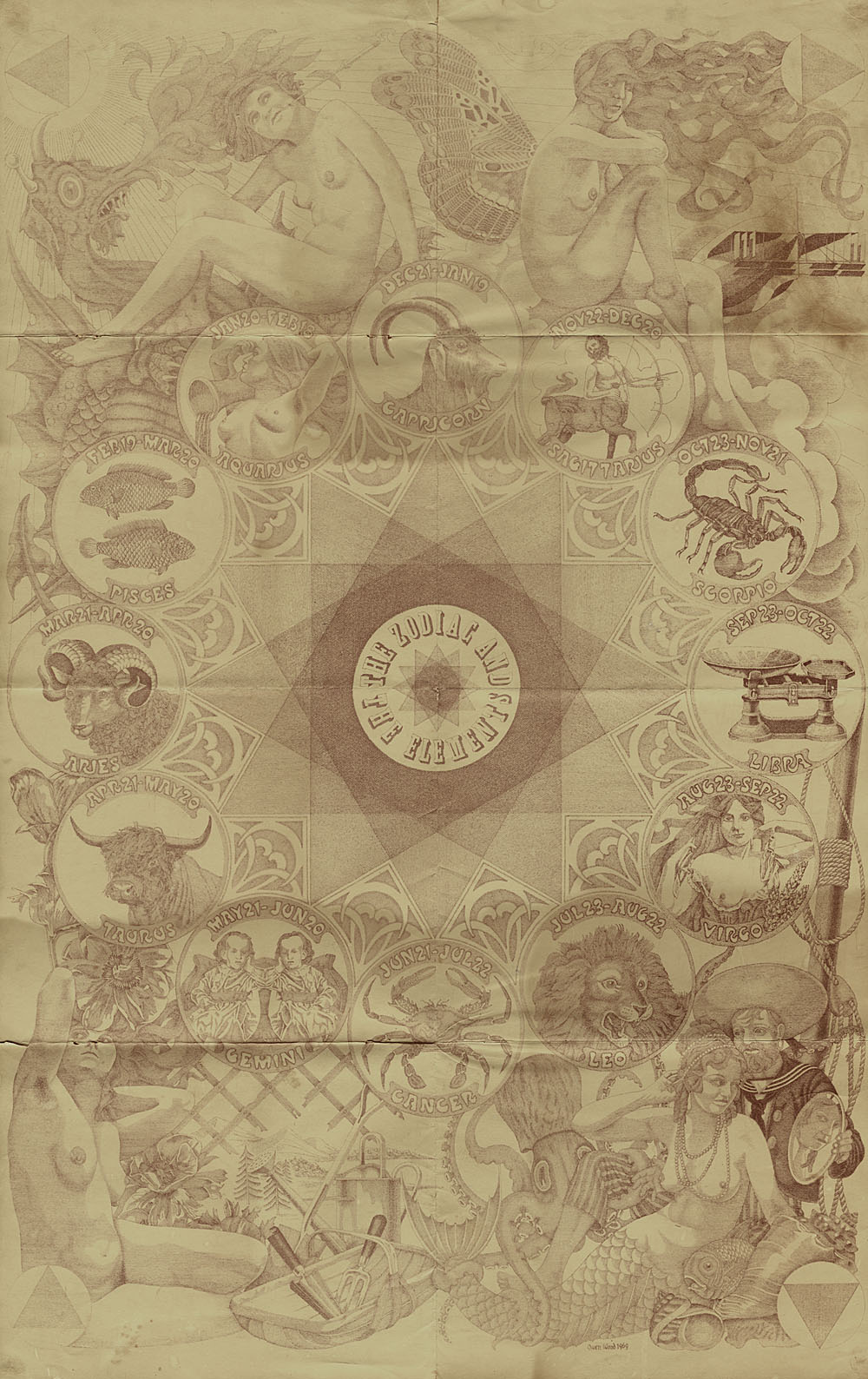
Owen Wood’s Zodiac

wood-zodiac.jpg

Yesterday’s zodiacal illustrations reminded me of this grubby item (depicting the twelve houses of the zodiac and four elements) which I took the trouble to scan since there’s no other example of it on the web. (Click for a larger version.) The artist, Owen Wood, was a highly-regarded illustrator commissioned to produce a poster in 1969 for the landmark magazine Man, Myth & Magic which was serialised weekly in the UK the following year. MMM had a few other giveaways in their early issues but Wood’s poster was by far the best piece. I thought I might have another copy somewhere but it didn’t turn up in a cursory search; if I find it I’ll replace this one. Wood’s very fine and intricate line-drawing deserves better appraisal than this dishevelled item which suffered from being pinned in too many smoke-filled rooms over the years. This obituary of the artist has details of his career.

wood-zodiac2.jpg

Fire (detail).

Elsewhere on { feuilleton }
The illustrators archive

Previously on { feuilleton }
Palladini’s Zodiac
Austin Osman Spare