Weekend links 343

carrington.jpg

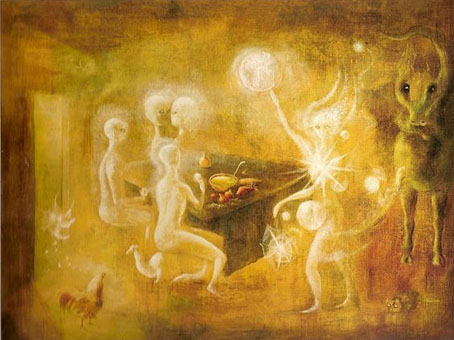
Sidhe, the white people of the Tuatha Dé Danann (1954) by Leonora Carrington.

• January brings a wealth of recommended-reading lists for the new year, together with the feeling that many of those lists are merely clones of each other. Not so the recommendations at Strange Flowers which also includes links to forthcoming events such as this exhibition of Symbolist art at the Guggenheim, New York.

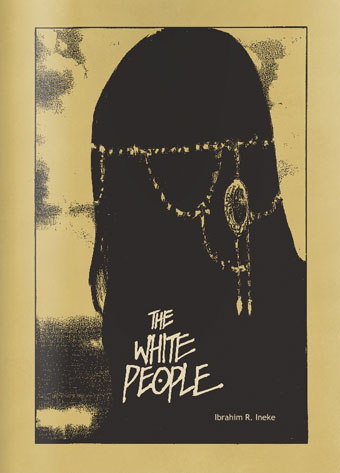
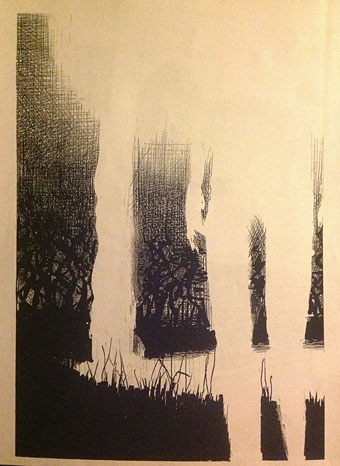
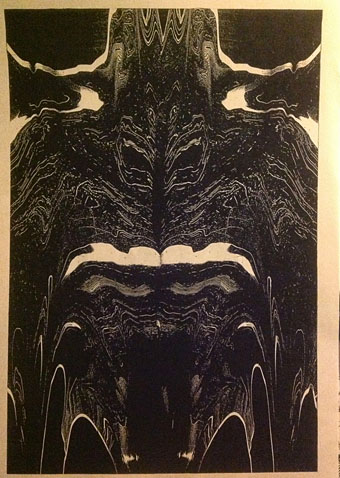
Some Ceremonies are Better than Others, an exhibition of sound objects and drawings by Matthias König & Ibrahim R. Ineke inspired by Arthur Machen’s The White People, at The Bries Space, Borgerhout, Belgium, from 21st January. Previously: Ineke’s comic-strip adaptation of the Machen story.

• “These must-reads explore Dada, Futurism, Surrealism, and the art of opposition,” says Carol Cooper. One of the titles under discussion is the Bruce Sterling book I designed and illustrated last year, Pirate Utopia. Sterling talked to Wired about the book and its relation to the present moment.

RIP Mark Fisher, a cultural theorist whose death was announced just as extracts from his latest book, The Weird and the Eerie, were beginning to appear. One of those extracts is at The Quietus. Related: Fisher’s k-punk blog and its earlier incarnation.

James Cargill (ex of Broadcast) announces a debut release by his new group, Children of Alice. Related: Jonathan Miller’s 1966 TV film of Alice in Wonderland rescored with Broadcast songs.

We are the Martians: the Legacy of Nigel Kneale, a collection of Kneale-related essays and appreciations edited by Neil Snowdon, is finally appearing in print from PS Publishing.

• Pursuing paths hauntological, The Electric Pentacle offers “an unholy stew of library music, Kosmische, arcane ritual electronica, modular synthesisers and shortwave radio”.

• Mixes of the week: The Ivy-Strangled Path Vol. XVI by David Colohan, and Low Visibility Across Sunken Village by The Geography Trip.

• “With Reflection, [Brian Eno] offers generative music for a turbulent time,” says Geeta Dayal.

Anna Biller, director of The Love Witch, talks to New Jack Witch about her film.

• The story behind Gay Bob, the world’s first out-and-proud doll.

Alice (1969) by Jon Plum | Alice (1982) by The Sisters of Mercy | Alice (2009) by Sunn O)))
Fractures

fractures.jpg

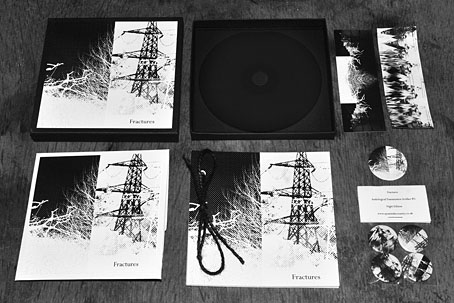
Fractures is the latest musical anthology from A Year In The Country, and having been listening to an advance copy for the past couple of weeks I can say it’s as fine a collection as the label’s previous opus, The Quietened Village. The latter album encouraged a variety of artists to create pieces around the theme of lost or abandoned villages; the theme for Fractures fixates on a year rather than a location:

Fractures is a gathering of studies and explorations that take as their starting point the year 1973; a time when there appeared to be a schism in the fabric of things, a period of political, social, economic and industrial turmoil, when 1960s utopian ideals seemed to corrupt and turn inwards. […] Fractures is a reflection on reverberations from those disquieted times, taking as its initial reference points a selected number of conspicuous junctures and signifiers: Delia Derbyshire leaving The BBC/The Radiophonic Workshop and reflecting later that around then “the world went out of time with itself”. Electricity blackouts in the UK and the three day week declared. The Wicker Man released. The Changes recorded but remained unreleased. The Unofficial Countryside published. The Spirit Of Dark And Lonely Water released.

Track list:
1) The Osmic Projector/Vapors of Valtorr – Circle/Temple
2) The Land Of Green Ginger – Sproatly Smith
3) Seeing The Invisible – Keith Seatman
4) Triangular Shift – Listening Center
5) An Unearthly Decade – The British Space Group
6) A Fracture In The Forest – The Hare And The Moon ft Alaska/Michael Begg
7) Elastic Refraction – Time Attendant
8) Ratio (Sequence) – The Rowan Amber Mill
9) The Perfect Place For An Accident – Polypores
10) A Candle For Christmas/311219733 – A Year In The Country
11) Eldfell – David Colohan

This isn’t the first time a year has been isolated as a basis for a musical anthology but prior examples such as Jon Savage’s Meridian 1970 are invariably concerned with the musical scene alone. Fractures is different for trying to seize the essence of the year itself even if a number of the musicians involved may not have been alive in 1973.

The year has a resonance for me that I recounted in the memorial post for David Bowie. That summer was significant (and therefore memorable) for being warm, carefree and positioned between the end of junior school and the beginning of secondary school. The years after those few weeks were increasingly bad on a personal level so 1973 for me spells “fracture” in more ways than one. None of this can be communicated by Fractures, of course, the contents of which have more of a cultural focus: A Fracture In The Forest by The Hare And The Moon sets readings from Arthur Machen to music, while The Land Of Green Ginger by Sproatly Smith draws in part upon a TV film of the same name that was broadcast in the BBC’s Play For Today strand. As those Plays For Today recede in time they seem increasingly like a dream of Britain in the 1970s, reflecting back in a concentrated form much more of the nation’s inner life than you get from today’s Americanised fare. Another Play For Today, Penda’s Fen, was being filmed in the fields of England in the summer of 1973 so we can add the crack in the church floor to the catalogue of fractures. (And for an additional musical entry, I’d note the astonishing Fracture by King Crimson, not released until 1974 but most of the track was a live recording from Amsterdam in November of the previous year.)

Fractures is available from the usual sources such as Bandcamp but hard copies are also being distributed via the Ghost Box Guest Shop.

Ibrahim Ineke’s The White People

ineke.jpg

A post last year about Arthur Machen’s masterpiece of weird fiction, The White People, ended with mention of a comic-strip adaptation by Ibrahim R. Ineke. At the time the strip was only available on Ineke’s website but this month the story is being published in a hardcover edition by Dutch comics imprint Sherpa. There’s a preview here (the dialogue is in English), and further details (in Dutch) about the publication here. Thanks to Ibrahim for the tip!

ineke3.jpg

ineke4.jpg

Previously on { feuilleton }
The White People
The Bowmen by Arthur Machen
Rex Ingram’s The Magician
The Great God Pan

La Bibliothèque de Babel

babel01.jpg

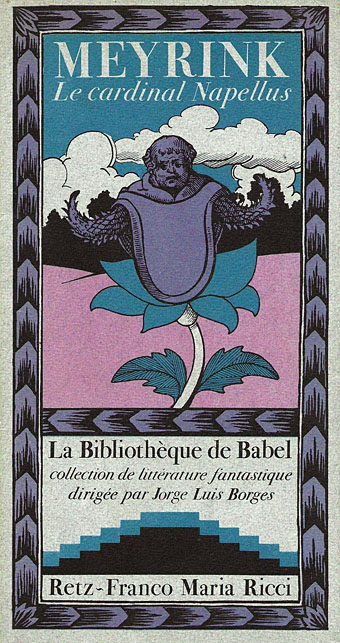
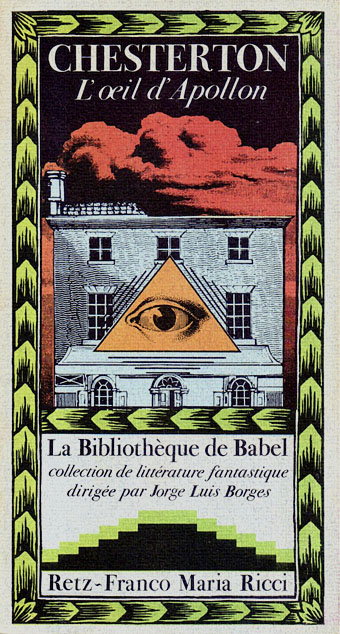
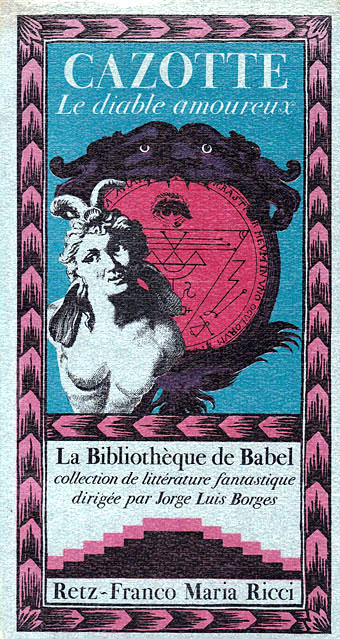
It was perhaps inevitable that this small collection of works of fantastic fiction was named after its director’s most famous creation, the Library of Babel. Jorge Luis Borges chose the titles, and also wrote introductions for each of the books. The series was published in France by Retz–Ricci, with 4000 numbered copies of each title appearing from 1977 to 1981.

Many of the selections will be familiar to Borges aficionados, others seem obscure as a result of the vagaries of translation: Jack London’s Les Morts Concentriques is The Minions of Midas, a story that Borges had earlier translated into Spanish as Las Muertas Concéntricas (The Concentric Deaths). The story of linked deaths apparently influenced the writing of Death and the Compass. I’ve never seen Borges discuss Arthur Machen at length so the inclusion of Machen in the selection is a welcome sight. In addition to The Shining Pyramid, the Machen volume also contained The Novel of the Black Seal and The Novel of the White Powder, two of the oft-anthologised sections of The Three Imposters.

The only detail that’s defeated me  is the identity of the illustrator of the series. If anyone knows who was responsible then please leave a comment.

Update: the covers are credited to publisher/designer Franco Maria Ricci and Marcella Boneschi. Thanks to herr doktor bimler and Al Diniz.

babel02.jpg

babel03.jpg

Continue reading “La Bibliothèque de Babel”

More trip texts

parry1.jpg

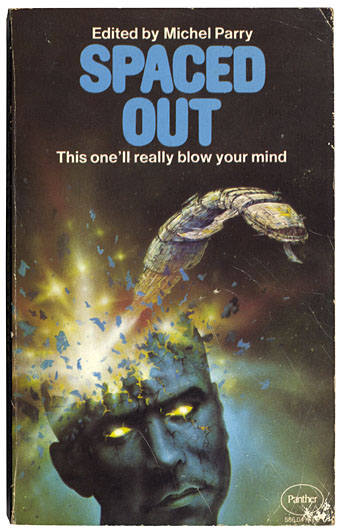
More psychedelia of a sort. Anthologist Michel Parry, who died last year, was a familiar name to British readers of fantasy, horror and science fiction for his themed collections: Beware of the Cat (1972; horror stories about cats), The Devil’s Children (1974; horror stories about children), The Hounds of Hell (1974; horror stories about dogs), Jack the Knife (1975; Jack the Ripper stories), The Supernatural Solution (1976; occult investigators), Sex in the 21st Century (1979), and so on.

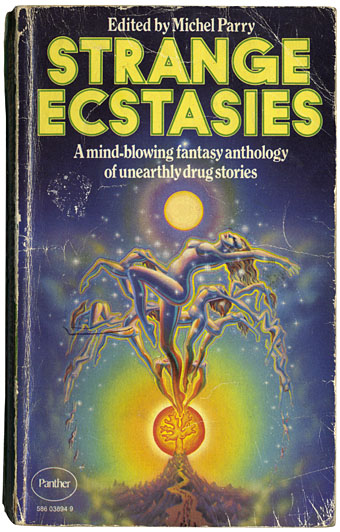
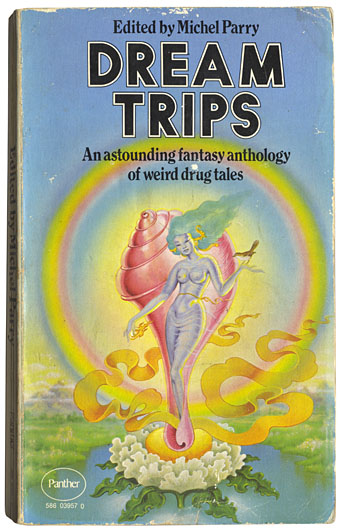
Parry also compiled multi-volume anthologies throughout the 1970s, two of which have always stood out for me: the Mayflower Books of Black Magic Stories ran to six volumes presenting a wide range of occult fiction that included a number of obscure tales from Victorian and Edwardian writers; for Panther Books he compiled three collections of drug-related fantasy and SF stories that are just as varied, and may even be unique for the way they place authors as such as Lord Dunsany and Norman Spinrad together in the same volume. Both series are very much of their time—occult psychedelia!—and are worth seeking out, if you can find them. I emphasise the last point because it’s taken me a while to find a copy of Strange Ecstasies that wasn’t being offered for bizarrely inflated prices; my paperback habit has its limits… None of these anthologies have been reprinted so they’ll become increasingly scarce. For more invented drugs, there’s a good list at Wikipedia.

parry2.jpg

Cover art by Bob Haberfield.

Strange Ecstasies (1973)
The Plutonian Drug (1934) by Clark Ashton Smith
The Dream Pills (1920) by FH Davis
The White Powder (1895) by Arthur Machen
The New Accelerator (1901) by HG Wells
The Big Fix (1956) by Richard Wilson
The Secret Songs (1962) by Fritz Leiber
The Hounds of Tindalos (1929) by Frank Belknap Long
Subjectivity (1964) by Norman Spinrad
What to Do Until the Analyst Comes (1956) by Frederik Pohl
Pipe Dream (1972) by Chris Miller

parry3.jpg

Cover art by Bob Haberfield.

Dream Trips (1974)
The Hashish Man (1910) by Lord Dunsany
As Dreams Are Made On (1973) by Joseph F. Pumilia
The Adventure of the Pipe (1898) by Richard Marsh
Dream-Dust from Mars (1938) by Manly Wade Wellman
The Life Serum (1926) by Paul S. Powers
Morning After (1957) by Robert Sheckley
Under the Knife (1896) by HG Wells
The Good Trip (1970) by Ursula K. Le Guin
No Direction Home (1971) by Norman Spinrad
The Phantom Drug (1926) by AW Kapfer

parry4.jpg

Cover art by Brian Froud.

Spaced Out (1977)
The Deep Fix (1964) by Michael Moorcock
All the Weed in the World (1961) by Fritz Leiber
The Roger Bacon Formula (1929) by Fletcher Pratt
Smoke of the Snake (1934) by Carl Jacobi
Melodramine (1965) by Henry Slesar
My Head’s in a Different Place, Now (1972) by Grania Davis
Sky (1971) by RA Lafferty
All of Them Were Empty— (1972) by David Gerrold

Previously on { feuilleton }
Trip texts
Acid albums
Acid covers
Lyrical Substance Deliberated
The Art of Tripping, a documentary by Storm Thorgerson
Enter the Void
In the Land of Retinal Delights
Haschisch Hallucinations by HE Gowers
The art of LSD
Hep cats