Psychetecture

stamp3.jpg

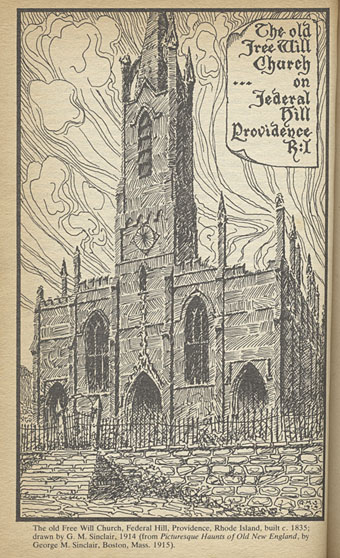
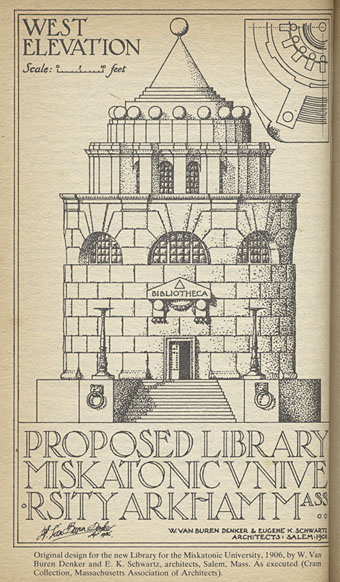
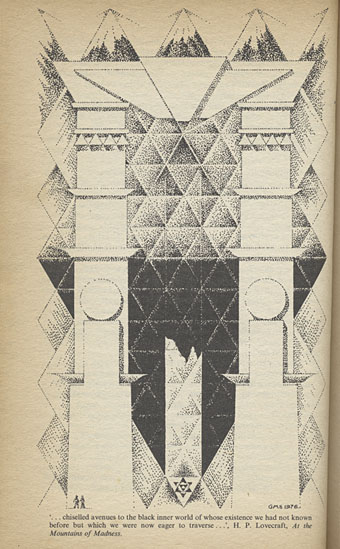
And speaking of architecture… I wouldn’t usually punish the spine of a scarce paperback by subjecting it to trial by flatbed scanner but not all of these drawings have found their way to the web. The artist is Gavin Stamp, here masquerading as “GM Sinclair” for illustrations used in the appendices of the aforementioned Necronomicon (1978), edited by George Hay. The book was published in hardback by occult specialists Neville Spearman, with a paperback following two years later from Corgi Books.
stamp1.jpg

For a purportedly real Necronomicon this one always struck me as more plausible than the US equivalent by Simon; Hay and his collaborators, Robert Turner and David Langford, go to some lengths to describe the sourcing of rare manuscripts from the British Museum, and the process of cryptographic decoding that follows. But the part of the book that made the greatest impression was the essay contributions by Christopher Frayling and Angela Carter, and Gavin Stamp’s accompanying illustrations. In 1980 unless you knew an older book collector (which I didn’t) serious writing about Lovecraft’s work was hard to find. Hay’s book and Stamp’s illustrations were one of several discoveries that pushed me towards illustrating Lovecraft myself.
stamp2.jpg

The pictures above are taken from the paperback while the ones below are lifted from David Langford’s site. I borrowed the pentagonal labyrinth from the title page for the cover of the NecronomiCon convention booklet: two Necronomicons joined, and a nod to a group of writers who helped me along the way.

Continue reading “Psychetecture”

Weekend links 261

hardie.jpg

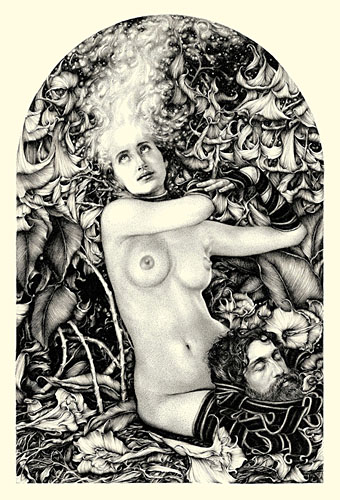
Salome (2013) by Lucie Hardie.

Aickmanesque, “A list of films that possess the same strange ambiguities, disturbing illogicalities, grim mundanities, psychological unpleasantness, narrative open-endedness, Freudian oddness and genuine disturbing moments of horror as the short stories of Robert Aickman.” One of those films, Symptoms (1974), has been out of circulation for a long time but may be watched at YouTube.

• “If this was psychedelia, then it had more in common with the variety peddled by US bands like The Rain Parade, The Three O’Clock…and The Bangles…all of whom had been grouped into a movement known as The Paisley Underground.” Joseph Stannard looks back at Around The World In A Day by Prince And The Revolution.

• “…what I do is not magical realism. I do realistic magic.” Alejandro Jodorowsky talking to Ilan Stavans about writing and filmmaking. A substantial interview in which Jodorowsky isn’t forced to express himself solely in English.

[Angela] Carter thoroughly upset the bien pensants with her essay The Sadeian Woman (1978) where she argued that Sade “was unusual in his period for claiming rights of free sexuality for women and in installing women as beings of power in his imaginary worlds … I would like to think that he put pornography in the service of women, or, perhaps, allowed it to be invaded by an ideology not inimical to women.” She also makes the connection between Sade’s misanthropy, as she calls it, and his splitting of women’s bodies from “the mothering function”. McQueen seems to me to fascinate for similar reasons. Some of the pull he exerts on huge numbers of people arises from this side of his sensibility: there’s no hint of motherhood; he disliked the way that traditional décolletage revealed the breasts, and instead encased the whole female torso in coiled silver, mussel shells or razor clams—even glass.

Marina Warner on Alexander McQueen whose Savage Beauty exhibition is currently running at the V&A

• London’s American poster king: Graham Twemlow on E. McKnight Kauffer’s posters for the London Underground.

• At Celluloid Wicker Man: Electronic music and mental illness in cinema.

• Mix of the week: Secret Thirteen Mix 154 by Moniek Darge.

#1 (1994), the first album by Skylab, has been reissued.

Vir·tu·al Ge·om·e·try

Tamborine (1985) by Prince And The Revolution | Indigo (1994) by Skylab | Metronomic Underground (1996) by Stereolab

Weekend links 260

burgher.jpg

Bachelor with “demons” (Sleezy) [sic] (2015) by Elijah Burgher. One of a new series of artworks by Burgher showing at Zieher Smith & Horton, NYC.

• The week in HR Giger: Belinda Sallin on her documentary, Dark Star: HR Giger’s World; Ron Kretsch on the unseen cinema of HR Giger; Matthew Cheney thinks the Gigeresque has become too familiar. I can see his point but originality is always in short supply; asking for something new means setting yourself up for a long wait.

Pwdre ser, or Star jelly, is “a pale, foul-smelling jelly traditionally associated with meteorite falls”. The Rot of the Stars at the ICA, London, is an audio-visual art collaboration between Jo Fisher and Mark Pilkington dealing with the mysterious substance.

• Mixes of the week: A Tri Angle Records birthday DJ set by Björk; OreCast 196 mix by Ilius; Secret Thirteen Mix 153 by M!R!M.

To assume that a given group of people would be similar because of birthdate, Ryder thought, was to risk committing a fallacy. “The burden of proof is on those who insist that the cohort acquires the organised characteristics of some kind of temporal community,” he wrote. “This may be a fruitful hypothesis in the study of small groups of coevals in artistic or political movements but it scarcely applies to more than a small minority of the cohort in a mass society.”

Generational thinking is a bogus way to understand the world says Rebecca Onion

The plan for an airport above the streets of Manhattan. Related: Charles Glover‘s similar plan for London.

Errol Morris on how typography shapes our perception of truth.

Michael Moorcock enjoyed The Vorrh, a novel by Brian Catling.

Clive Barker on almost dying, hustling, and killing Pinhead.

• A new Penguin Books website for Angela Carter.

• Callum James on artist Philip Core.

A Beginner’s Guide to King Tubby

King Tubby Meets Rockers Uptown (1976) by Augustus Pablo | Star Cannibal (1982) by Hawkwind | Sleazy (1983) by Jah Wobble, The Edge, Holger Czukay

Weekend links 259

bennett.jpg

The Endlessness (2012) by Emma Bennett.

• “Clearly if you’re familiar with The Arcades Project by Walter Benjamin you’ve got a leg up on what Rivette and company are up to. […] Like all Rivette works, it’s obsessed with the interrelationship between theater and life—reality and fantasy.” David Ehrenstein makes Jacques Rivette’s Out 1 sound even more intriguing. The 729-minute film is being reissued later this year.

• “It’s all your artistic friends. They frighten me…they seem evil, somehow—somehow unhealthy. And when you’re with them, dear, you change…” Steven Cordova reviews To the Dark Tower (1946), the debut novel by gay writer Francis King.

• “Sex isn’t a subtext in The Bloody Chamber, but the text itself. (Carter would explain that she was only making explicit a ‘latent content’ that is ‘violently sexual.’)” Laura Miller on Angela Carter’s re-told fairy tales.

Yet, as a citizen, and especially as an artist, [Chimamanda Ngozi] Adichie refuses to censor herself. “There is already enough silencing in public discourse,” says Adichie, and this is certainly true when the topic is race, and especially when the conversation is in America. It is our addiction to comfort that demands our silence regarding certain truths. Too often in America, Adichie claimed, “the goal of public discourse is comfort, not truth.” Comfort, Adichie said, also demands “international digestibility,” a reduction of complicated stories to a simple narrative. In the lecture, Adichie also warned of the silencing that is sometimes a product of social media outrage.

Kay Iguh on Chimamanda Ngozi Adichie’s Arthur Miller Freedom to Write Lecture at the PEN World Voices Festival

• New books: The Strangers and Other Writings by Robert Aickman, and Murderous Passions: The Delirious Cinema of Jesús Franco by Stephen Thrower & Julian Grainger.

• The world is rediscovering Mad Max and George Miller’s prowess for action cinema so Anne Billson posted a transcript of her 1985 interview with the director.

• Mixes of the week: Dmytro Fedorenko presents artists from Ukrainian record label Kvitnu, and The Ivy-Strangled Path Vol. VII by David Colohan.

Assault on Precinct 13 goes disco: The End (John Anthony’s New Scratch Mix) (1983) by “John Carpenter” (The Splash Band).

John Coltrane talked to Frank Kofsky for an hour in November 1966.

• Sleazy Cinema: A guide to Peter Christopherson‘s music videos.

Six hours of women in electronic music.

The weird world of Alfred Kubin.

Giallo Magic Orchestra

Blood (1972) by Annette Peacock | Blood On The Moon (1981) by Chrome | Blood From The Air (1986) by Coil

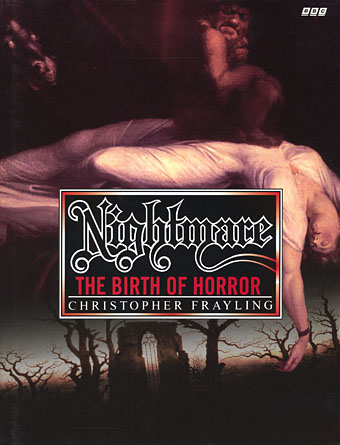
Nightmare: The Birth of Horror

frayling.jpg

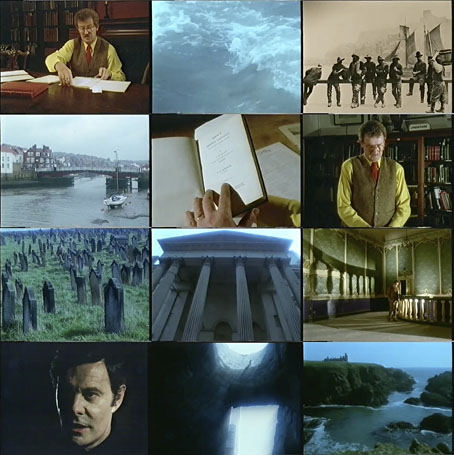
Nightmare: The Birth of Horror (1996): Dracula (and Louis Jourdan again).

Christopher Frayling, like Marina Warner, is that rare thing: a British academic with an enthusiasm for popular culture, and a talent for communicating that enthusiasm to a general audience. Both writers also have more than a passing interest in the darker areas of fiction, whether that means Gothic romance or contemporary horror films. One of Frayling’s first books was The Vampyre: Lord Ruthven To Count Dracula (1978); the same year he contributed an excellent Lovecraft essay, Dreams of Dead Names, to George Hay’s The Necronomicon: The Book of Dead Names, one of the two Necronomica published in the 1970s (three if you count Giger’s art book). Frayling’s essay, and another by Angela Carter are among the highlights in Hay’s curious volume.

frayling2.jpg

Nightmare: The Birth of Horror was both a book and a television series produced by the BBC in 1996. The year before, Frayling had written and presented Strange Landscape, an examination of the culture and philosophy of the Middle Ages. Nightmare looks at the creation of four British horror novels: Frankenstein, Dracula, The Strange Case of Dr Jekyll and Mr Hyde, and The Hound of the Baskervilles. Two of these stories—Frankenstein and Jekyll and Hyde—were famously the product of nightmares so Frayling stretches this coincidence to include the others; I’m still not sure the case is properly made for Bram Stoker but it hardly matters.

Another aspect of Frayling’s thesis is the extraordinary power of these works, all of which have had a lasting global influence. The book is naturally more detailed than the TV series, delving into the fiction for the subtexts that contribute to the power of the stories. The Dracula section is a tour-de-force of condensed information, sketching a history of fictional vampires then looking at Stoker’s career as assistant to actor Henry Irving, a man whose outsize personality was an inspiration for that of the vampiric count. There’s also some interesting speculation about Stoker’s sexuality; a letter he wrote to Walt Whitman is (to borrow a phrase from Sherlock Holmes)…suggestive. The rest of the chapter looks in detail at the slow creation of the novel. In the TV series what you lose in the literary specifics you gain in visits to some of the locations mentioned in the story, so for Dracula that means windswept Whitby on the Yorkshire coast. The same applies to the other novels: for Frankenstein there’s a visit to the Villa Diodati on the shore of Lake Geneva, a journey to Dartmoor for Hound of the Baskervilles, and so on.

I was hoping the whole series might be on YouTube but for the moment the Frankenstein episode seems to be missing. The Dracula one is the best quality, the other two look a little rough. In the meantime copies of the book may still be found at reasonable prices.

Nightmare: The Birth of HorrorDracula | Dr Jekyll & Mr Hyde | The Hound of the Baskervilles