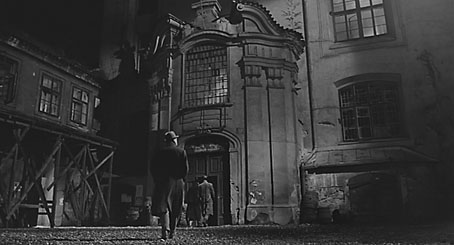
Screening Kafka

kafka1.jpg

Kafka (1991).

This week I completed the interior design for a new anthology from Tachyon, Kafkaesque, edited by John Kessel and James Patrick Kelly. It’s a collection of short stories either inspired by Franz Kafka, or with a Kafka-like atmosphere, and features a high calibre of contributions from writers including JG Ballard, Jorge Luis Borges, Carol Emshwiller, Jeffrey Ford, Jonathan Lethem and Philip Roth, and also the comic strip adaptation of The Hunger Artist by Robert Crumb. When I knew this was incoming I rewatched a few favourite Kafka-inspired film and TV works, and belatedly realised I have something of a predilection for these things. What follows is a list of some favourites from the Kafkaesque dramas I’ve seen to date. IMDB lists 72 titles crediting Kafka as the original writer so there’s still a lot more to see.

wellestrial.jpg

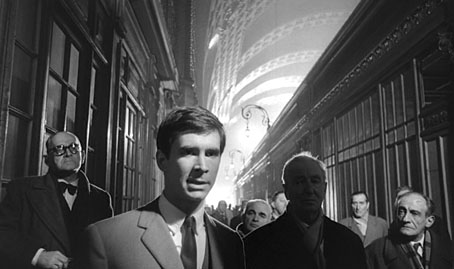
The Trial (1962), dir: Orson Welles.

Orson Welles in one of his Peter Bogdanovich interviews describes how producer Alexander Salkind gave him a list of literary classics to which he owned the rights and asked him to pick one. Given a choice of Kafka titles Welles says he would have chosen The Castle but The Trial was the only one on the list so it’s this which became the first major adaptation of a Kafka novel. Welles always took some liberties with adaptations—even Shakespeare wasn’t sacred—and he does so here. I’m not really concerned whether this is completely faithful to the book, however, it’s a first-class work of cinema which shows Welles’ genius for improvisation in the use of the semi-derelict Gare d’Orsay in Paris as the main setting. (Welles had commissioned set designs but the money to pay for those disappeared at the last minute.) As well as scenes in Paris the film mixes other scenes shot in Rome and Zagreb, with Anthony Perkins’ Josef K frequently jumping across Europe in a single cut. The resulting blend of 19th-century architecture, industrial ruin and Modernist offices which Welles called “Jules Verne modernism” continues to be a big inspiration when I’m thinking about invented cities. Kafka has been fortunate in having many great actors drawn to his work. Here with Perkins there’s Welles himself as the booming and hilarious Advocate, together with Jeanne Moreau, Romy Schneider and Akim Tamiroff.

brazil.jpg

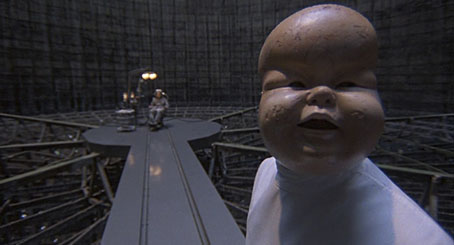
Brazil (1985), dir: Terry Gilliam.

Having watched Brazil again recently I was struck by how much it resembles the popular view of Kafka’s worlds rather than the Orwellian nightmare which Terry Gilliam first intended. The story is powered by a bureaucratic error caused by a crushed insect, after all, and Gilliam follows Welles in mashing up the styles and motifs of an authoritarian century to create a hybrid world he described as being “on the Belfast/Los Angeles border”. Tom Stoppard had a hand in the screenplay, and there’s another great cast with Jonathan Pryce, Katherine Helmond and Ian Holm. Also a nod to an Orson Welles role with the character named Harvey Lime.

insuranceman.jpg

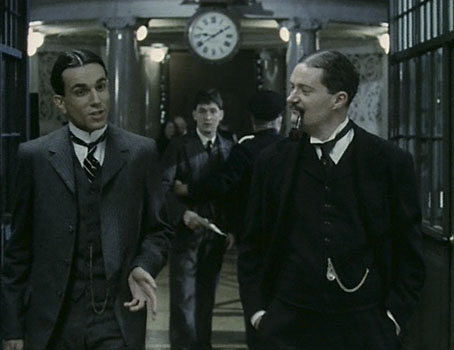
The Insurance Man: Daniel Day-Lewis, Robert Hines & Jim Broadbent.

The Insurance Man (1986), dir: Richard Eyre.

Jim Broadbent played a plastic surgeon in Brazil; here he’s a clerk in the offices of the Worker’s Accident Insurance Institute in Prague. Writer Alan Bennett was preoccupied with Kafka in the mid-1980s: his stage play, Kafka’s Dick (the title does indeed refer to the writer’s penis), was staged the same year as this TV film directed by Richard Eyre, a 70-minute drama which sees a young factory worker trying to find a cure for an industrial illness at the Insurance Institute where one “Doctor Kafka” is employed. Needless to say, his quest for health and some measure of justice becomes Kafkaesque. Kafka here is portrayed by Daniel Day-Lewis in a typically enthralling performance which is never mannered but makes him seem a stranger creature (and a more sympathetic clerk) than his fellow workers. Most of this was filmed in Liverpool in some wonderful old office buildings using a sombre blue/grey palette. As with all Bennett’s dramas the dialogue is a treat. The film is now available on DVD in the Alan Bennett at the BBC collection.
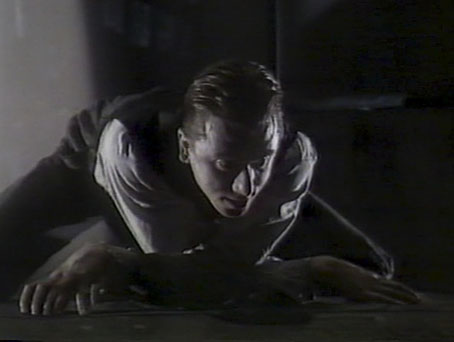

metamorphosis.jpg

Tim Roth as Gregor Samsa.

Metamorphosis (1987), dir: Jim Goddard.

Another TV drama based on one of Steven Berkoff’s three stage adaptations of Kafka in which he also plays the part of Mr Samsa. Berkoff’s preference for physical theatre means there are no insect suits or special effects here, Gregor Samsa’s insectile nature is conveyed entirely through Tim Roth’s energetic performance, with shrieks, twisted limbs, and a climbing frame for when he needs to scuttle up the wall or hang from the ceiling. Not available on DVD but it’s scattered around YouTube if you can be bothered.
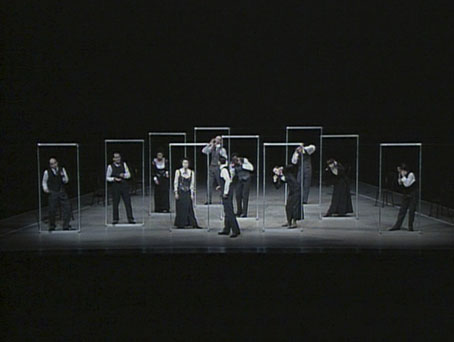

berkofftrial.jpg

The Trial (1991), dir: Steven Berkoff.

Another Berkoff adaptation which is available on DVD from his own company. As with his Salome, this is a filmed stage performance and highly recommended for its fidelity to the book, although of the two I prefer the Oscar Wilde play. Berkoff’s great innovation is the bare stage where the only props are a couple of chairs and a number of tall metal frames, one for each performer, which the actors use to create doors, windows, picture frames and even a series of moving corridors. Berkoff himself plays Titorelli the painter as a hyperactive Dalí type.
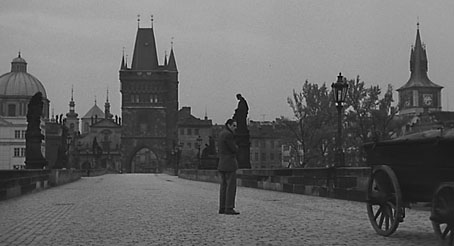

kafka2.jpg

Kafka (1991), dir: Steven Soderbergh.

A cult film of mine which I’ve written about before so there’s no need to go into great detail. It’s a shame that Daniel Day-Lewis couldn’t have played Kafka in this one instead of Jeremy Irons who does a decent job but always seems slightly wrong for the part. Ian Holm in Brazil had a role named after Terry Gilliam’s MAD-magazine mentor Harvey Kurtzman; here Holm is named after one of the great silent film directors in the role of the enigmatic Doctor Murnau. Shot on location in Prague.
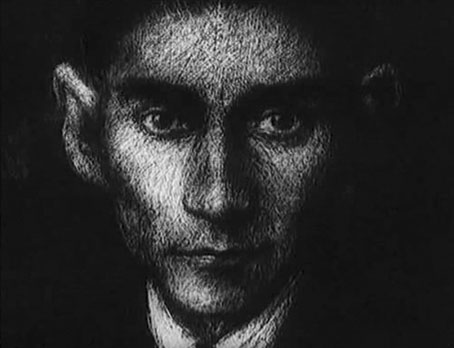

franzkafka.jpg

Franz Kafka (1992), dir: Piotr Dumala.

After all the fake Kafkas, something which is at least close to genuine article in a short and wordless animated film by Piotr Dumala. Can be watched in its entirety here.

zoetrope.jpg

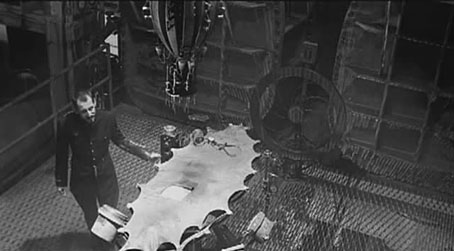
Zoetrope (1999), dir: Charlie Deaux.

Kafka’s In the Penal Colony is moved from its sun-blasted location to what looks like the interior of a power station in Charlie Deaux’s frenetic adaptation. The emphasis is very much on the industrial with the film nodding as much to David Lynch as Franz K. (And whatever happened to David Lynch’s proposed adaptation of The Metamorphosis?) The rumbling, clanging soundtrack by Lustmord provides the requisite Alan Splet-like atmospherics. Available on DVD from Soleilmoon.

Previously on { feuilleton }
Die Andere Seite by Alfred Kubin
Designs on Kafka
The Hourglass Sanatorium by Wojciech Has
Kafka’s porn unveiled
A postcard from Doctor Kafka
Alexandre Alexeieff and Claire Parker
Hugo Steiner-Prag’s Golem
Steven Soderbergh’s Kafka
Kafka and Kupka

Die Andere Seite by Alfred Kubin

kubin1.jpg

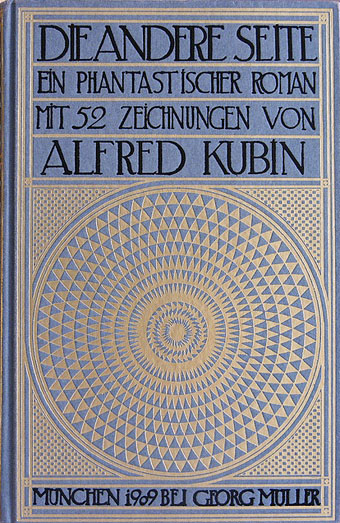
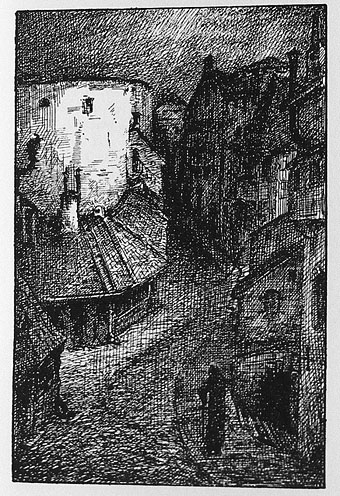
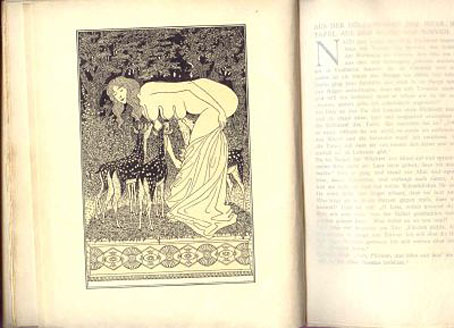
Re-reading Alfred Kubin’s strange fantasy novel Die Andere Seite (The Other Side) this week, I found myself suffering the same frustration as when I bought the book, namely that the illustrations in the Dedalus edition are very poor reproductions. When this new translation appeared in 2000 there wasn’t any convenient way to see better copies of Kubin’s drawings unless you had the earlier (and for me, elusive) Penguin edition. Thanks to Flickr we can now see reproductions from the first printing of 1909 in this set of photos. Not all the drawings are featured but the ones present are better than those in my volume. The illustrations are often rather perfunctory, and they lack the finesse and erotic weirdness of Kubin’s better known works, but a couple are as macabre as one would expect. And I love the cover design.

kubin2.jpg

As to the story, it concerns an unnamed narrator who receives a request from an old school friend, Claus Patera, to leave Munich and go with his wife to live in the city of Pearl, a newly-built metropolis in a nation known as “The Dream Realm” which Patera has founded in the Far East. Having travelled there the couple find themselves in a city filled with other displaced Europeans which is at first eccentric then increasingly nightmarish. It’s the kind of book you might expect an artist like Kubin to have written, in other words, and since the narrator is a thinly-veiled counterpart of the author we can occasionally glimpse the man behind the works. Anyone interested in Kubin the artist is advised to seek it out.

Alfred Kubin at Weimar

Elsewhere on { feuilleton }
The illustrators archive

Previously on { feuilleton }
The Hourglass Sanatorium by Wojciech Has
Kafka’s porn unveiled
Hugo Steiner-Prag’s Golem

Weekend links 24

early.jpg

Delta-Wing (2009) by Chloe Early.

• “Feted British authors are limited, arrogant and self-satisfied, says leading academic”. Stating the bleeding obvious but it still needs to be said, apparently, especially when the announcement of the Booker list this year caused the usual confusion when Amis Jr. and McEwan weren’t included, as though the mere existence of their novels makes them prize-worthy. And as someone pointed out, the word “male” is missing from that headline.

Hero of Comic-Book World Gets Real: Alan Moore again, in the NYT this time. Related: a review of Unearthing live.

• Announcing The Hanky Code by Brian Borland & Stephen S Mills, a 40-poem book to be published next year by Lethe Press. For an explanation of the Hanky Code there’s this, and there’s also an iPhone app.

Folk—the ‘music of the people’—is now hip again, says (who else?) Rob Young who can also be heard on the archived podcast here. Related: the folk roots of Bagpuss. Related to the latter: The Mouse Mill.

zvorykin.jpg

An endpiece from The Firebird and other Russian Fairy Tales by Boris Zvorykin.

‘Yes’ to Catastrophe: Roger Dean, Prog and SF. A lengthy and thoughtful analysis of Roger Dean’s early work.

Into the Media Web, the enormous Michael Moorcock book which I designed, is officially published this week.

Cassette playa: in praise of tapes. I’ve complained about tapes in the past but people continue to find them useful. Some technologies die harder than others.

Boy BANG Boy: “Quiet moments made suddenly very loud with the attitude and opinion of what it means to be a young male in an impossibly diverse world.” An exhibition opening at Eastgallery, London, on August 5th.

Empty your heart of its mortal dream: Alfred Kubin’s extraordinary novel, The Other Side.

Ghostly and Boym Partners devise a new way to deliver digital music.

Besti-mix #27: a great selection by producer Adrian Sherwood.

Agnostics are troublemakers. Amen to that.

• RIP Harry Beckett.

Acousmata.

Let Us Go In To The House Of The Lord by Pharoah Sanders (live, 1971): Part 1 | Part 2

Kafka’s porn unveiled

amethyst.jpg

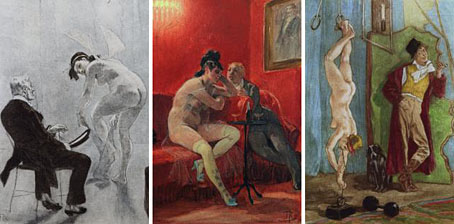
Pages from Der Amethyst (1906) showing Reh-Inkarnation by Thomas Theodor Heine.

Okay, don’t get too excited, I simply wanted to make a couple of points of order while this story is still causing a stir. I noted earlier the recent (London) Times piece about James Hawes’ new book, Excavating Kafka, described as a work which:

seeks to explode important myths surrounding the literary icon, a “quasi-saintly” image which hardly fits with the dark and shocking pictures contained in these banned journals.

Hawes claims to have been surprised, if not shocked, by the discovery—new to him but not to Kafka scholars, it seems—of Kafka’s collection of Franz Blei publications, The Amethyst and Opals. Blei published Kafka’s short stories as well as other literary works and fits the mould of many small publishers (Leonard Smithers and Maurice Girodias come to mind) who financed poorly-selling literature with erotic titles. Kafka may well have been “paid” for his writing with these books. However:

Even today, the pornography would be “on the top shelf”, Dr Hawes said, noting that his American publisher did not want him to publish it at first. “These are not naughty postcards from the beach. They are undoubtedly porn, pure and simple. Some of it is quite dark, with animals committing fellatio and girl-on-girl action… It’s quite unpleasant.”

Read the rest of the breathless saga here. The Times doesn’t show any of the pictures in that piece but the paper edition showed a drawing which looked like the usual erotica of the period, a slightly cruder version of the kind of thing done so well by artists like Franz von Bayros. So not photographs, then, but drawings. Sure enough, descriptions of Blei’s books list well-known names such as Aubrey Beardsley, Alfred Kubin, Thomas Theodor Heine, Karl Hofer, Félicien Rops, and von Bayros. Yesterday’s Guardian examined some of the reaction to Hawes’ assertions from other Kafka scholars which is generally hostile, their counter-assertion being that he’s making a mountain out of a molehill. That piece includes another description of the depraved contents:

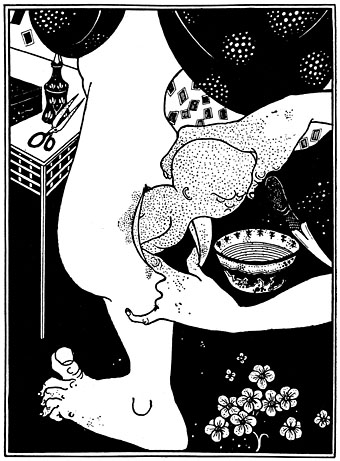
They include images of a hedgehog-style creature performing fellatio, golem-like male creatures grasping women’s breasts with their claw-like hands and a picture of a baby emerging from a sliced-open leg.

Hmm…Beardsley, sliced-open leg? That could only be Aubrey’s illustration for Lucian’s True History. Sensitive readers may wish to avert their gaze.

lucian.jpg

Birth from the Calf of the Leg. Illustration intended for Lucian’s True History (1894). Not used, but published in An Issue of Five Drawings Illustrative of Juvenal and Lucian by Leonard Smithers, London (1906).

Shocking stuff. Allow me to veer from the point for a moment with Beardsley scholar Brian Reade’s explanation of that drawing:

This illustration (was) rejected from the 1894 and 1902 editions of Lucian’s True History. At the time when it was drawn the artist was obsessed by foetuses and irregular births; creatures derived from the foetus form occur in the Bon-Mots series, in The Kiss of Judas, in Salome and elsewhere. That he chose to illustrate this subject suggests that there may have been a latent strain of homosexuality in Beardsley. Lucian describes in his True History the way in which children are born in the kingdom of Endymion on the Moon. “They are not begotten of women, but of mankind: for they have no other marriage but of males: the name of woman is wholly unknown among them: until they accomplish the age of five and twenty years, they are given in marriage to others: from that time forwards they take others in marriage to themselves: for as soon as the infant is conceived the leg begins to swell, and afterwards when the time of birth is come, they give it a lance and take it out dead: then they lay it abroad with open mouth towards the wind, and so it takes life: and I think thereof the Grecians call it the belly of the leg, because therein they bear their children instead of a belly”. Lucian also explains that “their boys admit copulation, not like unto ours, but in their hams, a little above the calf of the leg for there they are open”.

The other drawings mentioned by the Guardian don’t sound familiar but may well be by Alfred Kubin who produced a number of curious erotic pieces, one of which is in my Art of Ejaculation post. Meanwhile Die Welt Online reproduces some of the Félicien Rops pictures in a small gallery, all of which are rather innocuous depictions of prostitutes.

rops.jpg

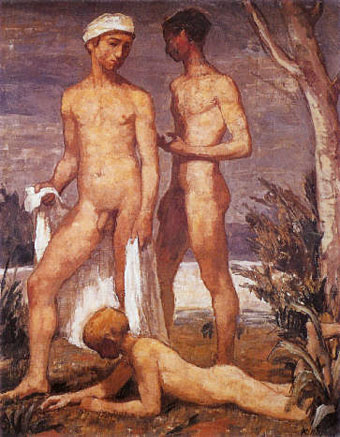
Rops could be a lot weirder and wilder than this. (See his Octopus drawing of 1900.) I haven’t seen Hawes’ book yet, but going on this evidence it seems the Kafka scholars may have a point about his inflated claims. Much of this work was shocking at the time, of course, and open publication of some of it would have been an invitation to an obscenity prosecution. But I’ll let the Kafka scholars haggle over Franz’s reputation, quasi-saintly or not; the main point for me was that the works in question are very familiar to anyone who knows the art of the period. So in place of rancour, here’s a nice homoerotic painting by another of the artists published by Blei, Karl Hofer, in style and colour reminiscent of Picasso’s Rose Period pictures.

hofer.jpg

Drei Badende Jünglinge by Karl Hofer (1907).

Update: this volume finally turned up in the Savoy Books office so I was able to look through it. The Beardsley picture above is indeed among the very few examples of “Kafka’s porn”, used without any credit and Beardsley receives no mention in the index. There’s also a Félicien Rops drawing with a caption which says it “may be Victorian”, along with a couple of other pieces, all equally uncredited. Yes, that’s the level of the scholarship at work here; the author couldn’t even be bothered to research the art in question. Summary: worthless.

Previously on { feuilleton }
A postcard from Doctor Kafka
Alexandre Alexeieff and Claire Parker
Hugo Steiner-Prag’s Golem
Steven Soderbergh’s Kafka
Kafka and Kupka
The art of ejaculation
The art of Félicien Rops, 1833–1898

The art of ejaculation

kwok1.jpg

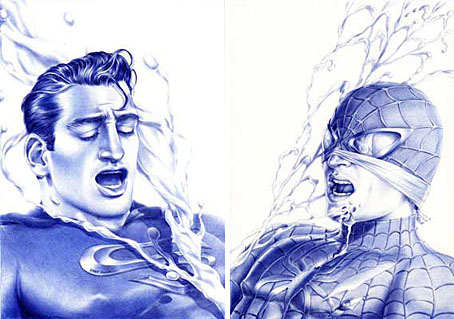
left: Sperman (2007) by Cary Kwok; right: Here Cums the Spider (2007) by Cary Kwok.

NSFW, as if you need to be told. It’s almost a commonplace of contemporary art that there are so many artists around today, producing such a volume of work, that any newcomer (as it were) has to find a niche and stay there if they want their efforts to stand out from the crowd. Cary Kwok’s niche seems to be the seminal emission which he depicts in a variety of ways, including showing various well-known comic-book characters shooting their respective loads. Kwok’s work has been shown recently at the Herald Street gallery, London, and Hard Hat, Geneva.

I like Kwok’s drawings, they’re carefully-done and funny, and serve to remind one that the cum shot is under-represented in art. Despite various Biblical prohibitions, women have been subject to no end of sexual display throughout art history, from copulations with gods in the form of animals to Danaë’s impregnation by Zeus as a literal golden shower. But male sexuality, especially at its most essential moment, has rarely been depicted outside the pages of pornography. The irony of this, as with arguments against erections in art, is that if it wasn’t for ejaculations we wouldn’t be here to discuss their pros and cons. Gay artists have been in the vanguard of addressing the sperm-drought, possibly because they have more than a passing interest in these matters; Michael Petry’s work earlier this year took a lateral view. There’s another sample (as it were) of Cary Kwok’s work below the fold plus some other seminal (as it were) artworks through the ages.

Update: Jack-Off Sculpture Sells For $15 Million.

Continue reading “The art of ejaculation”