House of Harrington

harrington1.jpg

Curtis Harrington.

House of Harrington is a short documentary from 2008 about the late filmmaker Curtis Harrington which has just been posted to YouTube by its makers, and by a curious coincidence this appearance occurs in the week of Dennis Hopper’s death. Harrington gave Hopper the lead in his debut feature Night Tide (1961) at a time when the actor was ostracised in Hollywood after a falling out with director Henry Hathaway. Hopper’s diligent performance in Harrington’s film, a low budget horror, is a long way from the histrionics one usually finds in works of this sort and is a good reason to seek it out.
harrington2.jpg

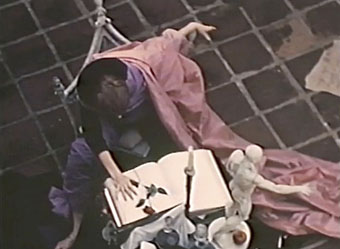
Marjorie Cameron in The Wormwood Star.

Also in Night Tide in a wordless role is the enigmatic occult artist Marjorie Cameron who drifts around looking spooky and mysterious. Cameron had earlier appeared with Harrington in Kenneth Anger’s Inauguration of the Pleasure Dome (1954), he as Cesaré the Somnambulist from Caligari, she as Aleister Crowley’s Scarlet Woman. That encounter led to Harrington making her the subject of one of his experimental shorts, The Wormwood Star in 1956. I’ve wanted to see this film for years, if only to sate a persistent curiosity, and House of Harrington contains a few tantalising glimpses. With luck it may turn up on YouTube (or even DVD) in the future.

Lastly, Automat Pictures, the makers of House of Harrington, also have a lengthy filmed lecture in their channel, Queer for Fear, which “explores gay and lesbian subtext in the horror film, and examines the intertwining of queer history and monster movies.”

• House of Harrington: Part 1 | Part 2 | Part 3 | Part 4

Previously on { feuilleton }
Curtis Harrington, 1926–2007
The art of Cameron, 1922–1995
Kenneth Anger on DVD…finally

Weekend links 10

harlequin.jpg

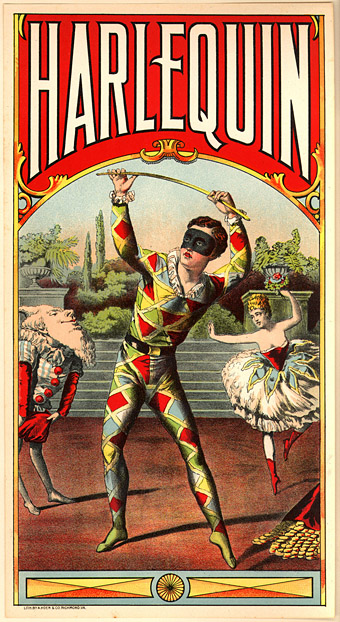
One of a number of vintage ads and ephemeral items at this Flickr set.

• From 1971: The Anthony Balch/William Burroughs/Jan Herman video experiment.

• The NYT reports on World on a Wire, a neglected science fiction drama by Rainer Werner Fassbinder.

• “While some of the technology industry’s brightest minds were inventing the first PCs and developing groundbreaking software, they were also feeding their heads with LSD.”

• The archive of author and illustrator Mervyn Peake has been acquired by the British Library for £410,000.

• Thames & Hudson are publishing I Wonder, a book by the wonderful Marian Bantjes, later in the year. Her site has a preview. I want.

• The gays: It’s election season in the UK so My Gay Vote looks at how the three main parties have supported LGB issues. (No data for the graphs, however.) Is theatre finally glad to be gay? Yet more Tumblrs: I heart skinny boys & Cute boys with cats.

• Trend-spotter, “svengali”, Situationist and the man who named the Sex Pistols: RIP Malcolm McLaren. The Guardian ran a number of memorial pages. Related: Anarchy in Gardenstown.

• Dublin’s One City, One Book choice for April 2010 is The Picture of Dorian Gray.

The Catastrophist: Christopher Hitchens on JG Ballard.

Steampunk Taxidermy by Lisa Black.

• LIFE looks back at Aleister Crowley.

• Groovy songs of the week: Julie Driscoll (with Brian Auger & The Trinity), a pair of songs by Bob Dylan—This Wheel’s On Fire—and Donovan—Season Of The Witch—and sets which look like a collaboration between Verner Panton and Marcel Duchamp. Amazing.

The art of Pamela Colman Smith, 1878–1951

smith_tarot.jpg

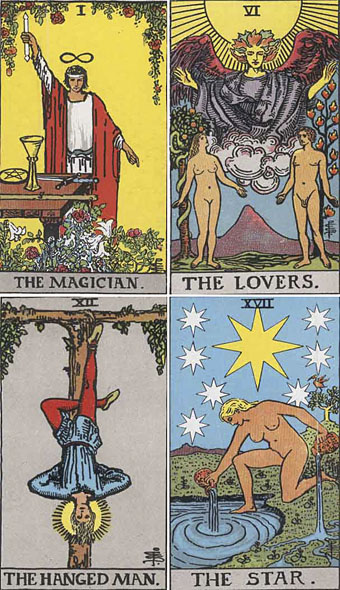
Following yesterday’s post about Frieda Harris’s Tarot designs, it only seems right to acknowledge the other major Tarot artist of the 20th century. Pamela Colman Smith has been overshadowed by her male mentor, Golden Dawn scholar AE Waite, even more than Frieda Harris whose name at least gets mentioned as much as Crowley’s in discussion of her paintings. US Games lists Smith and Waite’s so-called Rider-Waite Tarot of 1909 as “the world’s most popular tarot deck” and uses a silhouette of Smith’s design for The Fool as the company logo, yet it was years before I saw a credit for Smith as artist of this deck, her personal presence being reduced to a tiny monogram in the corner of each picture.

crane.jpg

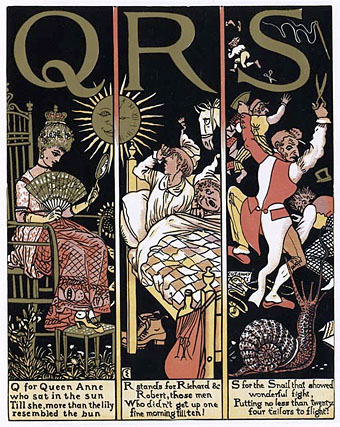
The Absurd ABC by Walter Crane (1874).

I’ve often thought of Smith’s deck as “the Art Nouveau Tarot” which it isn’t really—it’s more late Victorian in style, if anything—but it was created when Art Nouveau was at its height and has some of the character of the poster art of the period. Smith’s designs are incredibly striking in places, with the clarity of drawn archetypes, and her style possibly owes something to the books Walter Crane created for children in the 1870s and 1880s; the clean lines and bright colouring are very similar. In that respect, Smith’s deck might be more fittingly labelled “the Arts and Crafts Tarot.”

hermit.jpg

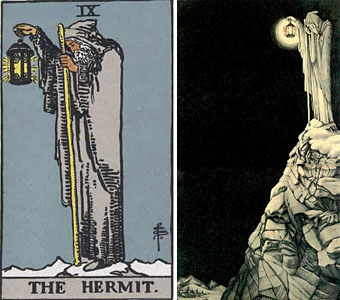
left: Pamela Colman Smith’s Hermit; right: Barrington Colby’s inner sleeve for Led Zeppelin IV.

Pamela Colman Smith also worked as a book illustrator but her other work is overshadowed completely by the popularity of the Rider-Waite cards. Her design for The Hermit was famously borrowed by Crowley obsessive Jimmy Page in 1971 for a gatefold illustration, View in Half or Varying Light by Barrington Colby, on Led Zeppelin IV. This use alone makes it possibly the most famous Tarot card in history (there was even a statue made of it for the now defunct Hard Rock Park Led Zeppelin roller coaster) but I doubt many people familiar with the image could name the original artist.

Happily, Ms Smith’s obscurity is gradually diminishing. US Games recently produced the Pamela Colman Smith Commemorative set for the 100th anniversary of the Rider-Waite deck, a package featuring a book of her artwork (including non-Tarot drawings), prints, postcards and a reprinted set of cards. A long overdue reappraisal but, as is always the case, it’s better late than never.

Mary K Greer’s Tarot blog has some excellent postings devoted to Pamela Colman Smith including this page which gathers links to sites containing further information about the artist’s life and work.

Elsewhere on { feuilleton }
The illustrators archive

Previously on { feuilleton }
Layered Orders: Crowley’s Thoth Deck and the Tarot
William Rimmer’s Evening Swan Song
The art of Cameron, 1922–1995

Layered Orders: Crowley’s Thoth Deck and the Tarot

magus.jpg

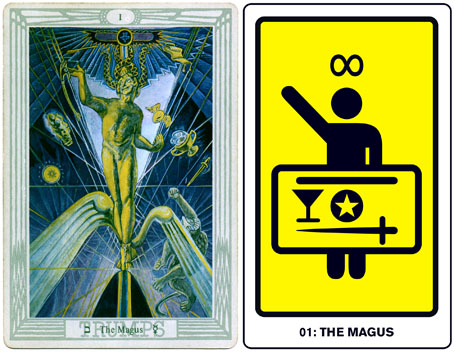
left: The Magus from the Thoth Tarot by Frieda Harris and Aleister Crowley (1938–1940?); right: The Magus from The Major Arcana by John Coulthart (2006).

Phantasmaphile presents another magickal art event in NYC next week. Layered Orders: Crowley’s Thoth Deck and the Tarot is described as “a personal narrative by Jesse Bransford”, an artist with a very distinctive approach to traditional occult symbolism. Bransford’s talk will focus on the peerless Thoth Tarot deck which Frieda Harris painted over several years under the careful direction of Aleister Crowley. The Thoth deck for me is still the ultimate Tarot deck. Crowley and Harris sought to create a Tarot for the 20th century, throwing out much of its tired and degraded iconography. This they replaced with dramatic interpretations which brought new layers of symbolism to the cards—including references to contemporary science—and also acknowledged the developments of Cubism and Futurism in the visual sphere. Tarot decks have proliferated since the 1960s but the Thoth deck has few (if any) rivals. I made use of Crowley’s controversial reordering and renaming of the cards in 2006 when I produced my set of Major Arcana designs based on international symbol signs.

The Tarot in general and Aleister Crowley’s Thoth Tarot in particular represent a miasmic confluence of image and thought into a single structure that is both liberating and overwhelming in its scope. In creating the deck, Crowley (in collaboration with painter Lady Frieda Harris) sought to integrate the mythological structures of the major mystical systems of both Western and Eastern occult traditions and to bring them into line with contemporary scientific thinking. The symbolism of the cards blends Kabbalah, Alchemy, Astrology, Egyptian mythology, quantum physics and even the I-Ching in ways that are at the same time clear and utterly confounding.

In an image-soaked personal narration Bransford, whose research-based artwork has delved into many of the territories Crowley sought to unify, will discuss some of the basic concepts of Tarot symbolism, returning to Crowley’s deck as among the most total example of the cards’ syncretism and as the most controversial.

Layered Orders: Crowley’s Thoth Deck and the Tarot takes place at Observatory, 543 Union Street, Brooklyn, NYC on Friday, July 17 at 7:30pm. Admission is free and there are further details at the Observatory website and Phantasmaphile.

Previously on { feuilleton }
Fata Morgana: The New Female Fantasists
Aleister Crowley on vinyl
The Man We Want to Hang by Kenneth Anger
The art of Cameron, 1922–1995

The Great God Pan

pan_daphnis.jpg

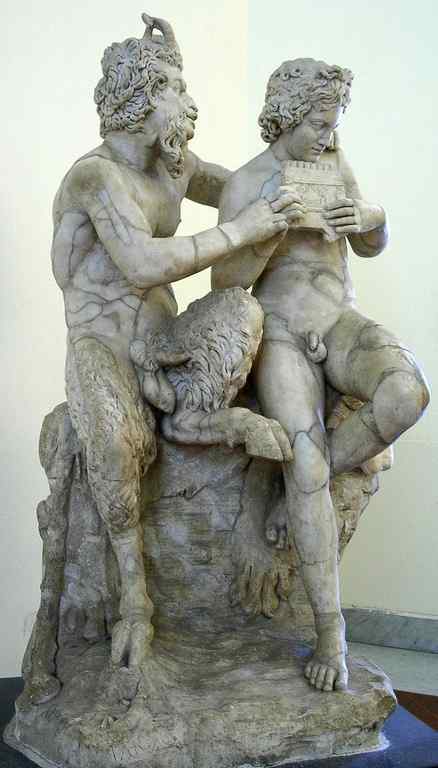
Pan teaching Daphnis to play the panpipes; Roman copy of a Greek original from the 3rd-2nd centuries BCE by Heliodoros.

“The worship of Pan never has died out,” said Mortimer. “Other newer gods have drawn aside his votaries from time to time, but he is the Nature-God to whom all must come back at last. He has been called the Father of all the Gods, but most of his children have been stillborn.”

So says a character in The Music on the Hill, one of the slightly more serious stories from Saki’s The Chronicles of Clovis (1911). Saki’s Pan is a youthful spirit closer to a faun than the goatish creature of legend. But being a gay writer whose tales regularly feature naked young men (surprisingly so, given the time they were written) I’m sure Saki would have appreciated the Roman statue above. There’s nothing chaste about this Pan with his “token erect of thorny thigh” as Aleister Crowley put it in his lascivious 1929 Hymn to Pan, a poem which caused a scandal when read aloud at his funeral some years later. The Roman statue was for a long while an exhibit in the restricted collection of the Naples National Archaeological Museum where all the more scurrilous and priapic artefacts unearthed at Pompeii were kept safely away from women, children and the great unwashed. These are now on public display and include the notorious statue of a goat being penetrated by a satyr.

Continue reading “The Great God Pan”