Aleister Crowley: Wandering The Waste

crowley1.jpg

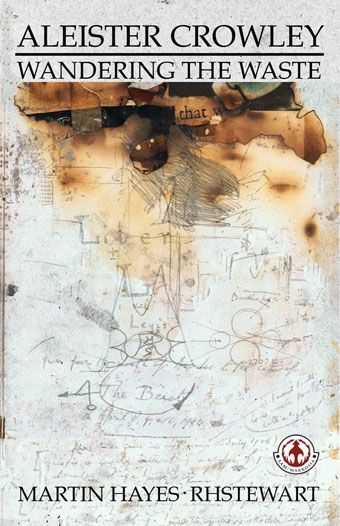
I mentioned this graphic biography of Aleister Crowley earlier in the year but pressure of work has meant it’s taken me all this time to finally read it. Aleister Crowley: Wandering The Waste is written by Martin Hayes and illustrated by RH Stewart. The title alludes to Alastor, or The Spirit of Solitude, a Shelley poem concerning an itinerant poet with whom Crowley often identified.

Crowley isn’t a stranger to the comics world but this book is the first I’ve encountered that devotes itself to the facts of the man’s life rather than using his notorious persona as a general purpose scare figure. Crowley’s life was nothing if not eventful: in addition to the numerous rituals and magickal exploits, he was also a serious mountaineer, and something of a globetrotter before his inheritance ran out; he wrote novels, memoirs, several volumes of poetry, even more volumes of occult philosophy, and was a world-class drug-taker and libertine in an age when sexual escapades of the mildest sort could provoke the deepest outrage.

Given all of this you’d expect somebody to have tried to film his life by now, but doing so presents a number of problems. Period biopics are by their nature very expensive which is why they tend to take the least controversial figures for their subjects. Crowley isn’t only controversial, his life’s work remains esoteric and difficult for a general audience; you’d have to work hard to dispel Devil Rides Out clichés for people who’ve never opened an occult book. There’s no life without the magick, however, so you’re unlikely to get either trying to follow the costume-drama route. In the past I’ve thought that a better solution would be to adopt the jigsaw approach used in François Girard’s Thirty Two Short Films About Glenn Gould (1993); significant moments could be dramatised as they are in the Gould film while other sections could be more graphical, abstract or theoretical.
crowley2.jpg

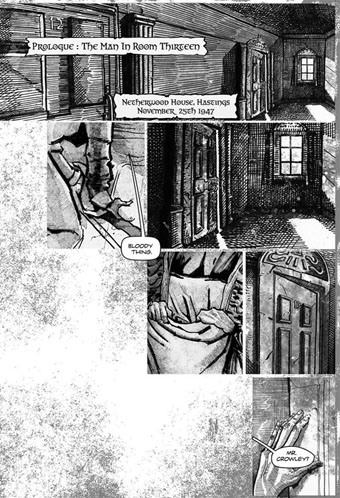
Hayes and Stewart’s book goes for the traditional biopic approach (albeit with some deviations), there being no reason not to when you have an unlimited budget. It’s 1947, and Crowley in his Hastings nursing home remembers his life for a young visitor, delivering a narrative that ranges across seventy years, and which acknowledges the more scandalous moments whilst also repudiating some of the rumours. Hayes backs up his facts with copious endnotes, some of which offer more detail about disputed incidents. Alan Moore and Eddie Campbell’s From Hell is the obvious progenitor here; both books show the strength of comics in being able to deliver historical material in a visual form without having to worry about the constraints of cinema.

Stewart’s artwork is from the sketchy, collaged Sienkiewicz/McKean school of comic art. In some scenes I would have preferred more visual detail but then having drawn historical comics myself I know how difficult it can be having to research the appearance of every last piece of clothing or furniture. (The lettering is also afflicted with a few typos.) Some of the scenes away from 1947 are delivered in a fragmented, hallucinatory style in which occult figures and symbols are confused with Crowley’s memories. The technique enables many years to be covered without padding the book to doorstop size while also keeping the magick as a continual background presence. It’s quite a change to have the aged Crowley as the focus for once, a dishevelled magus rather than the usual libidinous firebrand. After so much turmoil, there’s always a sombre atmosphere around the Great Beast’s less-than-beastly final days, although they were considerably more peaceful than those of some of his wives and associates. Whatever regrets or disappointments Crowley may have felt, his books are still in print, and we’re still talking about him.

The Atlantis Bookshop in London has been showing some of Stewart’s artwork throughout this month. I’ve always liked the way the Atlantis doubles as a mini-gallery, I saw some Austin Spare drawings there a few years ago; it’s a good venue, and the ideal place to view this work. The exhibition will run to December 24th.

Previously on { feuilleton }
Brush of Baphomet by Kenneth Anger
Rex Ingram’s The Magician
The Mysteries of Myra
Aleister Crowley on vinyl

Weekend links 178

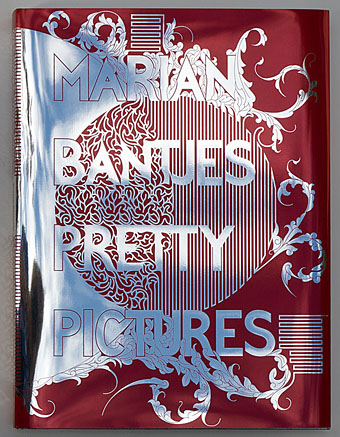
bantjes.jpg

Pretty Pictures, a new book by designer Marian Bantjes, is out on October 1st.

• A writer admired by Angela Carter, Michael Moorcock, Harlan Ellison, Anthony Burgess, Jonathan Meades and Iain Sinclair; a “writer’s writer…[whose] best stories bear comparison with the Ficciones of Jorge Luis Borges”; a writer with an “unsettling quality to his writing, a whiff of brimstone that links him to fin-de-siècle occult figures such as HP Lovecraft—and even, at a further remove, Aleister Crowley”. David Collard explains why you may want to read something by Gerald Kersh (1911–1968), four of whose books are being republished.

• The Eccentronic Research Council and Maxine Peake pay homage to Delia Derbyshire’s The Dreams project with a new single out at the end of the month (Pye Corner Audio and Carol Morley appear on the flip). Ms Peake’s barm-cake reverie may be heard here.

• “Applying for grants, writing artist statements, showing up to openings—artists have to do far more than just make art if they want to find an audience for it.” Jen Graves on lies and deception in the art world.

The material does not make the work. The life does not make the art. Exactly the opposite. The work creates the material. The art creates the life. Did Trinidad exist before Naipaul? Did cargo ships exist before Joseph Conrad? Did Newark and the New Jersey suburbs exist before Philip Roth? Did women in playgrounds in New York City exist before Grace Paley? See how the writer invents the material? These places did not exist as literary subjects. They were invisible to literature. The magic of a great book is that it makes its own subject seem inevitable. The danger is, it makes the subject seem like the source of power in the work.

Phyllis Rose on life and literature.

• Mix of the week: Secret Thirteen Mix 087, 40 minutes of original electronic music by Geistform (Rafael Martinez Espinosa).

• “You’ve Got This“, an It Gets Better-style video support campaign for people recently diagnosed with HIV.

• At Dangerous Minds: Babalon Working: Brian Butler’s trippy occult odyssey with Paz de la Huerta.

Manfred Mohr‘s computer-created artwork, from the 1960s to the present.

Robert Macfarlane on the strange world of urban exploration.

Rick Poynor on Bohumil Stepan’s Family Album of Oddities.

• Oli Warwick talks to Martin Jenkins, aka Pye Corner Audio.

• The 384-page BUTT calendar for 2014 is now on sale.

• Pye Corner Audio: We Have Visitors (2010) | Toward Light (2011) | The Mirror Ball Cracked (2012)

Alas Vegas Tarot cards

alasvegasdevil.jpg

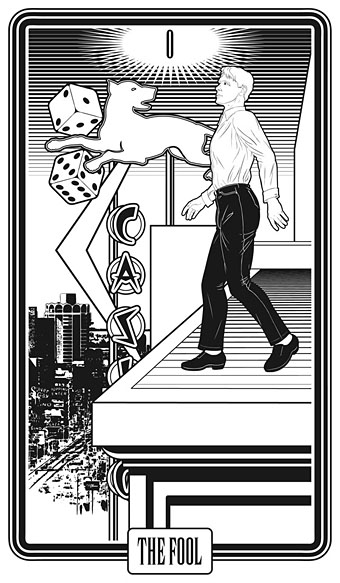
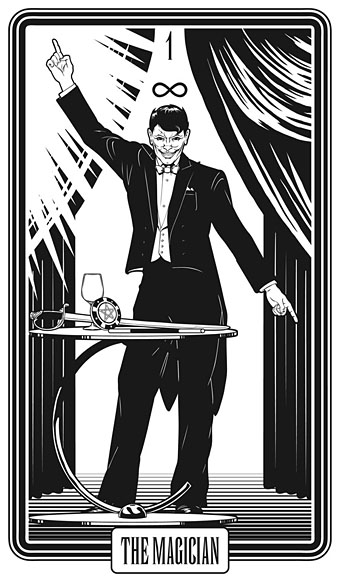
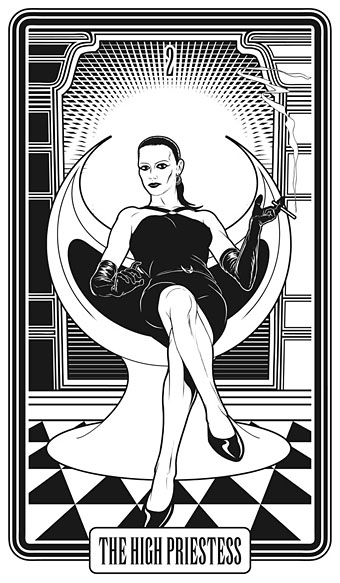
Back in February I bought a Wacom drawing tablet and said I’d show some proper results from its use later. For the past few months I’ve been working on this project using a combination of Wacom drawing and vector graphics. The initial brief from games designer James Wallis was for six Tarot-style card designs for his Alas Vegas role-playing game which has as its theme a fantasy extrapolation from Las Vegas and its gaudy mythology. The Kickstarter funding for the game turned out to be more successful than was anticipated so James asked me to expand the six cards idea into a full set of black-and-white Major Arcana designs.

This has been a fun series to work on although a number of the cards presented problems at first, the antique nature of the Tarot symbolism being a difficult thing to map across a very commercial American city. The symbolism from the Rider-Waite-Smith (RWS) deck was used as a rough guide although we deviated in a few places from the more traditional attributes. Las Vegas has changed over the years so rather than represent a single period of the city’s history there are references to different eras, from the huge casinos of today back to the buildings of the 50s and 60s with their distinctive “Googie” architecture. Notes for the cards follow below. The artwork can be seen at larger size here.

alasvegas00.jpg

The Fool is usually a young man about to step off a cliff edge with a dog barking a warning at his heels, hence the dog on the sign.

alasvegas01.jpg

Several of the cards convert the Tarot characters into cabaret acts. This one was pretty inevitable, and I’m sure it’s not the first time a stage conjuror has appeared on this card.

alasvegas02.jpg

The chair is based on the 1965 “Ball Chair” design by Eero Aarnio (as seen in The Prisoner TV series), adapted here to resemble the Priestess’s crescent moon.

alasvegas03.jpg

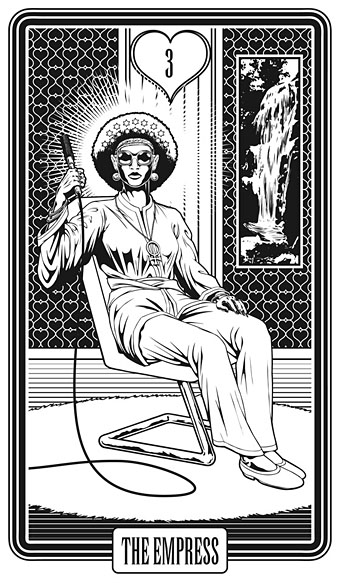
The style on this one is more 70s than 60s: patterned wallpaper (the hearts derive from the symbolism of The Empress, and from playing cards, of course), white rug, Kung Fu pyjamas.

Continue reading “Alas Vegas Tarot cards”

The Wormwood Star

cameron1.jpg

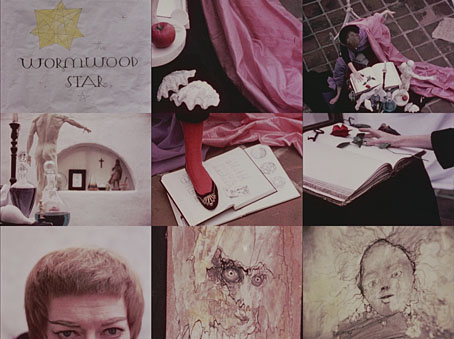
I’ve waited about 20 years to see this one, after first learning of it via a Curtis Harrington interview in Michael Weldon’s Psychotronic magazine in the 1990s. The Wormwood Star (1956) is a 10-minute study of the occult art and witchy persona of Harrington’s friend Marjorie Cameron (1922–1995), best known these days for her memorable incarnation as the Scarlet Woman in Kenneth Anger’s Inauguration of the Pleasure Dome (1954), a film in which Harrington also appeared. With her flame-red hair, green eyes and basilisk gaze, Cameron (as she preferred to be called) would have made an impression wherever she landed. Her presence in Anger’s film is so striking that stills of her face have often been used to stand for the entire Magick Lantern Cycle.

cameron2.jpg

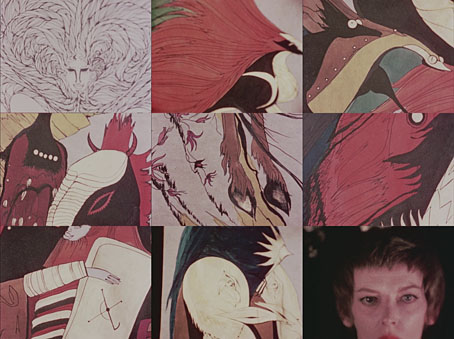
In The Wormwood Star Harrington ramps up the mystique with oblique shots and at least half the running time given to Cameron’s strange drawings and paintings. The subtitle, “Concerning the Knowledge and Conversation of the Holy Guardian Angel” harks back to the 1940s and her husband, Jack Parsons, a rocket researcher and, for a time, the American head of Aleister Crowley’s Ordo Templi Orientis. Harrington later gave Cameron a wordless role as the “Water Witch” in his low-budget horror film, Night Tide (1961), where she drifts around Venice Beach looking suitably mysterious. Night Tide is out-of-copyright so can be watched in full at YouTube. The Wormwood Star appeared on a Curtis Harrington DVD only last month which is no doubt where this copy originates. It may not stick around so watch it while you can.

Previously on { feuilleton }
Street Fair, 1959
House of Harrington
Curtis Harrington, 1926–2007
The art of Cameron, 1922–1995
Kenneth Anger on DVD…finally

Weekend links 164

panikanova.jpg

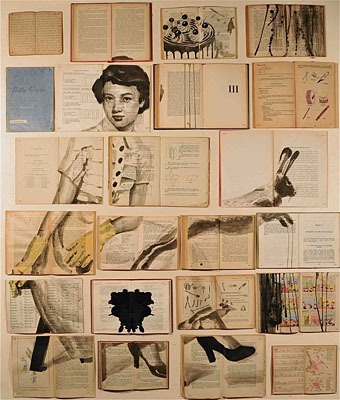
Ekaterina Panikanova paints on books.

Back in 2009 I bought a book of Art Nouveau illustration and design which contained an intriguing drawing by an Austrian artist, Franz Wacik (1883–1938). At the time there was little of Wacik’s other work online so I was delighted by the latest post at 50 Watts which showcases a selection of his illustrations. Wacik was a contemporary of British illustrator Sidney Sime, and both artists share a predilection for the comic and the grotesque.

• “The outlawing of drugs such as cannabis, MDMA and LSD amounts to the ‘the worst case of scientific censorship since the Catholic Church banned the works of Copernicus and Galileo’, the former Government drugs advisor Professor David Nutt has claimed.” Related: “At last, the edifice of drugs prohibition is starting to crumble,” says Amanda Feilding.

Alan Johnston on “A gay island community created by Italy’s Fascists”, and at Another Nickel In The Machine a report on The Gateways Club, one of the few meeting places for London’s lesbians in the 1960s. Alex Park wonders “Why Is Gay Porn So Popular In Pakistan?”

• If it’s June 16th then it must be Bloomsday: The Irish Times has a page of Joyce-related links to mark the anniversary. This year there’s a global reading of Ulysses taking place.

• “Now we can concentrate on album number nine,” says Kraftwerk’s Ralf Hutter. The rest of us will impatiently count the passing seconds.

• After a week in which George Orwell’s Nineteen Eighty-Four has seen an increase in sales, a look at its cover designs old and new.

Aleister Crowley: Wandering the Waste is a 144-page graphic biography of the Great Beast by Martin Hayes and RH Stewart.

Barnbrook Design‘s presentation of Taxidermy, a book by Alexis Turner, is rather splendid.

• FACT Mix 386 is a great collection of dubby grooves compiled by Young Echo.

• From 2001: Michael Wood in the LRB reviewing Apocalypse Now Redux.

• The first recording of Allen Ginsberg reading Howl.

Rejoyce (1967) by Jefferson Airplane | The Sensual World (1989) by Kate Bush | Molly Bloom (2013) by Alan Munde