Vertumnus

arcimboldo1.jpg

Rudolf II of Habsburg as Vertumnus (detail).

With the spring here starting to show its reluctant face it’s an apt moment to find a handful of Giuseppe Arcimboldo’s paintings at the Google Art Project. Vertumnus is the perennial favourite, Arcimboldo’s portrait of his patron, Rudolf II of Hapsburg, as the Roman god of the seasons. I’ve always thought this portrait flattered Rudolf more than those which faithfully depict his homely features. We’re told the Emperor was very pleased with his fruity likeness.

arcimboldo2.jpg

Rudolf II of Habsburg as Vertumnus (1590).

arcimboldo3.jpg

Summer (1563).

arcimboldo4.jpg

Four Seasons in One Head (c. 1590).

Previously on { feuilleton }
Arcimboldo’s Four Elements

Weekend links 154

poizat.jpg

Collage by Chloé Poizat.

Xenis Emputae Travelling Band plays the Music of John Dee, and free at Bandcamp: Victorian Machine Music by Plinth, the “creaking, winding, piping, chiming and wood-knocking of Victorian parlour music machines”.

Jeremy Willard on Mikhail Kuzmin, “the Oscar Wilde of Russia”. Related: Conner Habib on the Disinfo podcast discussing pornography, sexuality, and whether sex be a revolutionary act.

Ed Vulliamy paid a visit to Hawkwind’s Hawkeaster festival. The Hawks’ Warrior On The Edge Of Time album is released in a remastered edition next month.

• Blasts from the past: Mahavishnu Orchestra, live in France, August 23rd, 1972, and Ashra (Manuel Göttsching & Lutz Ulbrich) in Barcelona, 1981.

martini.jpg

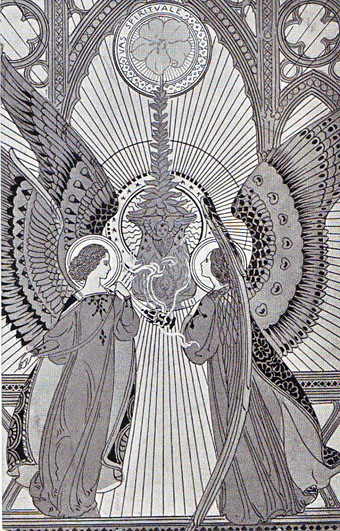
An illustration by Alberto Martini for Raw Edges (1908) by Perceval Landon.

NASA’s cover designs for Space Program manuals, guidebooks, press kits, reports and brochures.

PingMag—”Art, Design, Life – from Japan”—makes a welcome return as an active blog.

Suzanne Treister‘s Hexen 2.0 Tarot designs.

Listening to records that no longer exist

The architectural origins of the chess set

The Bohemian Realm of Absinthiana

Les sources d’une île: a Tumblr

Hammer Without A Master (1998) by Broadcast | Test Area (1999) by Broadcast | Make My Sleep His Song (2009) by Broadcast & The Focus Group

Jiří Barta’s Pied Piper

barta1.jpg

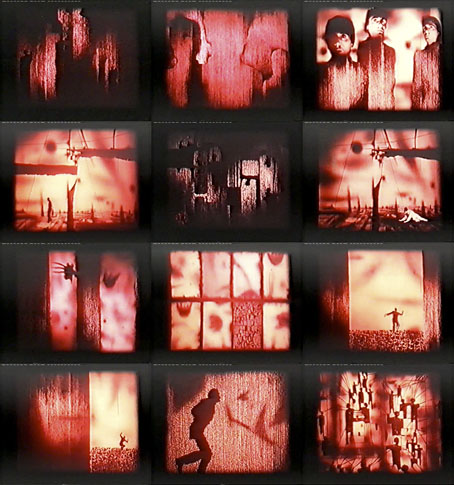
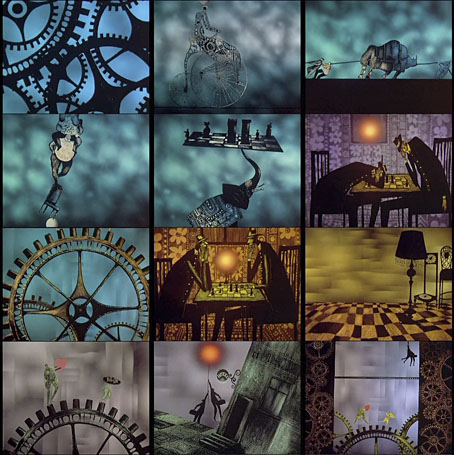
The last time I mentioned Jiří Barta’s extraordinary animation of the Pied Piper story there were only short clips on YouTube. That was several years ago, in which time the 53-minute film has been posted in its entirety. Barta pulls the tale away from its sanitised derivations back to its darker origins in the folk mythology of Central Europe; he also gives the end of the story a twist which I won’t reveal here. The characters are almost all angular wooden figures, while their rat-infested town is constructed from the disjunctive perspectives of German Expressionism. The whole effect is so successful it makes you wish even more that Barta might have completed his feature-length version of the Golem story.

barta2.jpg

Previously on { feuilleton }
Gloves
More Golems
Barta’s Golem

René Bull’s Rubáiyát

bull00.jpg

One of the more obscure artists from the Golden Age of the illustrated book, finding this volume by René Bull (1872–1942) makes up for my earlier dismissal of his Arabian Nights where the illustrations tend towards the comical. This volume dates from 1913, and shows Bull to be a fine exponent of Edwardian Orientalism. Browse the rest of it here or download it here.

bull01.jpg

bull02.jpg

bull03.jpg

bull04.jpg

Continue reading “René Bull’s Rubáiyát”

Hodgsonian vibrations

utpatel.jpg

Illustration by Frank Utpatel from the 1947 Arkham House edition of Carnacki, the Ghost-Finder.

“Presently I got hold of myself a bit, and marked out a pentacle hurriedly with chalk on the polished floor; and there I sat in it almost until dawn. And all the time, away up the corridor, the door of the Grey Room thudded at solemn and horrid intervals. It was a miserable, brutal night.”

The Gateway of the Monster (1913) by William Hope Hodgson

“Word falling – Photo falling – Time falling – Break through in Grey Room”

The Ticket That Exploded (1962) by William S. Burroughs

Among other things, 2013 is the centenary of the first book publication of William Hope Hodgson’s collection of weird tales, Carnacki, the Ghost-Finder, and while I don’t believe that William Burroughs was referring to the supernatural eruption that occurs in Hodgson’s Grey Room it would be remiss of me to ignore the connection. Listening this week to Music for Thomas Carnacki by Jon Brooks (he of The Advisory Circle) had me wondering whether there’s any other Hodgson-derived music of note. Lovecraft has inspired hours of musical endeavour while Hodgson’s weird contemporaries, Algernon Blackwood and Arthur Machen, are referenced on some of the Ghost Box releases. Hodgson is the poor relation in these celebrations, often passed over despite the sonic potential of Carnacki stories such as The Whistling Room, The Horse of the Invisible, and especially The Hog, a tale whose manifestations are almost wholly perceived through the medium of sound. Searching around turned up the following examples.

tactile.jpg

Borderlands (1999) by Tactile.

The House on the Borderland is the big favourite in this list, this album being a series of tracks by John Everall based on Hodgson’s novel. John Balance of Coil appears on the first track, Grief, reading the poem which opens the book.

Continue reading “Hodgsonian vibrations”