Burt Shonberg’s Poe paintings

usher1.jpg

House of Usher (1960): Vincent Price and Mark Damon.

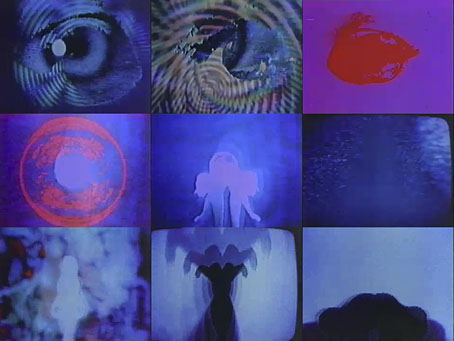
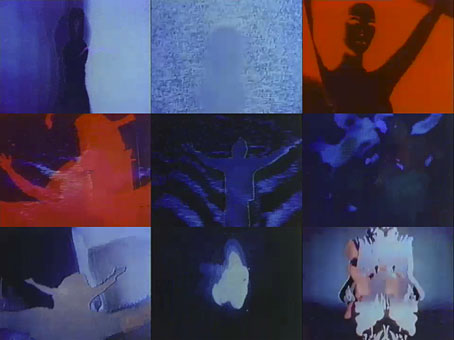
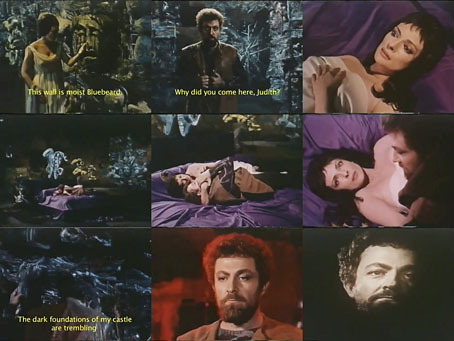
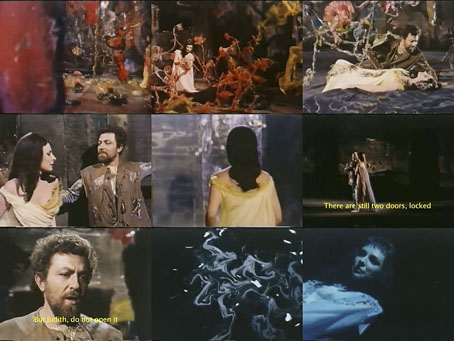
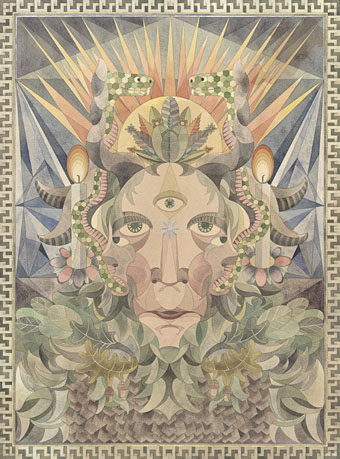
This post ought to have followed the one in January about the sinister portraits glimpsed in Roman Polanski’s Dance of the Vampires. I still don’t know who was responsible for those paintings but the artist who created the equally outré family portraits in Roger Corman’s House of Usher (1960) was credited for his work. Burt Shonberg (1933–1977) was a friend of Corman’s who had to produce the six portraits at speed (the entire film was shot in fifteen days) so the results are sketchier than they might have been in a production with a bigger budget. I always liked the anachronism of these pictures, the way they look very much of their time; the effect is a jarring one that adds a note of much-needed strangeness to Corman’s otherwise sparse interiors.

usher2.jpg

Shonberg was a curious artist, the gallery page on his website shows a progression from Picasso-style early works in the 1950s to his own brand of mystical psychedelia. Some of his paintings from around the time of House of Usher have that stained-glass fragmentation one finds in the work of Leo & Diane Dillon from the same period. Shonberg’s biography says Corman used more paintings in The Premature Burial (1962) but I don’t have a copy of that to hand and haven’t found any examples. There’s also the detail that Shonberg was involved for a while with Marjorie Cameron, herself an artist who appeared as the mysterious “Water Witch” in another AIP production, Curtis Harrington’s Night Tide, a year after House of Usher.

usher3.jpg

usher4.jpg

Continue reading “Burt Shonberg’s Poe paintings”

Le Cantique des Cantiques

kupka1.jpg

An oddity from the career of František Kupka, Le Cantique des Cantiques (1905) in this version is a stage presentation of the Song of Solomon by Jean de Bonnefon. Kupka provided a series of illustrations in a style similar to his Symbolist paintings which in the original printing are decorated with coloured borders. The copies here are from a bad scan at Gallica whose page I’ve been unable to find again. For the moment there are better copies to be seen at eBay. The drama is very much oriented towards the sexual exotica which Oscar Wilde had rendered notorious in Salomé, and which underpins so many of the obsessions of the period. A few years after this Kupka was in a different world entirely, following new directions into abstract art.

kupka6.jpg

kupka5.jpg

kupka3.jpg

Continue reading “Le Cantique des Cantiques”

Paolo Soleri, 1919–2013

soleri1.jpg

Hexahedron, The City in the Image of Man (1969).

“We must build up, not out,” said Soleri. “The problem is the present design of cities are only a few storeys high, stretching outward in unwieldy sprawl for miles…turning farms into parking lots, and waste enormous amounts of time and energy transporting people, goods and services over their expanses.”

Paolo Soleri, visionary architect, dies aged 93

For obvious reasons, Paolo Soleri’s plans for kilometre-high megastructure cities towering over green landscapes were popular in science fiction books and magazines in the 1970s. Soleri’s solution to unstoppable urban sprawl seems eminently sensible despite the difficulties of building anything on this scale; complaints about undesirability can be countered (in Britain at least) with dismal stories such as this recent report. Or maybe it’s better to live in a Hong Kong shoebox? Soleri devoted most of his life to thinking about how architecture could better serve our limited planetary resources; with Arcosanti he was leading by example.

• LA Times: Paolo Soleri, architect of innovative city Arcosanti, dies at 93
• Arch Daily: Paolo Soleri’s Arcosanti : The City in the Image of Man
Architect Paolo Soleri – a life in pictures
• Flickr: Arcosanti, An Urban Laboratory

soleri2.jpg

Babel IIB, The City in the Image of Man (1969).

Previously on { feuilleton }
The paper architecture of Brodsky and Utkin
Hugh Ferriss and The Metropolis of Tomorrow

The Web by Joan Ashworth

theweb.jpg

Another animated gem, The Web (1987) is an eighteen-minute film based on Mervyn Peake’s Gormenghast novels which dramatises the lethal duel between Flay and Swelter. Director Joan Ashworth reduces the cast to manservant, cook, and bedridden earl, no doubt for reasons of economy since the film was originally a student work. Economy or not, for me this has always captured more of the flavour of the books than the BBC’s well-intended but ultimately unsatisfying television adaptation. Watch The Web here.

Previously on { feuilleton }
Peake’s glassblowers
Mervyn Peake in Coronation Street
The Worlds of Mervyn Peake
A profusion of Peake
Mervyn Peake at Maison d’Ailleurs
Peake’s Pan
Buccaneers #1
Mervyn Peake in Lilliput
The Illustrators of Alice

Memories

scarfe1.jpg

Untitled cartoon by Gerald Scarfe (early 1980s).

Margaret Thatcher saved career of police chief who made Aids remarks

Margaret Thatcher helped save the career of a police chief constable who said Aids patients lived in a “human cesspool of their own making”, newly-released documents show.

THE TELEGRAPH, 04 Jan 2012

Sir James Anderton, then chief constable of Greater Manchester Police, faced calls to quit after making the comments, which were perceived as homophobic.

Now documents secured by the Manchester Evening News give an incredible insight into the 1986 political storm – and show how close the country’s second largest police force came to meltdown.

It can revealed that the government staged a series of crisis meetings aimed at keeping Sir James in post, and that other chief constables accused Sir James of ‘bringing ridicule’ on the police service.

The papers also show that senior civil servants were dismayed over the top cop’s ‘religious overtones’ and feared he had a ‘taste for martyrdom’, but that Mrs Thatcher, the then Prime Minister, privately backed Sir James’s right to speak out – and stamped down demands for a public inquiry into the state of the force. (more)

scarfe2.jpg

Belgrano Nightmare – Thatcher Wakes Screaming (1982) by Gerald Scarfe.

bell.jpg

Cartoon by Steve Bell (2000).