Eugène Grasset’s calendar

grasset01.jpg

I was going to post a few more paintings depicting the month of February but now I’ve circled the calendar with the monthly theme suitable candidates are harder to find. Searching wasn’t a waste of time, however, since I turned up a complete set of the prints by Art Nouveau designer Eugène Grasset (1845—1917) that depict the months of the year. Some of these have appeared here before but I’d not seen a complete set until now. Grasset was commissioned by the Parisian department store La Belle Jardinière in 1894 to produced twelve artworks to be used as a calendar. The portfolio was published as The Months in 1896. The prints also serve as zodiac when you notice that each woman has an astrological symbol on her clothing. See them at larger size here.

grasset02.jpg

grasset03.jpg

Continue reading “Eugène Grasset’s calendar”

Listen to the Colour of Your Dreams: Part Six

usa.jpg

The United States of America, 1968. Back, left–right: Joseph Byrd, Dorothy Moskowitz, Gordon Marron; front, left–right: Ed Bogas, Craig Woodson, Rand Forbes.

Concluding the psychedelic mega-mix based on Jon Savage’s list of “100 mind-expanding masterpieces” (see this post). The last of the six mixes is the third visit to the USA, and features songs from the years 1968 to 1969 arranged in chronological order. As before, the selections from the Savage 100 are in bold, and I’ve added notes about my additions or amendments.

The most notable deviation from Savage’s list in this final collection is the substitution of Lothar and the Hand People for two other groups combining psychedelic music with electronic sounds, Fifty Foot Hose and The United States Of America. Lothar and the Hand People were so named because of their use of theremins; they’re often described as electronic pioneers but I’ve never liked their music very much or thought it was as inventive as people claim. Fifty Foot Hose and The United States Of America are better on all levels, the self-titled USA album is a masterpiece that proved an inspiration for Portishead (listen to Half Day Closing) and Broadcast.

Savage ended his UK list with Can’t Find My Way Home, a song that captured the come-down feeling after the psych fireworks were over. The US list lacked an equivalent resolution, hence the choice of Wooden Ships; where Blind Faith’s lament is a personal one, Jefferson Airplane offer something more global, a pessimistic vision of the future that you can tie to all the other crashing dreams of 1969. It’s also a great song, and a fitting way to bring everything to a close.

US Psychedelia, Part Three by Feuilleton on Mixcloud

Radio news — Grateful Dead drug bust
The Grateful Dead — That’s It For The Other One
Nazz — Open My Eyes (The first single by a band with Todd Rundgren on guitar, and another song from the original Nuggets collection.)
Iron Butterfly — In-A-Gadda-Da-Vida
Fifty Foot Hose — If Not This Time (One of several songs whose unusual chord progressions—some of them inspired by Schoenberg—set them apart from their contemporaries.)
Steppenwolf — Magic Carpet Ride
The Steve Miller Band — Song For Our Ancestors
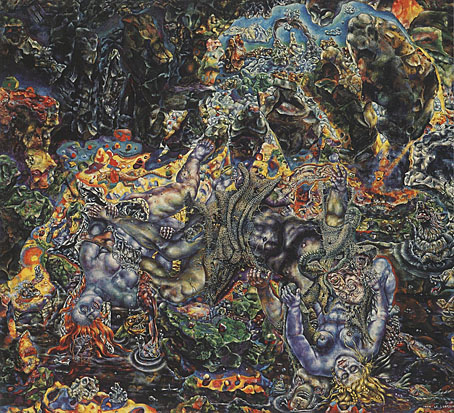
The United States Of America — The Garden Of Earthly Delights (A paean to poisonous love with a title borrowed from Bosch.)
Tommy James And The Shondells — Crimson And Clover
White Lightning — William
Spirit — Dream Within A Dream
Skip Spence — War In Peace
The Youngbloods — Darkness, Darkness
Kak — Electric Sailor
Kaleidoscope (US) — Lie To Me (A last nod to the psychedelic sound from an album very aptly entitled Incredible!)
The Grateful Dead — Mountains Of The Moon
Jimi Hendrix — The Star Spangled Banner
Jefferson Airplane — Wooden Ships

Previously on { feuilleton }
Listen to the Colour of Your Dreams: Part Five
Listen to the Colour of Your Dreams: Part Four
Listen to the Colour of Your Dreams: Part Three
Listen to the Colour of Your Dreams: Part Two
Listen to the Colour of Your Dreams: Part One
What Is A Happening?
My White Bicycle
Ogdens’ Nut Gone Flake
Tomorrow Never Knows
The Dukes declare it’s 25 O’Clock!
A splendid time is guaranteed for all

Weekend links 245

htbag.jpg

First English-language edition of Hard to Be a God, 1973. Cover design by Alan Peckolick.

A group of scientists is sent to the planet Arkanar to help the local civilization, which is in the Medieval phase of its own history, to find the right path to progress. Their task is a difficult one: they cannot interfere violently and in no case can they kill. The scientist Rumata tries to save the local intellectuals from their punishment and cannot avoid taking a position. As if the question were: what would you do in God’s place?

Hard to Be a God is a 170-minute Russian science-fiction film based on a novel by Arkady & Boris Strugatsky, the authors of Roadside Picnic. The film was the magnum opus of director Aleksey German (1938–2013) who died shortly before post-production was complete. German’s wife and son finished the film.

“…the wonder about this exhausting, astonishing film is not that it took so long to make, it’s that it got made at all,” says Gabriel Winslow-Yost; “one of the most consistently disgusting films ever made,” says Glenn Kenny, “…not only an unforgettable individual masterpiece but probably one of the capital-G Great Films.”; “There are no bones to be made about it, Hard to Be a God is a modern masterpiece,” says Matt Thrift.

This pushes all of my cinematic buttons, of course, so now I’m itching to see it. YouTube has trailers, and (if you must) you can also find the entire film without subtitles. I’d rather wait for a disc version. Meanwhile, Chicago Review Press have republished the novel with a new translation by Olena Blumberg and a foreword by Hari Kunzru.

• At the Guardian John Doran recommends new Middle Eastern and North African music; the playlist includes a song from the forthcoming album by Melechesh which features my cover art. At the Quietus this week Doran explored Manchester’s urban wastelands with local musician Julie Campbell aka Lonelady.

• “Research into psychedelics, shut down for decades, is now yielding exciting results,” says Michael Pollan. Related: Ryan Cooper on why the [US] government should be funding mass scientific studies of Ecstasy, magic mushrooms, and LSD, and “Early humans used magic mushrooms, opium“.

Dad combined porn with all manner of genre fiction. He wrote pirate porn, ghost porn, science-fiction porn, vampire porn, historical porn, time-travel porn, secret-agent porn, thriller porn, zombie porn and Atlantis porn. An unpublished Old West novel opens with sex in a barn, featuring a gunslinger called Quiet Smith, without doubt Dad’s greatest character name. By the end of the decade, Dad claimed to have single-handedly raised the quality of American pornography.

Chris Offutt on the prolific writing career of his father, Andrew Jefferson Offutt V

The Sound Repository 2 by Wizards Tell Lies, a free collection of “rare tracks, demos, early and alternative versions” at Bandcamp.

Jennifer Rothwell‘s new fashion collection uses prints based on Harry Clarke’s stained-glass windows.

• Mix of the week: My Body Full Of Stars, an Afrofuturism mix by Oyinboy.

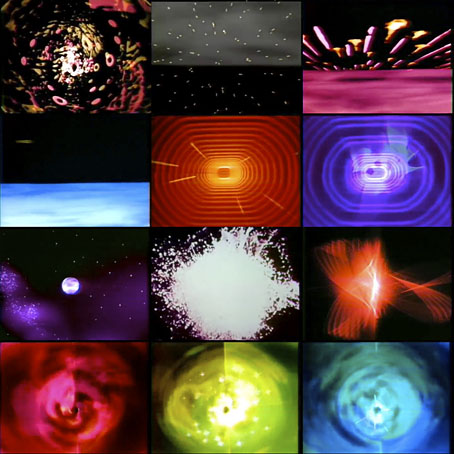
Terry Gilliam’s title sequence for Cry of the Banshee (1970).

Endless Endless: Kraftwerk at Tumblr.

Sehr Kosmisch (1974) by Harmonia | Walky-Talky (1975) by Harmonia | Sometimes In Autumn (1976) by Harmonia 76

German gear

Ralf and Florian, 1973. Back cover photo by Barbara Niemöller.

At that time, Kling Klang Studio was far from the technological hub it would become. “The studio was a big room in an old factory building with brick walls,” recalls [Wolfgang] Flür. “There were big home-made speakers, amplifiers and so on. Florian had his side, with his flutes and one of the very first ARP Odyssey synthesizers, while Ralf’s side had Hammond and Farfisa organs and a Minimoog synthesizer.”

Andy Gill, Mojo magazine, April 1997

Last week’s Autobahn post prompted a week of revisiting Kraftwerk’s three pre-Autobahn albums, all of which remain unreissued. The photo that fills out the back cover of the third album, Ralf & Florian (1973), has appeared here twice before so if you want an example of an obsession look no further. I only have a bootleg CD of this one, a package that doesn’t do much for the photograph so I went searching for a larger copy.

ralf.jpg

The attractions, if you have to list them, are multiple: Ralf & Florian is Kraftwerk’s most human album, and the cover photos reflect this. Trans-Europe Express originally had pictures of the group on its sleeve (now replaced by the TEE train) but they were airbrushed, idealised portraits; the showroom-dummy personas they adopt there would turn into robots on the album that followed. There’s an overt sense of camp about the Ralf & Florian cover shots that runs counter to the tenor of rock music in 1973. The charts in Britain might have been filled with glam acts but for all their flirtatious androgyny they were selling the same assertive macho sexuality as the big rock bands of the time. One of the things I enjoy about this cover photo is its refusal to follow that crowd: the neon name signs, the standard lamp from a 1950s’ living room, Florian’s semiquaver brooch; all are effete enough to give Deep Purple the vapours. (The first UK release of Ralf and Florian replaced the cover photo of the pair with a printed circuit.) The closest comparison in the same year would be the sleeve for Brian Eno’s Here Come The Warm Jets with its shelves of dead flowers and junk-shop discoveries. But this wasn’t so surprising for an ex-member of Roxy Music, and Eno’s album is still very much a rock production.

florian.jpg

Then there’s the details: the egg-box soundproofing (Can used old mattresses to soundproof their studio); the enormous white speaker; the traffic cone that nods back to the sleeves of the first two albums and forward to the automotive theme of the next; Ralf’s white shoes (and is he wearing leather trousers?); Florian’s oscilloscope, his mysterious tone generators and that peculiar stringed instrument. This diverse range of gear somehow produced the music you’re listening to.

Continue reading “German gear”

John Austen’s Tales of Passed Times

austen01.jpg

The retellings of old folk tales by Charles Perrault (1628–1703) became the earliest examples of what we now call fairy tales, but Perrault’s versions of Little Red Riding Hood, Puss in Boots, Sleeping Beauty, Cinderella et al have tended to be overshadowed by the more copious works of the Brothers Grimm and their followers. Perrault has attracted illustrators, however, including major figures such as Gustave Doré and Harry Clarke. This edition by John Austen is one of the artist’s earliest books dating from 1922. Perrault collections are often short; this one is only 74 pages but Austen fills the book with many small illustrations and vignettes. It’s a surprise seeing his work in colour when the more familiar drawings are all striking black-and-white. Spot colours help highlight Little Red Riding Hood’s outfit and Bluebeard’s beard. See the rest of the book here or download it here. (Thanks again to Nick for the tip!)

austen02.jpg

austen03.jpg

austen04.jpg

Continue reading “John Austen’s Tales of Passed Times”