Weekend links 439

sadismo.jpg

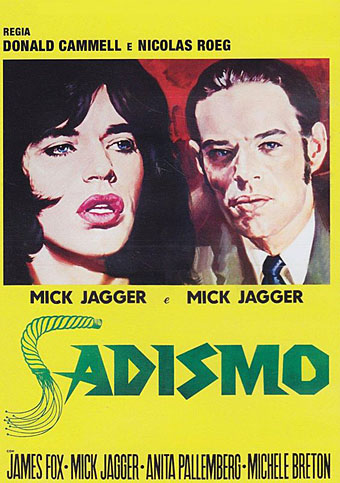
Cammell & Roeg’s Performance (1970) was marketed in Italy with all the restraint for which the Italian film industry has long been celebrated.

• “To the good men I offer the hand of friendship, to the foes of our sex I offer resistance and annihilation!” We Women Have no Fatherland (1899), a novel by Ilse Frapan, is the latest title from Rixdorf Editions.

• More Edward Gorey: Mark Derey discusses his biography on the Virtual Memories Show podcast. Related: Edward Gorey’s Calling Cards, a spoiler-heavy investigation.

• “It starts how most horror films end, and it just keeps building and building, crescendo on crescendo…” Ben Cobb on the original (and, for me, only) Suspiria.

• The next compilation release from the excellent Light In The Attic label will be Kankyo Ongaku: Japanese Ambient, Environmental & New Age Music 1980–1990.

Saint Flournoy Lobos-Logos and the Eastern Europe Fetus Taxing Japan Brides in West Coast Places Sucking Alabama Air (1970) is a short film by Will Hindle.

• Film producer Sandy Lieberson and author Jay Glennie on Donald Cammell & Nicolas Roeg’s Performance.

• “Wes Anderson‘s offbeat debut as a curator drove a storied museum’s staff crazy. The results are enchanting.”

Above Water, Inside, a video by James Ginzburg from his recent album, Six Correlations.

• For the LRB Podcast: Iain Sinclair and Patrick Wright discuss living with buildings.

• Not necessarily the best ambient and space music of 2018: a list by Dave Maier.

• “The net is not a good guide to book prices,” says Mark Valentine.

David Bennun on 30 years of the Pet Shop Boys’ Introspective.

• Mix of the week: XLR8R Podcast 568 by Young Marco.

• At Dennis Cooper’s: Chris Marker Day.

Introspection Pt. 1 (1969) by The End | Introspection (1984) by Minimal Compact | Intro-Spectiv (1996) by Chris & Cosey
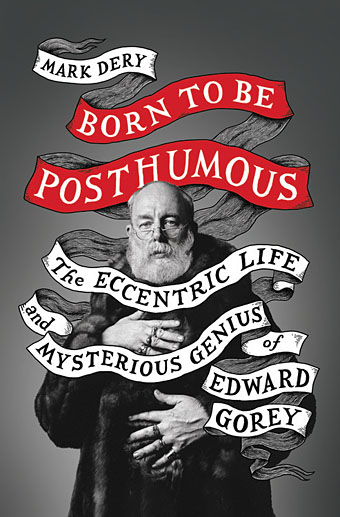
Born to be Posthumous: The Eccentric Life and Mysterious Genius of Edward Gorey

dery.jpg

Cover design by Jim Tierney; photo by Richard Corman.

When so many current biographies are recounting the lives of those about whom we’ve already heard a great deal (see the new biography of Oscar Wilde by Matthew Sturgis), a book exploring the career of a previously undocumented yet worthwhile figure is especially welcome. Such is the case with Born to Be Posthumous, Mark Dery’s life of the elusive Edward Gorey: artist, writer, illustrator, book designer, book creator, bibliophile, theatre designer, cat lover and balletomane.

gorey5.jpg

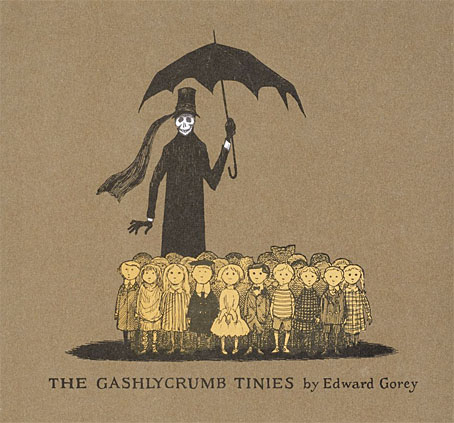
The Gashlycrumb Tinies (1963).

Gorey’s small books have long been one of the more curious fixtures of American culture: many of them look like children’s books but aren’t (unless the child is Wednesday Addams); others look like comic books but they aren’t comics either. The books are sometimes (but not always) Surrealist fables; or brief accounts of irreducible mystery; or sombre inexplicabilities; or camp ripostes to the pieties of Victorian morality; infrequently spiced with black humour and with lurches into outright horror. Gorey delivered his miniature tales in an idiosyncratic drawing style that combines a cartoon-like stylisation with the density of shading found in old wood engravings, a blend that would prove influential as his popularity grew. As Dery notes in his book’s introduction, without Edward Gorey’s work there would be no Lemony Snicket, while Tim Burton would be a skeletal shadow of his present self. (Given the latter’s current output, this might do him some good. But I digress.)

gorey4.jpg

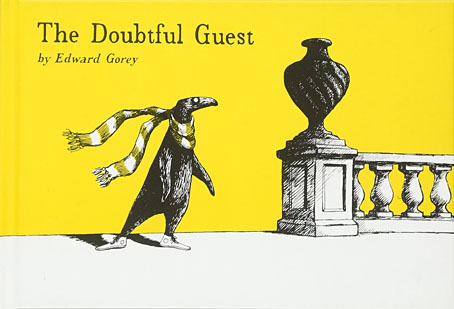
The Doubtful Guest (1957).

In Britain, however, Gorey remains a cult rather than cultural figure, still overshadowed by better-known contemporaries such as Maurice Sendak and Charles Addams. Until the publication of the Amphigorey story collections Gorey’s books were produced in small editions with such a limited availability you were more likely to encounter his art on the cover of another author’s book than within the pages of his own. I became aware of Gorey’s work by gradual osmosis. The first substantial piece I read about him was his entry in Philip Core’s Camp: The Lie that Tells the Truth (1984), in which Core’s mention of an art style “recollecting Victorian engravings” marked Gorey as an artist to be investigated. Two years later he received a longer entry in The Penguin Encyclopedia of Horror and the Supernatural edited by Jack Sullivan. (Camp and horror: how many other artists sit so easily in both worlds?) But Gorey is absent from many books about 20th-century illustrators, and despite the sequential nature of his work you won’t find him in histories of comic art.

gorey6.jpg

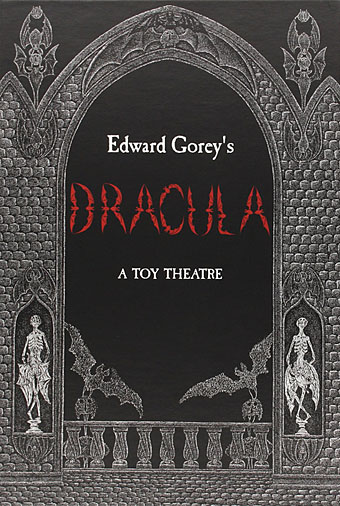
Edward Gorey’s Dracula: A Toy Theatre (1979).

In a way it’s fitting that the work of a man who was adamant in his determination to avoid being pinned down should be so difficult to find. But it’s also a shame that the work of an ardent Anglophile should be hard to find in the country that fuelled his imagination. Among Gorey’s literary favourites Dery lists Jane Austen and Agatha Christie together with Ronald Firbank, Saki, and EF Benson’s Mapp and Lucia novels. (The latter trio are all present in Core’s book on camp, which no doubt makes Gorey camp to the core. Whether he would have approved of being labelled as such is another matter.) I wasn’t surprised by the mention of Saki when so many of Saki’s story titles (The Secret Sin of Septimus Brope) sound like Gorey books, while many of the stories themselves are like Gorey scenarios in prose. Not all Gorey’s work is camp or comic, however; the 32 drawings that comprise the wordless masterpiece of The West Wing (1963) are closer to David Lynch or the “strange stories” of Robert Aickman, the latter an author that Gorey illustrated on several occasions. Dery emphasises how Gorey’s love of silent cinema contributed to The West Wing and other pieces, especially the serials of the Surrealists’ favourite filmmaker, Louis Feuillade.

Continue reading “Born to be Posthumous: The Eccentric Life and Mysterious Genius of Edward Gorey”

Weekend links 438

awazu.jpg

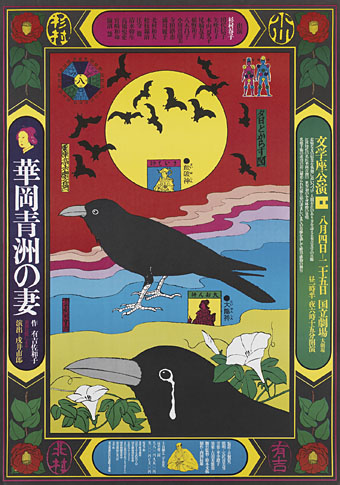
Seishu Hanaoka’s Wife (1970) by Awazu Kiyoshi.

Hoodoo, Conjuration, Witchcraft & Rootwork: a colossal new addition to the Internet Archive, being a 5-volume, 4766-page collection of folkloric material gathered by Harry Middleton Hyatt in Alabama, Arkansas, Florida, Georgia, Illinois, Louisiana, Maryland, Mississippi, North Carolina, South Carolina, Tennessee, and Virginia between 1936 and 1940.

• Edward Gorey is the theme du jour, so here’s some more: Gorey’s 1977 appearance on The Dick Cavett Show is revelatory, especially if you’ve never seen him talking before. Meanwhile, Laughing Squid has a previously unpublished interview in which Gorey discusses his love for his disruptive cats.

• Jeff Nuttall’s mid-century survey of the aesthetic underground, Bomb Culture, receives a fiftieth anniversary republication by Strange Attractor. The new edition is edited by Douglas Field and Jay Jeff Jones, with a foreword by Iain Sinclair and an afterword by Maria Fusco.

I have always questioned identity politics with my work. I often have characters that engage in homosexual sex but do not identify as gay (hustlers, neo-Nazi skinheads, extreme left wing revolutionaries, gerontophiles, etc.). But my films have also always been inclusive in terms of race, class, and gender. I find that the new emphasis on identity politics has really narrowed creative expression. It demonstrates a profound ignorance about sexuality, history, and human experience.

My sexual identity is pretty much fixed—I’m a Kinsey 6, if not a 7—but I acknowledge that this means I’m sexually repressed. I believe, after Freud, that everyone has some bisexual potential, and the tendency to increasingly entrench gender identity as innate and immutable is really preposterous. It also leads to strict rules about sexual representation—how gays, lesbians and transgender people “must” be portrayed, the policing of representation, a kind of proprietary stance about who is allowed to portray these characters.

It really boils down to a naivety about sexuality, and a complete failure of the imagination. It discourages people who may have the potential for some kind of sexual fluidity to express themselves. I’ve always been a “bad gay,” but now this political correctness has made me feel even more alienated from the notion of “gay identity”—particularly since the new assimilationist model is so conservative and dull.

Filmmaker Bruce LaBruce discussing art, porn and politics with Hoçâ Cové Mbede

• “Who is Barbara Baranowska? Despite the so-called Polish Poster School’s fame, certain people were seemingly forgotten. Perhaps they even wanted it that way…” Daniel Bird on an elusive artist. Related: Selected works by Barbara Baranowska.

• “I don’t think I’m ever mean-spirited and I try to understand human behaviour even though it’s impossible,” says John Waters.

Nine Dimensional Synod Of Oblique Pleasures is a very welcome new release by The Wyrding Module.

Galerie Dennis Cooper presents…The Resplendent Illegibility of Extreme Metal Logos.

Apocalypse Burlesque — Tales of Doomsday Eros: a new book by Supervert.

Rare booksellers rallied against an Amazon-owned company and won.

B. Alexandra Szerlip on the 80-year history of the ballpoint pen.

Anjelica Huston: how we made The Addams Family.

• Mix of the week: Secret Thirteen Mix 270 by Okkre.

The Cabinet of the Quay Brothers

Hoodoo Man Blues (1965) by Junior Wells’ Chicago Blues Band | Evil Hoodoo (1966) by The Seeds | I Been Hoodood (1973) by Dr John

The Corn Mother

cornmother.jpg

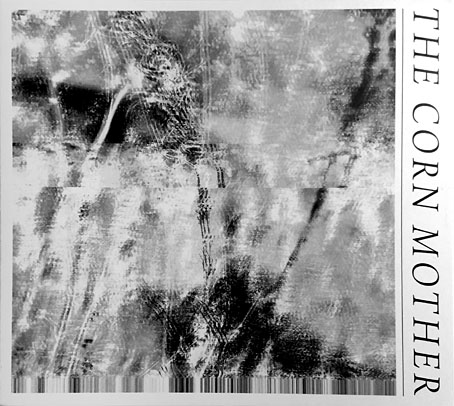
The latest release from A Year In The Country is the first to arrive as a manufactured compact disc rather than a hand-made artefact. Following the example set by The Shildam House Tapes, The Corn Mother is another soundtrack for a lost film (or a reflection of the same), suggesting that this is now an ongoing series within the body of AYITC releases. The film in question is, like its predecessor, a legended horror feature from the past, with a difficult production, few screenings, and a long train of rumour and mystery:

In the early 1970s a folk horror-esque screenplay made the rounds of the film industry but remained unmade until 1982.

The story is set in the late 19th century in a rural British village and revolves around the folklore of the “corn mother” – where the last row of the corn harvest is beaten to the ground by the reapers as they shout “There she is! Knock her into the ground, don’t let her get away!”, in an attempt to drive the spirit of the corn mother back into the earth for next year’s sowing. […] Through related second, third and more-hand reports and interpretations of the different versions of the screenplay, it has been suggested on the one hand that The Corn Mother was a typical direct-to-video piece of exploitation fare designed to take advantage of a rapidly-expanding home video market, and on the other that while the film does indeed contain elements of such things, it is actually nearer to a folkloric fever dream and closer in spirit to arthouse experimentalism than B-movie schlock.

Track list:
1) Gavino Morretti—Ritual and Unearthly Fire
2) Pulselovers—Beat Her Down
3) The Heartwood Institute—Corn Dolly
4) United Bible Studies—From The Last Sheaf On The Braes
5) A Year In The Country—The Night Harvest
6) Depatterning—The Keeper’s Dilemma
7) Widow’s Weeds—The Corn Mother
8) Sproatly Smith—Caught In The Coppice
9) Field Lines Cartographer—Procession At Dusk

Reading the description reminds me of the similarly elusive and sinister films that are the subject of Theodore Roszak’s novel, Flicker (1991). Roszak’s novel is flawed but the scenario is a fascinating one, especially his description of the films made by enigmatic Hollywood director Max Castle. These recent soundtrack collections by A Year In The Country suggest an equally occluded (and possibly occult) history for British cinema of the 1970s and 80s, a proposal which was explored from a different angle by Emily Jones and The Rowan Amber Mill in The Book Of The Lost (2013). The Corn Mother is more overtly sinister than The Book Of The Lost, the music (and some songs) being suitably guitar-led folk pieces interleaved with passages of doom-laden electronics. I haven’t been as enthused by The Corn Mother as I was with The Shildham Hall Tapes but this is more down to my feeling somewhat exhausted by the folk-horror trend than with the individual contributions (I also like haunted houses). Gavino Moretti who provided such a marvellous opening to The Shildham Hall Tapes returns here with another opening theme that sets the mood before dissolving into a fog of mutated cries and shrieks. Halloween may be over but its spell for me always lingers through November, and albums such as this are especially suited to chill days, early twilights and long, dark nights.

The Corn Mother will be available for pre-order from 12th November.

Previously on { feuilleton }
The Quietened Mechanisms
The Shildam Hall Tapes
Audio Albion
A Year In The Country: the book
All The Merry Year Round
The Quietened Cosmologists
Undercurrents
From The Furthest Signals
The Restless Field
The Marks Upon The Land
The Forest / The Wald
The Quietened Bunker
Fractures

Weekend links 437

watson.jpg

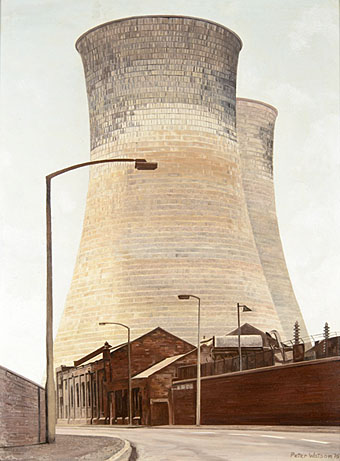
Rawmarsh Road, Rotherham, 1975 by Peter Watson.

Steel Cathedrals (1985), a composition by David Sylvian (with Ryuichi Sakamoto, Kenny Wheeler, Robert Fripp & others) was originally available only on the cassette release of Sylvian’s Alchemy: An Index Of Possibilities, and a video cassette where the music accompanied views of Japanese industry by Yasuyuki Yamaguchi. The video hasn’t been reissued since but may be viewed here.

• “If, as Arthur C Clarke famously observed, any sufficiently advanced technology is indistinguishable from magic, then can we accept that any sufficiently advanced magic is also indistinguishable from technology?” asks Mark Pilkington.

• “I didn’t like the idea of cartoons as just funny jokes, they had to have some relevant piece of observation in them to do with the society we are living in,” says Ralph Steadman.

I listen to music all the time, and I’ll often seek connections across quite disparate genres of that whatever I’m looking for. Sometimes it’s an aesthetic or a feeling, sometimes a pattern or structure, but it tends to cut across genres. The thing I liked about black metal and doom metal is the slowness and weightiness of it, it’s like deep time but in music. Sunn O))), Xasthur, and other bands captured this black gravity of sound. And they also tend to eschew the traditional vocal-lead guitar set-up, and everything is in the slow-moving wash and texture of sound.

I found that in other genres like noise music (especially Keiji Haino), the European avant-garde with composers like Ligeti, Scelsi, and Dumitrescu, dark ambient artists such as Lustmord or vidnaObmana, and contemporary works like Chihei Hatakeyama’s Too Much Sadness, Rafael Anton Irisarri’s A Fragile Geography, or Christina Vantzou’s No.4. There’s a lot to talk about in terms of music and forms of sorrow or grief, certainly every musical tradition has that—the funeral dirge, requiem, lamentation, or whatever.

Eugene Thacker listing a few favourite musicians and composers during a discussion with Michael Brooks about Thacker’s new book, Infinite Resignation

• The fourth edition of Wyrd Daze—”The multimedia zine of speculative fiction + extra-ordinary music, art & writing”—is out now.

• The Library of Congress has opened its National Screening Room, an online service for viewing films in the library’s collection.

The London Library discovered some of the books that Bram Stoker used for research when he was writing Dracula.

• “Oscar Wilde’s stock has never been higher,” says John Mullan, reviewing Oscar: A Life by Matthew Sturgis.

• Mixes of the week: RA Podcast 648 by Sarah Davachi, and Secret Thirteen Mix 269 by Sstrom.

• David Lynch directs a video for A Real Indication by Thought Gang.

• “Edward Gorey lived at the ballet,” says his biographer, Mark Dery.

• A new version of Blue Velvet Blues by Acid Mothers Temple.

• Photos of cooling-tower interiors by Reginald Van de Velde.

Aaron Worth on Arthur Machen: “the HG Wells of horror”.

• The Strange World of…Barry Adamson.

Glass And Steel No. 1 (1983) by Marc Barreca | Death Is The Beginning (1996) by Steel | Painless Steel (2000) by Bohren & Der Club Of Gore