Weekend links 299

blanco.jpg

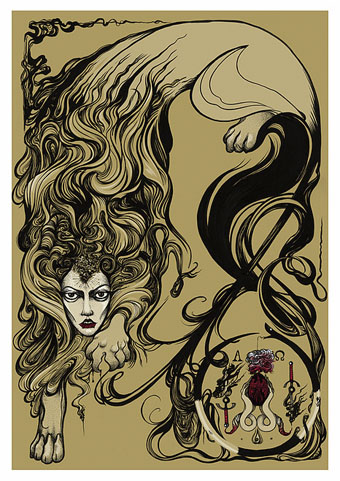
Starman (2016) by Nyahzul Blanco. From the Saint Bowie exhibition at Stephen Romano Gallery, NY.

• “…[Dashiel] Hammett’s first-hand experience of political sleaze, industrial violence and the everyday routine of an agent allowed for a realism that brought hard-boiled fiction to new heights.” Oliver Harris reviews a new life of Hammett, a history of the American detective, and a study of film noir.

• Mixes of the week: Secret Thirteen Mix 177 by Vladislav Dobrovolski, The After-School Club by Melmoth The Wanderer, and Perfect Monolake by Rich Ears.

Inside High-Rise: product designs by Michael Eaton and Felicity Hickson for Ben Wheatley’s feature film.

Yeats is not the only respected writer to make use of the tarot: Italo Calvino, Salvador Dalí, and even Charles Williams, a novelist and theologian who belonged to the Inklings literary circle, also drew on the cards. Still, the cards remain firmly associated with the occult—and, while [Jessa] Crispin is sympathetic to that tradition, she aims to bring tarot to those who may be skeptical of that way of thinking. Her references are more literary than arcane.

Peter Bebergal talks to Jessa Crispin about making the Tarot literary again

Legowelt’s best free paranormal synth samples, occult instruments and lo-fi effects.

• At Dangerous Minds: a smorgasbord of sorcerous bad taste via Vintage Occult.

• Free download: Cavern of Anti-Matter live at Acad, Berlin, 2015.

• Conversing with your Subconscious: The Art of Adrian Cherry.

Diagonal Science is the debut album from Black Helicopters.

111 Photographs of 111 Westminster Street in Providence, RI.

• More magick: occult documentaries of the 1970s.

• A Bosch-themed fashion feature by Tim Walker.

Cycloid Drawing Machine

Dark Star (1984) by Harold Budd | Dark Start (1994) by ELpH vs Coil | Dark Star Blues (2004) by Acid Mothers Temple & The Melting Paraiso U.F.O.

Jan Švankmajer, Director

svankmajer.jpg

As I have always said, my aim is to make Surrealist documentaries. I want to show that our world is imaginative by nature, that you can look at it imaginatively. It has something that escapes the quotidian gaze. And it is possible to reveal it through the technique of animation. Animation thus becomes a sort of new alchemy.

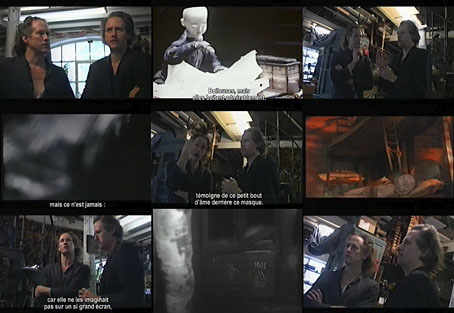
Thus Jan Švankmajer whose production company, Athanor, is named after the furnace used by medieval alchemists. Jan Švankmajer, Director (2009) is an hour-long documentary by Martin Sulík, one of several films from Golden Sixties, a Czech television series about film directors. Švankmajer has been the subject of several documentaries following his rise to international prominence, one of which, Les Chimeres des Švankmajer (2001), may be found on the BFI’s DVD set of the complete short films. Martin Sulík’s documentary doesn’t cover as much ground as the French film—the focus is on the 1960s—but has an advantage by allowing Švankmajer to talk at length about his work. Topics include his discovery of the usefulness of animation, his approach to filmmaking (and art in general), and peripheral subjects such as the soundtrack music of Zdeněk Liška, and the activities of the Prague Surrealist group. (Via MetaFilter.)

Jan Švankmajer, Director: Part one | Part two | Part three | Part four

Previously on { feuilleton }
Don Juan, a film by Jan Švankmajer
The Pendulum, the Pit and Hope
Two sides of Liška
The Torchbearer by Václav Švankmajer

Weekend links 297

floridxfauna.jpg

Crimson Metallic Emergent Skull Crystal Pendant by Kristen Phillips aka Floridxfauna.

The Noise-Arch Backup at the Internet Archive is 30GB of mp3s from noise-arch.net, a collection of cassette-based releases and artwork: “material represented includes tape experimentation, industrial, avant-garde, indy, rock, diy, subvertainment and auto-hypnotic materials…” 30GB is an intimidatingly large amount of material so it’s better to browse The Noise-Arch Archive, a selection of 468 releases.

• The week in erotica: Claire Voon on Ancient Erotic Dreams and Explicit Scenes in the New York Public Library Collection; Melanie Porter on Great Grandporn: Hardcore Pornography of the Silent Era; Cathy Camper on The Comics of Dale Lazarov: Illustrated Explorations of Sexual Inventiveness.

Void Beats/Invocation Trex by Cavern of Anti-Matter (Holger Zapf, Joe Dilworth & Tim Gane) was released this week. The opening number is Tardis Cymbals. Tom Furse condensed the 73-minute album into a 17-minute mini-mix.

Indeed, if you had to “place” ­Williams—put him alongside writers with whom he had something in common—it would be with the mystical autodidacts, the backstreet Rosicrucians more than with the pipe-smoking, tweedy Inklings. To that extent, the only unsatisfactory thing about Grevel Lindop’s book is its title. True, Williams went to Oxford when war broke out and became friends with the famous circle around C. S. Lewis. But he was not an Inkling in spirit. He was not at home in Oxford, and his arrival, far from consolidating the Inklings, actually broke them up by bewitching Lewis, and making Lewis neglect the central friendship of his life, that with ­Tolkien. Another scholar of Old English literature, C. L. Wrenn, said that meeting Williams made you realize why inquisitors thought they had the right to burn people. Tolkien agreed: “Williams is eminently combustible.”

Certainly, Williams’s books had an influence on the Inklings. Lindop is right to say that the central plotline of Many Dimensions suggests the story of The Lord of the Rings. In the Williams novel, it is a stone of great power, rather than a ring, but it has the same effect on those who bear it: They become its possession, not its possessor.

AN Wilson reviews Charles Williams: The Third Inkling by Grevel Lindop

• Russ Fischer recommends five films by Andrzej Żuławski (RIP). Possession (1981) is still the easiest to find, and a good place to start. I enthused about On The Silver Globe (1977–87) last year.

England’s Hidden Reverse: A Secret History of the Esoteric Underground by David Keenan has been published in a revised and expanded edition by Strange Attractor.

The Preservation Man (1962): Artist and collector Bruce Lacey (RIP) filmed by Ken Russell for the BBC’s Monitor.

Barry Adamson: “I’ve been called the outsider’s outsider”.

• At Dangerous Minds: Six degrees of Marty Feldman.

• Mix of the week: FACT mix 536 by Not Waving.

• The Alan Clarke page at the BFI shop.

Umberto Eco (RIP): Porta Ludovica

Possessions (1980) by The Residents | Possessed (1992) by The Balanescu Quartet | Possessed (2001) by Sussan Deyhim & Shirin Neshat

Can soundtracks

deepend.jpg

Trailer for Deep End (1970). Music: Mother Sky.

I’ve been listening to a lot of Can over the past week, and thinking—not for the first time—about their erratic soundtrack career. Their soundtrack music is very familiar from their second album, Soundtracks, and the recent Lost Tapes collection which unearthed a few pieces that were previously only available in films or TV episodes. Much less familiar is the films and TV episodes themselves so here’s a look at some of the available material. Deep End and Alice in the Cities are both acclaimed (and highly recommended) feature films available on DVD. Everything else in this collection has been less visible outside Germany.

Update: Added Das Millionenspiel.

millionenspiel.jpg

Das Millionenspiel (1970). Music: Millionenspiel.

A film for German television based on a science-fiction story (The Prize of Peril, 1958) by Robert Sheckley about a reality-TV manhunt game. IMDB has Irmin Schmidt listed as the uncredited composer but the theme was a Can production.

madchen.jpg

Trailer for Mädchen mit Gewalt (1970). Music: Soul Desert and Desert.

deadlock.jpg

Trailer for Deadlock (1970). Music: Deadlock and Tango Whiskeyman.

Another of the strange Westerns (or Western-like films) that flourished in the early 70s.

Continue reading “Can soundtracks”

Weekend links 295

dupre.jpg

Untitled (2014) by Lola Dupré. Via.

Announcement of the week (if not the month/year) is the news that the BFI will be releasing all of the BBC dramas directed by Alan Clarke on DVD/Blu-ray in May. In addition to the long-awaited appearance on disc of Penda’s Fen (1974) we can expect a previously unseen director’s cut of Clarke’s last TV film, The Firm (1989), the DVD premier of Baal (1982) with David Bowie, plus many other works including some from the 1960s that were believed lost. (And it should be noted that this isn’t everything of Clarke’s; he also worked occasionally for ITV and later directed feature films for Channel 4.)

The BFI attention is a tribute to an exceptional director that’s overdue. Clarke has long been a cult figure among the British actors who worked with him, and among directors such as Harmony Korine and Gaspar Noé, but the tendency of TV to give one-off dramas a single screening has meant that much of his best work has been unavailable for years outside old VHS tapes. Clarke is important for having persistently chosen difficult subjects which he directed with a flair and intensity usually only found in cinema. When he died in 1990 the BBC repeated a handful of his films but the only ones given repeated DVD release have been the violent dramas with the big names attached: Scum (1979, with Ray Winstone), Made in Britain (1982, with Tim Roth), and The Firm (with Gary Oldman). Clarke’s oeuvre is much more than a parade of nihilistic villains, as will become evident later this year.

• A psychedelic video directed by Peter Strickland for Liquid Gate (ft. Bradford Cox) by Cavern of Anti-Matter. The debut album from Cavern of Anti-Matter, Void Beats/Invocation Trex, will be out later this month.

Celebrating Dusseldorf, the city that birthed Krautrock. (Article loses points for not mentioning producer Conny Plank.)

All Rivette’s features might be regarded as different kinds of horror films; Céline et Julie vont en bateau is his first horror comedy. The anxiety and despair of Paris Nous Appartient and La Religieuse, L’Amour Fou and Spectre seem relatively absent, yet they perpetually hover just beyond the edges of the frames. We still have no privileged base of ‘reality’ to set against the fictions, each of which is as outrageous as the other; and along with Borges, we can’t really say whether it’s a man dreaming he’s a butterfly or a butterfly dreaming he’s a man—although we may feel, in either case, that he and we are just on the verge of waking.

Jonathan Rosenbaum on work and play in the house of fiction: Jacques Rivette’s Out 1 and Céline and Julie Go Boating

• Mixes of the week: Finders Keepers Radio Show Krautrock Special, and The Ivy-Strangled Path Vol. XV by David Colohan.

• At Dangerous Minds: Super strange sculptures (by Shary Boyle) only the dark and demented could love.

• Beautiful Brutalites: S. Elizabeth questions Arabella Proffer about her paintings.

KTL is a musical collaboration between Peter Rehberg and Stephen O’Malley.

• Why study art when you can make it? The strange world of…This Heat.

Sarah Galo on the explicitly sexual female artists that feminism forgot.

Irmin Schmidt‘s favourite music (this week).

• LSD: My life-saving drug by Eric Perry.

The Occult Activity Book

Twenty Tiny Cities

Der LSD-Marsch (1970) by Guru Guru | Krautrock (1973) by Faust | Düsseldorf (1976) by La Düsseldorf