Weekend links 328

jamison.jpg

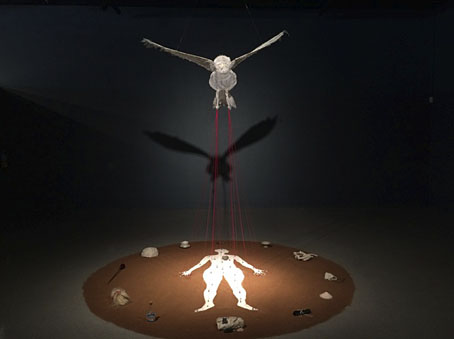
Feathers and Weights (2016) by Susan Jamison.

• The latest release from A Year In The Country is No More Unto The Dance, “a reflection of nightlife memories and the search for the perfect transportative electronic beat”.

Depero Futurista (1927), the bolted book showcasing the artistic work of Fortunato Depero, returns in a facsimile edition.

• This week in the occult: Sam Kean on 21st-century alchemists, and a second volume of The Occult Activity Book.

How could so many jazz critics have overlooked Davis’s powerful trumpet playing on Bitches Brew, and its continuities with his previous work? The reason for their bewilderment was, in large part, the brew, the music’s muddy electric bottom, which bore no resemblance to the jazz they knew. Davis had never been a pure bopper, but his music had always made allusion, however oblique, to the grammar of Parker and Gillespie. On Bitches Brew, Davis decisively broke with his roots in bop. As [George] Grella argues, building on the pivotal work of Greg Tate and Paul Tingen, the more revealing points of comparison were no longer to be found in jazz but in the psychedelic guitar of Jimi Hendrix, the warbled vocals of Sly Stone, and the bass lines of James Brown.

Adam Shatz on Miles Davis

Daniel Wenger on Bob Mizer, “the obsessive photographer behind America’s first gay magazine”.

The Hauntings at Tankerton Park, a book of words and very detailed drawings by Reggie Oliver.

• A 40-minute performance by Pentangle for Norwegian television in 1968.

Maisie Skidmore on ten things you may not know about René Magritte.

• Shirley Collins is the secret queen of England, says Nick Abrahams.

Eighth Climate: ethnographic recordings from the imaginal world.

Pasquale Iannone on five ways to recognise a Pasolini film.

The greatest record sleeves, as chosen by the designers.

Cosmic Horror, new comics work by Ibrahim R. Ineke.

• Mix of the week: FACT mix 569 by S U R V I V E.

• At Dennis Cooper’s: 47 unmade films.

Cosmic Dancer (1971) by T. Rex | Cosmic Slop (1973) by Funkadelic | Cosmic Tango (1973) by Ash Ra Tempel
Weekend links 327

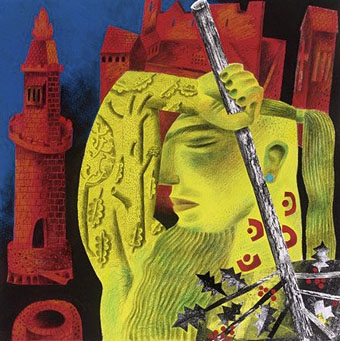
hickjenkins.jpg

The Green Knight Arrives by Clive Hicks-Jenkins. Part of a series based on the theme of Gawain and the Green Knight.

• RIP Don Buchla, inventor of the Buchla Electronic Musical Instrument (or simply Buchla to aficionados). The early Buchlas were produced contemporaneously with the Moogs but never achieved an equivalent popularity. Morton Subotnick was an early serious player, using one of the first Buchlas to record Silver Apples Of The Moon in 1967. By coincidence, this month has seen the release of Sunergy, an album created by two Buchla enthusiasts, Kaitlyn Aurelia Smith & Suzanne Ciani, the latter having been a Buchla player for many years. Sean Hellfritsch made a 25-minute film of the pair playing their machines, while they talked about their collaboration to Danny Riley.

• Erik Davis talks to occult book-dealer Todd Pratum about rejected knowledge, growing up Californian, book synchronicities, and the loss of knowledge in the age of the Internet.

• Mix of the week (month, year, etc) is undoubtedly this 12-hour history of Spiritual Jazz. Less intimidating (and more eclectic) is an exclusive mix by Fenriz for The Wire.

• More electronica: (The Microcosm): Visionary Music of Continental Europe, 1970–1986, another quality music collection from Light In The Attic.

Flying Saucers Are Real! is a history of 20th-century UFOdom by Jack Womack. Related: A map of the last remaining Flying Saucer Homes.

• Coming soon from the Ghost Box label, Peel Away The Ivy by The Pattern Forms. Jon Brooks gives an account of the album’s creation.

• Uri Bram meets computer scientist David Chapman to discuss the limits of formal learning, or why robots can’t dance.

Andrew Male on Julius Eastman: the groundbreaking composer America almost forgot.

Ship found in Arctic 168 years after doomed Northwest Passage attempt.

Anna Cafolia on the resurgence of witchcraft in 1970s Britain.

• Welcome to the Austronesian Embassy of Anaphoria Island.

Billy Gibbons of ZZ Top chooses some favourite records.

A profusion of Marty Feldman links.

• The Flying Saucer Pts 1 & 2 (1956) by Buchanan And Goodman | Flyin’ Saucers Rock’nRoll (1957) by Billy Lee Riley and The Little Green Men | Flying Saucers Have Landed (1972) by Paul St. John

The Quietened Bunker

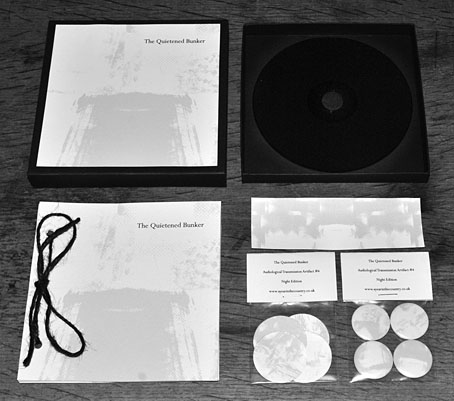
bunker.jpg

Bunkers were a recurrent feature in the media of the 1980s, a consequence of increasing Cold War tensions following the election of Ronald Reagan and the Soviet invasion of Afghanistan. The decade birthed new horrors of the body-mutating variety, and also reanimated some older ones in the figure of the knife-wielding psychopath, but the omnipresent spectre of nuclear war posed a threat not only to characters in films and TV serials but to the audiences who watched them. That threat manifests most strikingly in the middle of the decade with the TV film Threads (1984), the TV serial Edge of Darkness (1985), and the comic-book serial/graphic novel Watchmen (1986–87). To these you could add feature films such as WarGames (1983) and James Cameron’s The Terminator (1984) and its sequel. Not all of these works feature bunkers but nuclear warfare by its very nature implies the existence of subterranean control centres with all their latent mythological resonances. Some of those resonances are played with in David Rudkin’s Penda’s Fen (1974) and Artemis 81 (1981), the latter featuring an extended sequence in a sinister subterranean complex. Troy Kennedy Martin’s superb nuclear thriller, Edge of Darkness, runs the gamut of underground enclaves, from labyrinthine cave systems and abandoned nuclear shelters to a dusty Cold War command centre with a telephone link to Downing Street.

Bunkers of the abandoned variety provide the theme for the latest compilation album from A Year In The Country:

The Quietened Bunker is an exploration of the abandoned and/or decommissioned Cold War installations which lie under the land and that would have acted as selectively populated refuges/control centres if the button was ever pushed; a study and reflection on these chimeric bulwarks and the faded but still present memory of associated Cold War dread, of which they are stalwart, mouldering symbols.

Track list:
1) Lower Level Clock Room – Keith Seatman
2) Drakelow Tunnels – Grey Frequency
3) The Filter’s Gone / The Last Man Plays The Last Piano – A Year In The Country
4) Aggregates II – Panabrite
5) Bunker 4: Decommissioned – Polypores
6) Comms: Seen Through The Grey – Listening Center
7) Crafty Mechanics – Time Attendant
8) Crush Depth – Unknown Heretic
9) Waiting For The Blazing Skies – David Colohan

This is another quality collection in distinctive black-and-white packaging that will be of immediate interest to anyone who enjoys the releases on the Ghost Box label (Listening Center are already Ghost Box artists): spectral pianos, shortwave radios, ambient chords. The bunker theme connects to shared concerns among related artists with the old Civil Defence films, samples of which have been used on releases by The Advisory Circle and Mordant Music. The Cold War bunker is more than another empty space, it joins the bio-weapons lab (see The Satan Bug) as a source of contemporary horror that doesn’t require any supernatural component to chill the blood.

Previously on { feuilleton }
Fractures

Animation Magazine: The Brothers Quay

quays2.jpg

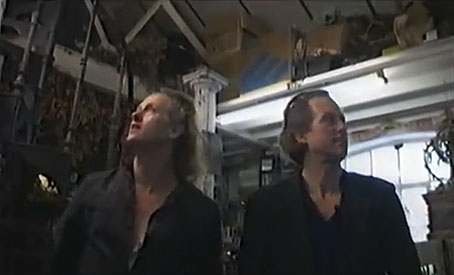
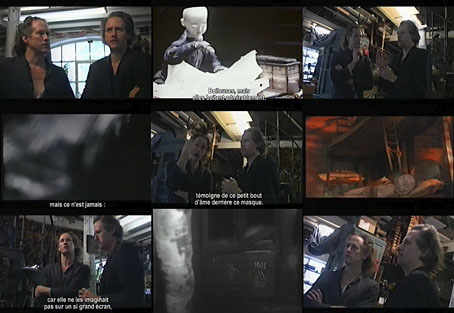
Interviews with the Brothers Quay have been quite plentiful in recent years—some may be found on their DVD releases—but for the Quay enthusiast some are more notable than others. This half hour programme for French TV stood out for me for taking place inside the London studio where many of the Quays’ short films have been made. The interview was conducted in 2002, and one of the brothers mentions that they may be leaving the premises soon; one of their exhibition catalogues has a recent photo of the studio so we can assume this wasn’t the case.

quays1.jpg

Since this was made for an animation series the discussion is mainly about the brothers’ animation techniques. There’s also some barbed comment later on about the conservative state of British television. The UK’s Channel 4 was a great champion of animation in its early days, and the channel’s budget for short films helped finance many of the early films by the Quays and their producer Keith Griffiths. This was at a time when there were only four TV channels to choose from; today we have numerous channels but no room on any of them for unusual or experimental fare. Similar sentiments are voiced on the BFI’s recent collection of Alan Clarke films. Just as there’s no room for the Quays in the current climate, there’s no room either for the single dramas that directors like Clarke were making in the 1970s and 1980s.

Elsewhere on { feuilleton }
The Quay Brothers archive

Weekend links 315

knights.jpg

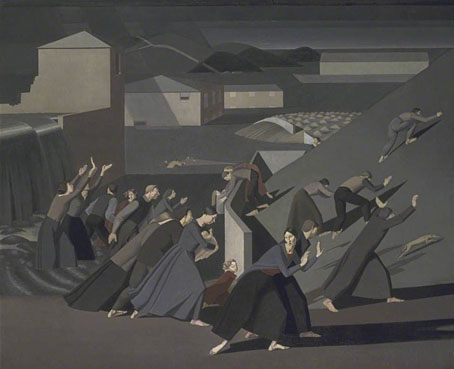
The Deluge (1920) by Winifred Knights.

Dennis Cooper‘s favourite fiction, poetry, nonfiction, film, music, art & internet of 2016 so far. (Thanks again for the nod to this blog!)

• At Literary Hub: Jonathan Russell Clark on Jorge Luis Borges, and Jon Sealy on why indie presses [in the US] are opening bookstores.

• “It’s not just about the music.” A conversation on the occult practices in the arts between poet Janaka Stucky and Peter Bebergal.

• Daisy Woodward talks to Andreas Horvath about Helmut Berger, Actor, a documentary about Visconti’s muse and lover.

• More Fritz Leiber: Brian J. Showers on his decision to republish Leiber’s horror novel, The Pale Brown Thing.

• Mixes of the week: Sextape 4 by Drixxxe, and Radio Oscillations #96 (Richard Pinhas/Heldon) by Iron Blu.

• The 5th Young One: Pay No Attention to the Girl Behind the Sofa; John Reppion on a television mystery.

• More reading suggestions: Cheerless beach reads for gloomsters and saddies by S. Elizabeth.

• Never the same film twice: Seances by Guy Maddin, Evan Johnson, Galen Johnson.

• How painter Winifred Knights became Britain’s “unknown genius”.

• The Journey & The Destination: An interview with Hawthonn.

Robert Latona goes in search of the grave of Constance Wilde.

• Invisible by Day: photos by Mikko Lagerstedt.

• A Queer Lit Q&A with Evan J. Peterson.

• RIP Michael Herr and Bernie Worrell.

Bridget Riley: The Curve Paintings.

• The typography of Blade Runner.

Japanese matchbox labels

SOS by Portishead

A Rainbow In Curved Air (1969) by Terry Riley | The Great Curve (1980) by Talking Heads | Dangerous Curves (2003) by King Crimson