Weekend links 481

gaussot.jpg

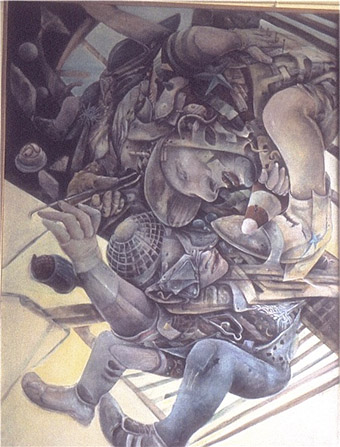
L’Hamestoque (1977) by Christine Gaussot.

• Another announcement from Strange Attractor Press: Of Mud & Flame: A Penda’s Fen Sourcebook edited by Matthew Harle and James Machin will be published at the end of October. Among the contents will be the screenplay of David Rudkin’s cult television play, an item that’s always been impossible to find in print.

• A trailer for Journey to the Beginning of Time (1955), another semi-animated fantasy film by Karel Zeman which will released on disc next month by Second Run.

• “There was craziness in getting lost and dizzy.” Stereolab choose favourite songs from their back catalogue.

E=MC² (1976), an album of spacey jazz-electronica by Teddy Lasry which has never been reissued.

• “Why do so many book covers look the same? Blame Getty Images,” says Cory Matteson.

• Mix of the week: The Ephemeral Man’s Teapot by The Ephemeral Man.

Masataka Nakano has been photographing a deserted Tokyo for almost 30 years.

• Beyond the bounds of depravity: an oral history of David Cronenberg’s Crash.

Woodblocks in Wonderland: The Japanese Fairy Tale Series.

• A new novel by M. John Harrison is always a good thing.

Hamid Drake‘s favourite music.

Warm Leatherette (1980) by Grace Jones | Crash (1980) by Tuxedomoon | A Crash At Every Speed (1994) by Disco Inferno

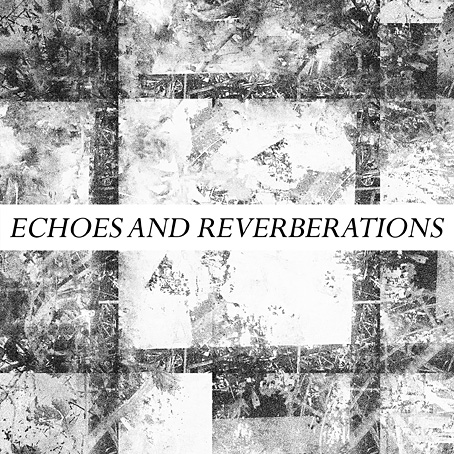
Echoes And Reverberations

echoes.jpg

Echoes And Reverberations, the latest themed collection of music presented by A Year In The Country, has a title that might refer to the Hauntological idiom in general. Not so much nostalgia, more the refashioning of memories, or imagined remembrances of the past, into something new.

Echoes And Reverberations is a field recording-based mapping of real and imaginary film and television locations.

It is in part an exploration of their fictional counterparts’ themes; from apocalyptic tales to never-were documentaries and phantasmagorical government-commissioned instructional films via stories of conflicting mystical forces of the past and present, scientific experiments gone wrong and unleashed on the world, the discovery of buried ancient objects and the reawakening of their malignant alien influence, progressive struggles in a world of hidebound rural tradition and the once optimism of post-war new town modernism.

Track list:
1) Grey Frequency—King Penda
2) Pulselovers—The Edge Of The Cloud
3) Dom Cooper—What Has Been Uncovered Is Evil
4) Listening Center—From Bull Island To Avondale
5) Howlround—Smashing
6) A Year In The Country—Not A Playground
7) Sproatly Smith—Gone Away
8) Field Lines Cartographer—Mr Scarecrow
9) Depatterning—The Ogham Stones
10) The Heartwood Institute—Ribble Head Viaduct

Using field recordings as a basis for music or sound art is as old as musique concrète, but the processes of Pierre Schaeffer and his followers were cumbersome and limited, and the results were invariably placed in the frame of Serious Music. The limitations of the approach can be seen in how quickly this avenue of exploration ran its course. It’s taken the flexibility and widespread use of digital sound tools to revitalise a moribund form to a degree that an acclaimed TV series like Chernobyl can use field recordings for a score (by Hildur Guðnadóttir) that matched the power of the on-screen drama.

The first piece in Echoes And Reverberations, King Penda, immediately caught my attention for the reference to David Rudkin’s Penda’s Fen, another TV drama with notable sound design by Paddy Kingsland of the Radiophonic Workshop. I thought the industrial thuds and clangs summoned by Grey Frequency might be taken from the scene where Stephen and his mother travel into Birmingham, but the release notes reveal that the sound source is the church where Stephen plays the organ, and in a later scene experiences a different kind of summoning. Whatever the source, the suggestion of menace suits a film whose transcendent message has to rise through an atmosphere of oppressive malevolence.

The Radiophonic Workshop is the ghost at this particular feast, unsurprisingly when the majority of the pieces are based on film and TV dramas from the Workshop’s golden decade, the 1970s: Flambards (The Edge Of The Cloud by Pulselovers, a beautiful piece of solo violin and piano with birdsong accompaniment); Survivors (Gone Away, a brittle instrumental by Sproatly Smith); and No Blade of Grass (Ribble Head Viaduct by The Heartwood Institute, a lumbering theme for one of the many angry and violent apocalypse films of the 70s). Of the other pieces Dom Cooper’s What Has Been Uncovered Is Evil takes the Hammer film of Quatermass and the Pit as its focus, creating a soundscape of sinister electronics in a nod to Tristram Carey’s Martian soundtrack, while the equally sinister electronics of Field Lines Cartographer’s Mr Scarecrow follows Stephen Gallagher’s gene-splicing thriller, Chimera, to the rain-drenched Lake District. The shadows of disaster lying over this release feel uncomfortably timely when the past week in Britain saw a heatwave like something from The Day the Earth Caught Fire, while this week we’ve had a village evacuated after torrential rains have threatened a dam with collapse, and an announcement from China about “hybrid chimeras“.

Echoes And Reverberations will be released on 16th August, and is available for pre-order now.

Previously on { feuilleton }
The Watchers
The Corn Mother
The Quietened Mechanisms
The Shildam Hall Tapes
Audio Albion
A Year In The Country: the book
All The Merry Year Round
The Quietened Cosmologists
Undercurrents
From The Furthest Signals
The Restless Field
The Marks Upon The Land
The Forest / The Wald
The Quietened Bunker
Fractures

Weekend links 473

spectra.jpg

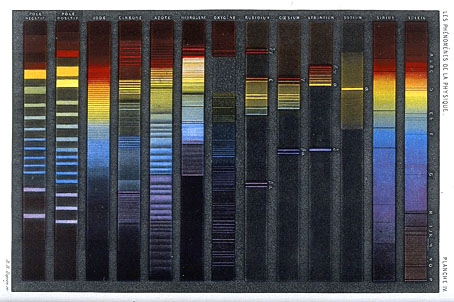
“Spectra of various light sources, solar, stellar, metallic, gaseous, electric”, print by René Henri Digeon; plate IV in Les phénomènes de la physique (1868).

• More polari: Thom Cuell this time with another review of Fabulosa!: The Story of Polari by Paul Baker. Good as it is to see these articles, one thing they all share is paying tribute to the polari-enriched radio series Round the Horne without crediting its writers, Barry Took and Marty Feldman.

• “…with its conspiracy theories, babbling demagogues and demonised minorities, Bahr’s investigation is sadly all too relevant today.” Antisemitism (1894) by Hermann Bahr, is the latest new translation from Rixdorf Editions.

Isao Tomita in 1978 showing a presenter from NHK around his tiny studio. Japanese-only but the discussion reveals that the words “synthesizer”, “tape recorder” and “mixer” sound the same as they do in English.

Ben Frost talks to Patrick Clarke about his music for German TV series, Dark.

• PYUR composes a guide through limbo with Oratorio For The Underworld.

• Steven Heller on Don Wall’s book design for a Paolo Soleri retrospective.

• Coming soon from Fulgur Press: Ira Cohen: Into the Mylar Chamber.

Will Harris compiles an oral history of Q: The Winged Serpent.

• Mix of the week: a mix for The Wire by Overlook.

• At Dennis Cooper’s: Magic Shop Internationale.

Shadow In Twilight by Pram.

The Feathered Serpent Of The Aztecs (1960) by Les Baxter | The Serpent (In Quicksilver) (1981) by Harold Budd | Black Jewelled Serpent Of Sound (1986) by The Dukes Of Stratosphear

Jan Švankmajer: The Animator of Prague

svankmajer.jpg

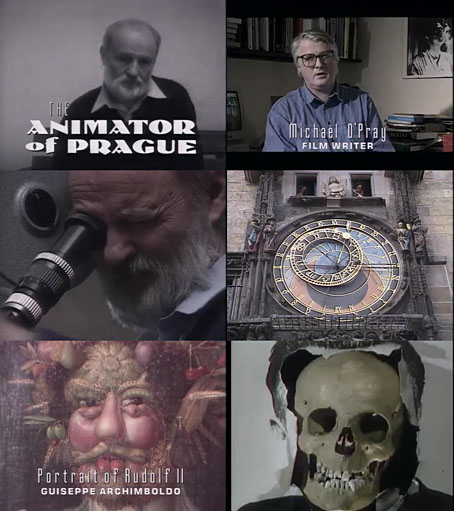
“Surrealism is not aesthetics. It is a philosophy,” says Jan Švankmajer in James Marsh’s short (25 mins) portrait for the BBC from 1990. This was broadcast at a time when Švankmajer’s films were receiving more attention in the UK than they had before or since, thanks in part to Channel 4’s screening and funding of animation, and to the late Michael O’Pray, a film writer and champion of avant-garde cinema. O’Pray is the main commentator here apart from Švankmajer himself, and his name was a regular fixture of any writing about Švankmajer or the Brothers Quay in the 1980s. Švankmajer’s films were featured in at least two of the touring programmes of short films that O’Pray put together for Film and Video Umbrella in the late 1980s, so its good to see his enthusiasm memorialised in this way, even if it is stuck on a rather temperamental Korean website. In addition to discussion of the influence of Bohemian emperor Rudolf II on Švankmajer’s work we also see the director filming his latest short, The Death of Stalinism in Bohemia; a rare glimpse behind the camera. (Note: the video wouldn’t load for me but the stream is downloadable if you’re determined to see it.)

Previously on { feuilleton }
Jan Švankmajer, Director
Don Juan, a film by Jan Švankmajer
The Pendulum, the Pit and Hope
Two sides of Liška
The Torchbearer by Václav Švankmajer

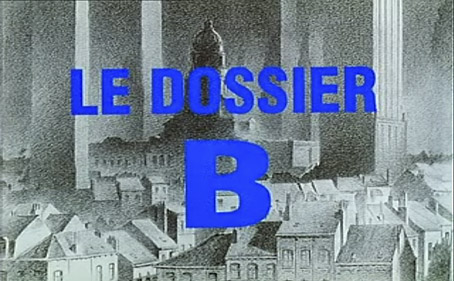
Le Dossier B by Schuiten and Peeters

db01.jpg

Almost ten years have elapsed since I devoted a week of blog posts to one of my favourite fantastic creations, the Obscure World/Obscure Cities of Belgian artist-and-writer team François Schuiten and Benoît Peeters. Schuiten and Peeters’ mythos is a multi-media project with a series of bande desinée albums as its core, a cycle of stories which introduce the reader to some of the cities in the Obscure World (a “counter-Earth” on the opposite side of our Sun), and which are connected by recurrent characters and motifs. Since the completion of the core series, Schuiten, with occasional help from Peeters, has expanded the mythos to encompass other books that flesh out some of the world’s invented history and its connections to our own world, together with other manifestations such as art exhibitions and music releases. Le Dossier B (1995) is a peripheral Obscure World production, a 54-minute TV documentary which entangles the genuine history of 20th-century Brussels with an invented secret society who believe in the existence of a twin city, Bruzel, that intersects with the Belgian capital.
db02.jpg

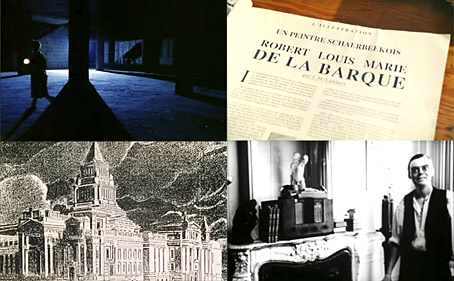
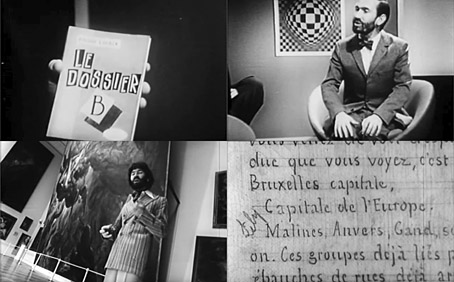
Le Dossier B was directed by Wilbur Leguebe from a script by Leguebe with Schuiten and Peeters. Valérie Lemaître plays the on-camera investigator, “Claire Devillers”, while artist and writer appear in roles that match their personalities. Schuiten is seen in silent footage as “Robert de la Barque”, an artist whose obsession with Brussels’ vast Palace of Justice provides clues to the Bruzel mystery via the eccentricities of its architect, Joseph Poelaert. Peeters appears later in the investigation as “Pierre Lidiaux” the author in 1960 of Le Dossier B (a book which has since vanished), his own study of the connections between Brussels and Bruzel. We first see Lidiaux being interviwed on a TV arts show, then later as the presenter of his own eccentric and unfinished film about Antoine Wiertz, the real-life Belgian painter of vast canvasses on morbid subjects whose museum Lidiaux explores. Aside from the well-realised historical fakery, one of the pleasures of Leguebe’s witty and imaginative documentary is the spotlight it throws on the history and culture of Brussels and Belgium. I hadn’t realised, for example, that the Wiertz Museum is so close to the European Parliament building which was still under construction when the film was being made. Elsewhere there are references to Magritte, Delvaux and Art Nouveau architect Victor Horta, and we catch a glimpse of work by another great Belgian painter, Jean Delville.
db03.jpg

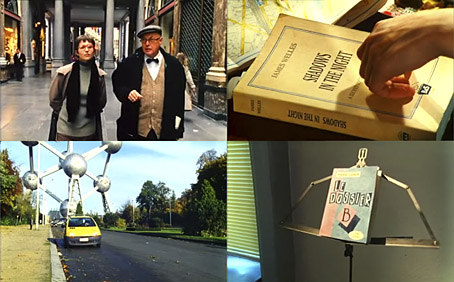
The last third of the film is based around the researches of one James Welles (Adrian Brine), a British historian whose book-length study, Shadows in the Night: A Secret Society in Belgium, explores the connections of yet more historical figures with the Bruzel mystery, including the aforementioned Horta and chemist Ernest Solvay. The historian’s surname may be taken as a deliberate choice: Orson Welles was the director of another documentary mixing fact and fiction, F for Fake, while Welles’ appearance as Falstaff in Chimes at Midnight provided Schuiten with the model for the central character in La Tour, one of the albums in Schuiten and Peeters’ Obscure Cities series.
db04.jpg

Some of this territory is explored in another of the Obscure Cities albums, Brüsel, especially the building of the Palace of Justice and the concept of “Brusselisation”, a pejorative French term for the rapid demolition of historical quarters of a city to make way for new construction. Where Brüsel has the freedom of the comics medium to refashion the capital in a fantastic manner, Le Dossier B uses the material of our world to suggest another city (possibly the one depicted in the album) whose existence we never see. Apart, that is, for the suggestion near the end of the film that the Bruzel of the secret society is the Brussels of today, a city which has overwritten the Brussels of a century ago, just as the invented encyclopedia in Borges’s Tlön, Uqbar, Orbis Tertius gradually changes the world at large to match its contents.

Le Dossier B is available on DVD but seems to be sold out for now. Alternatively, it may be watched at YouTube in an unsubtitled copy that’s been uploaded in the wrong aspect ratio. The really determined may wish to do what I did: download the video, grab some English subtitles, then watch it in VLC with the aspect ratio set to 16:10. A lot of messing around but it works.

(My thanks to Brussels resident Anne Billson for the YT link!)

Previously on { feuilleton }
Urbatecture
Echoes of the Cities
Further tales from the Obscure World
Brüsel by Schuiten & Peeters
La route d’Armilia by Schuiten & Peeters
La Tour by Schuiten & Peeters
La fièvre d’Urbicande by Schuiten & Peeters
Les Murailles de Samaris by Schuiten & Peeters
The art of François Schuiten
Taxandria, or Raoul Servais meets Paul Delvaux