Weekend links 81

wittkamp.jpg

Black Cat on a Chair (1850–1860) by Andrew L Von Wittkamp.

• “A little bit of acid, lots of weed, and too much Castaneda and I was ready to move from the magical realm of Middle Earth into a world that was much stranger than any involving hairy dwarves and white wizards…” Too Much to Dream by Peter Bebergal, “a psychedelic American boyhood”.

This year’s Booker prize isn’t about the power of the new – there’s no experiment with form or strangeness of imagination. The winner may get on the bedside tables of middle England, but that’s not as important as changing the way that even one person dreams.

Jeanette Winterson throws the cat among the pigeons.

• 50 Watts continues to show us things you’d be hard-pressed to find elsewhere: illustrations by TagliaMani from a new edition of Les Chants de Maldoror, and War Is a Verb, collages by Allan Kausch.

• Don’t go in the swimming pool! Coilhouse directs us to Fantasy: music by French outfit DyE with a weird and nasty animation by Jérémie Périn.

• Ace album cover designer and photographic Surrealist Storm Thorgerson is having another exhibition at IG Gallery, London.

The Art of Leo and Diane Dillon, an art and illustration archive.

John Turturro reads a short story by Italo Calvino.

Spaceport America by Foster + Partners.

Your Body of Work by Olafur Eliasson.

Wonder-Cat cures all ailments.

Blogging Moby-Dick.

Krazy Kat (1927) by Frankie Trumbauer & His Orchestra with Bix and Lang | Pussy Cat Dues (1959) by Charles Mingus | Katzenmusik 5 (1979) by Michael Rother | Big Electric Cat (1982) by Adrian Belew | Purrfect (1996) by Funki Porcini.

John Holmes, 1935–2011

holmes4.jpg

(1974).

Artist John Holmes, whose obituary was published this week, had a style that was immediately recognisable from the many paintings featured on book covers (and a few record sleeves) in the 1970s and 1980s. His painting for The Female Eunuch is by far the most well-known, of course, although I often used to wonder how many people who knew the picture could have named the artist responsible. Holmes’ art brought a touch of Magritte-like Surrealism to cover illustration (at times the debt to Magritte was quite overt), and his images are familiar to anyone in the UK who was reading science fiction or horror during the 70s. He also has the distinction of being the first artist to provide a cover for an M. John Harrison book with the painting for Harrison’s debut novel, The Committed Men, in 1971. (Or not quite… See comments.)

The McNeill Gallery has some original work for sale while the artist himself talked about some of his cover art at All Things Horror.

holmes2.jpg

(1974).

holmes3.jpg

(1981).

Elsewhere on { feuilleton }
The album covers archive
The book covers archive

Malicious Damage

orton.jpg

I was going to title this post “Fucked by Monty” but thought that might give the wrong impression. The phrase was one of several titles added to the cover of The Collected Plays of Emelyn Williams by Joe Orton and Kenneth Halliwell when they were happily defacing the books of Islington Library, London, in the early 1960s. Despite the outrage of the librarians at the vandalism most of the defaced books were put aside and are now prized items in Islington’s collection. This week the library announced an exhibition of the books, Malicious Damage: The crimes of Joe Orton and Kenneth Halliwell. The Guardian has a gallery of the covers here (and there’s more at Joe Orton central), rare examples of what might be called “guerilla collage”.

In addition to tarting up boring cover designs, Orton and Halliwell also typed their own descriptions of some the books’ contents. Gollancz volumes were apparently good for this since the publisher left the inside of their famous yellow dust jackets blank. John Lahr in Prick Up Your Ears gives an example from a Dorothy L Sayers novel which is also read out in the 1987 film adaptation:

When little Betty Macdree says that she has been interfered with, her mother at first laughs. It is only something the kiddy has picked up off television. But when sorting through the laundry, Mrs. Macdree discovers that a new pair of knickers are missing she thinks again. On being questioned, Betty bursts into tears. Mrs. Macdree takes her to the police station and to everyone’s surprise the little girl identifies P.C. Brenda Coolidge as her attacker. Brenda, a new recruit, denies the charge. A search is made of the Women’s Police Barracks. What is found there is a seven inch phallus and a pair of knickers of the kind used by Betty. All looks black for kindly P.C. Coolidge…. What can she do? This is one of the most enthralling stories ever written by Miss Sayers.

It is the only one in which the murder weapon is concealed, not for reasons of fear but for reasons of decency!

READ THIS BEHIND CLOSED DOORS. And have a good shit while you are reading!

Alan Bennett wrote the screenplay of Prick Up Your Ears and that line about “It is only something the kiddy has picked up off television” could well have been one of his own. Orton said that when the pair ended up in court the greatest outrage was shown not towards their obscene amendments but to simple bits of Surrealism such as the adding of a monkey’s face to the cover of Collins Guide to Roses. Schoolboy humour is understandable but don’t dare do something that makes no apparent sense.

Malicious Damage is a free exhibition and runs until January, 2012.

Previously on { feuilleton }
Joe Orton Online
Joe Orton

Weekend links 77

farmer.jpg

Art by Tessa Farmer.

• An exhibition of Tessa Farmer’s art is running at Viktor Wynd Fine Art, London, until October 30th. On Saturday, October 1st, Strange Attractor hosts Good Neighbours: Faeries, Folklore and the Art of Tessa Farmer also at Viktor Wynd.

Unearthing The Psychedelic Harp: “David Moats talks to harpist and songwriter Serafina Steer about her work with John Foxx and Patrick Wolf, being classically trained, the difficulties of doing live soundtracks and psychedelia.”

• And speaking of psychedelia, Arkhonia is still blogging up a storm here, here and here about the lost Beach Boys album, Smile, the farthest Brian and co. ventured into the tripped-out weirdness of 1967. The complete original recordings will finally be released in November.

• “‘We’ve arrived at a level of commodification that may have negated the concept of counterculture,’ Gibson says in the Paris Review.” William Gibson profiled by Thomas Jones.

One of the qualities I always stress when talking about this design work influenced by Surrealism is its enormous boldness and creative freedom, which is something of a paradox in many cases, since the Czech and Polish designs were created under communist regimes. So, while Uncanny documents a significant current in the history of 20th-century visual culture, the show also has a polemical intention aimed, quite deliberately, at our circumstances now. Students who encounter these images in lectures sometimes feel constrained by their conception of what they — or their teachers — regard as acceptable in today’s marketplace. At times, this has struck me as being a form of insidious self-censorship. (more)

Rick Poynor: Jan Švankmajer and the Graphic Uncanny.

• The exhibition curated by Mr Poynor last year, Uncanny: Surrealism and Graphic Design, is now showing at the Kunsthal in Rotterdam until early December. Related: MizEnScen’s somber, surrealist collages.

Howard Pyle’s Book of Pirates (1921) at Golden Age Comic Book Stories, the Urtext of buccaneer imagery.

bonnat.jpg

Another of those homoerotic religious pictures: Jacob Wrestling with the Angel (1876) by Léon Bonnat. Via Babylon Baroque.

• Celebrating the 250th anniversary of Laurence Sterne’s marbled page: Emblem of My Work.

John Martin’s Pompeii painting finally restored after 1928 Tate flood damage.

The Spectral Dimension: “where the paranormal and popular culture collide”.

The Writing of Stones (1970) by Roger Caillois at 50 Watts.

Mercury Arc Rectifiers.

• When silliness was an avant garde strategy: video from 1974 of Brian Eno performing China My China and (in better quality) The Seven Deadly Finns. (Go here for lyrics of the latter.)

Initiations in the Abyss: A Surrealist Apocalypse

harter1.jpg

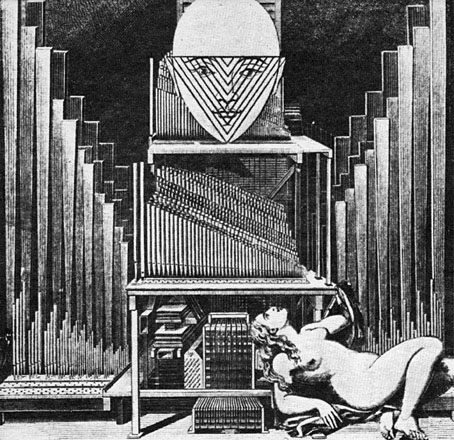
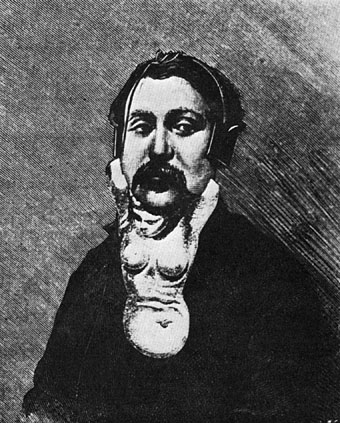
Among the many books inspired or influenced by the events of September 11th, 2001, Jim Harter’s Initiations in the Abyss: A Surrealist Apocalypse is one of the more obscure titles, and one you’re unlikely to hear about elsewhere. Harter is an American artist and archivist best known for his collections of wood engraving illustration published by Dover Publications, Harmony Books, Bonanza Books and others. I mentioned his work recently in a piece about steampunk illustration which will be appearing later this month at Tor.com. Harter’s books are invaluable source material for the style of collage popularised by Max Ernst and Wilfried Sätty. Harter was a friend of Sätty’s, with collages by the pair appearing in Harter’s Picture Archive for Collage and Illustration (1978).

harter5.jpg

The first collection of Harter’s collages, Journeys in the Mythic Sea: An Innerspace Odyssey, appeared in 1985. Initiations in the Abyss is the follow-up featuring work which dates from 1986, some of which was exhibited in 1988 at the Nicholas Roerich museum in New York. The book wasn’t published until 2003, however, and in his introduction Harter acknowledges the influence the events of the past two years had on his conception of the work as a whole. The book is reminiscent of Sätty’s Time Zone (1973), a book with a similar intent in its use of Surrealist collage techniques to make satirical or polemical points as well as to create striking and fantastic images. With both artists it’s the latter works which I find most successful. There’s a limit, for example, to how effectively our world can be represented using pictures which are over a hundred years old, and without the single-minded focus and attack of a John Heartfield the polemic can risk seeming diffuse or glib.

harter3.jpg

Harter’s book is divided into four parts—Mutant Faces of the Form Destroyer, The Holy Abattoir, The Archive of Dreams and Mystery Play—with 72 full-page plates printed on glossy paper. The quality of the printing is so good it makes me wish that Sätty and Ernst could receive the same treatment. In addition there’s a very long introductory essay by Harter which somewhat contradicts his Surrealist intent by explaining at great length some of the philosophy behind pictures whose interpretation he wants left to the reader. Near the end of his piece he says:

It could be said that the purpose of the collages in the present book’s first two sections is to ring an alarm bell. The canaries in the mine are dying and it is time to do something. At the same time, the images of the last two sections are intended as a kind of mystery play. They suggest a movement in another direction: a quest to seek a more universal vision, one where we can perhaps discard our religious fanaticism, ethnocentrism, and myths of apocalypse, and instead create a world of greater unity and harmony, eventually becoming one human family. On another level entirely, this work might be seen as a kind of shamanic soul journey, where all false attachments, beliefs, and illusions are destroyed through an ego death experience before the soil is allowed to proceed to dimensions of healing and revelation. Thus the first two sections might be seen as an encounter with what the Tibetans call the “wrathful deities,” spirits that mirror back one’s own unconscious darkness.

The last two sections of the book feature the best of his dream-like imagery, some of which are a match for Sätty’s superb creations. The examples here are mostly from the end sections. Further examples can be seen on this page where the plates have been coloured by the artist.

Initiations in the Abyss is available to buy direct from the publisher, Wings Press, while some of Harter’s psychedelic poster art can be seen here and here.

Continue reading “Initiations in the Abyss: A Surrealist Apocalypse”