Weekend links 123

niceron.jpg

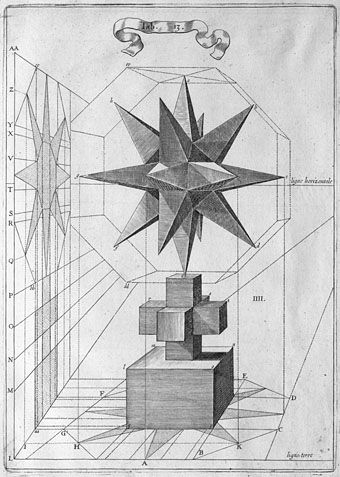
La Perspective Curieuse (1663) by Jean François Nicéron. From Curious Perspectives at BibliOdyssey.

• 1612 Underture is a forthcoming album by The Eccentronic Research Council and Maxine Peake which extends the electronics + occult concept to encompass Kraftwerk and the Pendle Witches. The Quietus has a review of their album, and an interview and report about a recent live performance (I missed the latter, unfortunately), while the Guardian’s interview with the splendid Ms Peake reveals that “musically, her tastes range from Japanese black metal, garage rock and folk, to techno and psychobilly.” The famous Lancashire witches also happen to be the subject of Jeanette Winterson’s latest novel, The Daylight Gate.

• Yet more Marker: The Owl’s Legacy: Chris Marker’s 13-Part Search for Western Culture’s Foundations in Ancient Greece, and J. Hoberman on The Lost Futures of Chris Marker.

• Dr Oliver Sacks talks about how hallucinogenic drugs helped him empathize with his patients.

Paulo Coelho’s ill-judged Joyce-bashing has made him a butt of scorn this week, but he’s a safe target because, with books that multitask a little too openly as self-help manuals, he’s not so clubbable. Unlike, say, Ian McEwan, who not-that-differently declared against “the dead hand of modernism“, for all the world as if the dominant literary mode in post-war England was Steinian experimentation or some Albion Oulipo, against which young Turks hold out with limpidly observed interiority, decodable metaphors, strained middle-class relationships and eternal truths of the human condition(TM).

China Miéville on the always contentious future of the novel.

• The Foliate Head: a new book by Marly Youmans with illustrations by Clive Hicks-Jenkins.

• Hysterical Literature: Session Two: Alicia reads from Leaves of Grass by Walt Whitman.

• Dreaming in Dirigibles: The Airship Postcard Albums of Lord Ventry.

• The Art of the Literary Fake (with Violin) by Jeff VanderMeer.

• RIP Neil Armstrong, first human on the Moon.

• Macho Man: Morgan Meis on Robert Hughes.

• Book covers by Hannes Bok.

• This Is Now!

• Squid Moth

• Lunar Rhapsody (1947) by Dr Samuel J. Hoffman | Lunar Musick Suite (1976) by Steve Hillage | Back Side Of The Moon (Steve Hillage’s Under Water Deep Space Remix) (1991) by The Orb.

Weekend links 122

jackson.jpg

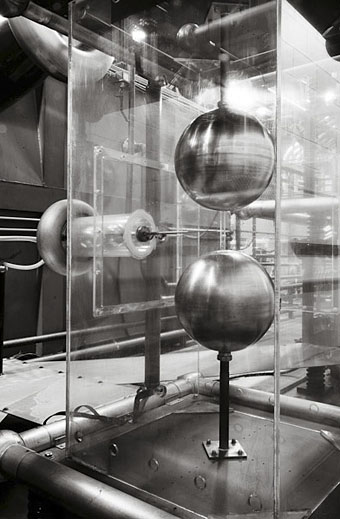
Transmitter Crowbar Discharge Unit, Bates Linear Accelerator. Photo by Daniel Jackson from his Dark Machines series.

The language we use for writing about art is oddly pornographic: We know it when we see it. No one would deny its distinctiveness. Yet efforts to define it inevitably produce squeamishness, as if describing the object too precisely might reveal one’s particular, perhaps peculiar, investments in it. Let us now break that unspoken rule and describe the linguistic features of IAE in some detail.

IAE has a distinctive lexicon: aporia, radically, space, proposition, biopolitical, tension, transversal, autonomy. An artist’s work inevitably interrogates, questions, encodes, transforms, subverts, imbricates, displaces—though often it doesn’t do these things so much as it serves to, functions to, or seems to (or might seem to) do these things. IAE rebukes English for its lack of nouns: Visual becomes visuality, global becomes globality, potential becomes potentiality, experience becomes…experiencability. […] Whatever the content, the aim is to sound to the art world like someone worth listening to, by adopting an approximation of its elite language.

International Art English by Alix Rule & David Levine

For years I’ve been calling it Artspeak: the frequently disingenuous, misleading or merely confused jargon that passes for descriptive writing in the art world. Alix Rule and David Levine apply the more neutral label of International Art English. In a lengthy essay at Triplecanopy they reveal the origins of IAE’s terminology and show why the stuff has spread like semantic kudzu.

• “What a bizarre focal point Anish Kapoor’s spiral callipers are: a Laocoönian observation platform strangled in red steel at a cost of many millions, while electricity pylons, with their austere elegance, once hymned by the poets of the 1930s, have been removed, at enormous cost, from the same site to be buried in the radioactive tilth of landfill dumps and industrial detritus.” Iain Sinclair reports on the Olympics.

• Alfred Kubin in…Nottingham! The Other Side, an exhibition of “haunting drawings of death, trauma and fantastical creatures inhabiting imaginary worlds”, running to the end of September.

• Francis Ford Coppola and Stewart Copeland discuss the making of Rumble Fish (1982). Over at The Rumpus there’s Coppola talking about his career and his latest film, TWIXT.

• Eraserhead: The Making of a Cult Classic. In the 1980s Kenneth George Godwin interviewed everyone responsible for making David Lynch’s film. Fascinating reading.

• Skin Job, the debut poetry collection by Evan J. Peterson, is twenty-one poems about monsters, horror, and science fiction. Evan made a trailer.

• Wood, brass and “the latest advances in nanotechnology”: Teka, an OLED lamp by Aldo Cibic and Tommaso Corà.

• Tonite Let’s All Make Love in London (1967): Peter Whitehead’s film of the capital at its swinging height.

• “Beam Us Up, Mr. Scott!”: Why Misquotations Catch On by Maria Konnikova.

• Hari Kunzru‘s ten favourite books about underground London.

• The Periodic Table of Heavy Metals.

• Alan Garner: A life in books.

• Fuck yeah, manuscripts!

• (HR) Giger Counter.

• This week was all about Vangelis in the 1970s: Creation du Monde (1973) | Spiral (1977) | Himalaya / Summit (1979).

Mars panoramas

mars7.jpg

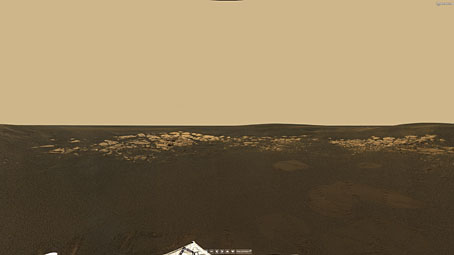
“Greeley Haven“, Mars (2012).

This is the latest panorama released by NASA July 2012. It was assembled from 817 images taken between Dec. 21, 2011, and May 8, 2012, while Opportunity was stationed on an outcrop informally named “Greeley Haven”, on a segment of the rim of ancient Endeavour Crater.

Probably the only time panoramas from another planet will be featured here, these have been around for a while but they’ve only impinged on the wider internet consciousness this week thanks to the arrival on Mars of the Curiosity Rover. Particularly impressive if you’re fortunate enough to have a large monitor. I’m looking forward now to seeing what panoramic images NASA’s new explorer delivers.

mars8.jpg

Eagle Crater, Mars (2004).

mars9.jpg

“Larry’s Lookout“, Mars (2005).

mars10.jpg

“Independence“, Mars (2005).

mars11.jpg

“Everest“, Mars (2005).

Elsewhere on { feuilleton }
• The panoramas archive

Previously on { feuilleton }
• A Trip to Mars
• Signals from Mars

A Trip to Mars

mars3.jpg

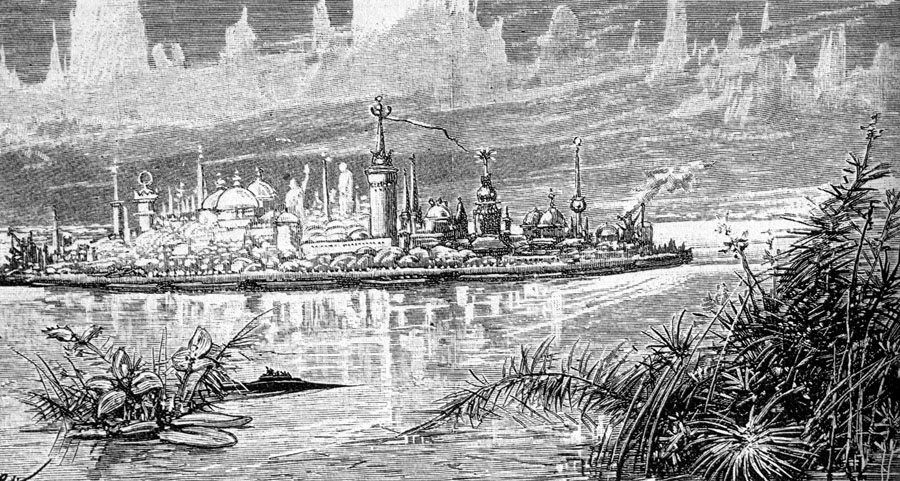
A floating Martian city from Letters from the Planets (1890) by WS Lach-Szyrma. Illustration by Paul Handy.

In honour of the remarkable landing on Mars of the Curiosity Rover, a handful of random illustrations from the vast stock of imagery generated by the Red Planet over the past century-and-a-half. When it comes to Mars I’m afraid you can keep your terraforming and geodesic domes, I prefer the more fanciful scenarios involving air-boats, cloaks and actual canals. Paul Handy’s illustration above shows what I believe is a Venusian vehicle sailing past a Martian city, Lach-Szyrma’s book concerning a journey through the solar system. I only have small copies of these pictures in a book, so far they don’t seem to have turned up online.

mars2.jpg

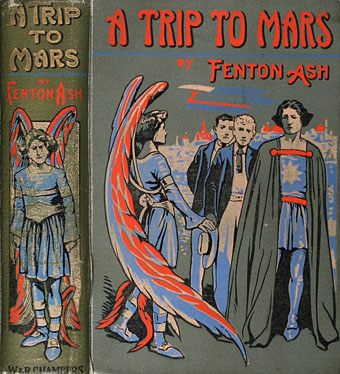
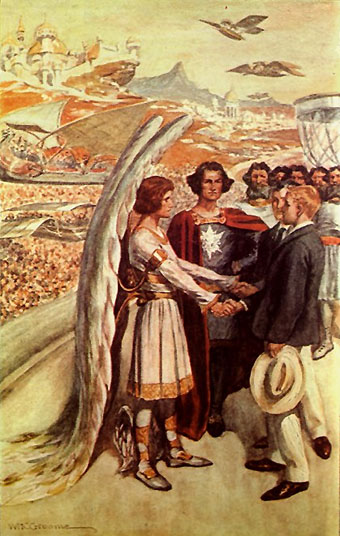
A Trip to Mars (1909) by Fenton Ash. Illustrations by WHC Groome.

Fenton Ash was the nom de plume of British author Francis Henry Atkins. A Trip to Mars concerns another exploratory journey taken this time by a pair of Edwardian schoolboys.

mars1.jpg

Continue reading “A Trip to Mars”

Weekend links 119

peterderome.jpg

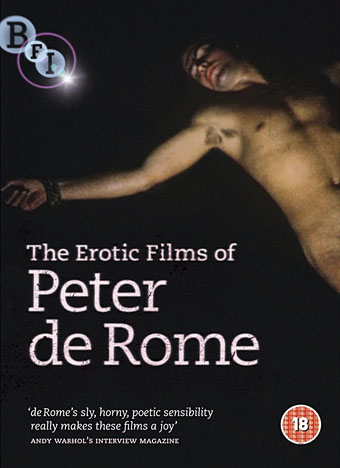
The BFI’s recent DVD release of Peter de Rome’s gay porn films has been mentioned here a couple of times already but I only bought a copy this week. It’s a remarkable release for a number of reasons, not least for showing how much attitudes towards pornography in Britain have changed in recent years. De Rome’s films are explicit enough to ensure that in the 1970s and 1980s anyone caught selling them in the UK might have been imprisoned. That you can now buy them uncut from a high street shop on a disc packaged with the usual care by the British Film Institute means another small part of our iniquitous past has gone for good. Among the extras there’s a documentary with the 88-year-old director discussing his work. This week he talked to BUTT magazine who also have one of his shorter films from the DVD, Hot Pants, on their site.

• “Reading this book, it is hard not to feel that the largest mental health problem – the really crazy thing – is society’s attitude to drugs in general and LSD in particular…” Phil Baker reviews Albion Dreaming: A Popular History of LSD in Britain by Andy Roberts.

• “Loved by aristocrats and immortalized in literature, Denham Fouts remains virtually unknown in his own hometown.” Richard Wall on The World’s Most Expensive Male Prostitute.

The very etiology of rabies is mythic: once the bite heals and the virus has traveled to the brain, “the wound will usually return, as if by magic, with some odd sensation occurring at the site.” Then there’s the fact that no definitive diagnosis can be made without taking a biopsy of the sick animal’s brain, leaving only one gory solution: decapitation.

Rabies is horror’s muse. In almost all iterations of the genre, those we most trust suddenly turn strange: a boyfriend morphs into a wolf at midnight, a fiancé turns out to be harboring a mad first wife in the attic, a friend is bit by a zombie and goes berserk.

Alice Gregory reviews Rabid: A Cultural History of the World’s Most Diabolical Virus by Bill Wasik and Monica Murphy.

• The Horror of Philosophy: Erik Davis talks to Eugene Thacker about Lovecraft, medieval mysticism, and thinking the world-without-us.

• Eagle Scouts Returning Our Badges: A Tumblr for those protesting the current anti-gay stance of the Boy Scouts of America.

• His Father’s Best Translator: Lila Azam Zanganeh on the late Dmitri Nabokov.

• Les Liaisons dangereuses: illustrations by Alastair (Hans Henning Voigt).

• Andrea Scrima looks at Robert Walser’s Der Spaziergang (The Walk).

• 10 Great Places to Meet Lesbians If You Have a Time Machine.

• Jesse Bering in Scientific American asks “Is Your Child Gay?”

• As Above, So Below (1981) by Tom Tom Club | Genius Of Love (1981) by Tom Tom Club | Mea Culpa (1981) by Brian Eno & David Byrne.