Weekend links 708

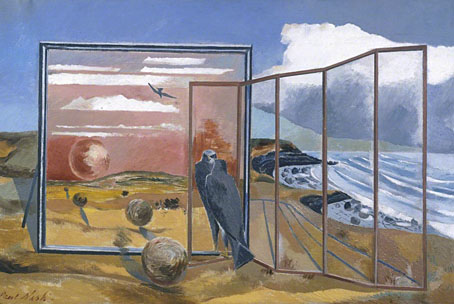
nash.jpg

Landscape from a Dream (1936–38) by Paul Nash.

• “I was telling a close friend recently, ‘at my funeral, please play this record…’” Yu Su on her love of Laurie Anderson’s second album, Mister Heartbreak.

• “Surrealism is more of an attitude than an art movement,” says Mark Polizzotti, talking about his new book, Why Surrealism Matters.

• New music: Spinning by Julia Holter; The Night Dwells In The Day by Jozef Van Wissem; and The River Of Light And Radiation by Ben Frost.

• The late David J. Skal, author of Hollywood Gothic and others, is remembered at Swan River Press.

• At Colossal: Dizzying gifs by Etienne Jacob infuse mathematical equations into endless loops.

• At Public Domain Review: Charles Rabot’s Arctic photographs (ca. 1881).

• At Unquiet Things, S. Elizabeth says “Help me downsize my library!

Drone footage of the recent volcanic eruption in Iceland.

• Mix of the week is a mix for The Wire by Kavari.

• At Dennis Cooper’s: Robert Bresson Day.

Dance On A Volcano (1975) by Genesis | Volcano Diving (1989) by David Van Tieghem | Eye Of The Volcano (2006) by Stereolab

Weekend links 707

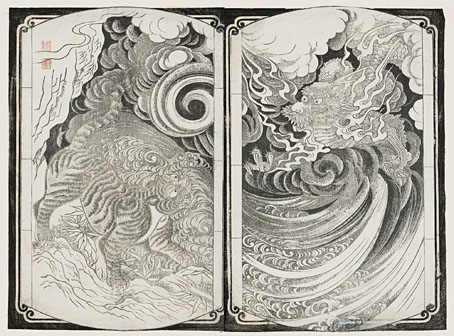
genkosai.jpg

Dragon and Tiger—Designs for Lacquer Inro (no date) by Mori Genkosai.

• “But where have all those copies of Corridor of Mirrors gone? Sometimes I entertain the thought that an obsessive collector has amassed them in his library lined with looking-glasses, so that nobody else can possess the book but he, and he can see them all, multiplied to infinity, as he stalks up and down in his scarlet smoking hat and velvet coat, and gloats.” Mark Valentine on the mysterious unavailability of Corridor of Mirrors (1941), a novel by Chris Massie. The film adaptation made a few years later is one I’ve managed to miss, despite its starring Eric Portman and featuring the first screen appearance of Christopher Lee. Future viewing, I think.

• “The intrepid logician Kurt Gödel believed in the afterlife. In four heartfelt letters to his mother he explained why.” Alexander T Englert explains Gödel’s explanations.

• At Open Culture: Hortus Eystettensis (1613), “the beautifully illustrated book of plants that changed botanical art overnight”.

• Mix of the week: Aquarium Drunkard presents The Secret Hemisphere: New Age, Fusion and Fourth World, 1970–2002.

• New music: Phases Of This And Other Moons by Field Lines Cartographer.

• Why Graphic Culture Matters is a new book of essays by Rick Poynor.

• At Spoon & Tamago: Japanese Designer New Year’s Cards of 2024.

• Steven Heller’s font of the month is Chutz.

• At Dennis Cooper’s it’s Barbara Steele Day.

The Hall Of Mirrors In The Palace At Versailles (1970) by John Cale & Terry Riley | The Hall Of Mirrors (1977) by Kraftwerk | The Room Of Mirrors (2000) by Harold Budd

Weekend links 703

hallbeck.jpg

Njommelsaska i Lappland (1856) by Carl Svantje Hallbeck.

101 hidden gems: the greatest films you’ve never seen. Not another clickbait listicle of Hollywood fare that you really have seen, this is 101 films from Sight & Sound‘s annual poll of critics and directors, each of which only received a single vote. Cinema from the silent era to the present day, “from every continent but Antarctica”, all presented on a single page, and with accompanying notes from the voters. I’ve only seen four of these so it’s a list to mine for the future.

• 2024 will see the 100th anniversary of the publication of the first Surrealist manifestos, so the following new books are making their presences known before the celebratory rush. At Colossal: extracts from New Surrealism: The Uncanny in Contemporary Painting by Robert Zeller; at AnotherMag: photos by Coco Capítan of Salvador Dalí’s home at Port Lligat.

• “Cocteau was like one of those magicians who, having announced that they are going to reveal the secret of one trick, immediately perform another.” Pierre Caizergues introducing extracts from The Secrets of Beauty, a small book of aphorisms by Jean Cocteau, newly translated into English by Juliet Powys.

• More Michael Powell: “Scorsese says The Red Shoes is in his DNA”: Thelma Schoonmaker on her life and work with Michael Powell and his friend Marty.

Dennis Cooper’s favourite fiction, poetry, non-fiction, film, art, and internet of 2023. Thanks again for the link here!

• At The Daily Heller: Book covers by Iris Alba (1935–1993), art director, illustrator and graphic designer.

• At Smithsonian Magazine: See the newest underwater sculptures residing on the floor of the Caribbean.

• At Wormwoodiana: Douglas A. Anderson goes looking for the fantasy fiction of Raymond Chandler.

• At Public Domain Review: Paige Hirschey on Anna Atkins’ cyanotypes.

Entries for the Northern Lights Photographer of the Year 2023.

• At Bibliothèque Gay: Der Mann in der Photographie, 1954.

Aurora (1971) by Tonto’s Expanding Head Band | Aurora (2005) by Alva Noto + Ryuichi Sakamoto | Aurora Liminalis (2013) by William Basinski + Richard Chartier

Weekend links 702

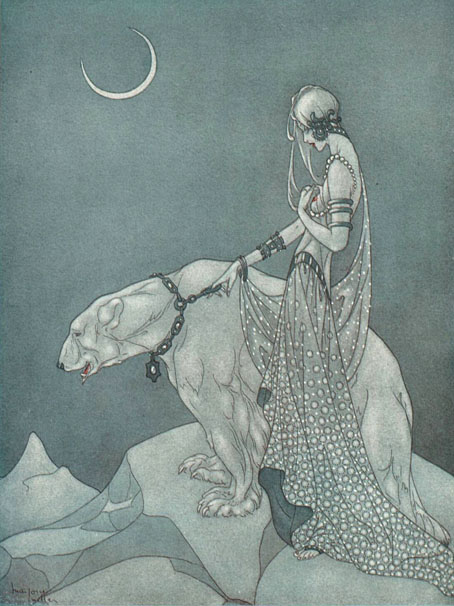
miller.jpg

The Great Bear (1933) by Marjorie Miller.

• New music: “Lo-fi no-fi post-fi fragments of disparate SCATTERBRAIN thoughts scrapbooked together using industrial glue discretely purloined from building site tea-break opportunities to fully form the definitive SEPIA PUNK AMBIENT (?) statement of assiduous apathy intent ~ hextracted from SEPIA CAT CITY (GEpH017LP) available via moonwiringclub.com areet now TA.” Nobody writes product descriptions like Moon Wiring Club.

• “Both the Harry Smith and the Sun Ra books were hard sells, because they were virtual unknowns who had pretty much given their life for art. In each case only about two publishers were interested in either one of them. The editors said either that they hadn’t heard of him, or else they had heard of him and didn’t want to hear any more.” John Szwed talking to Raymond Foye about the mercurial Harry Smith, and the problems of writing biography.

• At Public Domain Review: Max Beerbohm’s A Christmas Garland (1912), a collection of seasonal parodies of well-known writers of the day. As with any such work, the success of each piece depends upon familiarity with the author being parodied, but Beerbohm’s prose is always a delight.

Mirrorshades (1986), the cyberpunk story anthology edited by Bruce Sterling, is currently available for reading or e-text download at Rudy Rucker’s website. The book is still in copyright but I’m guessing this has been done with the agreement of the contributors.

• “…the richness of terrestrial creatures which at points are capable of sounding utterly extra-terrestrial.” Daryl Worthington explores the history of birdsong and its influence on human music.

• At Smithsonian Magazine: Listen to the centre of the Milky Way translated into sound or look at yet more photos of the aurora borealis. (Or do both at the same time.)

• At Wormwoodiana: Through the Golden Valley to the Dark Tower. Mark Valentine and friends go on a book-buying expedition.

14 x 14, a collection of Oulipo poems by Ian Monk, translated by Monk and Philip Terry, with collage cover art by Allan Kausch.

• “I am fascinated by electromagnetic waves.” Carsten Nicolai (aka Alva Noto) discussing art and creativity with Max Dax.

Secret Satan, 2023, the essential end-of-year book list from Strange Flowers.

Spice Islands Sea Birds (1957) by Les Baxter | Trippin’ With The Birds (1997) by Stereolab + Nurse With Wound | Strange Birds (1999) by Coil

Weekend links 700

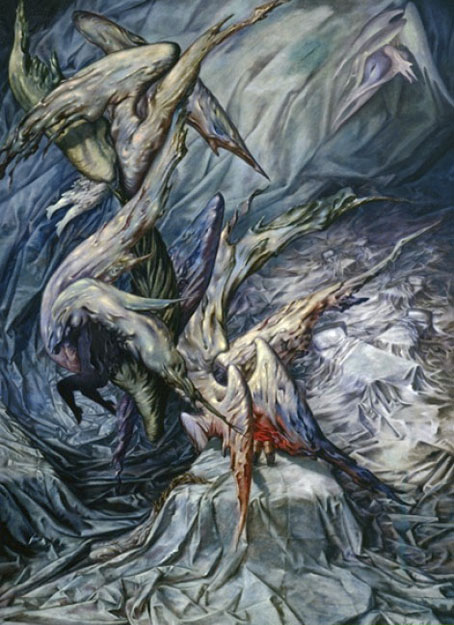
demorgan.jpg

Lux in Tenebris (1895) by Evelyn De Morgan.

• “NASA celebrates the worm logo designer, Richard Danne“. Until I read this story (and this one) I wasn’t aware that the NASA logos were known as The Meatball and The Worm.

The Red Shoes: behind the scenes of the classic Powell and Pressburger film – in pictures. Related: Kings of the movies: Martin Scorsese on Powell & Pressburger.

• The 700th weekend post happens to arrive on Alan Moore’s 70th birthday. Many happy returns to the Northampton Magus.

Fundamentally, we face a choice. Either:

• it’s a coincidence that, of all the possible values that the finely tuned constants of physics may have had, they just happen to have the right values for life;

or:

• the constants have those values because they are right for life.

The former option is wildly improbable; on a conservative estimate, the odds of getting finely tuned constants by chance is less than 1 in 10-136. The latter option amounts to a belief that something at the fundamental level of reality is directed towards the emergence of life. I call this kind of fundamental goal-directedness ‘cosmic purpose’.

As a society, we’re somewhat in denial about fine-tuning, because it doesn’t fit with the picture of science we’ve got used to. It’s a bit like in the 16th century when we started getting evidence that our Earth wasn’t in the centre of the universe, and people struggled to accept it because it didn’t fit with the picture of the universe they’d got used to. Nowadays, we scoff at our ancestors’ inability to follow the evidence where it leads. But every generation absorbs a worldview it can’t see beyond. I believe we’re in a similar situation now with respect to the mounting evidence for cosmic purpose. We’re ignoring what is lying in plain view because it doesn’t fit with the version of reality we’ve got used to. Future generations will mock us for our intransigence.

Philip Goff, professor in philosophy at Durham University, making an argument for cosmic purpose

• At Spoon & Tamago: Exploring Japanese Hell through art from the 12th to 19th century.

• New music: Turning The Prism by Ben Frost, and Sanctuary Of Desire by Steve Roach.

• Mix of the week is DreamScenes – November 2023 at Ambientblog.

• DJ Food looks at Tomi Ungerer’s Electric Circus posters.

• At Dennis Cooper’s: Alain Resnais Day.

Strange Flowers visits the Villa Stuck.

Diet Of Worms (1979) by This Heat | Opera Of Worms (1981) by Van Kaye & Ignit| Wormhole (2002) by Cliff Martinez