Hinton’s hypercubes

hinton.jpg

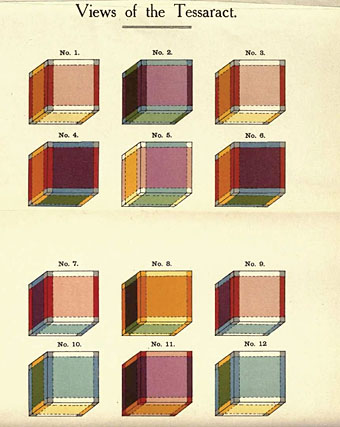
Illustration from The Fourth Dimension (1906) by Charles Howard Hinton.

A slight return to the worlds of Borges. I happened to be re-reading some of the stories in The Book of Sand (1975), one of the later collections which includes the story Borges dedicated to HP Lovecraft, There are more things. Borges’ writings are nothing if not filled with references to other works of literature, philosophies, religions, and ideas in general; following up the less-familiar references would preoccupy a reader to the detriment of the writing so there’s a tendency when reading a Borges piece to take for granted many of those nuggets of esoteric information. I’ve read There are more things many times—it’s a favourite in part for having the additional thrill of Borges going Lovecraftian—but only realised with this reading that I can now fully appreciate the following:

Years later, he was to lend me Hinton’s treatises which attempt to demonstrate the reality of four-dimensional space by means of complicated exercises with multicoloured cubes. I shall never forget the prisms and pyramids that we erected on the floor of his study.

Prior to reading this I did know that Hinton was Charles Howard Hinton (1853–1907), the British mathematician and dimensional theorist. Hinton’s name tends to turn up in discussions of the work of his mystical contemporaries, notably the Theosophists who were more taken with his theories than those in the scientific fields. (A conviction for bigamy didn’t help his reputation.) But those multicoloured cubes were a mystery until the publication of (fittingly) the fourth number of Strange Attractor Journal. Among the usual selection of fascinating articles the book contains a piece by Mark Blacklock about Hinton’s ideas including those mysterious cubes. Drawings of the cubes first appeared in A New Era of Thought (1888) where Hinton proposes using them as aids to a series of mental exercises with which the reader may visualise the higher dimensions of space. Hinton invented the word “tesseract” to describe the four-dimensional structure projected from the faces of his three-dimensional cubes.

dali.jpg

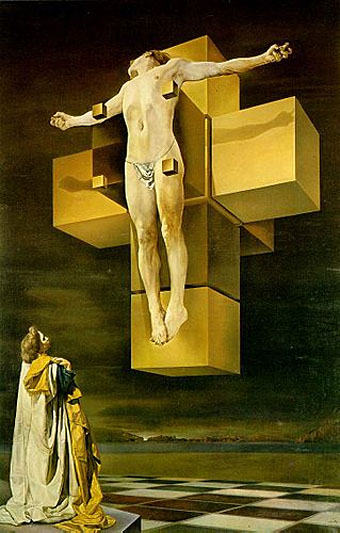
Crucifixion (Corpus Hypercubus, 1954) by Salvador Dalí.

Hinton may not have impressed his mathematical colleagues as much as he hoped but his ideas have an understandable attraction, as the Borges story demonstrates. The story concerns the refashioning of a Buenos Aires house for an unusual resident; thirty years earlier Robert Heinlein wrote “—And He Built a Crooked House—” in which an architect builds a house in the form of a four-dimensional hypercube: only the lowest cube attached to the ground is visible from the exterior. I read that story when I was a teenager, and was already acquainted with tesseracts thanks to school-friends who were maths whizzes; I was the arts whizz, and I think I was probably the first of us Dalí enthusiasts to discover the artist’s own take on the hypercube, Crucifixion (Corpus Hypercubus) from 1954. Borges and Heinlein in those stories were both writing their own forms of science fiction, and Dalí’s painting finds itself co-opted into another story with sf connections, The University of Death (1968) by JG Ballard, one of the chapters in The Atrocity Exhibition (1970):

He lit a gold-tipped cigarette, noticing that a photograph of Talbot had been cleverly montaged over a reproduction of Dalí’s ‘Hypercubic Christ’. Even the film festival had been devised as part of the scenario’s calculated psychodrama.

If we seem to have strayed a little then it’s worth noting that Borges was familiar with Ballard’s work: he included The Drowned Giant in the later editions of The Book of Fantasy, the anthology he edited with Adolfo Bioy Casares and Silvina Ocampo. The two writers also met on at least one occasion.

jlb-jgb.jpg

JLB and JGB, circa 1970. Photo by Sophie Baker.

Charles Hinton’s coloured cubes and tesseracts are described in detail in The Fourth Dimension (1906), a reworking of the ideas from A New Era of Thought, and also the source of the colour illustration that everyone reproduces. Mark Blacklock has his own multi-dimensional website where you can read about his construction of a set of three-dimensional Hinton cubes. As for the mental exercises, Blacklock’s piece in Strange Attractor contains an anecdotal warning that the auto-hypnotic system required to fully visualise Hinton’s dimensions can result in a degree of obsession dangerous to the balance of mind. Proceed with caution.

Previously on { feuilleton }
Borges and the cats
Invasion, a film by Hugo Santiago
Spiderweb, a film by Paul Miller
Books Borges never wrote
Borges and I
Borges documentary
Borges in Performance

Invasion, a film by Hugo Santiago

invasion1.jpg

From a film adapted from Borges to a film co-written by the man himself. Invasion (1969) is not to be confused with the British science fiction film of the same name made three years earlier, this is an Argentinian production and a much stranger piece of work. Hugo Santiago is an Argentinian director who moved to France where he worked for a while as assistant to Robert Bresson before establishing himself with this debut feature. Borges’ co-writer was his friend and regular collaborator Adolfo Bioy Casares.

I’ve not watched this yet, the two copies on YouTube are in Spanish with no subtitles but this is a blog with an international readership so there’s no need to exclude it on that account. Even without subtitles the film is visually intriguing, possessed of a moody and enigmatic style which online reviewers compare favourably to Antonioni and some of the Nouvelle Vague directors.

invasion2.jpg

In 1957, a small group of middle-aged men fight a clandestine battle against forces quietly invading and taking control of their city, Aquilea. Enigmatic in its story-telling, Hugo Santiago’s once-lost film obscures the motivations of either side, leaving only a series of moves and counter-moves that evokes past dictatorial oppression and those still to come.

This post at Make Mine Criterion—a site dedicated to potential Criterion DVD releases—goes into considerable detail examining the film they describe as “part fantasy, part science fiction, part political thriller”. Given this and the rest of the film’s evident qualities it’s surprising it isn’t better known. I only have one Borges biography, The Man in the Mirror of the Book (1996) by James Woodall, but there’s no mention in there of Santiago’s film or of The Others (1974), a later Santiago feature that was also scripted by Borges and Bioy Casares. For those wishing to pursue the film further there are subtitles available if you can be bothered searching for them then trying to synch them up with a YT rip. It might be better to look for a Spanish DVD and hope it has a good choice of subtitles.

invasion3.jpg

Previously on { feuilleton }
Spiderweb, a film by Paul Miller
The Library of Babel by Érik Desmazières
Books Borges never wrote
Borges and I
Borges documentary
Borges in Performance

Weekend links 211

shau.jpg

Secret Bloom (2014) by Natalie Shau.

Bloomsday approachs. “Reading Ulysses changed everything I thought about language, and everything I understood about what a book could do,” says Eimear McBride whose debut novel, A Girl Is a Half-formed Thing, recently won the first Bailey’s women’s prize for fiction. McBride was interviewed by Susanna Rustin last month, shortly before the award was announced, and her novel has now become one of those minor causes célèbres for being rejected so often it was eventually published by a new imprint set up by a bookseller. “If the publishing industry doesn’t take a risk then who will?” asks Henry Layte, the bookseller in question.

Speaking of risk, David Hebblethwaite coincidentally wrote a post earlier this week asking where the formal challenge has gone in science-fiction writing. (He mentions McBride in passing.) Nina Allen followed up with a post of her own. I suspect the books are still being written but they’re no longer being accepted by editors and publishers who want even more adventure stories, “sympathetic” characters, and easy reads. Novels that only aspire to be written equivalents of action films or computer games are doomed to be less exciting than their more kinetic competitors. The struggle between the values of art and the values of entertainment is an old one but it shouldn’t be an either/or proposition. “Difficulty is subjective,” says Eimear McBride, “the demands a writer makes on a reader can be perceived as a compliment.”

Related: the following from Geoffrey Hill on “difficulty”:

We are difficult. Human beings are difficult. We’re difficult to ourselves, we’re difficult to each other. And we are mysteries to ourselves, we are mysteries to each other. One encounters in any ordinary day far more real difficulty than one confronts in the most “intellectual” piece of work.

• The Quietus pulled out all the stops this week, interviewing Annette Peacock, Iain Sinclair (again), Alan Moore (again), and asking Peter Strickland, the director of Berberian Sound Studio, for a list of his favourite albums. Given the above, it’s worth noting that all those people have produced challenging work of their own in different media.

• “The Satyrs Motorcycle Club was founded in 1954 with seven members, but little did anyone know it would become the oldest running LGBT organization (and oldest gay motorcycle club) in the world.”

Trunk TV posted another great selection of television title sequences. The previous selection has been taken down for the usual tiresome copyright reasons so watch this one while you can.

• “Detroit techno and black metal have so much in common,” say Wolves In The Throne Room whose new album, Celestite, is predominantly a product of synthesizer technology.

• “Houghton Library’s copy of Arsène Houssaye’s Des destinées de l’ame (FC8.H8177.879dc) is without a doubt bound in human skin.”

• The secret of Nabokov’s sexual style: David Lodge reviews Nabokov’s Eros and the Poetics of Desire by Maurice Couturier.

• How long can you hold your breath? 2 models, 7 divers in an underwater shipwreck by photographer Von Wong.

• At Dangerous Minds: Paul Gallagher on The fantastic world of Sharmanka Kinetic Theatre.

• Wizards of the Coast: Benjamin Breen on John Dee and the occult in California.

• More photography: Peter Guenzel captures strange lights in forests.

• Mix of the week: Bleep podcast 121 presented by Margot Didsbury.

I’m The One (1972) by Annette Peacock | Eros Arriving (1982) by Bill Nelson | The Dire And Ever Circling Wolves (2005) by Earth

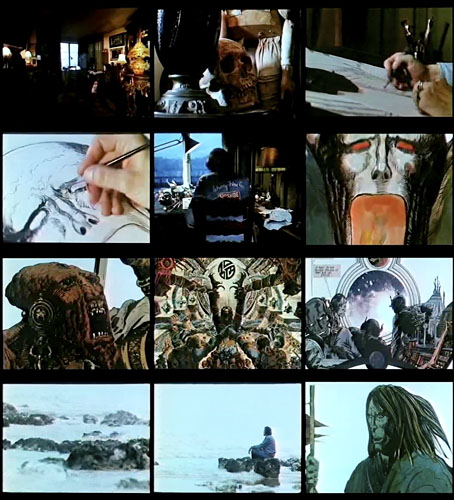
The Man Who Paints Monsters In The Night

giger.jpg

HR Giger. Photo by Eve Arnold, 1979.

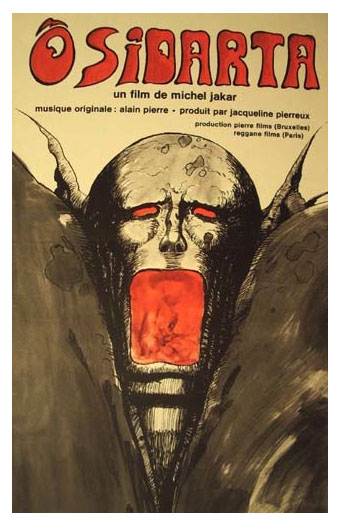
The news of HR Giger’s death was prominently featured in UK papers, something that wouldn’t have happened without his connection to the Alien films. Artists like Giger seldom make the front-page news even though he was well-established before the call from Ridley Scott. He’d already worked on Jodorowsky’s aborted Dune project alongside Moebius (who also did some work on Alien; people forget that), and his work had even appeared in a major feature film before Alien with a blink-and-you-miss-it appearance from his portrait of Li Tobler in Alain Resnais’s Providence (1977). Alien may have made him world-famous but I’ve always felt that Ridley Scott needed Giger far more than Giger needed either Scott or Hollywood. Paul Scanlon and Michael Gross’s The Book of Alien (1979) shows the production designs for the alien components before Giger’s involvement, none of which had the requisite strangeness that made the film such a success. That success would have made many artists decamp to Los Angeles in the hope of repeating the trick but Giger kept his distance. You can’t blame him when his work was diluted by James Cameron in Aliens while a unique project like Clair Noto’s The Tourist—which had heavy Giger involvement—never got made. (See here and here.)

The following is the first interview I read with Giger, a feature in the Sunday Telegraph magazine from August 1979, shortly before Alien was released in the UK. I wasn’t sure whether I still had this since I’d chopped up some of the other pages in the 1980s when I was making collages. The Sunday Telegraph then was even more of a stuffily conservative title than it is now so it’s a surprise to see Giger given such treatment; he was also the cover star although the cover on my copy is lost. I was given this by a friend whose parents read the paper; the only time I’ve ever bought the Sunday Telegraph was when I appeared in it in the early 1990s for a piece about Savoy Books. The interviewer on that occasion was Byron Rogers who I’m surprised to find wrote one of the other pieces in this magazine. (Thanks to Joe for sending me a picture of the missing cover!)

* * *

THE MAN WHO PAINTS MONSTERS IN THE NIGHT by Robin Stringer

giger4.jpgThe man in black is talking about his monster. “It is elegant, fast and terrible. It exists to destroy—and destroys to exist. Once seen it will never be forgotten. It will remain with people who have seen it, perhaps in their dreams or nightmares, for a long, long time. Perhaps for all time.”

The speaker is H. R. Giger, a Swiss-German surrealist painter, who designed the monster for Alien, the latest screen shocker, made in British studios under British direction to meet the apparently insatiable twin public cravings for space and horror films. Alien has already persuaded Americans to queue in record-breaking numbers outside their cinemas. It is said to have recouped its £15 million cost within 26 days of opening, and it comes to Britain on September 6.

The crew of a space tug on a fuelfinding mission answer a distress signal from an unknown planet. They land and discover an alien spacecraft in which, unknown to them, an awful creature has been spawned and waits seething, but with infinite patience, for a chance of life. Taken on board the space tug, clinging to one of the crew, the creature parasitically reproduces itself in him and bursts out into life in a welter of blood. It proceeds to make itself at home on board by hiding in dark places and jumping out at passers-by. It gobbles up the space crew one by one and grows prodigiously. Being unfamiliar with the monster’s lifestyle, the crew understandably panic.

That in brief the story of Alien, which, of course, has actually been spawned by the movie makers to scare us just a little bit and, in the process. to make them a lot of money.

The man who designed the monster will make some money, too—though not a lot, he says. He is not on a percentage. H. R. Giger, who calls himself H.R., because “the other things are too long and complicated”, is a chunky 39-year-old who lives with his girlfriend/secretary Mia, two cats, 12 skeletons and some books on magic in the middle of a rickety row of terraced houses in the industrial outskirts of Zurich. He always wears black.

Continue reading “The Man Who Paints Monsters In The Night”

Steampunk catalogued

steampunk1.jpg

Another month, another exhibition catalogue. Steampunk: The Art of Victorian Futurism is still running at Artcenter IDA in Seoul with a selection of my book covers on display among a great variety of mechanical sculptures, costumes and other creations. The catalogue is a suitably lavish affair, so much so that it puts to shame many of the bandwagon-jumping coffee-table books that have been appearing recently. Excellent printing with lots of gold-ink embellishment, and all the exhibits are given substantial space. I especially like the mechanical type designs, and can now credit them to designers Se Byeol Moon and Han Woong Yoon. Korean TV news has run a couple of reports about the exhibition, the best of which may be seen here. The exhibition itself continues until May 18th.

steampunk2.jpg

steampunk3.jpg

steampunk4.jpg

Previously on { feuilleton }
Steampunk: The Art of Victorian Futurism
Steampunk Calendar
Words and pictures
Nathanial Krill at the Time Node
Fiendish Schemes
Ghosts in Gaslight, Monsters in Steam
Steampunk Revolution
The Bookman Histories
Aether Cola
Crafting steampunk illustrations
SteamPunk Magazine
Morlocks, airships and curious cabinets
The Steampunk Bible
Steampunk Reloaded
Steampunk overloaded!
More Steampunk and the Crawling Chaos
Steampunk Redux
Steampunk framed
Steampunk Horror Shortcuts