
Sorcerer: Druillet and Friedkin

sorcerer1.jpg

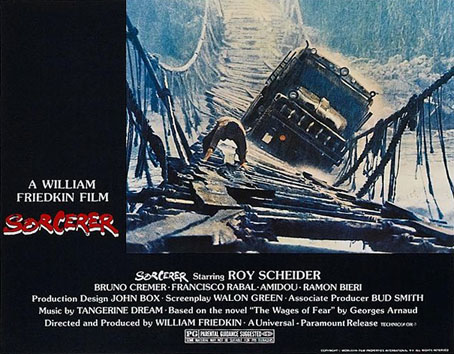
Earlier this week I finally got my hands on the recent Blu-ray reissue of William Friedkin’s Sorcerer (1977). Having only ever seen the film on the travesty of a DVD that appeared in 1998 I’m going to enjoy watching this at the weekend. Brits ought to know that (for now) the only edition available seems to be the US version although it is region-free, and if you buy from a UK film dealer on eBay you won’t get hit with import duties.

sorcerer2.jpg

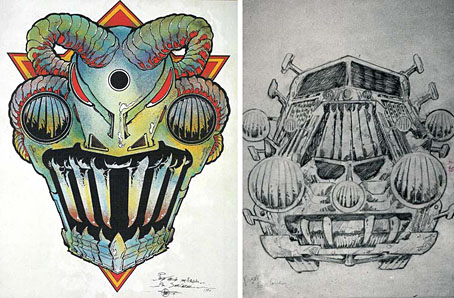
Sorcerer designs by Philippe Druillet.

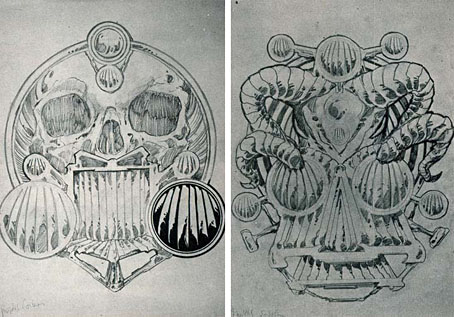
By coincidence, Sorcerer has a minor connection with Philippe Druillet, although his contribution was so minimal that there’s not even a mention of his name on the obsessively detailed Sorcerer film blog. If you’ve seen the film (or Henri-George Clouzot’s equally good earlier version, Wages of Fear), or even read George Arnaud’s novel, you’ll know that the crucial part of the story concerns a potentially suicidal expedition by four men in two trucks, each of which are carrying crates of nitroglycerine through hazardous terrain to the site of an oil-well fire. Friedkin and writer Walon Green expand the story without aping any of Clouzot’s set-pieces (something few directors today would resist), while Friedkin adds some details of his own, notably in the design of the trucks which have distinct “faces” and their own names—”Lazaro” and “Sorcerer”—hence the film’s title which also nods misleadingly to The Exorcist. The truck design was Druillet’s contribution although there’s very little of this apparent on-screen, understandably so when his sketches show fantastic designs that would have no place in the dishevelled jungle town where much of the film takes place. Later sketches by production designer John Box can be found at Wikipedia.

sorcerer3.jpg

Sorcerer designs by Philippe Druillet.

What interests me most about this connection is its being another example of the surreptitious influence of French comics on American cinema during the 70s and 80s. Moebius is the most obvious example of this but it’s also there in the influence of Métal Hurlant/Heavy Metal on the look of Blade Runner, and in Enki Bilal’s design of Molasar in Michael Mann’s The Keep. Since the 1980s we’ve seen a greater industrialisation of conceptual art for the cinema, as a result of which directors are less inclined to look outside Hollywood for their stylists. And now that the treadmill of superhero franchises is grinding away relentlessly, Continental comics and their creators are even less visible than before.

Probably the oddest thing about the Sorcerer/Druillet connection is that the commercial failure of the film in 1977 has often been laid at the door of Star Wars, the advent of George Lucas’s dismal saga being regarded, with some justification, as the opening of the gate to the barbarian hordes. (Friedkin’s film might also have fared better had it not been titled as though it were an Exorcist sequel.) The irony here is that George Lucas happened to be a big Druillet enthusiast, although there’s little evidence of this in his films; in addition to writing an appreciation for Les Univers de Druillet in 2003, he also commissioned Druillet to create a one-off piece of Star Wars art in the late 70s. Knowing this it’s tempting to imagine Lucas creating a very different kind of science-fiction film in 1977, one with some Continental weirdness at its core. But when the world has already been deprived of Jodorowsky’s Dune it’s best not to dwell too much on might-have-beens.

Previously on { feuilleton }
Ô Sidarta: a film about Philippe Druillet
Lovecraft: Démons et Merveilles
Heavy Metal, October 1979: the Lovecraft special
Philippe Druillet album covers
Druillet’s vampires
Salammbô illustrated
Druillet meets Hodgson

Ô Sidarta: a film about Philippe Druillet

sidarta2.jpg

“Qualité très médiocre,” says the uploader of this 10-minute film by Michel Jakar about French comic artist Phillipe Druillet but that’s okay with me when we’re given an opportunity to see Druillet at work in 1974. (Ô Sidarta, as Druillet-heads will tell you, is the name of Lone Sloane’s spaceship.) Jakar captured the saturnine artist on 35mm (!), accompanied by a buzzing electronic score from Alain Pierre; the drawing we see Druillet creating was later used on a poster when the film was being shown around festivals. Cut into the shots of the artist at work are pages and panels from the Lone Sloane story, Délirius (1973), and a later album, Yragaël (1974). Most fascinating for me was seeing Druillet flinging the ink and paint around at speed. This makes sense given the huge volume of pages he was producing in the 1970s, all of them crawling with detail and shading, but it’s still good to have suspicions confirmed.

sidarta1.jpg

Previously on { feuilleton }
Lovecraft: Démons et Merveilles
Heavy Metal, October 1979: the Lovecraft special
Philippe Druillet album covers
Druillet’s vampires
Salammbô illustrated
Druillet meets Hodgson

Weekend links 216

heathen.jpg

Why Do The Heathen Rage? (2014) by The Soft Pink Truth. Cover art by Mavado Charon.

Drew Daniel’s latest release as The Soft Pink Truth is Why Do The Heathen Rage?, a witty electronic riposte to the often reactionary attitudes of black metal music and the people who create it. (The album is dedicated to Magne Andreassen, a gay man stabbed to death by the drummer from Emperor.) Dorian Lynskey talked to Daniel about queering the metal world, as did Angus Finlayson at FACT. Daniel’s project has been receiving press everywhere but you wouldn’t know it to read US/UK gay news sites where the music coverage is relentlessly narrow and insular. To date, only BUTT magazine has mentioned Why Do The Heathen Rage? but then BUTT have always stood apart from their parochial contemporaries. Never mind, here’s another fucking article about “petite pop princess” Kylie Minogue.

• “By the letter of the law, Ulysses was obscene. Obviously, gratuitously, relentlessly obscene.” Josh Cook on censorship and dangerous books. One of my own dangerous publications, the fifth issue of the Lord Horror comics series, Hard Core Horror (declared obscene in a UK court in 1995), received a very belated review at The Comics Journal. More censorship: Judy Bloom on the perennial panics in US school libraries. Lest we feel superior to American prudery, Leena McCall’s painting of a semi-naked woman caused some consternation in a London gallery last week.

• “Over and over, we’re told that nobody buys [compact discs] anymore.” Steven Hyden on the latest obituaries being written for a music format. Ten years ago the death of vinyl was being confidently predicted: “The physical presence of the popular song is gone,” Paul Morley declared. Related: The death of mp3s.

There is nothing quite like Maryanne Amacher’s third ear music. It is alarming. Some of her fellow artists never quite believed that their ears were not being damaged. Third ear music invades you, wraps inside your body, your head, your eyes — just like she says. You can’t be sure, after a while, if the sounds you hear are those created by your ears or Maryanne Amacher.

Stefany Anne Golberg on the music of Maryanne Amacher

• At Dangerous Minds: Nothing Lasts Forever (1984), Bill Murray in a “lost sci-fi comedy set in a totalitarian New York City”.

• More Joyce (there’s always more Joyce): Humument Images to Accompany James Joyce’s Ulysses by Tom Phillips.

• Another celebration of Penda’s Fen by David Rudkin, and another reminder that it’s still not available on DVD.

• Stairway to Heaven: Atlas Obscura on the Gustave Moreau Museum, an essential stop if you visit Paris.

• Mix of the week: Secret Thirteen Mix 121 by Higher Intelligence Agency.

• MetaFilter has a wealth of links to pulp magazine archives.

Yan Nascimbene’s illustrations for Italo Calvino’s stories.

• Rebecca Litchfield’s Orphans of Time and Soviet Ghosts.

• RIP Charlie Haden

Going Home (1972) by Alice Coltrane (Charlie Haden, bass) | Earth (1974) by Joe Henderson Featuring Alice Coltrane (Charlie Haden, bass) | Malkauns (1975) by Don Cherry (Charlie Haden, bass)

Maska: Stanisław Lem and the Brothers Quay

maska1.jpg

Did I mention the Brothers Quay? This is a mesmerising piece, and another short film to add to the growing number of Quay works yet to be collected on DVD. Maska (2010) is a 23-minute digital animation based on Stanisław Lem’s short story, The Mask (1976), which the producers have recently made available on YouTube. It was perhaps inevitable that if the Quays were going to venture into science fiction they’d use an Eastern European source. Lem’s story concerns a sophisticated technological society which is nonetheless still a monarchy. The narrator is an artificial woman who the aristocracy have created for a special mission; her human exterior conceals a robot interior, but this is no Maria from Metropolis. Midway through the story the robot breaks free of its human shell and is revealed to be a mantis-like creature.

maska2.jpg

The Quays’ corpus has tended to avoid genres of any kind so it’s fascinating seeing how they wrangle both sf and horror into a mise-en-scène which is remote from their decaying European scenarios but which, in its details, is completely familiar: puppet characters, flickering light, shifting focus, everything immersed in shadow. Maska also departs from form by having a spoken narration which offers some rudiments of explanation. The habitual atmosphere of unease is still present, however, and pushed to outright horror in places, assisted by extracts from Penderecki’s nerve-jangling De Natura Sonoris No. 1.

maska3.jpg

As with Piotr Kamler’s Chronopolis, this is a good reminder of how science fiction can be presented in a less obvious manner by animation, offering a view into a world that doesn’t have to be explained down to the last detail. Some of the best written SF, and some comic-strip SF (usually the Continental titles), delivers a strangeness that’s completely absent from most filmed science fiction. Vast budgets demand simple-minded narratives with mass appeal so it’s left to animation and low-budget films to venture into areas that would be off-limits elsewhere. Maska is an impressive film, one of the best Quay shorts I’ve seen for some time. Watch it here.

Elsewhere on { feuilleton }
The Quay Brothers archive

Dune: some French connections

landi.jpg

French poster by Michel Landi for the ill-fated Jodorowsky film.

There’s more to French music than Air and Daft Punk, and there’s more to cosmic French music than Magma, although you wouldn’t always know it to read Anglophone music journalists. I’ve been championing the electronica recorded by Bernard Szajner for a long time, and even tried without success to get one of his albums reissued a few years ago. (Which reminds me: Gav, you’ve still got my Szajner albums!) That album (credited to “Zed”), Visions Of Dune (1979), has been out-of-print since 1999 so it’s good to know it’s being reissued on vinyl and CD next month by Finders Keepers’ Andy Votel. FACT has a mix of extracts to give the curious some idea of its buzzing analogue soundscapes.

szajner.jpg

Visions Of Dune (1979) by Zed (Bernard Szajner). Artwork by Klaus Blasquiz.

Visions Of Dune attempts to illustrate Frank Herbert’s novel in musical form; you wouldn’t really know this without the track titles but that’s the way it often is with instrumental music. The album has gained a surprising cult reputation in recent years although it’s difficult to tell whether this is merely a consequence of its rarity or whether it’s because people like Carl Craig have taken to listing it as a favourite electronic record. It’s a decent enough album but I’ve always preferred Szjaner’s follow-up, Some Deaths Take Forever (1980), a conceptual polemic against the death penalty which is ferocious enough in places to be classed among the post-punk electronica being produced in the same year by Throbbing Gristle and Cabaret Voltaire. Szajner later recorded an album with Howard Devoto, Brute Reason (1983), which puts him even more firmly in the post-punk camp. I suspect Some Deaths… offends the hardcore synth-heads with its squalls of electric guitar and other traces of the rock milieu. More amenable is another Szajner album, Superficial Music (1981), which remixes the Visions Of Dune tracks into seven chunks of doom-laden ambience. I’ve never thought of the resulting sound as very superficial, “unsettling” is closer to the mark which is why I included an extract in my Halloween mix last year.

pinhas.jpg

Chronolyse (1978) by Richard Pinhas. Artwork by Patrick Jelin.

Visions Of Dune isn’t the only Dune-related synth album from France. Chronolyse (1978) is the second solo album by Richard Pinhas, another musician you won’t find many Brit writers discussing even though he’s been recording since 1974. Pinhas’s inspirations are an unusual amalgam of science fiction and contemporary French philosophy, a subject he studied at the Sorbonne; prior to going solo he was performing with Heldon, a French prog band whose name is taken from Norman Spinrad’s The Iron Dream. Heldon may be classed as a prog group but their first album, Electronique Guerilla (1974), has one side dedicated to William Burroughs, features a track with “lyrics by Nietzsche”, and also contains an appearance by Gilles Deleuze. Deleuze and Norman Spinrad appeared on later Pinhas solo albums although neither of them are on Chronolyse which, like Visions of Dune, is a wordless (and often tuneless) meander through synthesised soundscapes named after Dune characters. The music on the first side is much more sparse than Szajner’s, and less satisfying as a result; the second side improves with the 29-minute Paul Atreïdes, a typical Pinhas guitar-and-synth jam with extended Fripp-like soloing. As with Szajner, all the Heldon/Pinhas output tends towards the abrasive, and looking at the recent Pinhas discography the man is showing no sign of growing soft, having played shows recently with notorious noise merchants Merzbow and Wolf Eyes.

dune.jpg

Dune paperbacks from Robert Laffont (1975–1983). Designer unknown.

Has there been any other Dune-related music from France? Given the French enthusiasm for science fiction I wouldn’t be surprised. A search for French covers of Frank Herbert’s novels turned up these strikingly abstract examples from Robert Laffont which I’d not seen before. That combination of foil backing and lower-case Helvetica is clearly derived from the celebrated Prospective 21e Siècle series of new music albums released by Philips in the late 1960s. Many of those albums featured exclusive recordings of musique concrète or electro-acoustic compositions (and many of them featured French composers) so there’s another electronica connection. Incidentally, if you ever find one of those Philips albums going cheap in a shop, buy it! The series is very collectible and some of them command high prices. Even if you don’t like the music, they’re worth having for the shiny sleeves.

Update: Further investigation reveals another French album with Dune connections, Eros (1981) by Dün, a Magma-like band whose name is taken from Herbert’s novel. So too are some of the track titles on their sole release: L’Epice and Arrakis.

Previously on { feuilleton }
Alejandro Jodorowsky’s Dune