Essex House book covers

essex01.jpg

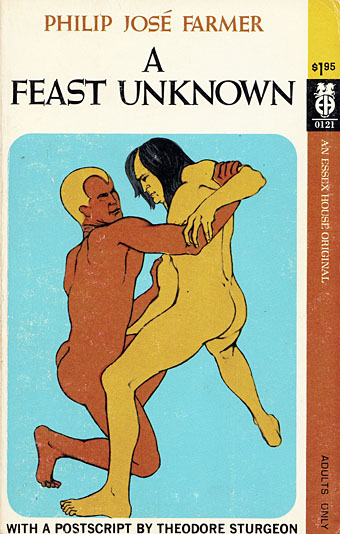
I’ve known the name of American publisher Essex House for many years but the books they published, all of which appeared in a frenzy of activity from 1968 to 1969, have never been easy to find in the UK. The company is chiefly of note today for having three original Philip José Farmer novels on their list, all works of fantasy with the erotic side more dominant than in Farmer’s previous work. Erotic fiction with a generic slant was the Essex House speciality, and while the Farmer covers have appeared here before, I’d not seen any other Essex House covers until the discovery of this page which collects 38 of the 42 published titles.
essex13.jpg

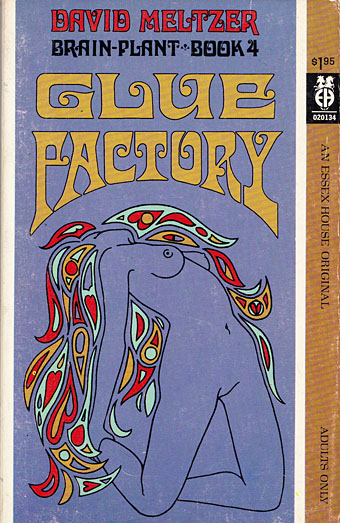
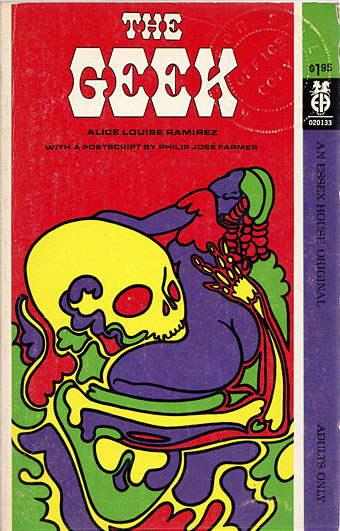
It’s immediately evident looking down the list that the (uncredited) designer managed to forge a distinctive identity for the books at a time when any cover would suffice if the written material was sufficiently pornographic. Many of the covers borrow (or mutate) pre-existing artworks, while others emulate the watered-down psychedelic style that by the late 60s was visible everywhere in the US and much of Europe. These aren’t all great pieces of design but the graphics on erotic titles in the 60s either played safe by favouring text-only covers or sported technically crude emulations of paperback illustration. (For an example of just how technically crude, see this post about some of the many gay pulps on sale in the US.)
essex33.jpg

Essex House may not have been around for long but they seemed to be attempting something different, at least where the covers were concerned. I’ve only read the Farmer books so I can’t vouch for the other titles but the Encyclopedia of Science Fiction writes that

…about half the 42 titles published by Essex House were sf/fantasy; they included novels by Philip José Farmer, Richard E Geis, David Meltzer (perhaps the most distinguished), Michael Perkins and Hank Stine…of which a number were ambitious, some literary, and most somewhat joyless—even emetic—and redolent of 1960s radicalism.

Pornography as a tool of radical politics had a brief vogue in the late 60s and early 70s, something that’s particularly evident in the underground magazines of the period. The results may be “joyless” to some but then I find a lot of the alleged classics of science fiction joyless so it’s all a matter of taste. There was no equivalent of Essex House in the UK but in the 1970s France had the Chute Libre imprint which not only published all of the Essex House Farmer titles but did so with a collection of equally striking (or “joyless”) cover designs.
essex23.jpg

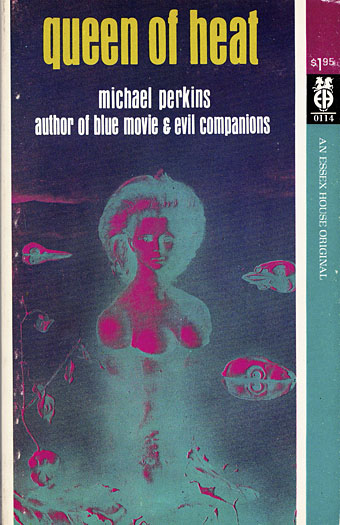
Artwork is a solarised version of Le Bout du monde (1949) by Leonor Fini.
Continue reading “Essex House book covers”

Weekend links 305

marchbank.jpg

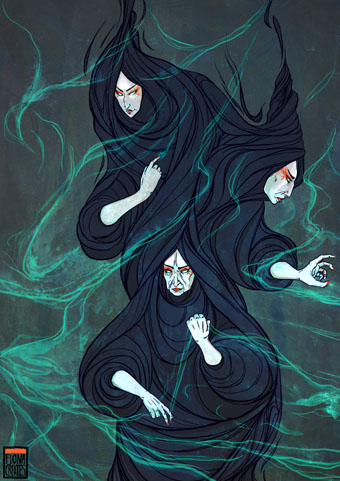
Threads of Fate—The Weird Sisters from Macbeth (2013) by Fiona Marchbank.

• The week in books: Claire Cameron on the difference between US & UK cover designs | Jason Diamond asks “Why do cats love bookstores?” | Alan Moore’s cover art for his forthcoming novel, Jerusalem, has been revealed | Brian Phillips on the typefaces used by New English Library for their Dune covers in the 1970s.

• On writing: Poetry and horror “share a universally human quest toward intimacy” says Evan J. Peterson | “The best work neither shows nor tells: it says by being, not by saying,” says M. John Harrison.

• At the BFI this week: Where to begin with Jerzy Skolimowski, and 10 overlooked British horror films of the 1970s. Both lists include Skolimowski’s excellent The Shout (1978).

Cultures do not, and cannot, work through notions of ‘ownership’. The history of culture is the history of cultural appropriation—of cultures borrowing, stealing, changing, transforming.

Nor does preventing whites from wearing locks or practicing yoga challenge racism in any meaningful way. What the campaigns against cultural appropriation reveal is the disintegration of the meaning of ‘anti-racism’. Once it meant to struggle for equal treatment for all. Now it means defining the correct etiquette for a plural society. The campaign against cultural appropriation is about policing manners rather than transforming society.

Kenan Malik on ill-considered complaints against “cultural appropriation”. Malik isn’t the first to note the intersection of such complaints with those of white supremacists who also want cultural purity and segregation

OUT, DEMONS, OUT!: The 1967 Exorcism of the Pentagon and the Birth of Yippie! An oral history by Larry “Ratso” Sloman, Michael Simmons and Jay Babcock.

• The long-overdue republication of Moebius’s work in English will begin with a new edition of The World of Edena (1985).

• More from radioactive Russia: Nadav Kander’s photographs of Soviet nuclear test sites.

• Comic artist and illustrator Kris Guidio in conversation with Jonathan Barlow.

• Francesca Gavin meets Tadanori Yokoo, “the Grandmaster of Pop-Psych Art”.

• “LSD’s impact on the brain revealed in groundbreaking images”

• Mix of the week: Secret Thirteen Mix 182 by Paul Jebanasam.

• A trailer for Nicolas Winding Refn’s The Neon Demon.

• Tony Conrad: 1940–2016 by Geeta Dayal.

Brian Eno’s favourite records

Neonlicht (1994) by Mitja VS (with Enzo Fabiani Quartet) | On Demon Wings (2000) by Bohren & Der Club of Gore | Shout At The Devil (2002) by Jah Wobble & Temple Of Sound

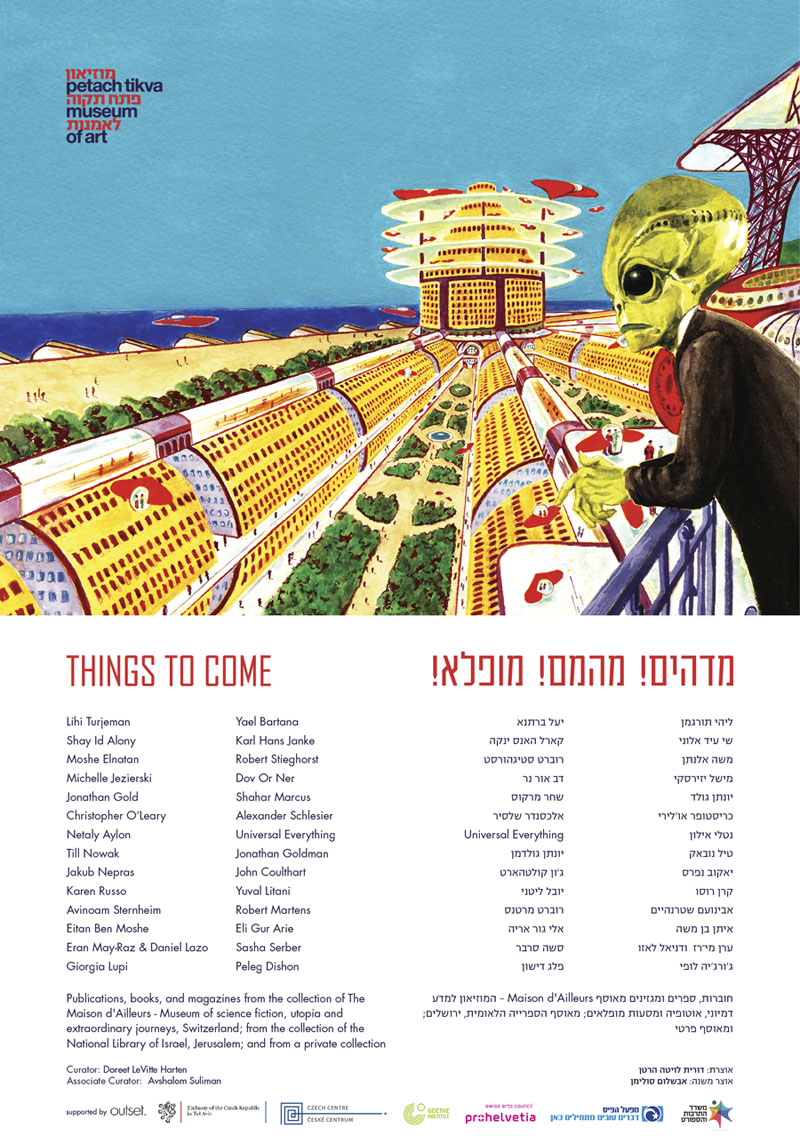
Things to Come

thingstocome.jpg

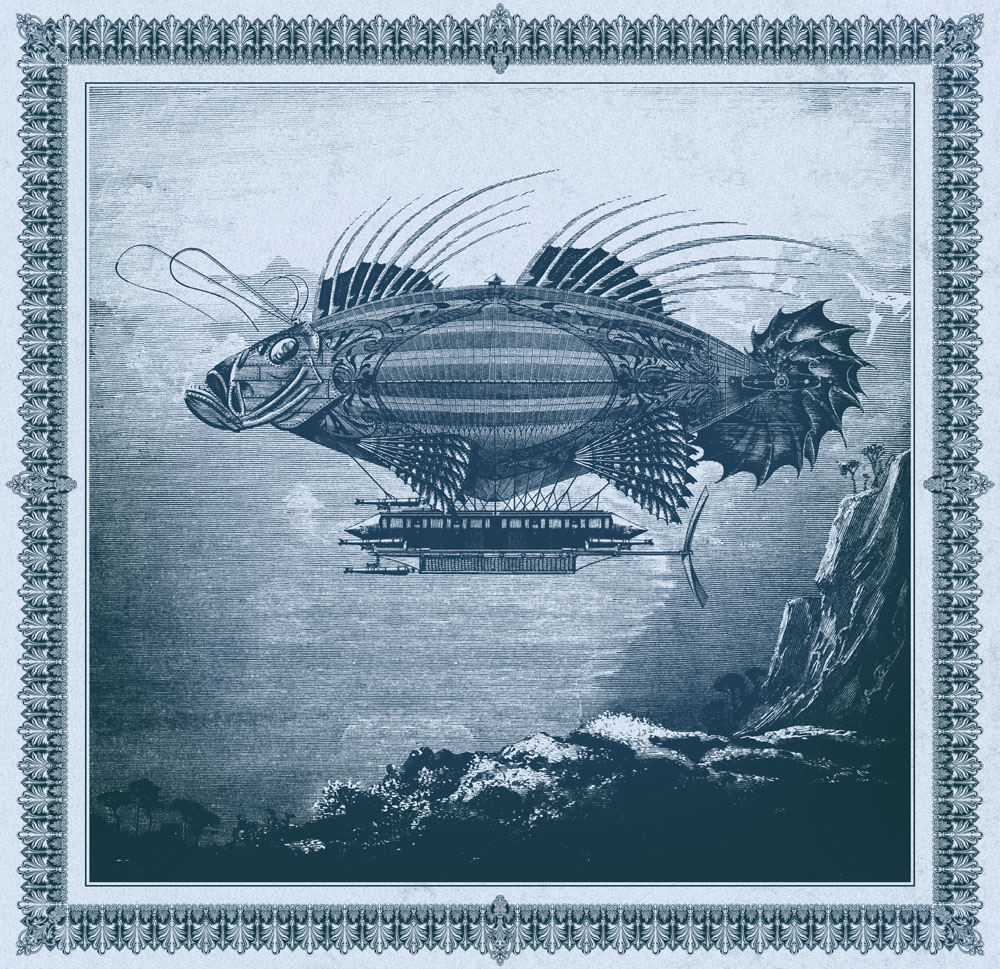
Things to Come is a science fiction-themed art exhibition opening this week at the Petach Tikva Museum of Art, Israel. Among the works on display there will be a large print of the fish-shaped dirigible that I created for Jeff VanderMeer and SJ Chambers, editors of The Steampunk Bible, back in 2010. After publication I reworked the picture slightly, adding a frame and trying out various tints, the idea being to produce a large version for print sales. I still haven’t got round to making prints available but I did let the museum have a copy of the framed version so its appearance at Petach Tikva is a first.

airfish.jpg

My thanks to Doreet LeVitte Harten for selecting this piece, and to Avshalom Suliman for dealing with the printing and other details. The exhibition runs to 20th August, 2016.

Previously on { feuilleton }
Steampunk in the Tank

Weekend links 303

belbury.jpg

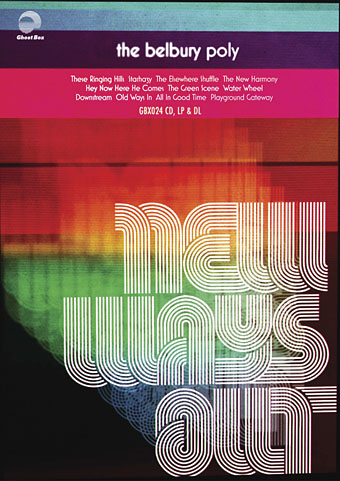
Design by Julian House.

• The last major release by Ghost Box recording artists Belbury Poly was The Belbury Tales in 2012, so news of a new album is most welcome. New Ways Out by The Belbury Poly (that definite article is a fresh addition) will be released next month. The Belbury Parish Magazine has links to larger copies of Julian House’s artwork for this and the recent release from Hintermass, The Apple Tree.

But before New Ways Out appears there’s a compilation album from A Year In The Country released at the end of April. The Quietened Village is “a study of and reflection on the lost, disappeared and once were homes and hamlets that have wandered off the maps or that have become shells of their former lives and times. Audiological contents created by Howlround, Time Attendant, The Straw Bear Band, Polypores, The Soulless Party, The Rowan Amber Mill, Cosmic Neighbourhood, A Year In The Country, Sproatly Smith, David Colohan and Richard Moult.” I’ve been fortunate to hear an advance copy, and it’s an excellent collection.

• “London’s architecture has become laughably boorish, confidently uncouth and flashily arid,” says Jonathan Meades in a review of Slow Burn City: London in the Twenty-First Century by Rowan Moore.

I feel very ill, physically and mentally ill when I hear Christmas carols. I feel so angry, so much like getting out a sniper’s rifle when I hear that kind of music. And Broadway shows with their sentimental songs, those kinds of things are terrifying for me because they call up memories from far back and I don’t necessarily know what they are but they just break me, they break my heart, they break my soul. Iannis Xenakis, the great Greek composer, he said the same thing. He couldn’t listen to the music his mother had played to him when he was young, because it was akin to thinking of someone who was disemboweled. And so for me, if I do a song that’s what you’d say is pretty, my interpretation takes it to another place because it shows the death of the virgin, the animal that goes out in the spring and then gets shot by a hunter. It is prettiness that is very alarming to me, so I tend to do a juxtaposition of something that might be pretty with something that is harsh, just because I feel that they occur in life together.

Diamanda Galás talking to Louise Brown about her work

The Fantastical Otherworlds of Adam Burke: S. Elizabeth talks to the artist behind Nightjar Illustration.

• “I try to frighten myself”: Master musician and curator David Toop on his extraordinary cassette tape archives.

• Silver Machine: Hawkwind’s Space Rock Journey throughout Science Fiction and Fantasy by Jason Heller.

• Mixes of the week: Secret Thirteen Mix 179 by Mesmeon, and a new Italian Occult Psychedelia Festival Mix.

• Offset Identities: Kenneth FitzGerald on graphic designer Barney Bubbles.

The Cine-Tourist lists some of the many cats in the films of Chris Marker.

John Patterson on Ran (1985), Akira Kurosawa’s last great masterpiece.

• Britain’s scarecrows photographed by Colin Garratt.

Strange Flowers explores the city of Turin.

The Museum of Talking Boards

Giallo-themed playing cards

Origami bookmarks

Silver Machine (1972) by Hawkwind | Silver Machine (1973) by James Last | Silver Machine (1988) by Alien Sex Fiend

Weekend links 302

bacchus.jpg

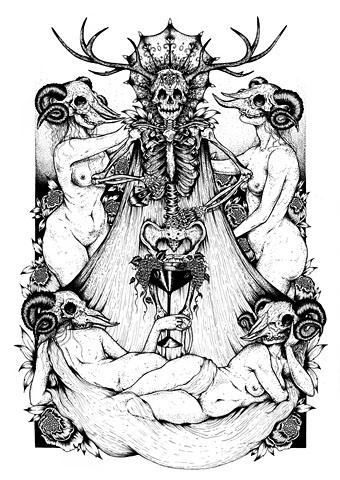
Nymphs of Bacchus by Lozzy Bones.

• “[Jonathan Meades] has a horror of explanation and an even greater one of manifestos, the artless moron’s medium of choice.” The writer turns artist with an “exhibition of Treyfs and Artknacks” at Londonewscastle.

Robert Aickman: Author of Strange Tales is a 50-minute introduction to the writer and his works by RB Russell and Rosalie Parker.

A second volume of  Cosmic Machine: A Voyage Through French Cosmic & Electronic Avantgarde will be landing in May.

Amelia Mangan talks to Kattomic Energy about her horror fiction, and mentions these pages in passing. (Thanks!)

• The Interpretation of Screams: AS Hamrah on David Lynch: The Man from Another Place by Dennis Lim.

• “People thought we were on drugs – and we were!” Minimalist musician Tony Conrad interviewed.

• Two 1975 Buchla concerts by Suzanne Ciani are released for the first time by Finders Keepers.

• Inspiration from above and below: The strange world of… Sunn O))).

• At Dangerous Minds: HR Giger’s ads for the Pioneer Corporation.

• At Dennis Cooper’s: New Queer Cinema (1985–1998).

Graphic Stamps, a history by Iain Follett and Blair Thomson.

Ramsey Campbell’s “Thirteen Novels on the Edge of Horror”.

• The occult artwork of David Chaim Smith.

Easter Woman (1980) by The Residents | Easter Parade (1984) by The Blue Nile | Easterfaust (2014) by The Cosmic Dead