Portuguese Diseases

disease1.jpg

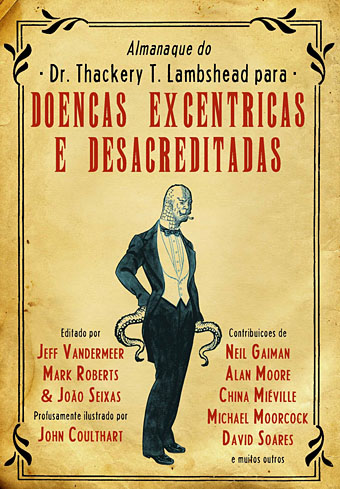
This volume appears to be in print now, the Portuguese edition of The Thackery T Lambshead Pocket Guide to Eccentric and Discredited Diseases, a unique fantasy anthology compiled in 2003 by Jeff VanderMeer and Mark Roberts. The new edition is published by Saida de Emergência and translated by Luís Rodrigues, João Seixas and Vítor Morta. I didn’t design this cover with its eccentric kerning but I did design the original edition for Night Shade, to date still one of my most elaborate and detailed book designs, too elaborate for the larger publishing houses, in fact, who either dropped or amended the deliberately diseased title spread for their paperback editions. You can see some of the original pages below. I sent the Portuguese publishers all the artwork and layouts but since I haven’t seen a printed copy of the book I don’t know how the interior looks. I don’t even know whether my name appears on the cover as it does here since other examples online show a different design. However, it’s often the case these days that cover designs get sent out prematurely for marketing purposes before things have been finalised.

disease2.jpg

Title spread.

disease3.jpg

Contents spread.

Previously on { feuilleton }
Pasticheur’s Addiction

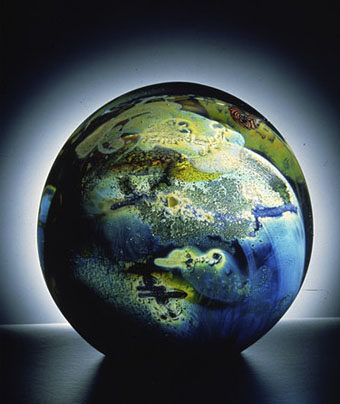
Josh Simpson’s glass planets

simpson1.jpg

Planet.

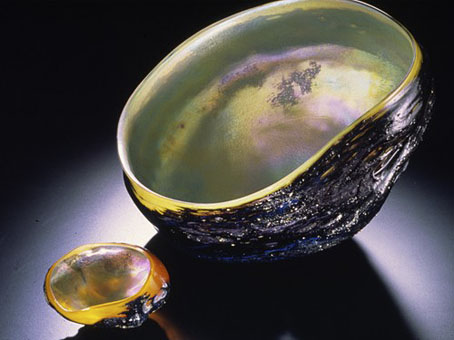
American glass artist Josh Simpson takes the paperweight-as-miniature-world to its logical conclusion by creating series of hyper-detailed spheres he calls Planets. He continues the extraterrestrial theme by also creating his own version of tektite meteor glass (below) embellished with iridescent interiors. His site is worth a browse for other glass artefacts such as his Inhabited Vases and I like the colourless glass bubble pieces. Finally, he has details of an ongoing project to hide his Planets in various remote places around the world with the intention of surprising future inhabitants or archaeologists. If that sounds intriguing, you can get involved here.

simpson2.jpg

Tektite.

Previously on { feuilleton }
Luke Jerram’s Glass Microbiology
Andy Paiko’s glass art
The art of Josiah McElheny
The art of Angelo Filomeno
Cristalophonics: searching for the Cocteau sound
Glass engines and marble machines
Wesley Fleming’s glass insects
The art of Lucio Bubacco
The glass menagerie

Weekend links: Ghosts, Spooks and Spectres edition

spectres.jpg

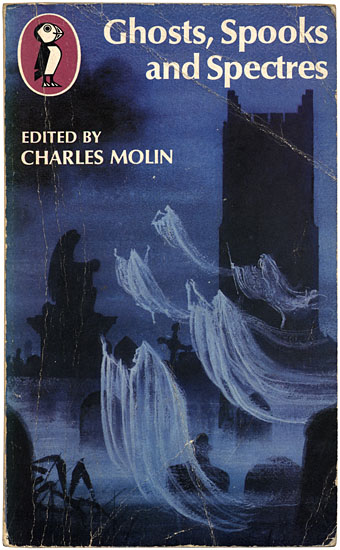
Cover design by Philip Gough.

Ghosts, Spooks and Spectres (1972 reprint). Editor Charles Molin collected nineteen ghost stories by writers including Oscar Wilde (The Canterville Ghost), Charles Dickens (The Signal-Man), J. Sheridan Le Fanu (Madame Crowl’s Ghost) and HG Wells (The Inexperienced Ghost). This was one of my favourite books when I was ten-years old. There’s nuffin like a Puffin. Puffin Books’ parent company, Penguin, is 75 this year.

• The good people at the Outer Alliance have posted an interview with me here in which I talk about the subversive sexualities of sf in the 1970s and also admit to writing fiction.

• There’s just time to mention It Came From Pebble Mill, an event which includes another screening of David Rudkin’s Penda’s Fen.

• “In our society, there has tended to be a very strong compartmentalization of different experiences, different cultural forms, different genres. We can talk in a very broad sense and say art is separate from science, for example, or body is separate from mind, or we can talk in a specific sense and say one certain form of dance music is separate from one form of, say, heavy metal. I don’t really buy those compartmentalizations. I understand why they exist, how they’ve come into being and why they’re convenient, but it’s not the way I think, it’s not the way I experience the world, it’s not the way I believe things should be.” From an interview by Colin Marshall with David Toop at 3QD. Toop’s latest book is Sinister Resonance: The Mediumship of the Listener.

The Kingdom of the Pearl by Léonard Rosenthal, illustrated by Edmund Dulac.

Ghost Stations by Dollboy, a CD package. And then there’s the Ghostly Bento.

7 Inch Cinema are Birmingham-based cultural historians.

• Mark Pilkington’s Mirage Men now has its own site.

Borges on Pleasure Island: JLB and his love of RLS.

• RIP Arne Nordheim, Norwegian composer.

• Charlie Visnic’s Modular Ghost Synth.

On the trail of Tutankhamen’s penis.

Photos by Thom Ayres.

Ghosts by Japan | Spooky Rhodes by Laika | Purple Dusk by Spectre.

Rammellzee RIP

rammellzee.jpg

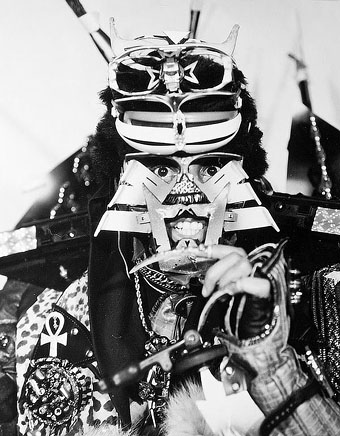
Rammellzee.

I consider that immortality is the only goal worth striving for: immortality in space. Man is an artefact created for space travel.
William Burroughs, 1982

We have to leave this tasteless mould of a planet.
Rammellzee, 2004

It’s fitting that a post about the late Rammellzee should follow one about Brion Gysin even if the circumstances aren’t those one would wish. Before he was involved in music Rammellzee was a graffiti artist and the convoluted mythologising which he later wove around the art of the graffiti tag—and his obsession with words and their meaning—bears comparison with Gysin and Burroughs’ similar mythologising, their theories about the viral origins of language. Look at Gysin’s calligraphic paintings (which he based on Arabic script) and you’ll see an exact analogue with the stylisations of graffiti taggers.

Given all of that, it’s even more fitting that Rammellzee was one of the voices chosen by Bill Laswell to set beside William Burroughs on Material’s finest forty minutes, Seven Souls, in 1989. I knew that voice from the great 1983 single he made with K-Rob, Beat Bop, one of many highlights on the best of the Street Sounds compilations, Electro 2, so it was a pleasant surprise finding it on the album which remains the best musical work that Burroughs was involved with. Rammellzee’s subsequent recordings with Laswell and others evolved an elaborate strain of what’s now known as Afrofuturism which he extended into paintings, collages and sculptural work. When you look at his detailed, science fiction philosophies, or at the underwater mythologies of Drexciya, it’s evident that there’s a rich seam of the African-American imagination which exactly parallels Burroughs’ visionary work. Visionaries right now are in short supply; we can’t afford to lose another.

Rammellzee: The Remanipulator versus Syntactical Virus by Peter Shapiro (1997)
No Guts No Galaxy—Rammellzee & phonosycographDISK (1999)
Rammellzee: The Ikonoklast Samurai by Greg Tate (2004)

Previously on { feuilleton }
Street Sounds Electro
The art of Shinro Ohtake

Dodgem Logic again

dodgem.jpg

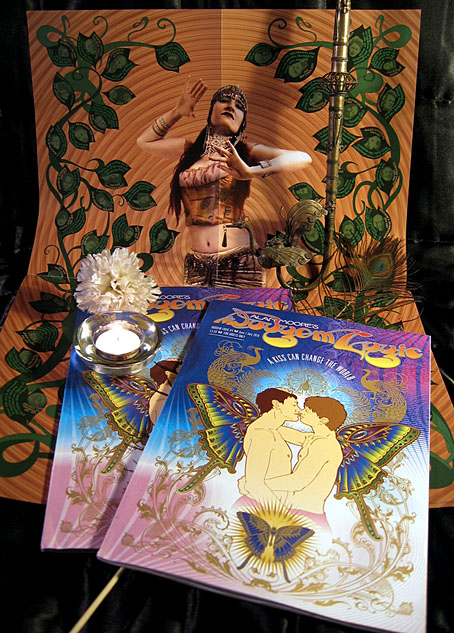
Look what the postman delivered. Well, not the peacock feather and candle, obviously… Dodgem Logic #4 is now in print and my cover design looks as splendid as I hoped, gold ink included. The bonus item for this delirious issue is the rather wonderful poster you see in the background, a Joe Brown & Alan Moore collaboration entitled Bohemia which features a burgeoning growth of Bohemians through the ages, from Sappho through to more contemporary cultural icons. Inside there’s Dick Foreman discussing psychedelia, comics from Steve Aylett, Barney Farmer, Lee Healey, Kevin O’Neill and Savage Pencil, Melinda Gebbie’s gorgeous paintings, Debbie Delano on how to be an openly gay school teacher, Steve Moore asking for no more war, and Mister Alan Moore giving us his personal history of science fiction. You can order it online here.

Previously on { feuilleton }
Dodgem Logic #4
Dodgem Logic