Raising the roof

ramases1.jpg

Roger Dean’s album cover art extends further than his sleeve illustrations for Yes. His earlier designs for the Vertigo label showed his visual invention to good effect, and a couple of those designs have had their imitators. The cover art for Dedicated To You, But You Weren’t Listening by the Keith Tippett Group is one that I’ve seen copied although I forget where for the moment so you’ll have to take this on trust. (Ahem.)

ramases2.jpg

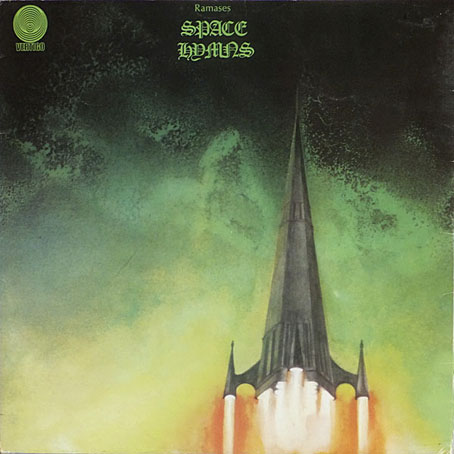
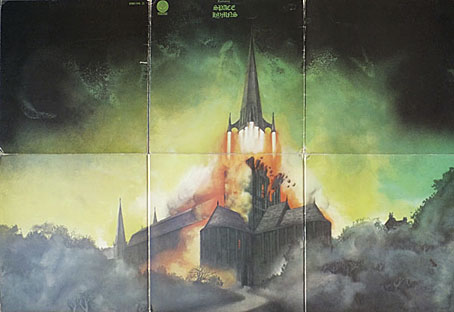
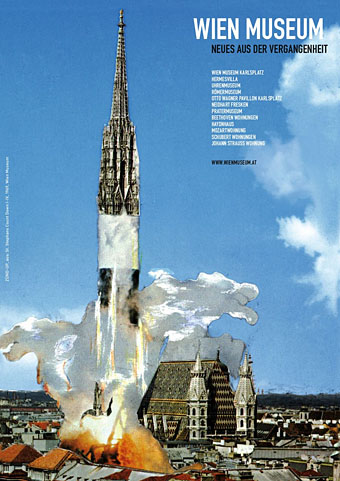
The church steeple blasting off from Space Hymns (1971) by Ramases is borrowed somewhat crudely in a 2011 ad for the Wien Museum which shows Vienna’s St Stephen’s cathedral undergoing a similar transformation. The Ramases idea is so eye-catching I’m surprised I’ve not seen it imitated before, although it wasn’t Dean’s invention; in his Views book he says that it was the group’s idea, and they gave him a thorough brief. I presume by this he means that they also wanted the spire as a cover detail, and looking sufficiently rocket-like to give a surprise when the sleeve is opened.

wien.jpg

“Ramases” was Martin Raphael Barrington Frost, an Egypt-obsessed British musician who recorded two albums and a single with wife, “Selket”. The single B-side, Mind’s Eye (1968), is a decent piece of psychedelia that turns up on compilations. The same can’t be said for Space Hymns, unfortunately; the presence of 10cc as backing band isn’t enough to rescue songs whose cosmic titles offer more than they deliver. But that’s still a great sleeve. Thanks to @weird_prophet for the Wien tip!

Elsewhere on { feuilleton }
The album covers archive

Previously on { feuilleton }
Roger Dean: artist and designer

L’amour des âmes

delville1.jpg

L’amour des âmes (1900) by Jean Delville.

Another of the many connections between the Symbolism and psychedelic poster art, the mystically-inclined Jean Delville (1867–1953) may at least have approved of the addition of a yin-yang symbol to his painting of drifting souls. I was originally going to post Delville’s Pour L’art poster design since I’ve not seen a copy on the web as good as the one below which is scanned from a book. (The principal Delville site has many of his works but in variable quality.) Delville’s pair of floating lovers happen coincidentally to suit the preoccupations of February 14th.

grimshaw.jpg

MC5 at the Grande Ballroom, Detroit (1967) by Gary Grimshaw.

Pour L’art was a Belgian circle of artists formed in Brussels in 1892 to stage exhibitions promoting their work. Delville was the most notable of the group as well as being one of its prime movers. Looking on the Delville website it’s good to see there’s a major study of the artist’s life and work in progress, with publication scheduled for later this year. Too many artists from the late 19th century have been neglected for far too long but attitudes are slowly changing. Anyone interested in Jean Delville is advised to also look at this site which is dedicated to that apostle of androgyny, Joséphin Péladan. One of the strangest characters in the Symbolist menagerie (and the competition for that label is fierce), Péladan’s occult theories inspired Delville and a number of other artists in Belgium and France. It’s good to see he’s also gaining some serious study at last.

delville2.jpg

Pour L’art (1892) by Jean Delville.

Previously on { feuilleton }
Philippe Jullian, connoisseur of the exotic
Delville, Scriabin and Prometheus
The faces of Parsifal
Masonic fonts and the designer’s dark materials
Angels 4: Fallen angels

Stuck’s serpents

stuck1.jpg

The Sin (1894).

Some pictures in honour of the Chinese year of the Water Snake which begins this Sunday. Paintings of women with snakes are legion, even after you winnow out all the Eve and the Serpent pictures, so you need to narrow the field of view. Artists of the 19th century must have been delighted when Gustave Flaubert published Salammbô in 1862, chapter 10 of which—The Serpent—gave them an excuse to depict an exotic woman involved with a snake completely free of any Biblical trappings.

stuck3.jpg

Sensuality (1891).

Franz Stuck’s celebrated trio of serpent women can be read as Eve figures but their provocative posing is more in line with the prurient misogyny common to much art of the period, an attitude which condemned women for being so tempting whilst also secretly lusting after their bodies. Sensuality is remarkable for the way its oiled snake is so firmly lodged between the woman’s thighs. Stuck was never very interested in Christian themes—many of his other works are a Teutonic take on Classical subjects—so I wonder whether his use of the word “sin” was merely a fig leaf for delivering imagery he wouldn’t have otherwise been able to exhibit.

stuck2.jpg

The Sin (1893).

wilson.jpg

Sin Dance (1966) by Wes Wilson.

Symbolist art was rediscovered in the 1960s after decades of neglect, and the psychedelic poster artists happily plundered the art books for suitable imagery. Stuck’s Sin returned to the world in these two Avalon Ballroom posters. Wes Wilson’s Sin Dance was a design for an event which was cancelled so this might explain why the same painting appeared a few months later on a Stanley Mouse and Alton Kelley poster. The Mouse & Kelley version was printed with metallic inks.

For more of Franz Stuck’s work see WikiPaintings.

mouse.jpg

Jefferson Airplane at the Avalon Ballroom (1966) by Mouse & Kelley.

Previously on { feuilleton }
Serpentine pulchritude
Salammbô illustrated
The Feminine Sphinx
Men with snakes

Weekend links 144

thomas.jpg

Ruins 3 by Rachel Thomas and Dan Tobin Smith.

“Dan wanted to do something on a really large scale and was looking at a lot of Piranesi and started talking to me about ruins. I then started looking at modern interpretations of this idea, I was obsessed with the post modern architecture of SITE, Disney fantasy settings, Busby Berkeley, Sotsass ceramics, Art Deco motifs in general, Giorgio de Chirico’s paintings, Arabic temples and on and on…” Rachel Thomas talks to Daisy Woodward about Imaginary View, an exhibition currently showing at Somerset House, London.

• A brief description of The Yokel’s Preceptor (1855), a guide to Victorian London’s gay underworld by William Dugdale. When do we get to see a facsimile of this document? The slang is a treat.

• Mix of the week: Secret Thirteen Mix 054, a great selection by Biosphere of doomy ambience from the Post Punk/early Industrial era, 1979–1981.

fannyandstella.jpg

Stella (Ernest Boulton) with Fanny (Frederick Park) (c. 1860–1870).

While Stella and Fanny might be the most terrible show-offs, not to mention industrious sex workers, even they drew the line at coupling in public places. Over the course of the subsequent trial, and despite bribing witnesses, the prosecution failed to prove that sodomy had ever occurred, either between the two young men themselves, or within their circle of genteel “sisters”, or even in a dark corner behind the Haymarket with a passing guardsman. Eventually, and only after a second trial a year later, the young men were found not guilty and allowed to slip back into their lives of pro-am theatricals, touring together and separately in such limp pieces as A Comical Countess and A Morning Call.

Kathryn Hughes reviews Fanny and Stella: The Young Men Who Shocked Victorian England by Neil McKenna. Related: photographs of the pair.

The Twilight Language of Nigel Kneale, a book of essays and a cassette tape dedicated to the television dramatist.

Sheltered and Safe from Sorrow: “Victorian mourning rituals, tombstones, epitaphs, and other creepy things”.

Crate digging and the resurgence of vinyl. Related: Men & Vinyl, a Tumblr devoted to men and their discs.

• Designer Shirley Tucker talks about her cover for the first edition of The Bell Jar by Sylvia Plath.

• More Will Bradley at The Golden Age (formerly Golden Age Comic Book Stories).

The Mirror Reflecting (Part 2), a new track by The Haxan Cloak.

Psychedelic Press UK | Related: Catnip: Egress to Oblivion?

Paris in colour circa 1900.

Twilight (1983) by Pete Shelley | Twilight (2000) by Antony and the Johnsons | Twilight (2005) by Robin Guthrie & Harold Budd

Weekend links 141

nguyen.jpg

From the Beautiful Faces series (2012) by Tran Nguyen.

• “What possessed a generation of young European artists, and a few Americans, to suddenly suppress recognizable imagery in pictures and sculptures? Unthinkable at one moment, the strategy became practically compulsory in the next.” Peter Schjeldahl on the birth of abstraction.

• “A profanely mystical work of hyperpurple theory-porn, ObliviOnanisM is an auto-erotic intellectual fiction envisioning the phantastical unending odyssey of a young woman, Gemma, whom you will never know.”

Psychedelia—An Ancient Culture, A Modern Way of Life, a 520-page history of psychedelic culture by Patrick Lundborg. Related: Ken Kesey talks about the meaning of the Acid Tests.

[Hodges] made a convincing case that Turing’s teenage crush on a fellow schoolboy, Christopher Morcom, was an important catalyst for his lifelong preoccupation with the relationship between brain and mind. Morcom’s unexpected death at the age of eighteen was a shattering blow to Turing, who began to reflect on whether his friend’s consciousness might survive after death or whether it was simply a result of complex material processes and expired when life did. Hodges also linked the famous “Turing Test”, in which a computer attempts to pass as an intelligent human being, to Turing’s own dilemma as a gay man in a homophobic world. (Turing called his test the “imitation game”, and Hodges observed, “like any homosexual man, he was living an imitation game, not in the sense of conscious play acting, but by being accepted as a person that he was not”.)

Michael Saler reviews three books about computing pioneer Alan Turing

• Paul Gallagher at Dangerous Minds looks at Flowers, Lindsay Kemp’s theatrical staging of Genet’s Our Lady of the Flowers.

David Pearson designed a new edition of George Orwell’s Nineteen Eighty-Four for Penguin.

• Quadtone – Lumisonic Rotera: Mariska de Groot plays a light-to-sound instrument.

“Cash Mobs” Go Global—Battle Spreads Against Chain Store Dominance.

Cities and the Soul: a feast of Italo Calvino links at MetaFilter.

25 dessins d’un dormeur, Jean Cocteau, 1929.

Haunted Decor: a Flickr group.

Computer In Love (1966) by Perrey & Kingsley | Computer Love (1981) by Kraftwerk | Computer Love (1992) by The Balanescu Quartet