Weekend links 144

thomas.jpg

Ruins 3 by Rachel Thomas and Dan Tobin Smith.

“Dan wanted to do something on a really large scale and was looking at a lot of Piranesi and started talking to me about ruins. I then started looking at modern interpretations of this idea, I was obsessed with the post modern architecture of SITE, Disney fantasy settings, Busby Berkeley, Sotsass ceramics, Art Deco motifs in general, Giorgio de Chirico’s paintings, Arabic temples and on and on…” Rachel Thomas talks to Daisy Woodward about Imaginary View, an exhibition currently showing at Somerset House, London.

• A brief description of The Yokel’s Preceptor (1855), a guide to Victorian London’s gay underworld by William Dugdale. When do we get to see a facsimile of this document? The slang is a treat.

• Mix of the week: Secret Thirteen Mix 054, a great selection by Biosphere of doomy ambience from the Post Punk/early Industrial era, 1979–1981.
fannyandstella.jpg

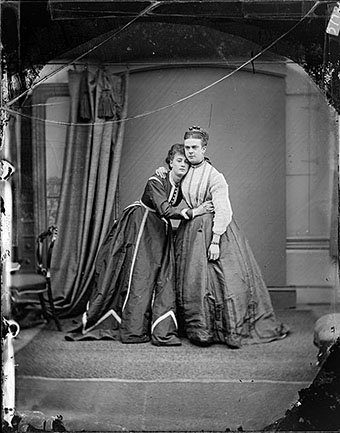
Stella (Ernest Boulton) with Fanny (Frederick Park) (c. 1860–1870).

While Stella and Fanny might be the most terrible show-offs, not to mention industrious sex workers, even they drew the line at coupling in public places. Over the course of the subsequent trial, and despite bribing witnesses, the prosecution failed to prove that sodomy had ever occurred, either between the two young men themselves, or within their circle of genteel “sisters”, or even in a dark corner behind the Haymarket with a passing guardsman. Eventually, and only after a second trial a year later, the young men were found not guilty and allowed to slip back into their lives of pro-am theatricals, touring together and separately in such limp pieces as A Comical Countess and A Morning Call.

Kathryn Hughes reviews Fanny and Stella: The Young Men Who Shocked Victorian England by Neil McKenna. Related: photographs of the pair.

The Twilight Language of Nigel Kneale, a book of essays and a cassette tape dedicated to the television dramatist.

Sheltered and Safe from Sorrow: “Victorian mourning rituals, tombstones, epitaphs, and other creepy things”.

Crate digging and the resurgence of vinyl. Related: Men & Vinyl, a Tumblr devoted to men and their discs.

• Designer Shirley Tucker talks about her cover for the first edition of The Bell Jar by Sylvia Plath.

• More Will Bradley at The Golden Age (formerly Golden Age Comic Book Stories).

The Mirror Reflecting (Part 2), a new track by The Haxan Cloak.

Psychedelic Press UK | Related: Catnip: Egress to Oblivion?

Paris in colour circa 1900.

Twilight (1983) by Pete Shelley | Twilight (2000) by Antony and the Johnsons | Twilight (2005) by Robin Guthrie & Harold Budd
Weekend links 141

nguyen.jpg

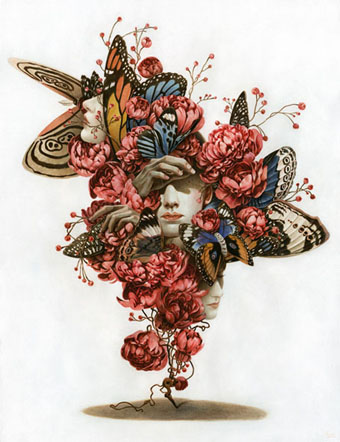
From the Beautiful Faces series (2012) by Tran Nguyen.

• “What possessed a generation of young European artists, and a few Americans, to suddenly suppress recognizable imagery in pictures and sculptures? Unthinkable at one moment, the strategy became practically compulsory in the next.” Peter Schjeldahl on the birth of abstraction.

• “A profanely mystical work of hyperpurple theory-porn, ObliviOnanisM is an auto-erotic intellectual fiction envisioning the phantastical unending odyssey of a young woman, Gemma, whom you will never know.”

Psychedelia—An Ancient Culture, A Modern Way of Life, a 520-page history of psychedelic culture by Patrick Lundborg. Related: Ken Kesey talks about the meaning of the Acid Tests.

[Hodges] made a convincing case that Turing’s teenage crush on a fellow schoolboy, Christopher Morcom, was an important catalyst for his lifelong preoccupation with the relationship between brain and mind. Morcom’s unexpected death at the age of eighteen was a shattering blow to Turing, who began to reflect on whether his friend’s consciousness might survive after death or whether it was simply a result of complex material processes and expired when life did. Hodges also linked the famous “Turing Test”, in which a computer attempts to pass as an intelligent human being, to Turing’s own dilemma as a gay man in a homophobic world. (Turing called his test the “imitation game”, and Hodges observed, “like any homosexual man, he was living an imitation game, not in the sense of conscious play acting, but by being accepted as a person that he was not”.)

Michael Saler reviews three books about computing pioneer Alan Turing

• Paul Gallagher at Dangerous Minds looks at Flowers, Lindsay Kemp’s theatrical staging of Genet’s Our Lady of the Flowers.

David Pearson designed a new edition of George Orwell’s Nineteen Eighty-Four for Penguin.

• Quadtone – Lumisonic Rotera: Mariska de Groot plays a light-to-sound instrument.

“Cash Mobs” Go Global—Battle Spreads Against Chain Store Dominance.

Cities and the Soul: a feast of Italo Calvino links at MetaFilter.

25 dessins d’un dormeur, Jean Cocteau, 1929.

Haunted Decor: a Flickr group.

Computer In Love (1966) by Perrey & Kingsley | Computer Love (1981) by Kraftwerk | Computer Love (1992) by The Balanescu Quartet

Calendars galore

calendars.jpg

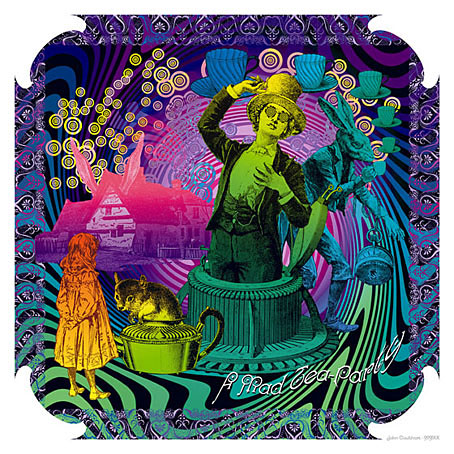
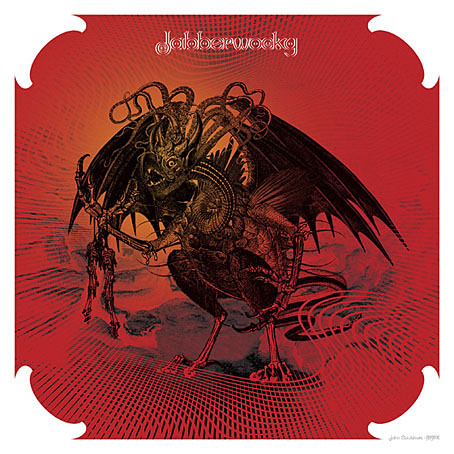
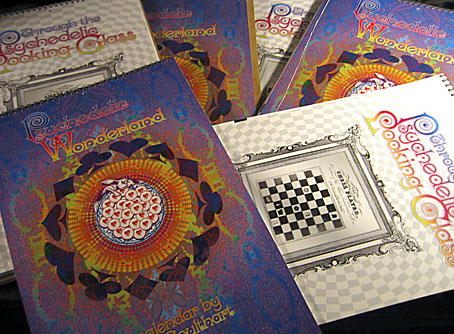
It’s those calendars again. I’ve had requests recently to put my Lewis Carroll-themed psychedelic designs back on sale but the past few months have been pretty work-heavy, and since I deleted the original product pages it was going to require some effort to make new ones. This weekend I finally found the time to tackle the CafePress upload system and make them available again. I’ve taken the year date off the covers so both calendars will remain available in the future. See below for details.

Meanwhile, this year’s Cthulhu Calendar is still on sale and proving almost as popular as the Wonderland one did in 2009. Thanks again for the support!

wonderland.jpg

A Mad Tea-Party from Psychedelic Wonderland (2009).

• Psychedelic Wonderland at CafePress | See preview pages here.

lookingglass.jpg

Jabberwocky from Through the Psychedelic Looking-Glass (2010).

• Through the Psychedelic Looking-Glass at CafePress | See preview pages here.

Previously on { feuilleton }
Scenes from a carriage
Through the Psychedelic Looking-Glass: the 2011 calendar
Jabberwocky
Alice in Acidland
Return to Wonderland
Dalí in Wonderland
Virtual Alice
Psychedelic Wonderland: the 2010 calendar
Charles Robinson’s Alice’s Adventures in Wonderland
Humpty Dumpty variations
Alice in Wonderland by Jonathan Miller
The Illustrators of Alice

Weekend links 133

woods1.jpg

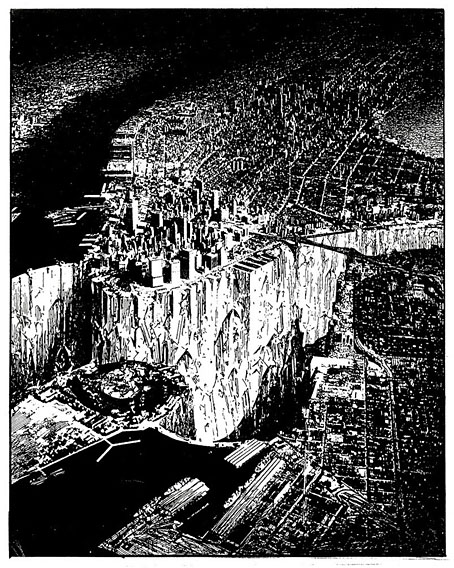
Lower Manhattan (1999) by Lebbeus Woods.

RIP Lebbeus Woods, an architect and illustrator frequently compared to Piranesi not only for his imagination and the quality of his renderings but also for the way both men built very little from a lifetime of designs. Lots of appreciations have appeared over the past few days including this lengthy piece by Geoff Manaugh at BLDGBLOG. (Geoff interviewed Woods in 2007.) Elsewhere: A slideshow at the NYT, Steven Holl remembers Lebbeus Woods and Lebbeus Woods, visionary architect of imaginary worlds. See also: Lebbeus Woods: Early Drawings and this post about Woods’ illustrations for an Arthur C Clarke story collection. Woods was at his most Piranesian with Gothic designs for an artificial planet that would have been the principal location in Vincent Ward’s unmade Alien 3.

Arkhonia draws to the end of a year of blogging about and around the Beach Boys’ errant masterwork, Smile (1967). Witty, discursive and frequently scabrous accounts of how Brian Wilson’s magnum opus was derailed and marginalised until it became convenient for commercial interests to exploit its reputation. Anyone following those posts won’t have been surprised by Wilson’s sacking from his own group by Mike Love in September.

• “We’ve been underground for 27 hours now. Everyone is caked in mud, with grit in their hair.” Will Hunt explores the catacombs and sewers of Paris.

I think the only remotely interesting drug was acid. I had a slightly peculiar attitude towards it I think. Just about everything about hippydom I hated. I liked the 60s up to about ’65 or ’66. I liked the mod clothes, I liked the look. I wasn’t a keen taker of speed because I didn’t like the comedown from it. Then everything changed and became looser, I didn’t like the clothes at all. I felt rather out of step with it. The acid thing was interesting though. I come from Salisbury and from the age of 12 I had a friend who was 30 years older than I was who I saw regularly up until when he died a couple of years ago, whose obituary I wrote in The Times. This man was called Ken James and he was deputy head at the chemical warfare unit at Porton Down [the MOD’s Defence Science and Technology Laboratory]. He then became head of the scientific civil service; he was the man who introduced computing into the civil service and he had taken acid as early as 1950. This was long before Aldous Huxley.

Sharp Suits And Sparkle: Jonathan Meades On Acid, Space And Place by John Doran. Marvellous stuff. Meades’ new book is Museum Without Walls.

• In New York later this month: A Cathode Ray Séance – The Haunted Worlds of Nigel Kneale.

• More acid: Kerri Smith talks to Oliver Sacks about his drug experiences.

• “It starts with an itch”: Alan Bennett (again) on his new play, People.

nymag.jpg

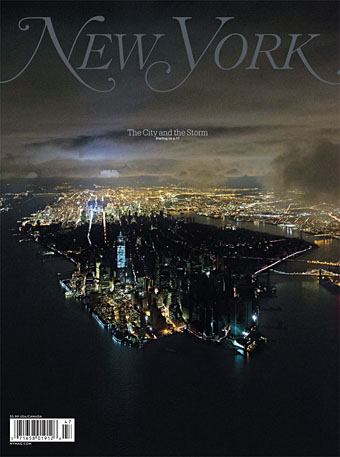
Lower Manhattan last Wednesday. Photo by Iwan Baan.

• Back issues of OMNI magazine can now be found at the Internet Archive.

• Alan Moore & Mitch Jenkins present their new film, Jimmy’s End.

• At BibliOdyssey: Atlas title pages part one & part two.

• Raw Functionality: An interview with Emptyset.

Athanasius, Underground

Vintage Caza

Stormy Weather (1979) by Elisabeth Welch.

Weekend links 131

thingposter.jpg

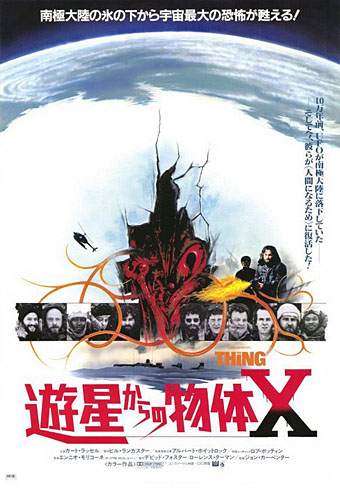
Japanese poster (1982).

At The Quietus Steve Earles looks back at John Carpenter’s visceral and uncompromising The Thing which exploded messily onto cinema screens thirty years ago. It’s always worth being reminded that this film (and Blade Runner in the same year) was considered a flop at the time following bad reviews and a poor showing at the summer box office. One reason was The Thing‘s being overshadowed by the year’s other film of human/alien encounters, something called E.T. the Extra-Terrestrial. To The Thing‘s status as the anti-E.T. you can add its reversal of the can-do heroics of Howard Hawks’ The Thing from Another World (1951), an attitude out-of-step with Reaganite America. Carpenter’s film is not only truer to the original story but from the perspective of 2012 looks like one of the last films of the long 1970s, with Hawks’ anti-Communist subtext replaced by bickering, mistrust, paranoia and an unresolved and completely pessimistic ending that most directors would have a problem getting past a studio today.

I was fortunate to see The Thing in October of 1982 knowing little about it beyond its being a John Carpenter film (whose work I’d greatly enjoyed up to that point) and a remake of the Hawks film (which I also enjoyed a great deal). One benefit of the film’s poor box office was a lack of the kind of preview overkill which made E.T. impossible to avoid, and which a couple of years earlier did much to dilute the surprise of Ridley Scott’s Alien. I went into The Thing mildly interested and came out overwhelmed and aghast. For years afterwards I was insisting that this was the closest you’d get on-screen to Lovecraft’s At the Mountains of Madness. The correspondence is more than merely Antarctica + monsters when you consider this:

Lovecraft’s story was rejected by his regular publisher Weird Tales but was accepted by Astounding Stories in 1936 >> The editor of Astounding, John W. Campbell, published his own Antarctica + monsters story (under the pen-name Don A. Stuart), “Who Goes There?”, in the same magazine two years later >> Charles Lederer wrote a loose screen adaptation of Campbell’s story which Howard Hawks and Christian Nyby filmed as The Thing from Another World.

This isn’t to say that Campbell copied Lovecraft—both stories are very different—but I’d be surprised if Lovecraft’s using Antarctica as the setting for a piece of horror-themed science fiction didn’t give Campbell the idea.

More things elsewhere: Anne Billson, author of the BFI Modern Classics study of The Thing, on the framing of Carpenter’s shots, and her piece from 2009 about the film | Mike Ploog’s storyboards | Ennio Morricone’s soundtrack music, of which only a small percentage was used in the film.

• The week in music: 22 minutes of unreleased soundtrack by Coil for Sara Dale’s Sensual Massage | Analog Ultra-Violence: Wendy Carlos and the soundtrack for A Clockwork Orange | A Halloween mixtape by The Outer Church | Herbie Hancock & The Headhunters, live in Bremen, 1974: a 66-minute set, great sound, video and performances | Giorgio Moroder’s new SoundCloud page which features rare mixes and alternate versions | A video for Collapse by Emptyset.

One of the main themes of the book, and what I found in The Arabian Nights, was this emphasis on the power of commodities. Many of the enchanted things in the book are lamps, carpets, sofas, gems, brass rings. It is a rather different landscape than the fairy tale landscape of the West. Though we have interiors and palaces, we don’t have bustling cities, and there isn’t the emphasis on the artisan making things. The ambiance from which they were written was an entirely different one. The Arabian Nights comes out of a huge world of markets and trade. Cairo, Basra, Damascus: trades and skills.

Nina Moog talks to Marina Warner

John Palatinus, “one of the last living male physique photographers of the 1950s”, is interviewed. Related: the website of Ronald Wright, British illustrator for the physique magazines.

• “A classic is a work which persists as a background noise even when a present that is totally incompatible with it holds sway.” Italo Calvino’s 14 Definitions of What Makes a Classic.

Huge Franz Kafka archive to be made public. Related: Judith Butler asks “Who owns Kafka?”

• Geoff Manaugh’s Allen Ginsberg Photos & Ephemera, 1994–Dec 1996.

Magic mushrooms and cancer: My magical mystery cure?

Clark Ashton Smith Portfolio (1976) by Curt Pardee.

Jan Toorop’s 1924 calendar.

artQueer: a Tumblr.

• All The Things You Are (1957) by Duke Ellington | Things That Go Boom In The Night (1981) by Bush Tetras | Things Happen (1991) by Coil | Dead People’s Things (2004) by Deathprod.