Consulting the Oracle

sfo01.jpg

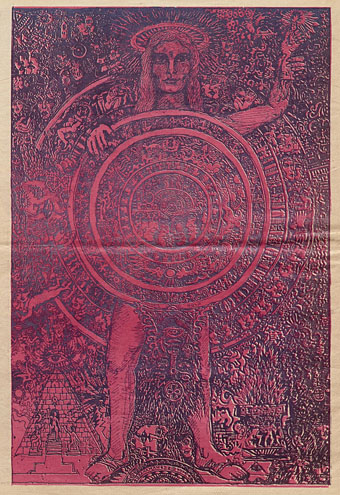
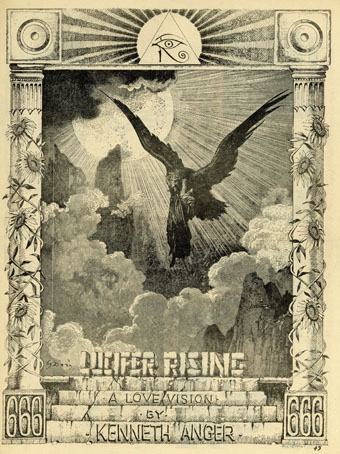
Good to find such a pristine reproduction of this Rick Griffin poster. Kenneth Anger commissioned the design in 1967 when he was putting together a package of promotional items to stimulate the interest of potential investors in his new film. Bill Landis in the unofficial Anger biography says the ploy was a successful one, investors were forthcoming although it would be several years before Anger had enough footage for the ill-fated first version of Lucifer Rising to appear in public. While we’re on the subject, I’ll note again that the Gustave Doré engraving used here is from the Purgatorio section of The Divine Comedy, not Paradise Lost as some people continue to claim. Milton’s Lucifer had wings of his own, as well as god-like powers, he didn’t need to be ferried around by a giant bird.

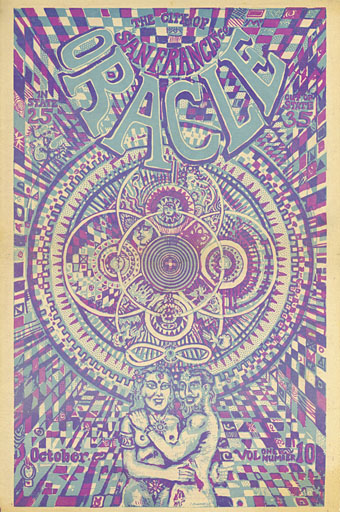
This copy of Griffin’s poster is from issue 7 of the Oracle, or the San Francisco Oracle as it was later titled and known outside the city, an underground newspaper, and one of the best where graphics are concerned.

sfo02.jpg

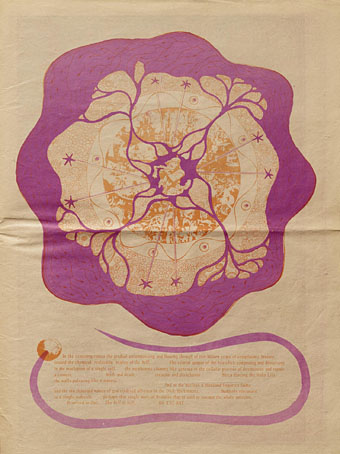
Underground papers and magazines of the late 1960s often followed the form of other amateur or semi-professional publications, with attractive cover art wrapped around more prosaic interiors. The Oracle ran for 12 issues, from 1966 to 1968, and in its later issues gave as much attention to the appearance of its inner pages as its covers, assisted by artists like Griffin and Bruce Conner. Being based in the city that gave the world so many exceptional concert posters was an obvious advantage.
sfo03.jpg

I was hoping the Internet Archive might have a complete run of the Oracle but only four of the highly-decorated issues are currently available. There’s no Wilfried Sätty artwork in evidence either, although I’m not sure he ever worked for the undergrounds despite there being many titles to choose from in the Bay area. Of note in one of the later issues is a full-page announcement for the forthcoming march on the Pentagon, an anti-war protest that took place in October 1967. Kenneth Anger attended the event although the exact nature of his involvement, like so many other Anger stories, varies according to the reporter.

San Francisco Oracle – Vol 1, No 7
San Francisco Oracle – Vol 1, No 9
San Francisco Oracle – Vol 1, No 10
San Francisco Oracle – Vol 1, No 12
sfo04.jpg

sfo05.jpg

Continue reading “Consulting the Oracle”

Saga de Xam revived

saga1.jpg

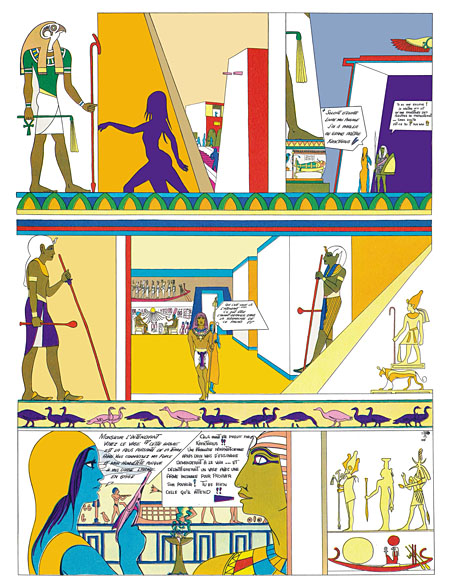
Saga est magnifique. Saga a la peau bleue. Saga est une extraterrestre. Envoyée par la reine de la planète Xam, la voici qui parcourt la Terre à plusieurs époques, traitées dans des styles différents. Son but: découvrir la quintessence artistique, politique et poétique de notre belle Terre. Marquée par l’Art nouveau, le psychédélisme américain, l’érotisme des années 1960 et la contreculture occidentale, Saga est une oeuvre hors norme et inclassable, dessinée sur des formats géants et publiée une première fois par Éric Losfeld en 1967. Hélas, le livre est très vite épuisé et devient un objet pour les collectionneurs. Cette édition reprend l’intégralité des planches de Saga, renumérisées et dotées d’une nouvelle mise en couleurs fidèle à l’originale. Saga peut enfin repartir dans une nouvelle… saga.

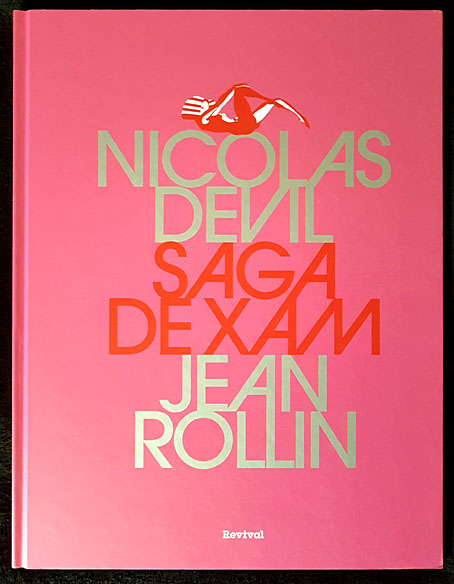
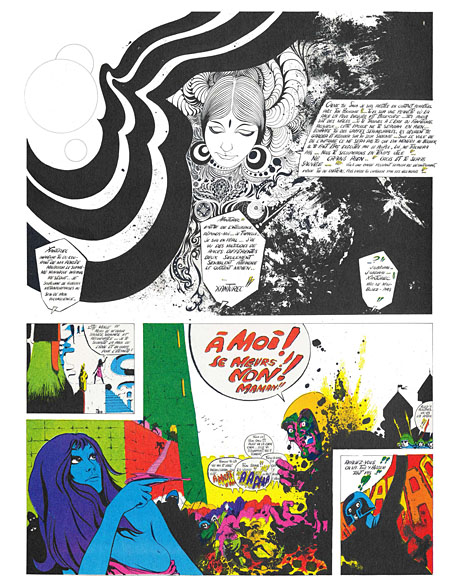
Here’s a book I never expected to see in a new edition. Saga de Xam is a 100-page bande dessinée depicting the time- and space-voyaging adventures of a blue-skinned alien woman, Saga, newly arrived on Earth from the planet Xam. The Xamians are a race of humanoid lesbians (their reproduction is parthenogenetic) whose planet is at war with the masculine Troggs; Saga has been sent to Earth to find a way to combat the Trogg invasion, an expedition that instructs her in the propensity of humans towards conflict and violence. The story was drawn by Nicolas Devil, with contributions from guest artists, and based on an outline by Jean Rollin which had been intended originally for a science-fiction film. There’s no need to go into detail about this cult item, I wrote about it at length several years ago after a couple of its pages stimulated my curiosity when they turned up in an exhibition catalogue. The book was published in 1967 by Éric Losfeld, an edition of 5000 which the publisher said he would never reprint, partly because of the expense, but also because he liked to think of the book becoming a rare object in the future. Rare it still is, although the embargo was broken in 1980, a year after Losfeld’s death, by the publication of a second edition. This was only a partial reprint, however, with a poor cover design and all the interior pages reproduced without their colour overlays.

saga2.jpg

The new edition from Revival is slightly larger than the original (27.5 x 36 cm to the original 24 x 31 cm), and bound between heavy boards. A lengthy preface by Christian Staebler describes the book’s history, offering a few biographical details about Nicolas Deville (as he was known pre-1967), together with further information about the story’s creation. The wildness of the final pages is explained as an attempt by all involved to capture some of the delirium of an LSD trip, while also bringing the story of Saga’s investigation of the human race and its violent nature into the present day. Jean Rollin was apparently unhappy with this dénouement but I find the ending to be a satisfying one for a story where each chapter explores a different period of time (and of space, when Saga returns to her home planet).

saga3.jpg

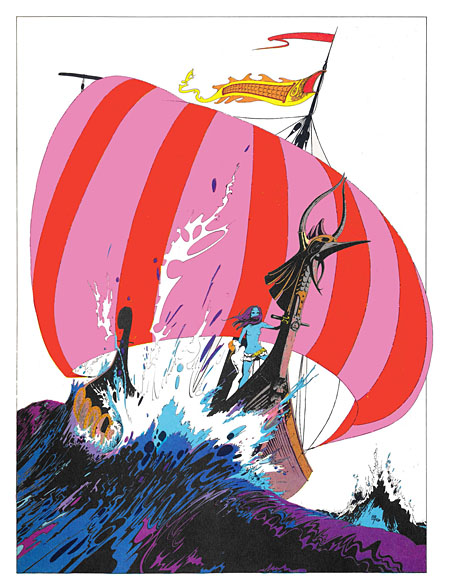
The icing on the cake is the appearance near the end of a few early drawings by Philippe Druillet, together with several beautiful pages by Devil, one of which found wider circulation when reprinted as a poster. The text in the new edition is still in French, of course, and even on slightly larger pages the legibility problem from the original remains. Devil was drawing on boards that were twice the size of their printed equivalents, without caring too much whether the story would be readable when scaled to a printable size. Losfeld’s solution was to provide a magnifying glass with each copy of the book. This isn’t too much of a problem; the story is easy enough to follow once you know the general outline, and for this story it’s the art that counts more than the words.

saga4.jpg

Continue reading “Saga de Xam revived”

Weekend links 669

claveloux.jpg

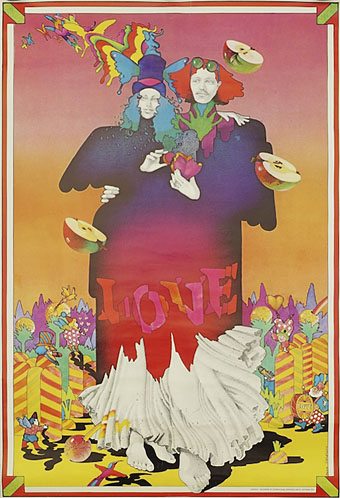
Love (1973), a poster by Nicole Claveloux.

• “Warner Brothers had been keen on a Rolling Stones movie. Jagger was keen on being a movie star. But Donald Cammell’s script was no Beatles’ jolly japes musical comedy…” Des Barry examines the ninth minute of Cammell & Roeg’s Performance.

• “…part of what made his 1970s work so original was the degree to which his band cross-pollinated guitar with synthesizer.” Aquarium Drunkard explores the esoteric jazz-rock of Steve Hillage.

• Magma, the cosmic jazz-rock group from France, have been around for 50 years without making a music video. Hakëhn Deïs is their first.

There was half-Tarkovsky embedded in async, “Solari” and “Stakra” and “Walker”, a hand outstretched to those great poems of living and light that we call films. “I had a strange dream last night,” Andrey Tarkovsky wrote in one of the diary entries collected in Instant Light, “I was looking up at the sky and it was very, very light and soft; and high, high above me it seemed to be slowly boiling, like light that had materialised like the fibres of a sunlit fabric, like silken living stitches in a piece of Japanese embroidery.”

David Toop remembers Ryuichi Sakamoto

• “Floor796 is an ever-expanding animation scene showing the life of the 796th floor of the huge space station…”

• The Electrifying Dreamworld of The Green Hand: Dan Clowes on the comic-art of Nicole Claveloux.

• At Bandcamp: Andy Thomas on the post-punk pop subversion of David Cunningham.

• At Unquiet Things: An enigmatic baroness and her collection of skulls.

• New music: River Of Dreams by Romance & Dean Hurley.

• Steven Heller’s font of the month is Ray Gun.

• Mix of the week: DreamScenes – April 2023.

• RIP Al Jaffee.

Skulls Of Broken Hill (1996) by Bill Laswell | The Bees Made Honey In The Lion’s Skull (2008) by Earth | Black Skulls (2018) by Jóhann Jóhannsson

Weekend links 661

rubin.jpg

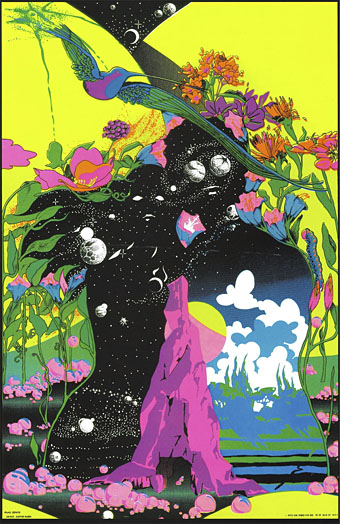
Zephyr (1970), a blacklight poster by Jupiter Rubin. Via.

• I wouldn’t usually expect Clark Ashton Smith’s Zothique to be mentioned at Literary Hub for any reason, but there it is. Emily Temple recommends some of the best stories from a century of Weird Tales that you can read online.

• Mixes of the week: A mix for The Wire by Gamut Inc, and The Last of Us, “a non-stop mix of ambient soundscapes, experimental electronics and modern classical music”.

• “…Yaggy believed that wonder was the helpmate of learning.” Sasha Archibald on Levi Walter Yaggy’s Geographical Maps and Charts (1887/93).

Stylistically, Beardsley’s pictures for Salome are among his most derivative and original. In the sharpness of their lines and great swaths of black and white, we see the well-documented influences of Japanese woodcuts and Ancient Greek vase-painting. And yet, Beardsley’s work bridges these grand traditions of East and West with such fresh dynamism and taboo as to be undeniably, and ultimately definitionally, Nouveau.

Mirror and Window Both: The Brief Superabundance of Aubrey Beardsley by A. Natasha Joukovsky

• New music: Rhinog Fawr by Somatic Responses, and Sargo/Posidonia by Sleep Research Facility/Llyn Y Cwn.

• “Why is there such a voracious consumer appetite for miniature things?” asks Steven Heller.

• At Dennis Cooper’s: Spotlight on…Julio Cortázar Blow Up and other Stories (1967).

• At Unquiet Things: The Prolific Pioneering Pulp Art Of Ed Emshwiller.

Random images from DJ Food’s desktop.

Miniature Sun (1989) by XTC | Adventures In A Miniature Landscape (2009) by Belbury Poly | Miniature Magic (2020) by Plone

Weekend links 658

ein-dor.jpg

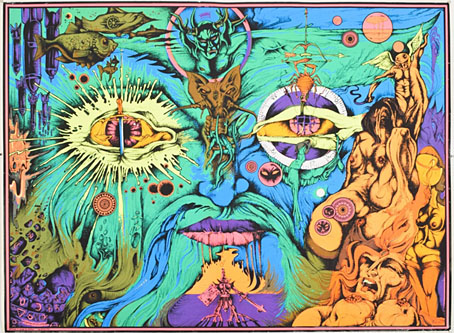
Also Sprach Zarathustra (1972), a blacklight poster by Asher Ein Dor.

• “Squaring the Circle (The Story of Hipgnosis) is a reasonably informative, if rather dry, look at a subject with much more potential for exploration,” says Dan Shindel, reviewing Anton Corbijn’s feature-length documentary about the album-cover design team. Sounds like a missed opportunity, on the whole, although the history of Hipgnosis has been so thoroughly explored over the course of several books (including a very recent one by Aubrey Powell) that any documentary seems almost superfluous. What I’d most like to see is something we’ll never have, a film about the company directed by the late Storm Thorgerson. And on that note, Thorgerson’s two-part documentary about art and drugs, The Art of Tripping (previously), has resurfaced on YouTube here and here.

• “LunaNet consists of a set of rules that would enable all lunar satellite navigation, communication and computing systems to form a single network similar to the Internet, regardless of which nation installs them. Setting lunar time is part of a much bigger picture. ‘The idea is to produce a Solar System internet,” says Gramling. ‘And the first part would be at the Moon.'” Elizabeth Gibney reports on plans to create a consistent time zone for the Moon.

• “Listening to 12, one cannot help but be struck by this deep expression of Sakamoto’s pain, of his human frailty, strength, and uncertainty about the future.” Geeta Dayal on Ryuichi Sakamoto’s latest album.

• At Public Domain Review: Illusory Wealth: Victor Dubreuil’s Cryptic Currencies by Dorinda Evans.

• At Aquarium Drunkard: Journey to inner space with The Groundhogs.

• DJ Food investigates the High Meadows psychedelic poster site.

• New music: Sub-Photic Scenario by Runar Magnusson.

• At Wyrd Daze: Disco Rd: 23 pages 23 minutes.

The Strange World of…Chris Watson.

Lunar Musick Suite (1976) by Steve Hillage | Lunar Cruise (1990) by Midori Takada & Masahiko Satoh | Luna Park (2006) by Pet Shop Boys