Weekend links 646

wallpaper.jpg

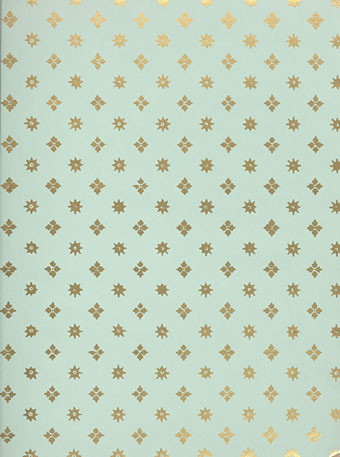
It’s that lethal book again. A sample of wallpaper impregnated with arsenic, one of many such pages in Shadows from the Walls of Death: Facts and Inferences Prefacing a Book of Specimens of Arsenical Wall Papers (1874) by RC Kedzie.

• “I like to spend time in the now because there I can create something new but in the past I cannot.” Damo Suzuki, former vocalist in Can, on creativity and his resilience in the face of long-term illness. Related: a trailer for Energy: A Documentary about Damo Suzuki.

• “I enjoy Carnival of Souls, but it is a dark form of enjoyment, with high stakes, because the enjoyment is predicated on me being able to shake myself free of the film after it is over, and that can be a struggle.” Colin Fleming on fear as entertainment.

• “Some people like fantasy epics or Regency romance or Sudoku or science-fiction world-building or the gentle challenge of cozy mysteries; I like the undead.” Sadie Stein on encounters with ghosts.

• “You’re now standing on the blocks of the Great Pyramid at Giza. For the first time ever you can explore the entire pyramid interior.” The Giza Project.

• “What do we think about when we watch films set in vanished decades that many of us experienced at first hand?” asks Anne Billson.

• At Bandcamp: Touch celebrates forty years of not being a record label.

• “Why scientists are sending radio signals to the Moon and Jupiter.”

• At DJ Food’s: Retinal Circus gig posters 1966–68.

• Steven Heller’s font of the month is Feneon.

The Pyramid Spell (1978) by Nik Turner | I Am Damo Suzuki (1985) by The Fall | Carnival Of Souls Goes To Rio (2001) by Pram

Abe Gurvin album covers

gurvin01.jpg

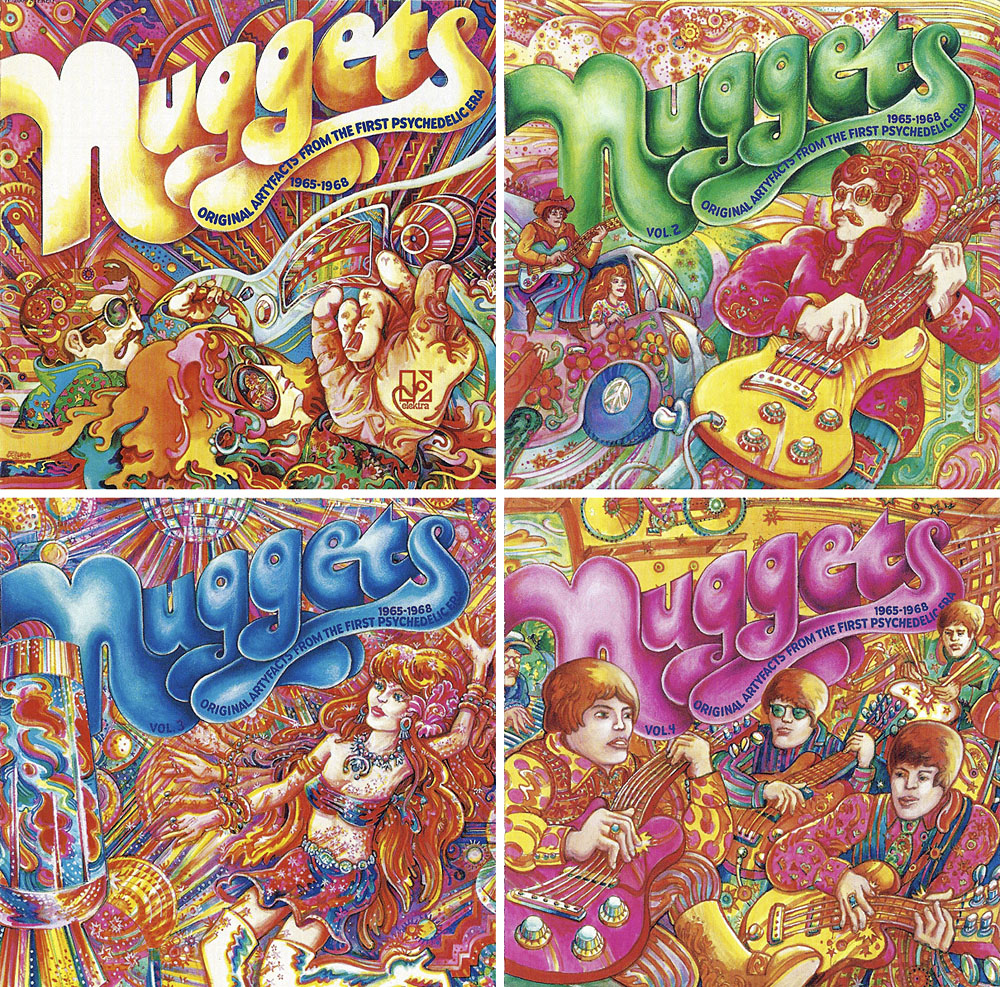
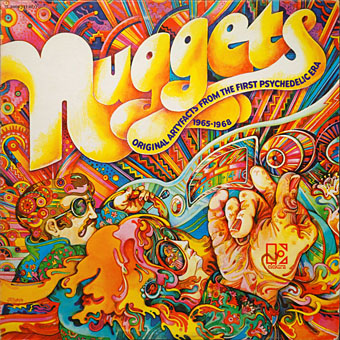
Nuggets: Original Artyfacts From The First Psychedelic Era 1965–1968 (1972).

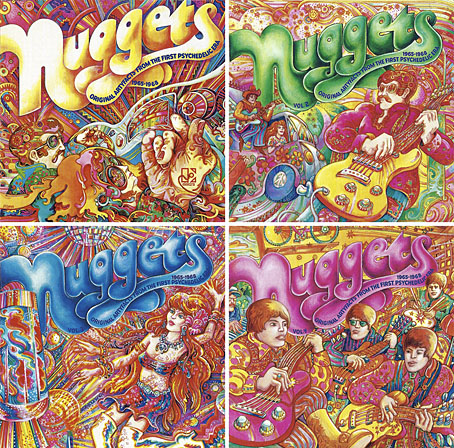
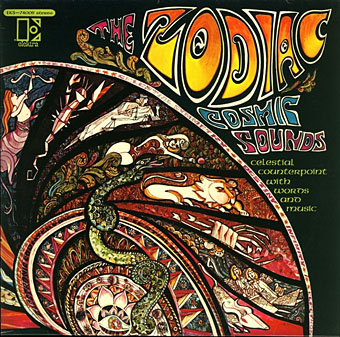
Reading this article last week about Lenny Kaye’s Nuggets compilation I realised I’d never looked up the album’s cover artist, Abe Gurvin (1937–2012); this despite owning two copies of Kaye’s compilation, one of which, an expanded box of four CDs, includes additional Gurvin art (see below). Nuggets was released in 1972 on Elektra, a label for whom Gurvin worked regularly as a designer as well as an artist. The only other cover of his I definitely recall seeing before is for one of Mort Garson’s electronic novelty albums, Cosmic Sounds (credited to The Zodiac), although some of the classical recordings on Elektra’s Nonesuch imprint look vaguely familiar. Nonesuch were using vivid art and graphics on the covers of their classical albums from the mid-60s on, years in advance of rival labels; Gurvin, along with Bob Pepper, Gene Szafran and others, provided the cover paintings. In the 1980s many of these albums turned up cheap in British remainder shops, hence the familiarity, although I can’t say whether it was Gurvin’s art I remember seeing.
gurvin02.jpg

Disc art from the four-CD Nuggets box (1998).

The subtitle of the Nuggets album—”Original Artyfacts From The First Psychedelic Era 1965–1968″—always promised more than it delivered when only a quarter of the songs could be called psychedelic. Without Gurvin’s artwork providing a contextualising frame it’s hard to imagine the compilation sustaining its reputation as a psych classic, whatever the subtitle might suggest. Gurvin’s florid aesthetics were put to similar use elsewhere, not only on classical recordings. Some of the examples below are a result of attempts by art directors to give artists like Gene Pitney a trendy spin.
gurvin03.jpg

Cosmic Sounds (1967) by The Zodiac. “Must be played in the dark” says a note on the back cover.

Nuggets, incidentally, was beneficial in its influence even if its psychedelic quotient is lacking. Without its success there might not have been the 28 psych/garage compilations known as Pebbles, a bootleg series that retrieved from obscurity many minor bands and one-off singles; and without Pebbles we wouldn’t have had further imitations like Boulders (11 discs) and all the many series that followed, including my personal favourite, Rubble, a 20-disc collection of British psychedelic singles.
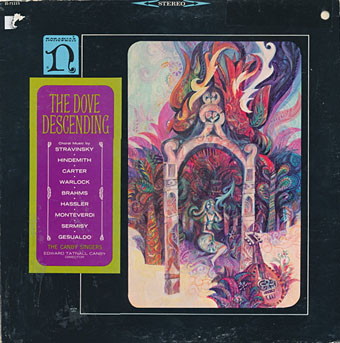
gurvin09.jpg

The Dove Descending: Choral Music (1966) by The Canby Singers.
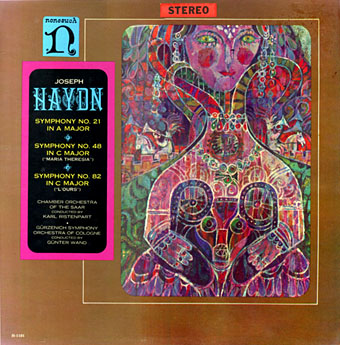
gurvin10.jpg

Haydn: Symphony No. 21 In A Major / Symphony No. 48 In C Major (“Maria Theresia”) / Symphony No. 82 In C Major (“L’Ours”); Chamber Orchestra Of The Saar, Karl Ristenpart / Gürzenich Symphony Orchestra Of Cologne, Günter Wand (1966).
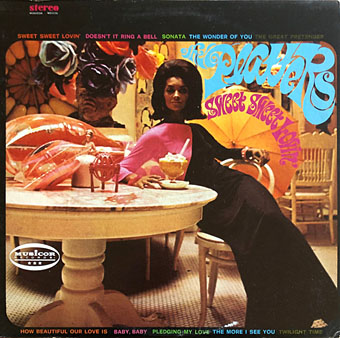
gurvin15.jpg

Sweet, Sweet Lovin’ (1968) by The Platters.

Gurvin’s contribution to this one is the hand-drawn title design.

Continue reading “Abe Gurvin album covers”
Weekend links 642

wheel.jpg

A light wheel. Via.

• “Part of the instrument’s draw is its fallibility. Famously, or perhaps infamously, every Rhodes is different: some freakishly responsive, some with keys that stick like glue, and all with uneven registers, darker corners, and sweet spots.” Hugh Morris on the delicate art of reinventing the Fender Rhodes.

Rambalac’s YouTube channel of first-person walks through Japanese locations is a vicarious pleasure, especially on a big screen. It’s not all city streets but if you like urban meandering then Tokyo walk from day to rainy night – Higashi-Ikebukuro, Mejiro, Ikebukuro is a good place to start.

• At Igloomag: Chang Terhune interviews Stephen Mallinder in a gratifyingly lengthy piece which covers Mallinder’s recent solo recordings and collaborations, his work with students on his sound-art course, and (unavoidably) the late Richard H. Kirk and Cabaret Voltaire.

What I think might be a useful approach—perhaps impractical, but bear me out—I think that if we were to reconnect magic and art as a starting point, because they’re practically the same thing anyway, make art the product of your magical experiments, the way that Austin Spare did for example, then that would give magic an enormous sense of purpose and I think it would also lend art the vision that it seems to be lacking at present. A lot of modern art seems rather empty and hollow conceptualism that lacks any real vision or substance or power. A linking of magic and art would help both of those fields. Then, once you’ve done that, maybe linking art and science. There’s plenty of work already done in that regard.

Alan Moore talking to Miles Ellingham about the usual concerns plus his new story collection, Illuminations

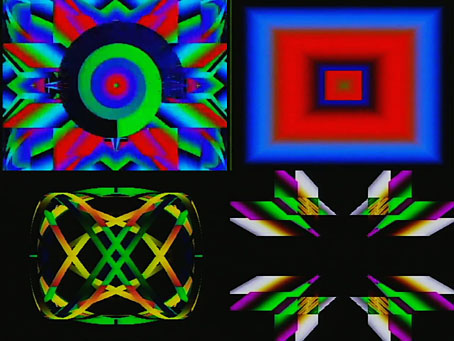
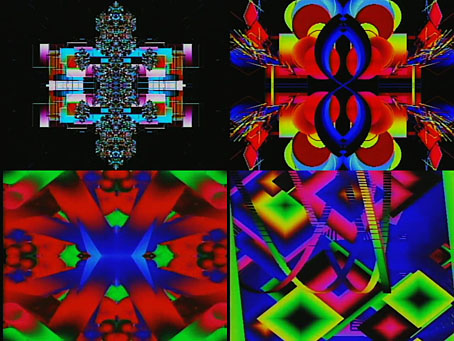
Wheels of Light: Designs for British Light Shows 1970–1990 is a book by Kevin Foakes (aka DJ Food) which will be published later this month by Four Corners Books. The author talks about his book here.

• “The Sandjak of Novi Pazar always sounded as if it were a title, like the Sultan of Zanzibar or the Dame of Sark…” Mark Valentine on discovering outdated maps in forgotten books.

• “My brief was to find tracks that had been left by the wayside or disregarded.” Lenny Kaye on 50 years of his influential garage-rock compilation Nuggets.

• Mixes of the week: XLR8R Podcast 768 by Lawrence English, and King Scratch (Musical Masterpieces from the Upsetter Ark-ive) by Aquarium Drunkard.

• At Dennis Cooper’s: Spotlight on Shirley Jackson The Haunting of Hill House (1959).

• Steven Heller’s font of the month is Slag.

• This Wheel’s On Fire (1968) by Julie Driscoll, Brian Auger & The Trinity | Cosmic Wheels (1973) by Donovan | Wheels On Fire (1985) by Haruomi Hosono

OM I, a film by Myron Ort

ort1.jpg

As should be evident from the stills, OM I is yet another example of psychedelic cinema, and a very good one at that. Myron Ort’s 20-minute silent film (add your own soundtrack) originates with experiments the director made in the late 60s and early 70s using hand-painted stock combined with optical printing.

ort2.jpg

The film isn’t wholly abstract—the raw material includes shots of people and animals, together with heavily processed military footage—but the processing creates a kaleidoscopic feel by mirroring many of the shots, one of those simple tricks that’s always effective. (For a more recent example of mirrored psychedelia, see the monochrome mushroom freakout in A Field in England.) There’s a lot more like this at Myron Ort’s Vimeo page including two sequels to OM I, and a related film Ommo, which runs hand-painted raw material through the optical printer to delirious effect.

Elsewhere on { feuilleton }
The abstract cinema archive

Weekend links 624

griffiths.jpg

An alphabet designed by Ben Griffiths. Via.

• “From the cellular to the galactic, via Paleolithic cave markings to the trace impressions left by drone photography on our mind’s eye, incorporating dancing plagues, communist psychedelic witches, hyper-sexual fungi, chthonic descents, and skyward ascents, The Neon Hieroglyph weaves together a series of painterly and poetic considerations on a feminized history of the rye fungus Ergot, the chemical basis of LSD.” Coming soon from Strange Attractor: The Neon Hieroglyph, a book, LP and folio of prints by Tai Shani.

• “3rd From The Sun was the last album of Chrome’s imperial phase, and it cemented their status as one of the most inhuman and superhuman rock bands that America ever produced. More people need to recognize.” Agreed. (previously)

• “People often say, ‘How can you be so disciplined?’ It’s easy. Otherwise, I would have to go work for somebody else!” John Waters (again). Also here.

I’ve always thought that literature should be entertaining as well as instructive—a very old-fashioned idea but one that I adhere to. When I set out to write in this way—particularly in this way, a political way, if you want to call it that—I intend to make a donation, to try to give something. There doesn’t seem to me to be any point in giving more misery or exacerbating unhappiness through some kind of hyper-intellectual, pyrotechnical writing about unhappiness and the shit that we all find ourselves in. That’s been done plenty. I think first of all that it doesn’t need to be done any more and second of all there’s a kind of reactionary aspect to it which is that the emphasizing of misery without any anti-pessimism, as you put it, would be simply seduction into inactivity and political despair. In other words, to do politics at all on any level, especially on a revolutionary or on an insurrectionary level, there has to be some anti-pessimism—I won’t say optimism because that sounds so fatuous, futile; but anti-pessimism is a nice phrase. And there’s a deliberate attempt at that in the writing. Then again it’s a matter of my personality, I guess, inclined towards the notion of the healing laugh to some extent. We have an anarchist thinker in America, John Zerzan, who wrote an essay against humour which maybe is one of the things I was reacting against. Even if irony is counter-revolutionary which I think it might be to a certain extent I don’t see any way in which you could say that laughter itself is counter-revolutionary. This doesn’t make any sense to me unless you mean to get rid of language and thought altogether, which is just another form of nihilism. So as long as you’re going to accept culture on some level you’re certainly going to have to accept humour. And as long as you’re going to have to accept humour you might as well see humour as potentially revolutionary.

Peter Lamborn Wilson aka Hakim Bey, who died last month. Many of Wilson’s writings are available at The Anarchist Library. From 2008: A poem for Leonora Carrington

• “It’s such a fundamental question,” says Midori Takada, “why do humans need to make rhythm, and the space that structure creates?”

• “14 Warning Signs That You Are Living in a Society Without a Counterculture” by Ted Gioia.

• A trailer for Earwig, the new film from Lucile Hadžihalilović, based on a story by Brian Catling.

• New music: Aura by Hatis Noit, and Warmth Of The Sun by Pye Corner Audio.

• At Dennis Cooper’s: Spotlight on…SE Hinton Rumble Fish (1975).

• “Hear tracks from the 1980s Peruvian electronic underground”.

Intermittent Eyeball Fodder at Unquiet Things.

West Tulsa Story (1983) by Stewart Copeland | Kála/Assassins Of Hakim Bey (1997) by Coil | Neon Lights (2000) by Señor Coconut Y Su Conjunto