The Major Arcana by Jak Flash

arcana1.jpg

The Fool.

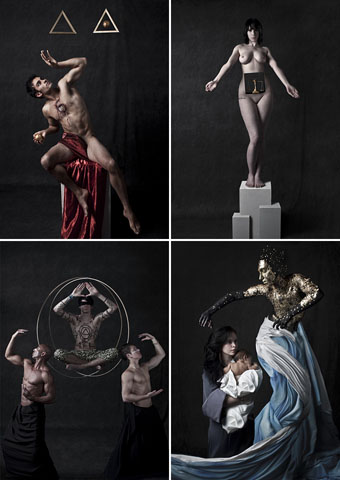
I’d like this photo series by young British photographer Jak Flash even if it didn’t feature attractive men; the eye candy is icing on a thaumaturgic cake. The Major Arcana takes the Trumps of the Tarot as its inspiration and manages to reinterpret the symbolism whilst retaining the hieratic nature of the traditional images. Of his reworking, the photographer says:

I developed my own themes based around things like geometric shapes so that I could encode my images with meaning. The images link to each other and can be read to some extent almost as a progressive story, or commentary. Various signifiers are used throughout the images such as cubes, triangles and spheres to help communicate my ideas. Cubes for example are a representation of the material world and triangles show transition. In an image such as The Hanged Man we see two men firmly seated on a large cube, whilst above their heads another cube breaks apart around them. … The Lovers image is an interpretation of the fall of man from Eden. The man represents mankind in his fall after taking the fruit of Knowledge, whilst being denied eternal life. (More.)

The Major Arcana is available in book form at Blurb. Via Homotography, doing all the leg work once again.
arcana2.jpg

top left: The Lovers; top right: Justice.
bottom left: The Wheel of Fortune; bottom right: The Sun.

Previously on { feuilleton }
The Sapphire Museum of Magic and Occultism
Strange Attractor Salon
The art of Pamela Colman Smith, 1878–1951
Layered Orders: Crowley’s Thoth Deck and the Tarot
In the Shadow of the Sun by Derek Jarman
The Major Arcana

Weekend links 21

nagai.jpg

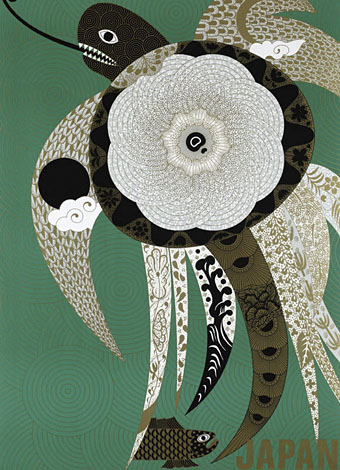
A poster by Kazumasa Nagai.

• Franco Maria Ricci creates the world’s largest maze. “The former publisher said he first confided his ambition to Jorge Luis Borges, who characteristically told him the world’s largest maze already existed and was called a desert.” Related: Mirror, Mask, Labyrinth, a review of two new collections of Borges’ poetry.

FACT mix 164 is a dubstep collection by Pinch and a promotion for the Dark Matter compilation which I designed earlier this year.

• One of the monuments of 20th century music, Bitches Brew by Miles Davis, is released in another new (and expensive) edition next month by Sony. Nice packaging, and there’s a vinyl edition included, but these things always come across as a cyncial attempt to milk the hardcore fans one more time. And have you noticed how all vinyl releases are now described as “audiophile”? If the big record companies had shown this much dedication to quality in the 1980s when they were jobbing out sub-standard vinyl pressings their reputation might be slightly higher today.

• More Gysin: Brion Gysin, William Burroughs, and the secret life of a building on the Bowery. And Ubuweb’s page of Gysin sound works and recordings.

Michael Moorcock: “I think I preferred my own imagination”. A two-part interview about the cover designs for Moorcock books.

The Pansy Project: “Artist Paul Harfleet plants pansies at the site of homophobic abuse, he finds the nearest source of soil to where the incident occurred and generally without civic permission plants one unmarked pansy. The flower is then photographed in its location and posted on his website, the image is entitled after the abuse … The Pansy Project also marks locations where people have been killed as a result of homophobic attack”

This Gaming Life: Travels in Three Cities. Jim Rossignol’s book is available as a free download.

Lost London. Also, the Victorian Catacombs of South London.

Dedalus Books had its Arts Council grant reinstated.

’Zine Lutefisk: fashion/art/escape.

Time Will Show The Wiser (1968) by Fairport Convention | She Moves Through The Fair (1969) by Fairport Convention | She Moved Through The Fair (1994) by Jam Nation.

Weekend links: Ghosts, Spooks and Spectres edition

spectres.jpg

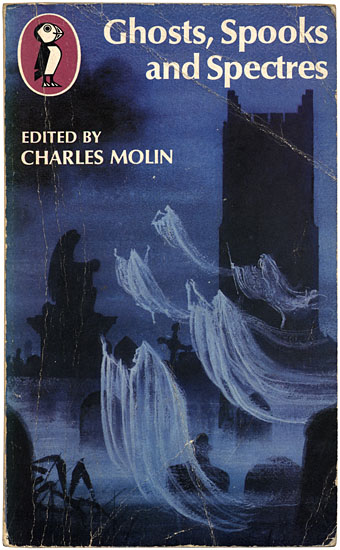
Cover design by Philip Gough.

Ghosts, Spooks and Spectres (1972 reprint). Editor Charles Molin collected nineteen ghost stories by writers including Oscar Wilde (The Canterville Ghost), Charles Dickens (The Signal-Man), J. Sheridan Le Fanu (Madame Crowl’s Ghost) and HG Wells (The Inexperienced Ghost). This was one of my favourite books when I was ten-years old. There’s nuffin like a Puffin. Puffin Books’ parent company, Penguin, is 75 this year.

• The good people at the Outer Alliance have posted an interview with me here in which I talk about the subversive sexualities of sf in the 1970s and also admit to writing fiction.

• There’s just time to mention It Came From Pebble Mill, an event which includes another screening of David Rudkin’s Penda’s Fen.

• “In our society, there has tended to be a very strong compartmentalization of different experiences, different cultural forms, different genres. We can talk in a very broad sense and say art is separate from science, for example, or body is separate from mind, or we can talk in a specific sense and say one certain form of dance music is separate from one form of, say, heavy metal. I don’t really buy those compartmentalizations. I understand why they exist, how they’ve come into being and why they’re convenient, but it’s not the way I think, it’s not the way I experience the world, it’s not the way I believe things should be.” From an interview by Colin Marshall with David Toop at 3QD. Toop’s latest book is Sinister Resonance: The Mediumship of the Listener.

The Kingdom of the Pearl by Léonard Rosenthal, illustrated by Edmund Dulac.

Ghost Stations by Dollboy, a CD package. And then there’s the Ghostly Bento.

7 Inch Cinema are Birmingham-based cultural historians.

• Mark Pilkington’s Mirage Men now has its own site.

Borges on Pleasure Island: JLB and his love of RLS.

• RIP Arne Nordheim, Norwegian composer.

• Charlie Visnic’s Modular Ghost Synth.

On the trail of Tutankhamen’s penis.

Photos by Thom Ayres.

Ghosts by Japan | Spooky Rhodes by Laika | Purple Dusk by Spectre.

Centaurs

centaur1.jpg

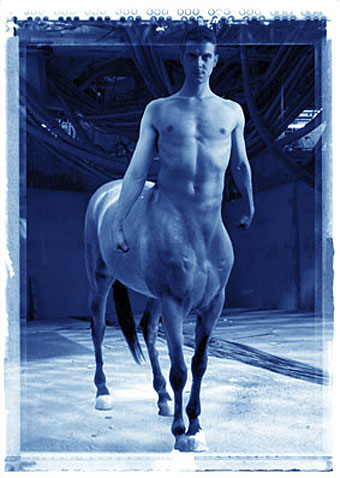
Elatus from Pandaemonium I (Centaurs) (2010) by David Trullo.

One of a series of centaur portraits by Spanish artist David Trullo. Placing characters from Classical mythology in contemporary settings makes a change. The title Pandaemonium I implies further series so I’m curious to see how Trullo follows these.

centaur2.jpg

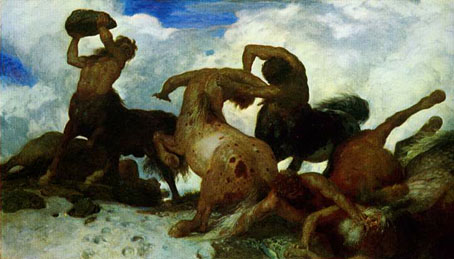
Battling Centaurs (1873) by Arnold Böcklin.

Centaurs had a flush of popularity in Germanic art of the 19th century; Franz Stuck painted them a number of times and Jugend magazine is littered with many often grotesque representations. I’ve never seen an explanation for this resurgence of interest. Is it because a man/horse hybrid is a potent symbol of masculine power? Arnold Böcklin’s painting is one of the better examples and suits its title more than Michelangelo’s famous sculpture in which the hybrids are lost in a tangle of writhing bodies.

Previously on { feuilleton }
Mermaids
The Masks of Medusa