Schloss Neuschwanstein

neuschwanstein1.jpg

This weekend’s film viewing was a DVD of Luchino Visconti’s Ludwig (1972), something I’ve seen in parts before but don’t recall ever having watched all the way through. I enjoyed it on the whole although Visconti’s “hose-piping” camera style and crash zooms are frequently annoying. Helmut Berger was very good as the tragic King of Bavaria and the subject was given additional interest by my reading earlier this year of a number of Philippe Jullian books. Ludwig II was camp enough to have interested Jullian whatever age he lived in but the way his life connects to the Symbolist period lends him a special significance. He can’t quite be described as a Symbolist monarch but his tireless support for Symbolist god Richard Wagner, and his lavish construction projects, made him a hero to Verlaine and others, who saw in the realisation of his fantasies the actions of an artist working on the grandest scale.

neuschwanstein2.jpg

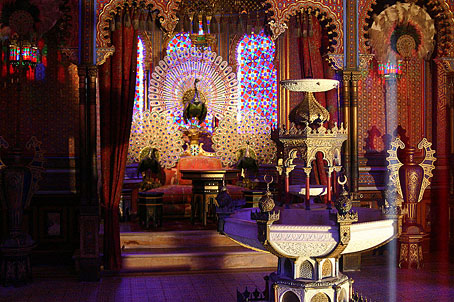
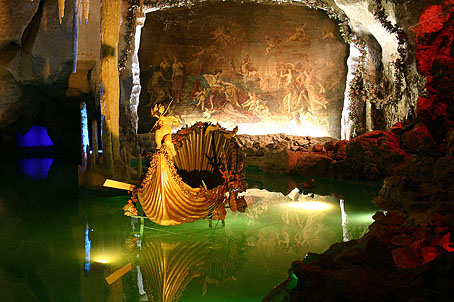
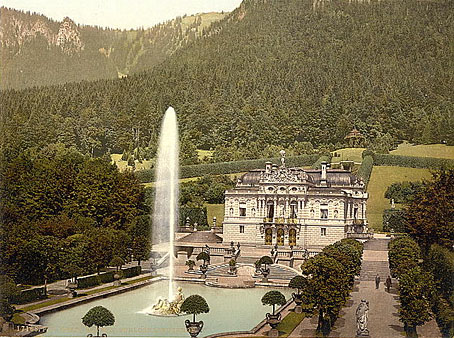
Of all the palaces, Schloss Neuschwanstein at Hohenschwangau is easily the most spectacular, and Wikimedia Commons has a great selection of photos of which the two here are examples. The first picture is a 1900 photochrome print originally from the Library of Congress collection and the large version makes a great desktop picture. The helicopter view shows how the apparent isolation of the castle depends on where you place the camera. Visconti’s film makes use of all the King’s buildings although we never see a full exterior shot of Neuschwanstein possibly because the castle was unfinished at the time of Ludwig’s death in 1886. While he was alive Ludwig’s palaces were regarded as outrageous extravagances by a government dismayed by his patronage of Wagner, his scandalous homosexual behaviour, and his lack of interest in the nation’s political squabbles. Over a century later, Wagner’s music receives endless performances around the world while Schloss Neuschwanstein is the most popular tourist destination in Germany. Bavaria’s wars are long forgotten yet it was the King they declared to be “mad”. There’s a moral there.

The Neuschwanstein pool at Flickr

Previously on { feuilleton }
Temples for Future Religions by François Garas
Willy Pogány’s Lohengrin
Dallamano’s Dorian Gray

Weekend links 23

groovy.jpg

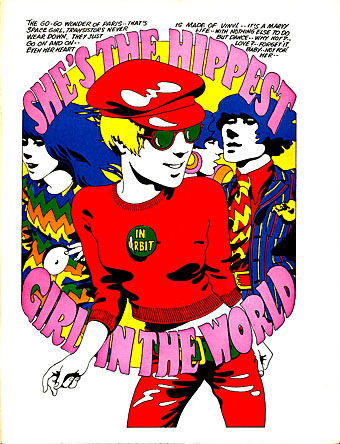
“The Go-Go wonder of Paris — That’s space girl. Transistors never wear down, they just go on and on — Even her heart is made of vinyl — It’s a marvy life — With nothing else to do but dance — Why not? – Love? — Forget it, baby — Not for her —” From Mod Love (1967) by Michael Lutin and Michel Quarez.

• “Gay people are not advancing themselves in the (publishing) industry, they’re just regurgitating familiar territory. Of course, artists are always ahead of gatekeepers. That’s the way it works—artists innovate. But in order to fulfill your promise as an editor, agent, publisher or reviewer, you have to be a person who’s embracing the new and looking to elevate what is not yet known. And unfortunately, there’s not a discussion among publishing professionals about enhancing this aspect of people’s responsibilities. In fact, it goes the other way. So there needs to be a psychological revolution on behalf of the people who are controlling what information is allowed to be seen.” From an interview with Sarah Schulman at Lambda Literary.

Jonathan Ross meets Jim Steranko. Also at the Guardian: Unearthing the truth about Alan Moore.

• Photographing an abandoned Art Deco skyscraper. From the people who photographed Neverland at night.

Powers: “aural sculptures” by Andy Partridge inspired by the strange science fiction art of Richard M Powers.

barbier.jpg

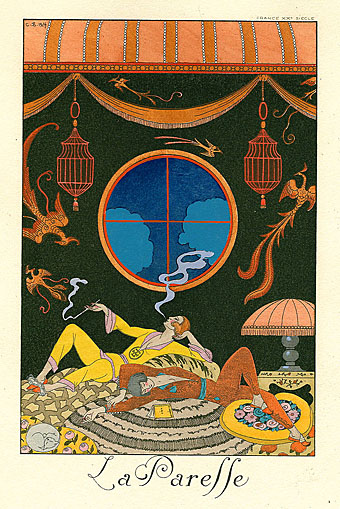
La Paresse (Laziness) (1924) by George Barbier.

Lautréamont’s poison-drenched pages. Roger Cardinal reviews a new edition of Les Chants de Maldoror and Poésies.

The Wire‘s Top 50 Rhythms of All Time, a list from 1992. Some great recommendations but it’s impossible to imagine that being written now without a mention of Klaus Dinger. And where’s Fela Kuti?

• The Wire Salon at Cafe Oto, London, on August 5th presents Rob Young discussing his forthcoming book, Electric Eden: Unearthing Britain’s Visionary Music.

American Pictorial Photography, 1912–1955. Another astonishing picture set at Golden Age Comic Book Stories.

The Beats: Pictures of a Legend. Edmund White on a new exhibition of Allen Ginsberg’s photographs. Related: the trailer for Howl.

The Dream Machine is a point-and-click adventure game made using hand-crafted animation.

Fuck yeah Francisco Lachowski: Brazilian model cutie has many Tumblr fans.

Polly Morgan’s wings of desire. The taxidermy artist interviewed.

Thomas Dolby’s solar-powered boat studio.

Rückstoss Gondoliere (1971) by Kraftwerk: pt. 1 | pt. 2

The Major Arcana by Jak Flash

arcana1.jpg

The Fool.

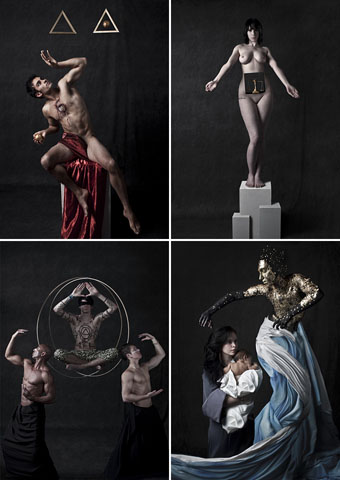
I’d like this photo series by young British photographer Jak Flash even if it didn’t feature attractive men; the eye candy is icing on a thaumaturgic cake. The Major Arcana takes the Trumps of the Tarot as its inspiration and manages to reinterpret the symbolism whilst retaining the hieratic nature of the traditional images. Of his reworking, the photographer says:

I developed my own themes based around things like geometric shapes so that I could encode my images with meaning. The images link to each other and can be read to some extent almost as a progressive story, or commentary. Various signifiers are used throughout the images such as cubes, triangles and spheres to help communicate my ideas. Cubes for example are a representation of the material world and triangles show transition. In an image such as The Hanged Man we see two men firmly seated on a large cube, whilst above their heads another cube breaks apart around them. … The Lovers image is an interpretation of the fall of man from Eden. The man represents mankind in his fall after taking the fruit of Knowledge, whilst being denied eternal life. (More.)

The Major Arcana is available in book form at Blurb. Via Homotography, doing all the leg work once again.

arcana2.jpg

top left: The Lovers; top right: Justice.
bottom left: The Wheel of Fortune; bottom right: The Sun.

Previously on { feuilleton }
The Sapphire Museum of Magic and Occultism
Strange Attractor Salon
The art of Pamela Colman Smith, 1878–1951
Layered Orders: Crowley’s Thoth Deck and the Tarot
In the Shadow of the Sun by Derek Jarman
The Major Arcana

Weekend links 21

nagai.jpg

A poster by Kazumasa Nagai.

• Franco Maria Ricci creates the world’s largest maze. “The former publisher said he first confided his ambition to Jorge Luis Borges, who characteristically told him the world’s largest maze already existed and was called a desert.” Related: Mirror, Mask, Labyrinth, a review of two new collections of Borges’ poetry.

FACT mix 164 is a dubstep collection by Pinch and a promotion for the Dark Matter compilation which I designed earlier this year.

• One of the monuments of 20th century music, Bitches Brew by Miles Davis, is released in another new (and expensive) edition next month by Sony. Nice packaging, and there’s a vinyl edition included, but these things always come across as a cyncial attempt to milk the hardcore fans one more time. And have you noticed how all vinyl releases are now described as “audiophile”? If the big record companies had shown this much dedication to quality in the 1980s when they were jobbing out sub-standard vinyl pressings their reputation might be slightly higher today.

• More Gysin: Brion Gysin, William Burroughs, and the secret life of a building on the Bowery. And Ubuweb’s page of Gysin sound works and recordings.

Michael Moorcock: “I think I preferred my own imagination”. A two-part interview about the cover designs for Moorcock books.

The Pansy Project: “Artist Paul Harfleet plants pansies at the site of homophobic abuse, he finds the nearest source of soil to where the incident occurred and generally without civic permission plants one unmarked pansy. The flower is then photographed in its location and posted on his website, the image is entitled after the abuse … The Pansy Project also marks locations where people have been killed as a result of homophobic attack”

This Gaming Life: Travels in Three Cities. Jim Rossignol’s book is available as a free download.

Lost London. Also, the Victorian Catacombs of South London.

Dedalus Books had its Arts Council grant reinstated.

’Zine Lutefisk: fashion/art/escape.

Time Will Show The Wiser (1968) by Fairport Convention | She Moves Through The Fair (1969) by Fairport Convention | She Moved Through The Fair (1994) by Jam Nation.