Weekend links 102

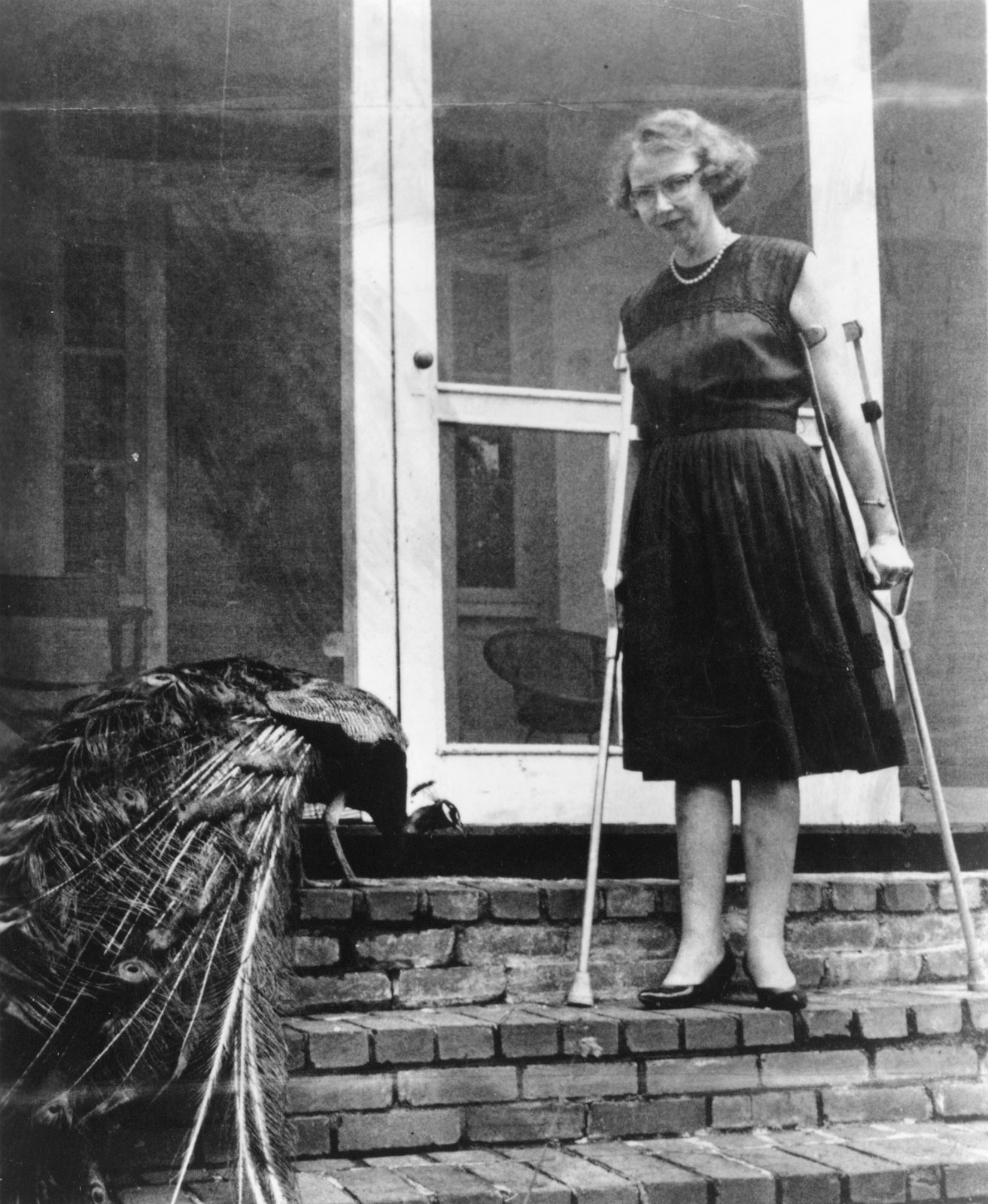
flannery.jpg

Flannery O’Connor with one of her many peacocks.

When the peacock has presented his back, the spectator will usually begin to walk around him to get a front view; but the peacock will continue to turn so that no front view is possible. The thing to do then is to stand still and wait until it pleases him to turn. When it suits him, the peacock will face you. Then you will see in a green-bronze arch around him a galaxy of gazing haloed suns. This is the moment when most people are silent.

Flannery O’Connor

Essay of the week was without a doubt Living with a Peacock by the great Flannery O’Connor, originally published in Holiday magazine in September 1961. I’d heard about Flannery’s peacocks before but had no idea she was such a pavonomane. Thanks to Jay for the tip!

• “‘He’s chameleon, comedian, Corinthian and caricature.’ But he was more like the very hungry caterpillar, munching his way through every musical influence he came across…” Thomas Jones reviews two new books about David Bowie for the LRB.

• In June Mute Records release The Lost Tapes by Can, a 3-CD collection. Here’s hoping this doesn’t merely repeat the outtakes that’ve been circulating for years as the Canobits bootlegs. This extract is certainly new.

• Animator Suzan Pitt, director of the remarkable Asparagus (1979), discusses her new film, Visitation, inspired, she says, by reading HP Lovecraft in a cabin while wolves howled outside.

Night Thoughts: The Surreal Life of the Poet David Gascoyne, a biography by Robert Fraser reviewed by Iain Sinclair.
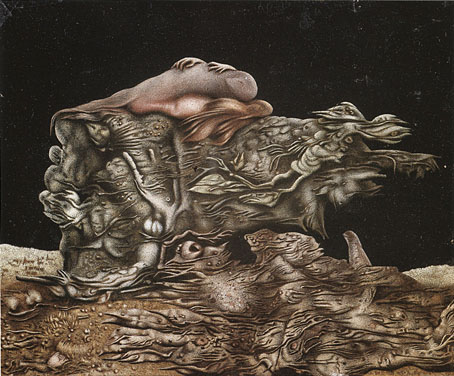
oelze.jpg

The Dangerous Desire (1936) by Richard Oelze (1900–1980) at But Does It Float.

• Making the Mari: the stuff of nightmares brought into the world by Jefferson Brassfield.

• The Background to the Moorcock Multiverse: Karin L. Kross reviews London Peculiar.

Orson Welles’s lost Heart of Darkness screenplay performed for the first time.

The Erotic Films of Peter de Rome: the new BFI DVD collection reviewed.

• Page designs by Alphonse Mucha for Ilsée, Princess de Tripoli (1897).

• A Slow-Books Manifesto by Maura Kelly.

Tim Parks asks “Do we need stories?”.

Musical table by Kyouei Design.

Horror Asparagus Stories (1966) by The Driving Stupid | Peacock Lady (1971) by Shelagh McDonald | Peacock Tail (2005) by Boards of Canada.
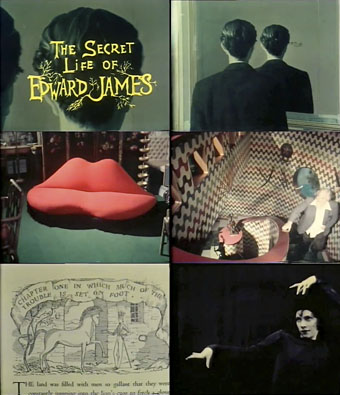
The Secret Life of Edward James

james1.jpg

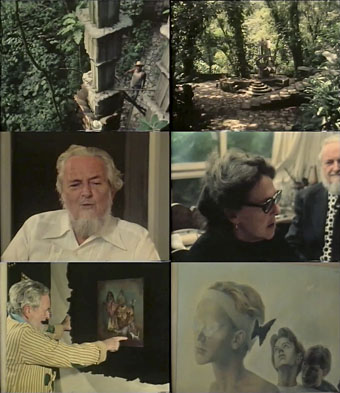
From the earliest days of YouTube there were two films about Surrealist art that I’d been hoping would one day be posted somewhere so I could watch them again. One was José Montes-Baquer’s collaboration with Salvador Dalí, Impressions de la Haute Mongolie – Hommage á Raymond Roussel (1976), which eventually turned up at Ubuweb; the other was Patrick Boyle’s The Secret Life of Edward James, a 50-minute documentary about the wealthy poet and Surrealist art patron that was screened once, and once only, on the UK’s ITV network in 1978. Boyle’s film, which was narrated by James’ friend and fellow Surrealism enthusiast, George Melly, was my first introduction to a fascinating figure who was one of the last—if not the last—of the many eccentric aristocrats that these islands have produced. I knew James’ name from Surrealist art books where the Edward James Foundation was credited as the owner of paintings by Magritte and Dalí, but had no idea that James was the model for three of Magritte’s paintings, including La reproduction interdite (1937); or that he’d abandoned his huge ancestral home to create a Surrealist house at nearby Monkton, and had also commenced the construction of a concrete fantasia, Las Pozas, in the heart of the Mexican jungle at Xilitla. Boyle’s film explores all of this in the calm and uncondescending manner that used to be a staple of UK TV documentaries. I’ve been telling people about this film for years, hoping that somebody might have taped it (unlikely in 1978) but no-one ever seemed to have seen it.

james2.jpg

In 1986, two years after James’ death, Monkton was up for sale so Central TV sent George Melly and director Patrick Boyle to revisit the place. Monkton, A Surrealist Dream, was the result, a 26-minute documentary which relied heavily on the earlier film to fill out the details of James’ life. The original resurfaced for me again, albeit briefly, in Brighton in 1998. A Surreal Life: Edward James (1907–1984) was an exhibition at the Brighton Museum & Art Gallery that featured many works from the James art collection, including major pieces by Leonora Carrington (who appears in Boyle’s film), Dalí, Leonor Fini, Magritte, Picasso, Dorothea Tanning, Pavel Tchelitchew and others. A tape of the 1978 documentary was showing on a TV in one part of the exhibition but the people I was with were reluctant to stand around for an hour so all I got to see was a minute or so of Edward in his jungle paradise. Happily we’re all now able to watch this gem of a film since it was uploaded to YouTube earlier this month (my thanks to James at Strange Flowers for finding it!).

james3.jpg

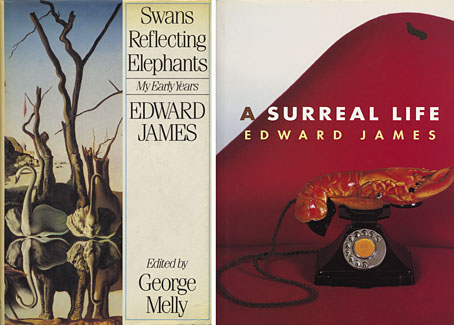
For anyone whose interest is piqued by all of this, two books are worth searching for: Swans Reflecting Elephants, My Early Years (1982) is an autobiography which George Melly compiled from conversations with its subject (and which apparently finished their friendship). James’ propensity for invention means it can’t always be trusted but then that’s the case with many memoirs. A Surreal Life: Edward James (1998) is the 160-page exhibition catalogue which explores James’ life and aesthetic obsessions in a series of copiously-illustrated essays. Both books can be found relatively cheaply via used book dealers.

Previously on { feuilleton }
Las Pozas panoramas
René Magritte by David Wheatley
Soft Self-Portrait of Salvador Dalí
Mongolian impressions
Hello Dali!
Return to Las Pozas
Dirty Dalí
Impressions de la Haute Mongolie revisited
Las Pozas and Edward James

Val Denham album covers

denham01.jpg

Funeral In Berlin (1981) by Throbbing Gristle.

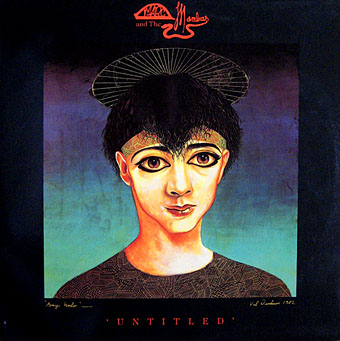
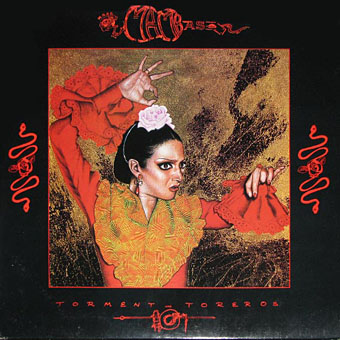
British artist and musician Val Denham was mentioned in yesterday’s post so I thought it worthwhile following up with a selection of the painter’s record sleeves. Denham’s art stood out for me when I first saw the cover of Throbbing Gristle’s Funeral In Berlin album, and for its visceral immediacy this is still a big favourite. The early 1980s were the perfect time for Denham’s paintings to appear on record sleeves, the diminished area of CD packages providing a poor stage for work that’s this vivid and dramatic. Her associations with Throbbing Gristle extended to work with Marc Almond, a cover for the Some Bizzare compilation If You Can’t Please Yourself You Can’t, Please Your Soul which featured ex-TG members Coil and Psychic TV, and further associations with Coil via allies Black Sun Productions. Many of these connections can be explored at Denham’s detailed website which has a great gallery section showing work in a variety of media from the past thirty years. Her art is surreal, intense, often disturbing, and deeply personal in its exploration of shifting gender boundaries. Isn’t it time someone published a Val Denham book?

Some cover samples follow. More can be seen at the artist’s website.

denham02.jpg

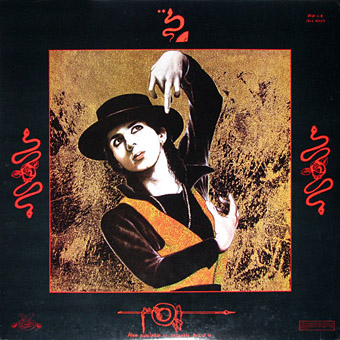
Untitled (1982) by Marc and The Mambas. Design by Huw Feather.

denham03.jpg

Torment And Toreros (front, 1983) by Marc and The Mambas. Design by Huw Feather.

denham04.jpg

Torment And Toreros (back, 1983) by Marc and The Mambas. Design by Huw Feather.

Continue reading “Val Denham album covers”

Weekend links 101

cabat.jpg

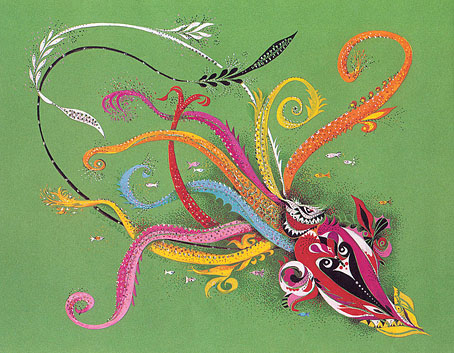
Kraken from Ernie Cabat’s Magical World Of Monsters (1992) at Monster Brains.

“I think for a lot of people who don’t read pulp growing up, there’s a real surprise that the particular kind of Pulp Modernism of a certain kind of lush purple prose isn’t necessarily a failure or a mistake, but is part of the fabric of the story and what makes it weird. There’s a big default notion that ‘spare,’ or ‘precise’ prose is somehow better. I keep insisting to them that while such prose is completely legitimate, it’s in no way intrinsically more accurate, more relevant, or better than lush prose.” China Miéville at Weird Fiction Review expressing an opinion that few in the literary world ever articulate, never mind agree with. Far more common is (to pick a recent example) Ursula K Le Guin dismissing Cormac McCarthy for “pretentious prose”.

• “Militant feminist scientists brainwash a research subject to assassinate the Welsh Minister of Prostitution. Meanwhile World War III is being fought and the USA has been invaded.” The IMDB précis for Taking Tiger Mountain (1983), a feature film directed by Tom Huckabee from a script by William Burroughs, and featuring a 19-year-old pre-Aliens/Near Dark Bill Paxton. The director discusses the film’s production at Screen Slate and attends a rare screening at Spectacle, Brooklyn, NYC, today (March 25th). YouTube has a three-minute clip. Surprising this has remained buried for so long. When can the rest of us get to see it?

• Prestel have published the catalogue for In Wonderland: The Surrealist Adventures of Women Artists in Mexico and the United States. AnOther previewed some of the contents. The exhibition runs at the LACMA, Los Angeles, until 6th May.

…gays only make up about 3% of the population so we spend our whole lives “translating” straight movies, books, ballets into gay terms and studying the heterosexuals around us—we know much more about them than they know about us, just as blacks know a lot about whites but whites know virtually nothing about blacks.

Edmund White (again) interviewed by Frank Pizzoli at Lambda Literary Review.

• New on Caroline True Records: Jon Savage’s “Fame”, Secret History of Post-Punk 1978–81. “Some of it doesn’t sound like anything that has happened since,” says Savage. Indeed. FACT has the track list which I was pleased to see includes Chrome among the usual suspects. Hear a 12-minute promo mix at Soundcloud.

guerin.jpg

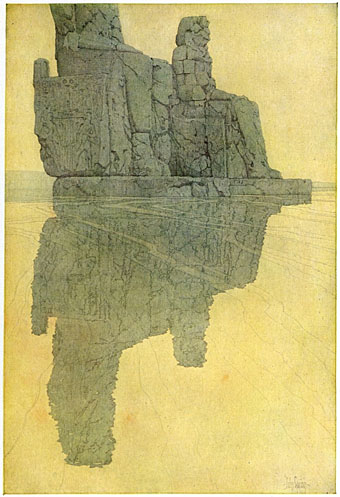
The Colossi of Memnon by Jules Guerin. From Egypt and its Monuments (1908) by Robert Hichens at Golden Age Comic Book Stories.

Gay Life Stories, “a colourful compendium of same-sex love through the ages” by Robert Aldrich. Reviewed here. Related: Alice Dreger asks “Are straight people born that way?”

• Clive Hicks-Jenkins created a series of designs for a Washington DC performance of Stravinsky’s The Soldier’s Tale. Follow their evolution in reverse order at his blog.

• Hocus Pocus: Margaret Eby on the brief epistolary relationship between Harry Houdini and Arthur Conan Doyle.

Rick Poynor on more cover designs for JG Ballard’s Crash.

London, city of dreams and rivers, caught on Polaroid.

• Photo prints by Thom Ayres for sale at Society6.

B*tches in Bookshops

• Meet You In The Subway (1979) by Chrome | New Age (Version III) (1980) by Chrome | Danger Zone (1981) by Chrome | Firebomb (1982) by Chrome.

Weekend links 100

bedini.jpg

How to become a mermaid and dissolve into sea foam in just seven surgical operations (2010) by Carla Bedini.

D.I.Y. Magic was a regular feature in the late Arthur Magazine that’s now become a book by Anthony Alvarado: “Think of it as jail-breaking the iPhone of your mind. Teaching it to do things that its basic programming was never set up for. Advanced self-psychology.” A first edition letterpress silver foil cover is limited to 1000 copies. | More magic: Jimmy Page’s unused soundtrack for Kenneth Anger’s Lucifer’s Rising finally gets an official release on March 20th.

Julia Holter‘s tremendous new album, Ekstasis, has been rocking my world this week. She’s interviewed at FACT where you can also hear the opening track, Marienbad, which receives extra points for being derived from that film. And there’s more: Ritual Music, a live performance at Sea & Space Gallery in Los Angeles, and Fur Felix, a film by Eric Fensler.

Brute Ornament, an exhibition of new work by Seher Shah and Kamrooz Aram opens at the Green Art Gallery, Dubai, on Monday. While the UAE is out of reach for most of us, the gallery site has samples of the work on display.

• This week’s mixtape arrives courtesy of BUTT magazine: Rock Bottom Mix by Cesar Padilla, a blend of acid, glam, grunge, punk, surf and stoner rock. Elsewhere, Richard Norris lists his 20 favourite UK psychedelic records.

the name is BURROUGHS ? Expanded Media at ZKM, the Center for Art and Media in Karlsruhe, is a comprehensive exhibition presenting for the first time in Germany the artistic output of William Burroughs.

Boneland by Alan Garner will be published in August, a new novel that concludes a narrative thread begun with The Weirdstone of Brisingamen in 1960.

• Coming soon (so to speak) on BFI DVD, The Erotic Films of Peter de Rome, more gay obscurities receiving quality attention.

The Northampton Chronicle reports on Alan Moore’s forthcoming novel about the town, Jerusalem.

Susan Cain is playing my tune (again): Why the world needs introverts.

• Techniques of terror: Carl Dreyer‘s Danish Gothic dissected.

• NASA has the latest map of Everything.

The male sex toy revolution.

Lucifer Rising Sessions (1972) by Bobby Beausoleil.