Weekend links 172

thielker.jpg

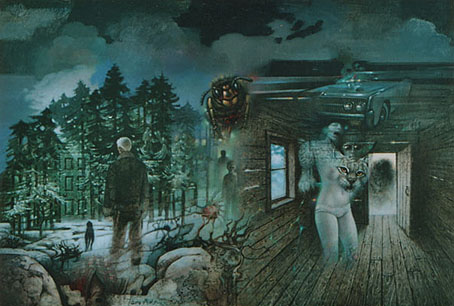
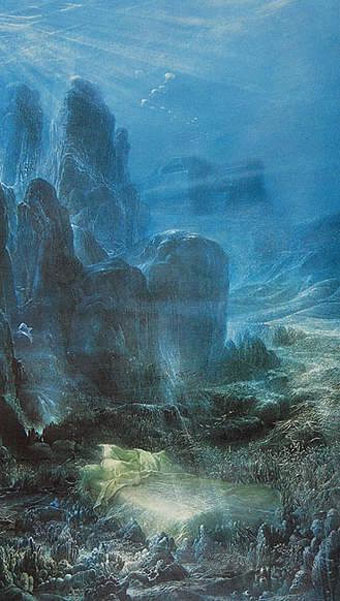
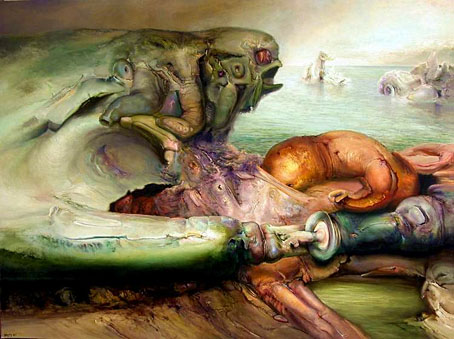
Complete Stop (2008), an oil painting by Gregory Thielker from his Under the Unminding Sky series.

• For Halloween last year I watched a very poor copy of a BBC Play For Today production, Robin Redbreast, a piece of rural horror by John Bowen which received a single screening in 1970. That poor copy—black-and-white, timecoded, multi-generation video—has been circulating for years, so it’s good to know that the BFI will be releasing Robin Redbreast on DVD in time for this year’s Halloween. This might be news enough but the following month the BFI also releases Leslie Megahey’s stunning adaptation of Schalcken the Painter in a dual DVD/Blu-ray edition. I wrote a short review of the latter film last October.

• Mixes of the week: August Sun High from The Advisory Circle, and John Wizards’ Quietus Mix “African music, R&B and chamber pop, filtered through gentle electronic arrangements that cross-pollinate with South African house, Shangaan electro and dub”.

• A trailer has surfaced for The Counselor, a film by Ridley Scott from an original screenplay by Cormac McCarthy. Trailers are too spoilerish so I’m refusing to watch it but for those interested Slate has the details.

Luckhurst makes an admirable attempt to link Lovecraft’s most frustrating writing tic to this theme of the unknown when he claims that Lovecraft’s “catachresis”—deliberate muddling of language through the use of mixed metaphors and the like—is a tool he uses to bolster the atmosphere of futility in the face of “absolute otherness.” The trauma of encountering something so far outside the realms of imagination triggers a collapse of logic in the language itself.

Cate Fricke reviews The Classic Horror Stories of HP Lovecraft, a collection from Oxford University Press edited by Roger Luckhurst.

• “Contemporary audiences found it too weird, too wonky and even borderline distasteful…” Xan Brooks goes looking for the locations from Powell & Pressburger’s 1943 film, A Canterbury Tale.

• Two songs from Julia Holter’s forthcoming album, Loud City Song: World and Maxim’s I. Also unveiled this week: Evangeline, a new track by John Foxx & Jori Hulkkonen.

• Have Ghost, Will Find: Colin Fleming on William Hope Hodgson’s Carnacki, The Ghost Finder.

• At PingMag: Urban Calligraphy: Turning the Streets into Big, Loud Canvases.

• Sex, Spirit, and Porn: Conner Habib talks to Erik Davis.

Serendip-o-matic: Let Your Sources Surprise You

The Pronunciation of European Typefaces

Twilight (2004) by Robin Guthrie & Harold Budd | Luminous (2009) by John Foxx & Robin Guthrie | Cling (2011) by Robin The Fog

The Wormwood Star

cameron1.jpg

I’ve waited about 20 years to see this one, after first learning of it via a Curtis Harrington interview in Michael Weldon’s Psychotronic magazine in the 1990s. The Wormwood Star (1956) is a 10-minute study of the occult art and witchy persona of Harrington’s friend Marjorie Cameron (1922–1995), best known these days for her memorable incarnation as the Scarlet Woman in Kenneth Anger’s Inauguration of the Pleasure Dome (1954), a film in which Harrington also appeared. With her flame-red hair, green eyes and basilisk gaze, Cameron (as she preferred to be called) would have made an impression wherever she landed. Her presence in Anger’s film is so striking that stills of her face have often been used to stand for the entire Magick Lantern Cycle.

cameron2.jpg

In The Wormwood Star Harrington ramps up the mystique with oblique shots and at least half the running time given to Cameron’s strange drawings and paintings. The subtitle, “Concerning the Knowledge and Conversation of the Holy Guardian Angel” harks back to the 1940s and her husband, Jack Parsons, a rocket researcher and, for a time, the American head of Aleister Crowley’s Ordo Templi Orientis. Harrington later gave Cameron a wordless role as the “Water Witch” in his low-budget horror film, Night Tide (1961), where she drifts around Venice Beach looking suitably mysterious. Night Tide is out-of-copyright so can be watched in full at YouTube. The Wormwood Star appeared on a Curtis Harrington DVD only last month which is no doubt where this copy originates. It may not stick around so watch it while you can.

Previously on { feuilleton }
Street Fair, 1959
House of Harrington
Curtis Harrington, 1926–2007
The art of Cameron, 1922–1995
Kenneth Anger on DVD…finally

Mati Klarwein book covers

mati1.jpg

The World’s Desire (1972) by H. Rider Haggard & Andrew Lang. Painting: Astral Body Asleep (1968).

The use of Mati Klarwein’s paintings on album covers is well documented, the official Klarwein site has a small section devoted to some of the covers. Less well-known are these book covers which were evidently the product of a brief enthusiasm for Klarwein’s work in the Ballantine Books’ art department. As with many of the album covers, these are all pre-existing paintings which have been cropped for use as cover art.

The most surprising example is the cover for The Alien Condition with its detail from Annunciation, a painting better known for its appearance on Abraxas (1970), a very successful Santana album. Given how visible that cover art would have been in 1973 you have to suspect that the painting’s use as a book cover was a deliberate bid to attract a youthful readership. All these titles are works of science fiction or fantasy; I don’t recall having seen a Klarwein cover for any non-genre titles. If anyone knows of an example then please leave a comment. (Thanks to Jay for the tip!)

mati2.jpg

With a Finger in My I (1972) by David Gerrold. Painting: Blessing (1965).

mati3.jpg

The Alien Condition (1973) edited by Stephen Goldin. Painting: Annunciation (1961).

mati4.jpg

Two Views of Wonder (1973) edited by Thomas N. Scortia & Chelsea Quinn Yarbro. Painting: Unknown.

mati5.jpg

Arrive at Easterwine: The Autobiography of a Ktistec Machine (1973) by RA Lafferty. Painting: Nativity (1961).

Elsewhere on { feuilleton }
The book covers archive

Previously on { feuilleton }
The art of Mati Klarwein, 1932–2002

Weekend links 167

field.jpg

Poster by Luke Insect & Kenn Goodall.

In recent years I’ve had little patience for British cinema: too much dour “realism” with little of Alan Clarke’s vitality, too many comedies that aren’t funny, too many Hollywood calling cards, too much Colin Firth… So it’s been a pleasure to see Peter Strickland’s Berberian Sound Studio followed this month by Ben Wheatley’s A Field In England, a pair of films that stand out by daring to be different in a medium which seems to grow more creatively conservative with each passing year. A Field In England adds to the micro-genre of weird British films set around the time of the English Civil War. In place of witchfinders and devil worshippers we have magic, murder, madness, and a field of hallucinogenic mushrooms. Wheatley, like Strickland, takes risks that wouldn’t be allowed with a bigger budget which makes me excited to see what they’ll be doing next. A Field In England is already out on DVD & Blu-ray. The trailer is here. The director talked to Mat Colegate about the genesis of the film (spoiler alert). There’s more big hats and cloaks in this list of ten 17th century films.

• “I like to look at men…the way they look at women,” photographer Ingrid Berthon-Moine says about her pictures of sculpted testicles.

Roger Dean has finally sued James Cameron over the designs for Avatar. Will be interesting to see how this one turns out.

• Google has taken its Street View cameras to Battleship Island, “the most desolate city on earth“.

• The strange fantasy novels of Edward Whittemore are available again in digital editions.

Julia Holter talks about her forthcoming Gigi-inspired album Loud City Song.

• At Pinterest: Maneki-neko, the beckoning cat of good fortune.

Beautiful Books: Decorative Publishers’ Cloth Bindings.

• The abstract paintings of Hilma af Klint (1862–1944).

Lee Brown Coye illustrates August Derleth in 1945.

Bill Laswell’s discography intimidates the collector.

• Mix of the week: Kit Mix #23 by Joseph Burnett.

• The Soundcarriers: Last Broadcast (2010) | Signals (2010) | This Is Normal (2012)

The art of Sergius Hruby, 1869–1943

hruby1.jpg

Sergius Hruby was an Austrian artist who specialised in that fin de siècle staple, the malevolent or sinister woman. Or so it would seem from these examples which, since I’ve chosen the more assertively Decadent fare, may be doing him a disservice. The style is very similar to another Austrian artist, Franz von Bayros, albeit without the overt pornography that’s a feature of Bayros’s drawings. What’s surprising about the Hruby pictures below is that they’re all from the pages of Die Muskete for 1933, a Viennese periodical which ran humorous articles, cartoons, and “glamour” pictures of a type which would have been far too risqué for a British magazine of the same period. Hruby’s work wouldn’t have seemed out of place in 1903 but in 1933 it looks somewhat old-fashioned. Another artist requiring further research, especially if there are more vampire sphinxes lurking somewhere. (And another tip via Beautiful Century.)

hruby2.jpg

hruby3.jpg

hruby4.jpg

Continue reading “The art of Sergius Hruby, 1869–1943”