Weekend links 175

maeda.jpg

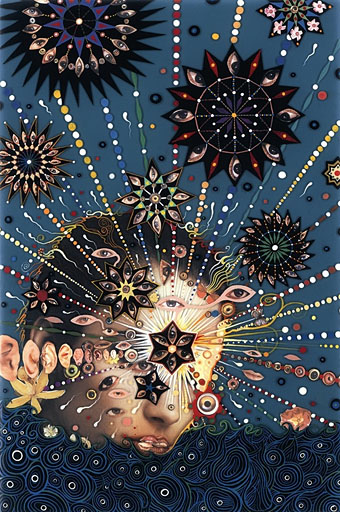
Heartbeat of the Death – Queen Elizabeth the First (2013) by Haruko Maeda.

• “The casual mixing of people from across the world at The Garden broke down many barriers. Its rich, beautiful, smart, and successful people were confident enough to exercise the kind of sexual freedom that would land you in jail elsewhere in the country.” Kate Webb on Alla Nazimova’s Hollywood estate, The Garden of Alla.

• “…from 1956 to 1970 Borges taught English literature at the University of Buenos Aires, and now, over half a century later, one of his courses is finally available in English in a slim, delightful volume.” Will Glovinsky on Professor Borges. Related: Jacob Mikanowski says “To Tlön: Let’s Invade Reality”.

• Mixes of the week: Secret Thirteen Mix 084 by Koen Holtkamp—Alice Coltrane, Alan Watts, John Cage, Popol Vuh, Faust and others—and Sequenze E Frequenze, “the rarefied outer limits of ‘stare at the sun, outsider peaked’ Italian music”.

Consider the fate of the concept of ‘futuristic’ music. The ‘futuristic’ in music has long since ceased to refer to any future that we expect to be different; it has become an established style, much like a particular typographical font. Invited to think of the futuristic, we will still come up with something like the music of Kraftwerk, even though this is now as antique as Glenn Miller’s big band jazz was when the German group began experimenting with synthesizers in the early 1970s.

Where is the 21st-century equivalent of Kraftwerk? If Kraftwerk’s music came out of a casual intolerance of the already-established, then the present moment is marked by its extraordinary accommodation towards the past. More than that, the very distinction between past and present is breaking down. In 1981, the 1960s seemed much further away than they do today. Since then, cultural time has folded back on itself, and the impression of linear development has given way to a strange simultaneity.

Mark Fisher on the present cultural moment, and the weirdness of Sapphire and Steel.

• At Front Free Endpaper: A Gay Library Thing and French Line Gay Pulp Cover Designs. Callum is also giving away books by Frederick Rolfe/Baron Corvo to anyone who asks. The proviso is you write a short review for his blog.

• Film director Ben Wheatley on Don’t Look Now: “I felt a great panic come over me”. Elsewhere it was announced this week that Wheatley is planning a film of JG Ballard’s High Rise.

• Brits may remember the wonderful Laurie Pike from the Manhattan Cable TV show in the early 1990s. These days she’s writing an online guide to the city of Paris.

Ben Frost has made three previously unreleased recordings available at Bandcamp.

The Media History Digital Library: 800,000 pages of film and radio periodicals.

• The results of three derives in London by Christina Scholz here, here and here.

• The late Seamus Heaney reads his own translation of Beowulf here and here.

High Rise (1979) by Hawkwind | Pop Sicle (1994) by High Rise | High Rise (2005) by Ladytron

Tom Adams book covers

adams01.jpg

Dust jacket for The Magus (1966) by John Fowles.

I pulled my 1982 paperback of John Fowles’ The Magus from the bookshelf recently. After flicking through the pages I decided to start re-reading it, having realised that in the thirty years which have elapsed since I first read it I couldn’t remember much at all about it. One thing I did remember, however, was the cover of the first edition, a painting and design I’d admired in the past without knowing the name of the artist responsible.

adams02.jpg

American illustrator Tom Adams is the artist in question, and looking at his painting again it further occurred to me that his cover deployed an evocative but not wholly specific assemblage of figures and objects that I’d often seen elsewhere, notably on the first edition cover of Peter Straub’s Ghost Story. So it was no great surprise to discover that Tom Adams was also responsible for that cover painting. The Fowles and Straub novels are big books which slowly reveal their layered mysteries. Adams’ approach to illustrating them strikes me as an ideal solution when neither of the novels can be easily reduced to a single image. (This hasn’t prevented subsequent designers from trying.) Fowles approved wholeheartedly of the painting but this isn’t a particularly fashionable technique at the moment, the trend being to try and condense complex narratives into a single motif.

adams03.jpg

Cover painting for Ghost Story (1979) by Peter Straub.

Looking for more of Adams’ art tipped me into an entire world of Agatha Christie book covers which were the artist’s main body of work for many years. Adams is understandably celebrated by Christie-philes (Paper Tiger published a book of his Christie covers in 1981) but outside Sherlock Holmes and Father Brown I’ve never had much of a taste for the classic detective story so this was a previously undiscovered niche. Here Adams sidesteps the chore of painting Christie’s meddlesome sleuths in favour of a remarkable display of grotesque Surrealism which—for a sceptic such as myself—makes the books seem potentially interesting. As with The Magus and Ghost Story there’s the same assemblage of evocative figures or objects but with an additional macabre twist. Many of these covers are so grotesque they could easily function as horror illustrations so it’s no wonder he was asked to illustrate the Straub. This Flickr page has many more examples (warning: wretched user-unfriendly Flickr layout in operation) as does this site. The artist has a website where prints of The Magus painting may be purchased.

adams04.jpg

adams05.jpg

Continue reading “Tom Adams book covers”

The art of Roland Cat

cat02.jpg

The Rime of the Ancient Mariner (Axium, 1969).

The work of French artist Roland Cat is less Surreal—although some of it could be classed as such—than Fantastic in a manner similar to that of contemporaries such as Michel Henricot, Jean-Pierre Ugarte, Jean-Marie Poumeyrol, Gérard Trignac and others. Art of this nature receives support and encouragement from the French to a degree which often seems inversely proportional to the ignorance it receives from the Anglophone art world. For years the only example of Cat’s work I’d seen was the picture that Dave Britton used on the cover of the Savoy edition of New Worlds magazine in 1979. The examples here are the result of a web trawl, hence the missing titles and dates.

The Coleridge illustration above was for a volume that was part of a series produced by a French publisher in 1969, each edition of which was illustrated by a different artist. This forum post has more details. For more about Roland Cat see this short appraisal at Visionary Review.

cat08.jpg

Sleep (1980).

cat01.jpg

Dagon (Belfond, 1987).

Continue reading “The art of Roland Cat”

The art of James Gleeson, 1915–2008

gleeson1.jpg

Funeral Procession in a Wounded Landscape (1945).

James Gleeson was an Australian Surrealist painter whose work I don’t think I’d seen before. The early pictures tend towards the post-Dalí school that crowds the second and third generation of Surrealist painting. More interesting for me are the later landscapes (if they can be labelled such) produced by a combination of collage and painting techniques. Some of HR Giger’s work in the 1970s explored similar organic terrain but this period didn’t last very long before he was into his biomechanical territory.

gleeson3.jpg

Locus Ganesa (1985).

gleeson2.jpg

Sky Techtonics (2002).

Elsewhere on { feuilleton }
The fantastic art archive

Weekend links 173

orszag.jpg

Icarus (1974–75) by Lili Ország.

• The Cabaret Voltaire albums released on the Virgin label in the 1980s have suffered the same shoddy treatment on CD as other Virgin reissues, a situation to be rectified in November with an extensive revisiting of the CV back catalogue. The long-overdue reappraisal will also include the release of Earthshaker, a collection of previously unavailable recordings from the Virgin period.

• It’s that book again: Design Observer has the preface from Lolita — The Story of a Cover Girl: Vladimir Nabokov’s novel in art and design, a book by John Bertram and Yuri Leving. At The Millions John Bertram talks to designer John Gall about the problems Lolita poses for cover designers.

• Jerry Lewis’s The Day the Clown Cried (1972) has acquired legendary status over the years for the apparent tastelessness of its subject matter—a clown in Auschwitz—and the fact that its director/star has never allowed the film to be seen in public. This week some footage arrived on YouTube.

Candy Bullets And Moon (1967), a one-off psychedelic collaboration between Don Preston and Meredith Monk.

• What’s the collective term for many bookshops? Whatever it is, there’s a lot of them in this Pinterest collection.

• At Dangerous Minds: Artist Gail Potocki’s exploration of Alice in Wonderland and the passing of time.

Anne Billson on the late Karen Black and why horror movies deserve our respect.

Tobias Carroll on the Surreal life and fiction of Leonora Carrington.

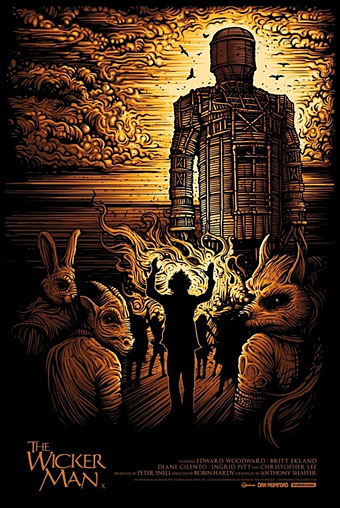
More details emerge about The Wicker Man – The Final Cut.

• Issue 35 of Arthur Magazine is now available for order.

• Graphics, drawings and collages by Jan Švankmajer.

• Every film poster designed by Saul Bass.

• Cabaret Voltaire: Just Fascination (1983) | Sensoria (1984) | I Want You (1985)