Weekend links 198

boty.jpg

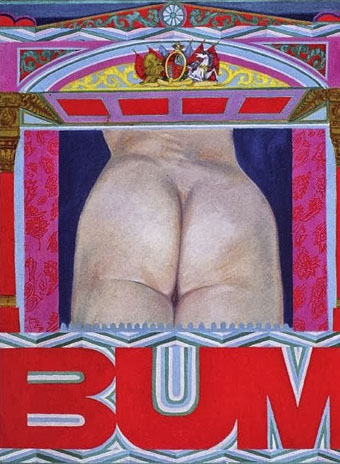
Bum (1966) by Pauline Boty.

Eleanor Birne on Pauline Boty, “the only prominent female Pop artist among a generation of famous men”. Ken Russell’s Pop Art documentary, Pop Goes the Easel (1962), which features Boty, may be seen here. Two years later Boty was back with Ken Russell playing the part of the prostitute from The Miraculous Mandarin in a film about Béla Bartók. That’s something I’d love to see. There’s more about her painting, and the work of other female Pop artists, here.

• Why Are We Sleeping? Mark Pilkington on the music world’s recurrent interest in the philosophy of GI Gurdjieff. Pilkington’s most recent Raagnagrok release with Zali Krishna, Man Woman Birth Death Infinity, was reviewed by Peter Bebergal.

• Cinematic details: Frames-within-frames in The Ipcress File (1966), and the typography of 2001: A Space Odyssey (1968).

highrise.jpg

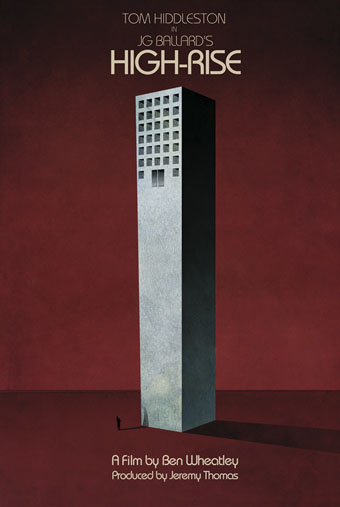
A Jay Shaw poster for Ben Wheatley’s forthcoming film of High-Rise.

• “…a large cavity must be dug in the bird’s shoulder and filled with ball bearings.” Christine Baumgarthuber on the dubious delights of The Futurist Cookbook.

• Why Tatlin Can Never Go Home Again: Rick Poynor on the difficulties of finding a definitive representation of an artwork online.

Jay Parini reviews Inside a Pearl: My Years in Paris by Edmund White. At AnOther Donatien Grau talks to White about fashion.

• At Bajo el Signo de Libra (in Spanish): the homoerotic and occasionally Surrealist art of Pavel Tchelitchew.

• At 50 Watts: Kling Klang Gloria: Vintage Children’s Books from Austria.

• The motorbike girl gangs of Morocco photographed by Hassan Hajjaj.

Geoff Manaugh on how LED streetlights will change cinema.

Stylus “is an experiment in sound, music and listening”.

• Mix of the week: Secret Thirteen mix 106 by Senking.

• At Pinterest: JG Ballard

This Is Pop? (1978) by XTC | Pop Muzik (1979) by M | Pop Quiz (1995) by Stereolab

Spanish Salomés

salome1.jpg

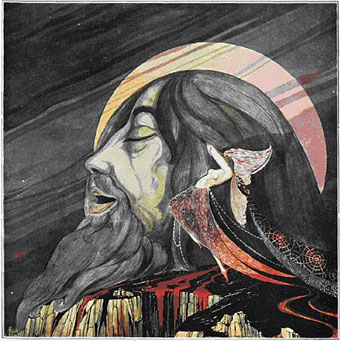
Uncredited painting based on Modern Salomé (1927), a poem by Emilio Carrere.

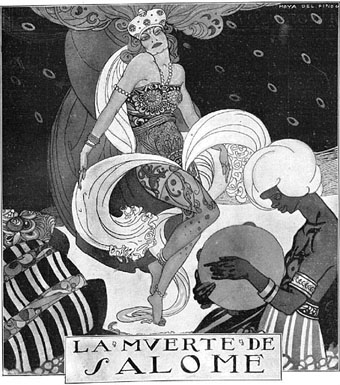
Yet more on this indefatigable theme, the examples this time being by Spanish artists and illustrators. All the pieces are from this page, and the artists involved aren’t well-known at all so checking details isn’t easy. Take the references with a pinch of salt. Thanks to Thom for the tip!

salome2.jpg

Illustration by José Moya del Pino for The Death of Salomé (1915), a poem by Emilio Carrere.

Continue reading “Spanish Salomés”

The Art of Tripping, a documentary by Storm Thorgerson

aot1.jpg

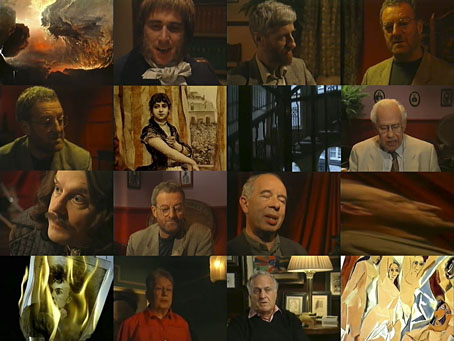
How does this sound? 100 minutes of solidly informative documentary about the use of drugs by artists from the early 19th century on; a production that calls upon a remarkable cast of contributors (see below), with music by David Gilmour, and the whole thing “devised and directed” by Storm Thorgerson, better known as one third of the great Hipgnosis design team.

The Art of Tripping was broadcast in two parts in 1993 during the Without Walls arts strand on Channel 4 (UK). David Gale was the writer, with actor Bernard Hill playing the part of the narrator and guide. The programme managed to deal with a contentious subject without indulging in hysteria or insulting the intelligence of the audience, a rare thing today. Twenty years ago it was still possible to make a documentary about a popular subject without having any low-grade celebrity-du-jour offering their wretched opinion. The contributors here who aren’t medical people are almost all writers of one kind or another; Thorgerson and Gale punctuate the proceedings with a few actors who impersonate various historical figures.
aot2.jpg

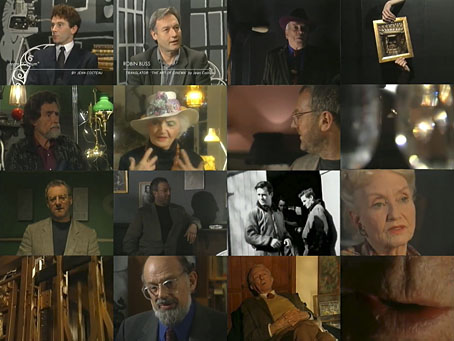
Without Walls was a very good series on the whole but this for me was a real highlight (no pun intended). In addition to it being a rare example of Storm Thorgerson working in television, the direction showed how it was possible to match the theme without recourse to cliché or flashy visuals. There isn’t a single moment of archive footage either. Thorgerson’s history of “socially unacceptable” drugs is structured as a journey through the levels of a multi-storey building, from ground floor to roof; being familiar with the director’s free-associative working methods I can imagine this being a result of thinking about getting high. Bernard Hill encounters the various commentators in successive rooms, each of which is furnished and lit to suggestively imply the drug in question. The use of lighting as a key motif is a smart one, and another metaphor, of course, for literal and symbolic (or spiritual) illumination. Editing effects are also deployed to thematically correspond to the different substances.
aot3.jpg

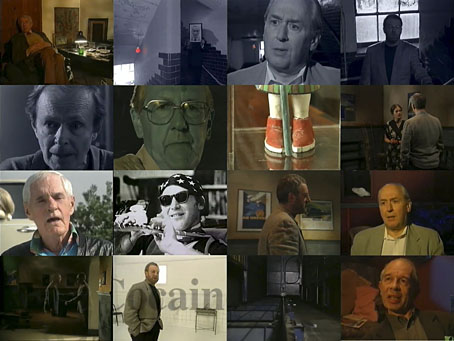
This would be very successful even without a wide range of contributors but Thorgerson and company assembled a stunning array of different writers, many of whom I’d never seen on TV before, and many of whom didn’t turn up again. Some of them fill dual roles, so JG Ballard is on hand to enthuse about Naked Lunch, and appears later talking about his bad LSD trip. Similarly, Brian Aldiss talks about Anna Kavan, and also about Philip K Dick. Below there’s a rough list of the drugs covered and the people involved. In the two decades since this was made many of the people involved have since died, the director included, so the film now has the feel of a historical artefact. The Art of Tripping can be see in full at YouTube. This is how good British television used to be.

Opium
Dr Virginia Berridge (author), Grevel Lindop (author), Marek Kohn (author), Dr EMR Critchley (author), Phil Daniels (as Thomas De Quincey), Dr Tony Dickenson (neuropharmacologist), Dr Ian Walker (author), Thom Booker (as Edgar Allan Poe), Dr Peggy Reynolds (author)
Hashish
Prof John Hemmings (author), Ronald Hayman (author), Patrick Barlow (as Theophile Gautier), John McEnery (as Charles Baudelaire), Jon Finch (as Gérard de Nerval), Bernard Howells (lecturer, King’s College, London), June Rose (author), John Richardson (author), Margaret Crosland (author), Danny Webb (as Jean Cocteau), Robin Buss (translator), David Gascoyne (poet), George Melly (collector, Surrealist art)
Mescaline
Prof Eric Mottram (University of London), Francis Huxley (nephew of Aldous Huxley), Jay Stevens (author), Laura Huxley (widow of Aldous Huxley),
Psilocybin
Brian Cory (as Robert Graves), Paul O’Prey (author)
Marijuana / Nitrous Oxide
Harry Shapiro (author), Carolyn Cassady (author), Prof Ann Charters (author), Allen Ginsberg (poet)
Kief
Paul Bowles (author)
Heroin
JG Ballard (author), Prof Avital Ronell (author), Hubert Selby Jr (author), Brian Aldiss (author)
LSD
Dr Oscar Janiger (experimental psychiatrist), Diana Quick (as Anaïs Nin), Prof Malcolm Lader (psychopharmacologist), Dr Timothy Leary (author), Todd Boyco (as Andy Warhol)
Amphetamine
Lawrence Sutin (author)
Cocaine
Robert Stone (author), Prof. Annette Dolphin (neuropharmacologist)
MDMA

Previously on { feuilleton }
Storm Thorgerson, 1944–2013
Hipgnosis turkeys
Enter the Void
Opium fiends
La Morphine by Victorien du Saussay
In the Land of Retinal Delights
Haschisch Hallucinations by HE Gowers
Storm Thorgerson: Right But Wrong
Demon rum leads to heroin
The art of LSD
Hep cats
German opium smokers, 1900

Weekend links 195

ethellerossignol.jpg

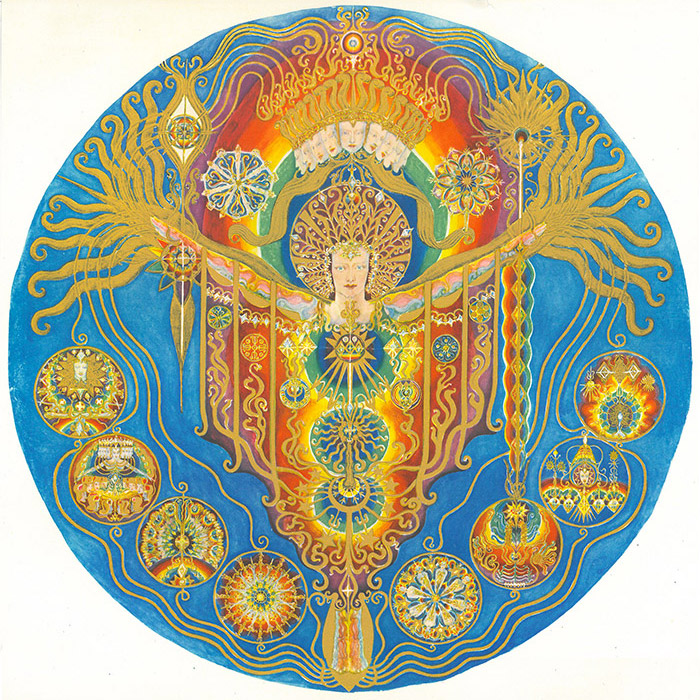
Untitled painting (c. 1920–1933) by Ethel le Rossignol depicting “the Sphere of the Spirit”. An exhibition of  Ethel le Rossignol’s channelled paintings takes place at the Horse Hospital, London, next month.

• “It’s always disconcerting to discover a favourite writer was kind of a jerk. How does this realization effect our understanding of Walter Benjamin’s work?” asks Morgan Meis.

• Mixes of the week: Georges Vert (aka Jon Brooks) presents The Pan-Europa Mix. Mr Brooks also unveiled another seasonal mix which he calls Winter Velvet.

Knopheria by Chrome Hoof ft. Shingai Shoniwa. A video from the band’s latest album.

Without sci-fi trappings of any kind, The Metamorphosis forces us to think in terms of analogy, of reflexive interpretation, though it is revealing that none of the characters in the story, including Gregor, ever does think that way. There is no meditation on a family secret or sin that might have induced such a monstrous reprisal by God or the Fates, no search for meaning even on the most basic existential plane. The bizarre event is dealt with in a perfunctory, petty, materialistic way, and it arouses the narrowest range of emotional response imaginable, almost immediately assuming the tone of an unfortunate natural family occurrence with which one must reluctantly contend.

David Cronenberg on Franz Kafka’s story.

• “I was very much into now-ism.” Laraaji talks to Bobby Barry about his music.

The Edge Question for 2014: “What scientific idea is ready for retirement?”

Storybook Apocalypse: Beasts, Comets, and Other Signs of the End Times.

• Return of the wunderkammer: Philip Hoare on cabinets of curiosities.

• Birditis: Ian Penman on the “full catastrophe” of Charlie Parker.

Rick Poynor on The Compulsively Visual World of Pinterest.

• RIP psychedelic poster artist Gary Grimshaw.

• At PingMag: The automaton clocks of Tokyo.

Dust & Grooves: Vinyl music culture.

Wunderkammern at Pinterest.

Ligeti: String Quartet No. 1 “Metamorphoses nocturnes” (recorded 1978) The Arditti Quartet | Thru Metamorphic Rocks (1979) by Tangerine Dream | Metamorphosis (2012) by Demdike Stare

Big fish

undying.jpg

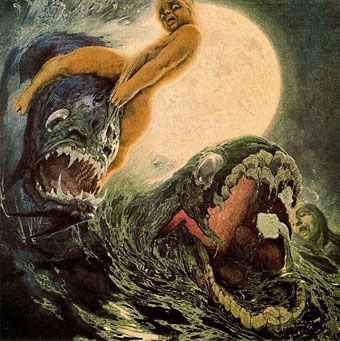
Illustration by Lawrence for The Undying Monster (1946) by Jessie Kerruish.

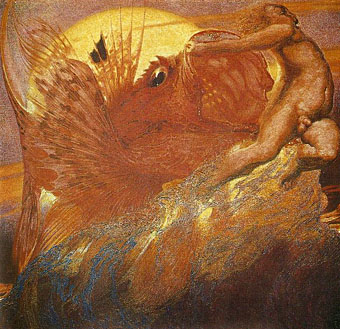
Another of those collisions between fine art and pulp fiction that I like to note now and then. The drawing above by Lawrence Sterne Stevens (from this page) I immediately recognised as borrowing its fish from the painting below by Néstor Martín-Fernández de la Torre (1887–1938), or Néstor as he’s usually known. Stevens was also usually credited by the single name Lawrence, and this is one of his many first-rate contributions to Famous Fantastic Mysteries. I’ve already noted a similar borrowing by his contemporary, Virgil Finlay, so this example isn’t too surprising. It’s unlikely that many of the readers eagerly devouring Jessie Kerruish’s tale would have been familiar with Néstor’s paintings. On the same Lawrence page there’s his illustration for Arthur Machen’s The Novel of the Black Seal which ran in the same issue.

nestor1.jpg

Poema del Mar: Noche (1913–1924).

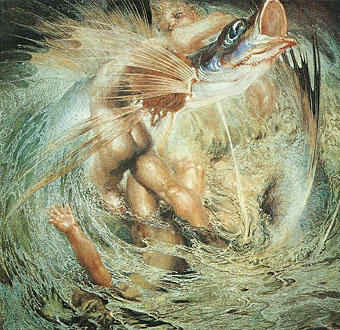
Néstor is distinguished by a predilection for aquarian scenes and writhing figures, all of which are presented in a very distinctive and recognisable style. He also happens to be one of the few major artists to come from the Canary Islands which no doubt explains his interest in the sea. The Poema del Mar series, and other works such as this satyr head, often find him numbered among the Spanish Symbolists although he’s rather late for that movement, and this assumes that every artist has to be placed in one box or another whether they belong there or not. These giant fish could just as well make him another precursor of the Surrealists, and they do occasionally receive a mention for their similarity to (and possible influence upon) Dalí’s enormous Tuna Fishing (Homage to Meissonier) (1966–67). There’s more of Néstor’s work over at Bajo el Signo de Libra (Spanish language).

nestor2.jpg

Poema del Mar: Tarde (1913–1924).

nestor3.jpg

Poema del Mar: Reposo (1913–1924).

Continue reading “Big fish”