Weekend links 100

bedini.jpg

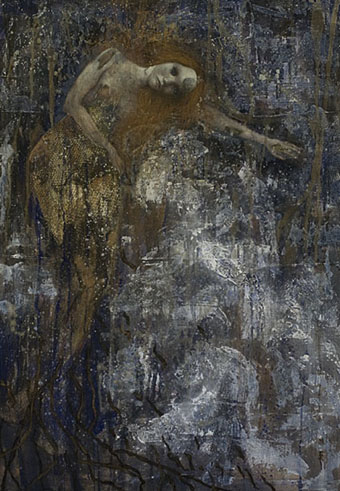
How to become a mermaid and dissolve into sea foam in just seven surgical operations (2010) by Carla Bedini.

D.I.Y. Magic was a regular feature in the late Arthur Magazine that’s now become a book by Anthony Alvarado: “Think of it as jail-breaking the iPhone of your mind. Teaching it to do things that its basic programming was never set up for. Advanced self-psychology.” A first edition letterpress silver foil cover is limited to 1000 copies. | More magic: Jimmy Page’s unused soundtrack for Kenneth Anger’s Lucifer’s Rising finally gets an official release on March 20th.

Julia Holter‘s tremendous new album, Ekstasis, has been rocking my world this week. She’s interviewed at FACT where you can also hear the opening track, Marienbad, which receives extra points for being derived from that film. And there’s more: Ritual Music, a live performance at Sea & Space Gallery in Los Angeles, and Fur Felix, a film by Eric Fensler.

Brute Ornament, an exhibition of new work by Seher Shah and Kamrooz Aram opens at the Green Art Gallery, Dubai, on Monday. While the UAE is out of reach for most of us, the gallery site has samples of the work on display.

• This week’s mixtape arrives courtesy of BUTT magazine: Rock Bottom Mix by Cesar Padilla, a blend of acid, glam, grunge, punk, surf and stoner rock. Elsewhere, Richard Norris lists his 20 favourite UK psychedelic records.

the name is BURROUGHS ? Expanded Media at ZKM, the Center for Art and Media in Karlsruhe, is a comprehensive exhibition presenting for the first time in Germany the artistic output of William Burroughs.

Boneland by Alan Garner will be published in August, a new novel that concludes a narrative thread begun with The Weirdstone of Brisingamen in 1960.

• Coming soon (so to speak) on BFI DVD, The Erotic Films of Peter de Rome, more gay obscurities receiving quality attention.

The Northampton Chronicle reports on Alan Moore’s forthcoming novel about the town, Jerusalem.

Susan Cain is playing my tune (again): Why the world needs introverts.

• Techniques of terror: Carl Dreyer‘s Danish Gothic dissected.

• NASA has the latest map of Everything.

The male sex toy revolution.

Lucifer Rising Sessions (1972) by Bobby Beausoleil.

Giovanni Battista Palatino

palatino1.jpg

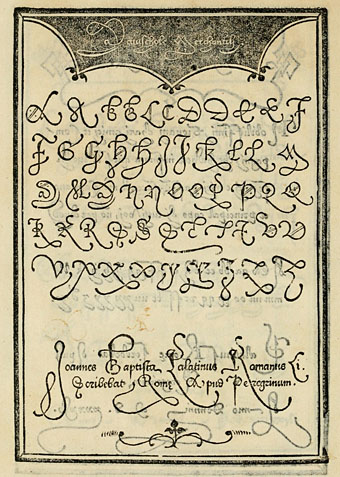
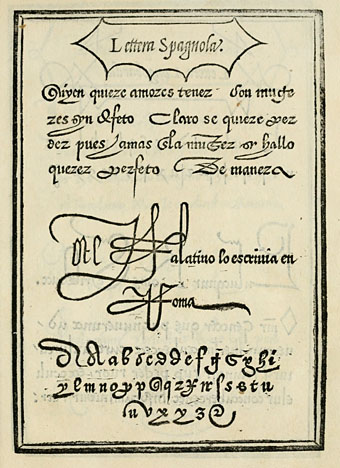
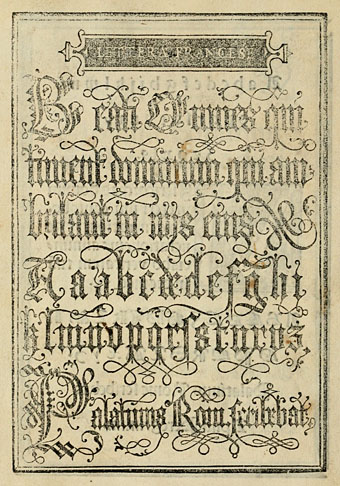
Say the name Palatino today and the only thing it brings to mind for most people is the elegant typeface designed by Hermann Zapf in 1948. Giovanni Battista Palatino (c.1515–c.1575) is the Italian calligrapher from whom Zapf took the name, and the pages here are from a 1550 reprinting of one of Palatino’s sample books, another of those volumes with a sprawling title: Libro di M. Giovambattista Palatino cittadino romano: nel qual s’insegna à scriuere ogni sorte lettera, antica, & moderna di qualunque natione. One of the fascinations for me in going through these old alphabet books is seeing the same designs reprinted down through the centuries until you arrive at the origin of a particular page or design. The third image in this post I have uncredited in a 1997 Pepin Press book of typography; I’ve seen someone wearing it at a gig on a T-shirt, and it turns up in a number of 19th century design books. But this is its origin, and for once the designer receives a credit (although he did sign some of his pages).

Also of interest in this book are the renderings of ancient alphabets. These range from familiar Greek and Hebrew letters to more obscure alphabets some of which resemble a number of occult alphabets that appeared around this time. Agrippa’s Passing the River and the Alphabet of the Magi by Paracelsus in particular look as though they might have been derived from a lettering book such as this.

palatino2.jpg

palatino3.jpg

Continue reading “Giovanni Battista Palatino”

Weekend links 99

moebius.jpg

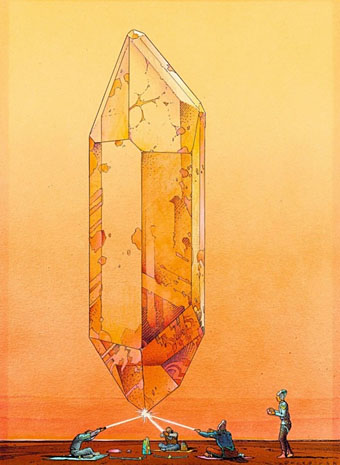
From the Crystal Saga portfolio (1986) by Moebius. Via Quenched Consciousness.

Moebius: A while ago, [science fiction] was filled with monstrous rocket ships and planets; it was a naive and materialistic vision, which confused external space with internal space, which saw the future as an extrapolation of the present. It was a victim of an illusion of a technological sort, of a progression without stopping towards a consummation of energy. But we’ve completely changed that vision. It’s been a sharp, radical change, and somewhat brutal.
HM: Why brutal?
Moebius: Because all those beautiful projects we believed in are gone. But the real sense of science fiction is the discovery that the voyage is interior, and the real energy, the rockets of the past, is what is contained in people’s spirits.
HM: One doesn’t have to read other people’s visions then, one can make the discovery oneself?
Moebius: Well, that, and also the fact that the “new planet” of old science fiction is right here: it’s the Earth.

The Moebius Interview by Diana K. Bletter, Heavy Metal, August 1980.

RIP Jean Giraud, aka Moebius, one of the great artists of the 20th century. My approach to drawing comics was almost wholly derived from the illustrational style of the French, Belgian and other artists being published in Heavy Metal magazine in the late 1970s/early 1980s. Many of the stories were appearing in English for the first time, and for me they revitalised a medium in which (undergrounds aside) I’d lost all interest. It wasn’t only the exceptional artwork that was attractive. The narratives of Moebius, Druillet, Bilal and co. presented a more sophisticated approach to science fiction and fantasy than the simple-minded fare filling the superhero titles or the pages of 2000 AD. Moebius’s work was wittier, sexier and far more imaginative than any American comics I’d seen up to that time. Some of the stories read like graphic equivalents of New Worlds-era science fiction so it came as no surprise to find Moebius drawing a strip called The Airtight Garage of Jerry Cornelius (the title was later amended at Moorcock’s request) while Druillet in his September 1980 Heavy Metal interview mentioned enjoying books by William Burroughs, Michael Moorcock and Thomas Disch, and singled-out Ballard’s Crash as a favourite novel. Without the examples of Druillet and Moebius (and the intoxicating inspiration of the October 1979 issue of Heavy Metal) I wouldn’t have spent 17 months adapting The Call of Cthulhu as a comic strip.

Hasko Baumann’s 2007 documentary, Moebius Redux: A Life in Pictures (some of which can be seen on YouTube) is a good place to start when trying to appraise Jean Giraud’s extensive career. The film is now available on DVD.

Update:
The hour-long cut of Moebius Redux has been posted to Vimeo
An obituary by Kim Thompson at The Comics Journal
The Moebius posts at But Does It Float
moebius2.jpg

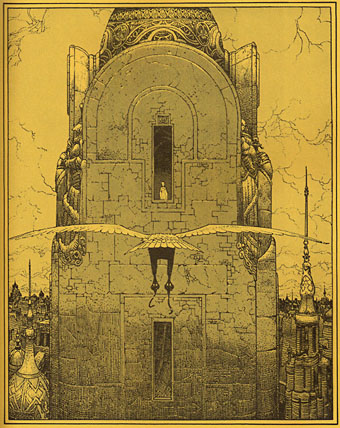
From Les Yeux du Chat (1978) by Jodorowsky & Moebius. Via Quenched Consciousness.

• “Naked Lunch,” Ballard wrote later, “was a grenade tossed into the sherry party of English fiction.” The criss-crossing careers of JG Ballard and William Burroughs are examined in detail at RealityStudio. Related: The Discipline of D.E. (1982) by Gus Van Sant and The Unlimited Dream Company (1983) by Sam Scoggins.

• Dr John’s forthcoming album, Locked Down, has been produced by The Black Keys‘ Dan Auerbach. Those of us who favour the Doctor’s voodoo-inflected early albums are hoping this might mean he gets groove back after wandering for years in an MOR swamp. One of the new recordings, Revolution, sounds promising.

I don’t think sexuality is fixed anymore. I think more from the gay male side than the lesbian side, there is often a wish for things to be fixed. I heard Lady Gaga’s Born This Way and I don’t know why they like it. Maybe, they need more certainty than girls do. For me, it’s like why do you care anyway? Maybe you were, maybe you weren’t. What’s the big deal? I can’t connect to that emotionally, so it baffles me.

Jeanette Winterson talks to Sassafras Lowrey.

• “In [Jacob’s Room], [Virginia] Woolf makes the subject matter not Jacob himself but the ways in which we know and don’t know each other – the gaps in our knowledge.” Alexandra Harris on Modernism in art and literature.

• The Northwest Film Forum in Seattle hosts Magick in Cinema on 5th April, an evening of occult-themed short films which includes a rare screening of Curtis Harrington’s Wormwood Star.

• John Bertram’s Lolita cover competition from 2009 is due to appear in June as a book-length study entitled Recovering Lolita. Bertram previews the contents here.

• “Erotic fiction is having a steamy renaissance and its hottest authors are women.”

LSD helps to treat alcoholism.

• The other Moebius (Dieter): News (1980) by Moebius & Plank | Tollkühn (1981) by Moebius & Plank | Conditionierer (1981) by Moebius & Plank.

Schütze and Unstable at Maggs Bros

schutze.jpg

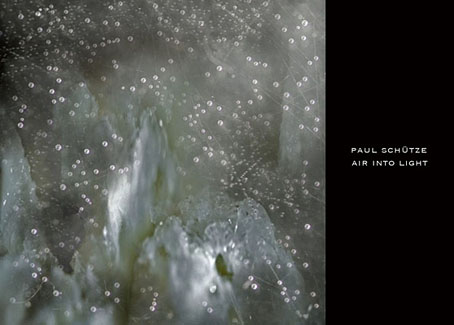
Maggs Bros. Ltd, London, hosts two events soon featuring { feuilleton } friends and cohorts. First up is Paul Schütze with Air Into Light, a showing of eighteen of his photo prints with musical and perfume accompaniment. Paul has been making perfume a subject of particular concern recently. The combination of sound and scent is still little explored despite Scriabin’s ambitious plans for his apocalyptic Mysterium. Air Into Light opens on 12th March.

biroco.jpg

Chaos (2001) by Joel Biroco.

Unstable is a Strange Attractor event which will run from 8th May to 8th June, 2012 presenting new and old work by Battle of the Eyes (Chris Long & Edwin Pouncey), Joel Biroco, Julian House and Cathy Ward. Maggs Bros. has a page with exhibition details here including a PDF catalogue.

Previously on { feuilleton }
Strange Attractor Salon

The Piper at the Gates of Dawn

witw1.jpg

Illustration by W. Graham Robertson (19o8).

(No, this doesn’t concern Pink Floyd.)

The chapter – The Piper at the Gates of Dawn – is normally dropped because it jars, seems so strange compared to all the others and, to some, is vaguely homoerotic. [Kenneth] Grahame thought it essential.

Thus Mark Brown discussing the curious seventh chapter of The Wind in the Willows (1908) wherein Mole and Rat have a mystical encounter with the Greek god of nature in the British countryside:

Perhaps he would never have dared to raise his eyes, but that, though the piping was now hushed, the call and the summons seemed still dominant and imperious. He might not refuse, were Death himself waiting to strike him instantly, once he had looked with mortal eye on things rightly kept hidden. Trembling he obeyed, and raised his humble head; and then, in that utter clearness of the imminent dawn, while Nature, flushed with fullness of incredible colour, seemed to hold her breath for the event, he looked in the very eyes of the Friend and Helper; saw the backward sweep of the curved horns, gleaming in the growing daylight; saw the stern, hooked nose between the kindly eyes that were looking down on them humorously, while the bearded mouth broke into a half-smile at the corners; saw the rippling muscles on the arm that lay across the broad chest, the long supple hand still holding the pan-pipes only just fallen away from the parted lips; saw the splendid curves of the shaggy limbs disposed in majestic ease on the sward; saw, last of all, nestling between his very hooves, sleeping soundly in entire peace and contentment, the little, round, podgy, childish form of the baby otter. All this he saw, for one moment breathless and intense, vivid on the morning sky; and still, as he looked, he lived; and still, as he lived, he wondered.

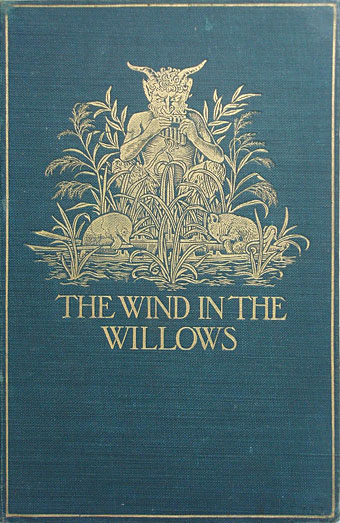
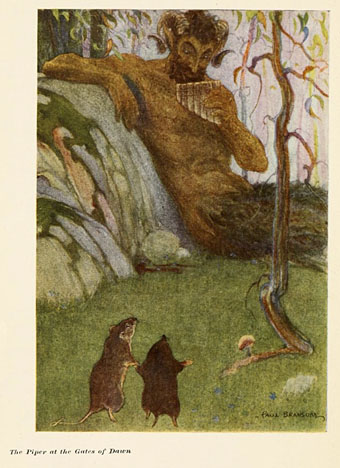
Brown’s article concerns a forthcoming exhibition, Writing Britain: Wastelands to Wonderlands, at the British Library, part of the summer’s Olympic celebrations. Kenneth Grahame’s hand-written text of chapter seven will be on display together with a later Arthur Rackham illustration of the goat god. The Library makes a point of noting that the Pan chapter is sometimes excised from the book although I’m not sure how often this occurs, it’s been present in all the editions I’ve seen including the cheap paperback edition I have somewhere. W. Graham Robertson’s rather fine drawing above (showing Mole and Rat bowing to their presiding deity) embellishes the first UK edition. Paul Bransom’s illustration below is the frontispiece to a 1913 US edition.

witw2.jpg

Illustration by Paul Bransom (1913).

One benefit of this bit of news has been finding Robertson’s illustration which gives Brown’s use of “homoerotic” a slight twist. Robertson was a children’s illustrator and playwright who Neil McKenna in The Secret Life of Oscar Wilde (2003) describes as being a member of the surreptitiously gay art world in London during the 1890s. (If there’s to be any dissent about this let’s note that one of his plays was entitled Pinkie and the Fairies…) Robertson knew Oscar Wilde but fell in with the contra-Wilde fraternity, notably Robert de Montesquiou, so gets left out of many accounts of Wilde’s circle. He was however immortalised by John Singer Sargent in this well-known portrait. I’ll be writing a little more about Robertson and Sargent’s painting at a later date. For more about the surprising recurrence of Pan in Victorian and Edwardian literature, see this earlier post.

Writing Britain: Wastelands to Wonderlands at the British Library opens on May 11th and runs throughout the summer.

Elsewhere on { feuilleton }
The illustrator’s archive

Previously on { feuilleton }
The Great God Pan
Peake’s Pan