4 Hours by Clock DVA

clockdva1.jpg

Sleeve by Neville Brody.

After mentioning Clock DVA’s Thirst (1981) a couple of days ago I’ve been playing the album together with Pow-Wow ever since. 4 Hours was Thirst‘s accompanying 7-inch single, a marvellous slice of rumbling post-punk angst. The B-side, Sensorium, includes the words “Uptown apocalypse” among its lyrics, a phrase that’s also the title of the second track on the equally marvellous Music For Stowaways (1981), an instrumental album by the post-Human League, pre-Heaven 17 offshoot British Electric Foundation. This isn’t a coincidence; the latter number was co-written by Clock DVA’s Adi Newton, and features him playing guitar and synth, Newton having been in The Future with BEF’s Marsh & Ware prior to the formation of Clock DVA and The Human League. And to further complicate this tangle of Sheffield connections, 4 Hours was reissued in 1985 in 12-inch format on Cabaret Voltaire’s Doublevision label. I bought almost all the Doublevision releases but this was one I missed. (Was the title of Cabaret Voltaire’s Sensoria derived from Sensorium? Maybe…)

clockdva2.jpg

Previously on { feuilleton }
Pow-Wow by Stephen Mallinder
Old music and old technology
Neville Brody and Fetish Records

Pow-Wow by Stephen Mallinder

pow-wow1.jpg

The debut solo album by Stephen Mallinder of Cabaret Voltaire received an overdue reissue on the Ice Machine label a few weeks ago; my CD turned up yesterday. Pow-Wow was one of the last albums released by Fetish Records in 1982, and it’s always been one I preferred to the solo recordings by Mallinder’s much more prolific colleague, Richard H. Kirk. Away from Cabaret Voltaire, Kirk and Mallinder’s music is mostly instrumental but the latter had a very different sound, dubbier and much more rhythmic than Kirk’s abrasive distortions. The longer pieces on Pow-Wow work variations on the energetic industrial funk developed by the Cabs and 23 Skidoo, benefiting a great deal from Mallinder’s dominant bass and insistent rhythms for which he was aided by Cabaret Voltaire’s regular percussionist, Alan Fish. Last Few Days, the most mysterious of Britain’s early Industrial groups, receive a credit for “chance element”. Mallinder sings on a couple of the tracks (if his whispered growl can be described as singing) while taped voices fill out the spaces elsewhere: a ménage à trois on Three Piece Swing, a voice from an assassination drama (Executive Action?) identifying the speaker as “Lee Harvey Oswald”, and so on. A handful of shorter pieces that run for less than two minutes are little more than looped sketches, but the unidentifiable analogue sources still sound unusual and original today, unlike synth-heavy albums from the same period.

pow-wow2.jpg

Mallinder’s other solo recordings from this time were just as good: a 12-inch single, Temperature Drop/Cool Down, and Del Sol, his uptempo contribution to the Fetish compilation/memorial album, The Last Testament. Cabs-affiliated groups like Hula and Chakk aimed for a similar blend of industrial menace and danceable grooves but the results were seldom as successful. Mallinder’s greater experience shows on these recordings, the best of which are the equal of anything that Cabaret Voltaire was doing at the time.

pow-wow4.jpg

A Fetish ad from the Neville Brody-designed event booklet for The Final Academy, 1982.

The sleeve design by Neville Brody is another plus, vying with his cover art for Thirst by Clock DVA for being the most cryptic design among the many covers he produced for Fetish Records. The designer revealed his rationale in The Graphic Language of Neville Brody (1988):

This sleeve was about human ritual and human slaughter. In the media world of newscasters and advertisers everybody becomes a viewer; conditioned to regard other people’s sufferings as no more than a form of entertainment. The bullring is a metaphor for this.

A good example, then, of a cover that means more to the designer than to the record owner.

pow-wow3.jpg

All design by Neville Brody.

The new edition of Pow-Wow improves on the original and the scarce reissues by bundling the album with Del Sol, both tracks from the 12-inch single and an edit of Cool Down from a Japanese release. It also includes one of the shorter tracks which for some reason was missing from previous reissues (this and the long version of Cool Down are from vinyl sources). I’ve had all of this material for many years so didn’t really need the CD, but my records are a little worn through over-use, and besides which, these are cult works.

Previously on { feuilleton }
TV Wipeout revisited
Doublevision Presents Cabaret Voltaire
Just the ticket: Cabaret Voltaire
European Rendezvous by CTI
TV Wipeout
Seven Songs by 23 Skidoo
Elemental 7 by CTI
The Crackdown by Cabaret Voltaire
Neville Brody and Fetish Records

Weekend links 523

miller.jpg

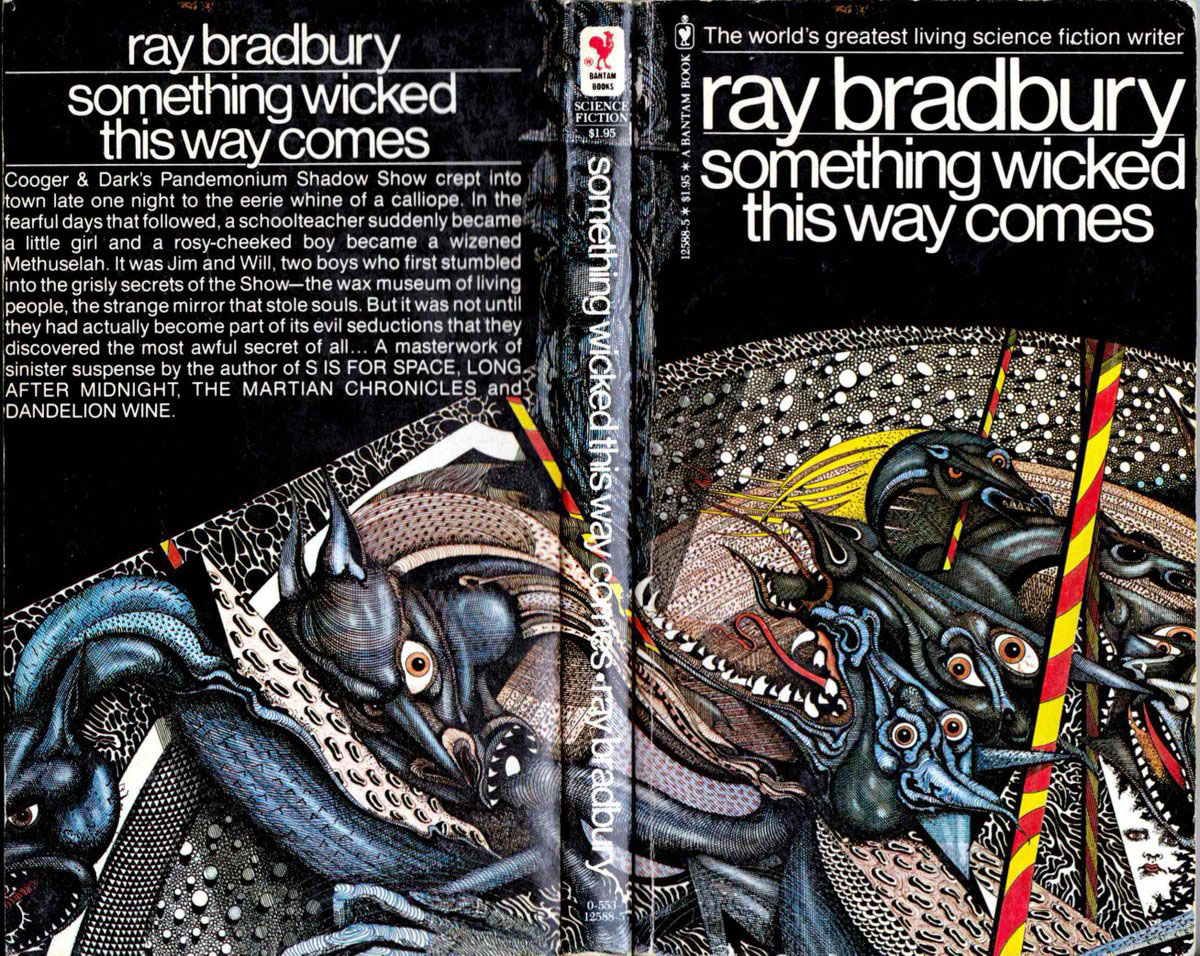
One of Ian Miller‘s drawings from the illustrated edition of Ray Bradbury’s The Martian Chronicles, 1979.

• “I always said we were kind of an electronic punk band, really. We were never New Romantics, I don’t like it when we get lumped in with that.” Dave Ball of Soft Cell and The Grid talking to Duncan Seaman about his autobiography, Electronic Boy: My Life In and Out of Soft Cell. I’ll now be waiting impatiently for the unreleased Robert Fripp/Grid album to appear.

• “[Patricia] Highsmith’s writing—often eviscerating, always uncomfortable—has never been more relevant,” says Sarah Hilary.

• Ron Peck’s debut feature, Nighthawks (1978), is “a nuanced look at gay life in London,” says Melissa Anderson.

And then there are those figures who seem to flit around the edges of movements without ever being fully involved in any of them, who pursue their own eccentric paths no matter what is going on around them. These are the writers who make up the secret history of literature, the hidden history that’s not easily reduced to movements or trends, and who always waver on the verge of invisibility until you stumble by accident onto one of their books and realize how good they actually are, and wonder, Why wasn’t I told to read this before? But of course you already know the answer: You were not told because it doesn’t fit smoothly into the story those in authority made up about what literature is—it disrupts, it can’t be reduced to the literary equivalent of a meme.

That’s the kind of writer Pierre Klossowski (1905–2001) is. He is not a joiner. He has his own particular and often peculiar concerns, and pursues them. He does not particularly welcome you in. The content of his writing, too, has the feel of a gnostic text, as if you are reading something that, if only you were properly initiated, you would understand in a different way. In that sense his work has an esoteric or occult quality to it—and likewise in the sense that it returns again and again to the intersection of religion and pornography, the sacred and the profane.

Brian Evenson on The Suspended Vocation by Pierre Klossowski

• Chad Van Gaalen creates a psychedelic animation for Seductive Fantasy by the Sun Ra Arkestra.

• More sneak peeks from the forthcoming The Art Of The Occult by S. Elizabeth.

• More Robert Fripp: Richard Metzger on Fripp’s sui generis solo album, Exposure.

Pamela Hutchinson on the pleasures of David Lynch’s YouTube channel.

• Mix of the week: a second Jon Hassell tribute mix by Dave Maier.

• At Dennis Cooper’s: Ferdinand presents…Dark Entries Day.

15 fascinating art documentaries to watch now.

Soft Power by Patten.

• RIP Milton Glaser.

hauntología

Aquarium (1992) by The Grid (with Robert Fripp) | Soft Power (2005) by Ladytron | The Martian Chronicles (2007) by Dimension X

Être Dieu: Dalí versus Wakhévitch

etredieu1.jpg

Or should that be Wakhévitch versus Dalí? The so-called “Dalí opera”, recorded in 1974, is more an opera by Igor Wakhévitch (music) and Manuel Vázquez Montalbán (libretto) which is interrupted from time to time by Salvador Dalí’s shouts, squeaks, impromptu lectures and even occasional snatches of song. (Dalí couldn’t sing.)

etredieu2.jpg

Être Dieu has always been the least accessible of the Wakhévitch compositions, difficult to find and an uneven listening experience that sprawls over three discs. But the (deleted) Eurostar reissue looks very nice: three gold CDs and a thick booklet with a translation of the rambling cosmic scenario, all packaged in a blue felt box. I’ve been rewatching the best of the Dalí documentaries over the past couple of weeks so I’ve felt more accommodating towards Être Dieu than usual; I’m a Wakhévitch cultist, so any Wakhévitch is good Wakhévitch, but I still need to be in the mood for this one. The immediate pleasures are mostly peripheral: Igor’s synthesizers, Delphine Seyrig as one of the celestial components of Dalí’s “divine” character, plus Didier Batard and François Auger from Richard Pinhas’s rock outfit, Heldon, on bass and drums. The Heldon duo get to rock-out properly on the third disc. Buried somewhere in the intersection between this recording, Jean-Christophe Averty’s Soft Self-Portrait of Salvador Dalí (1970) and José Montes-Baquer’s Impressions de la Haute Mongolie (1976) is an intimation of how Dalí might have appeared (or misbehaved) as the Emperor in Alejandro Jodorowsky’s unmade film of Dune.

etredieu3.jpg

Previously on { feuilleton }
Dalí’s discography
The music of Igor Wakhévitch

Chance encounters on the dissecting table

maldoror2.jpg

In times of great uncertainty about our mission, we often looked at the fixed points of Lautréamont and De Chirico, which sufficed to determine our straight line.

André Breton, Surrealism and Painting, 1928

1: The metaphor, 1869

maldoror.jpg

You can’t read the history of Surrealism for very long before encountering some variation of the most famous line from Les Chants de Maldoror by the Comte de Lautréamont/Isidore Ducasse: “beautiful as a chance encounter on a dissecting table of a sewing-machine and an umbrella”. Translations vary, as do misquotations; the page above is from the Alexis Lykiard translation where you can also read the surrounding text. The context of the description is seldom mentioned when the quote is used, and reveals that the words are describing the attractiveness of an English schoolboy living with his parents in Paris. The insipid Mervyn is stalked, seduced and finally murdered by the villainous Maldoror. Lautréamont’s metaphor, like so much else in the book, carries a sting in its tail.


2: The Enigma of Isidore Ducasse, 1920

ray.jpg

Man Ray, like Mervyn, was a foreigner living in Paris when he created this artwork. The “enigma” may be taken as referring both to the wrapped object (a sewing machine sans umbrella) as well as to the mysterious author of Les Chants de Maldoror, who died at the age of 24 after writing his explosive prose poem, and about whose life little is known. I first encountered Ducasse’s name in art books showing pictures of this piece which is one of the earliest works of Surrealist art. For a young art enthusiast the enigma was more in the name itself: who was this Ducasse, and why was he enigmatic? The original of Man Ray’s piece was subsequently lost, like many of his pre-war sculptures, but may be seen inside the first issue of La Révolution Surrealiste. Editions of the work that exist today are recreations made in the 1970s.


3: An illustration for Les Chants de Maldoror, 1934

dali3.jpg

Salvador Dalí created 30 full-page etchings and 12 vignettes for an illustrated edition of Lautréamont’s work published by Skira in Paris in 1934. Dalí must have seemed an ideal match for a book whose prose descriptions offer copious atrocities and mutations but, as with many of Dalí’s illustrations, the pictures owe more to his obsessions than to Lautréamont’s text, and could easily be used to illustrate something else entirely. Plate 19 does, however, feature a sewing machine.


4: Electrosexual Sewing Machine, 1935

dominguez.jpg

A Surrealist painting by Oscar Dominguez which emphasises the sexual nature of Lautréamont’s metaphor, or at least the Freudian interpretation of the same. Breton and company took the sewing machine for a female symbol, while the umbrella was male; the dissecting table where their encounter takes place is, of course, a bed.

[In Electrosexual Sewing Machine] the dissection appears to be under way. There is a strange abusive surgery being undertaken, the thread of the sewing machine replaced with blood which is being funnelled onto the woman’s back. The plant itself may even echo de Lautréamont’s umbrella. Domínguez has taken one of the central mantras of Breton’s Surreal universe and has pushed it, through a combination of painterly skill and semi-automatism, in order to create an absorbing and haunting vision that cuts to the quick of the movement’s spirit. (via)


5: Sewing Machine with Umbrellas in a Surrealist Landscape, 1941

dali4.jpg

More from Dalí who was hired by Fritz Lang to create images for a sequence of drunken delirium in the film Moontide. The commission arrived four years before Dalí’s work for Hitchcock on Spellbound, and if successful might have even dissuaded Hitchcock from hiring Dalí, but Lang left the film once shooting had begun, and his replacement, Archie Mayo, disliked the artist’s contributions. This surviving concept painting seems lazy compared to the Spellbound sequences (which were also trimmed by the ever-interfering David O. Selznick): the colonnade is a bald swipe from De Chirico, while the umbrella-bedecked sewing machine makes clumsy and literal use of the Lautréamont metaphor which is better left as a provocative collision of verbal imagery.


6: “As beautiful as the chance meeting on a dissection table of a sewing-machine and an umbrella…”: Andy Warhol and Marcel Duchamp, 1976

core.jpg

A painting by Philip Core, part of a series in which well-known cultural figures (eg: Harold Pinter and Joe Orton) encounter each other in rooms that reflect their works. Core wrote a biography of Andy Warhol, so maybe he knew something that I don’t, but I’d be very surprised if the Pop artist ever played a game of chess in his life, never mind being proficient enough to win so many pieces from the chess-obsessed Duchamp. As for Marcel, he’d raise an eyebrow at that wrongly positioned chess board…


7: Nurse With Wound, 1979

nww1.jpg

Lautréamont infects another medium. Steven Stapleton’s music group/art project has been infused from the outset by a pranksterish Dada/Surrealist spirit, so the purloining of the metaphor for the title of the first Nurse With Wound album is entirely fitting.

nww2.jpg


8: L’Ombrello E La Macchina Da Cucire, 1995

battiato1.jpg

Unlike this album by the very prolific Franco Battiato which Discogs describes as “experimental”. The first piece on the album uses the same title as the album, and is anything but experimental, especially compared to the improvised racket created by Nurse With Wound.

battiato2.jpg


9: Maldoror, 2003

friedlander.jpg

A jazz album by Erik Friedlander which I haven’t heard but which takes its track titles from phrases by Lautréamont.

Do other examples exist? No doubt they do, but the more recent uses of Lautréamont’s words only demonstrate how over-familiarity dulls an effect that was once shocking and original.

Previously on { feuilleton }
Santiago Caruso’s Maldoror
Jacques Houplain’s Maldoror
Hans Bellmer’s Maldoror
Les Chants de Maldoror by Shuji Terayama
Polypodes
Ulysses versus Maldoror
Maldoror
Books of blood
Magritte’s Maldoror
Frans De Geetere’s illustrated Maldoror
Maldoror illustrated