Design as virus 13: Tsunehisa Kimura

kimura.jpg

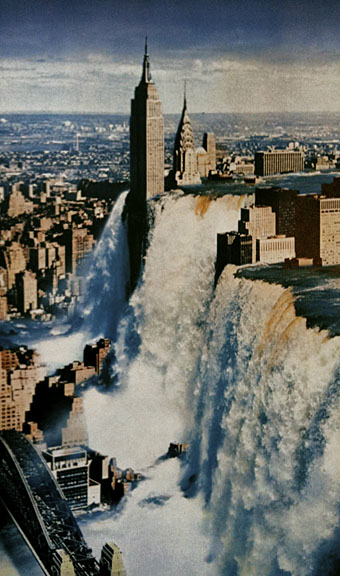
Waterfall by Tsunehisa Kimura.

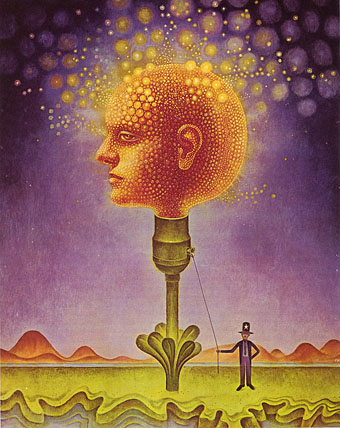
Continuing an occasional series. Japanese artist Tsunehisa Kimura (1928–2008) was initially inspired by the polemical graphics of John Heartfield to create his own photomontages, a painstaking collage technique now rendered obsolete by Photoshop. Kimura’s work exchanges Heartfield’s satire for an overt and frequently apocalyptic Surrealism, as in his most visible piece, Waterfall. The copy above is one of a number of pictures reproduced by Geoff Manaugh at BLDGBLOG from a 1979 Kimura collection, Visual Scandals by Photomontage.

schutze1.jpg

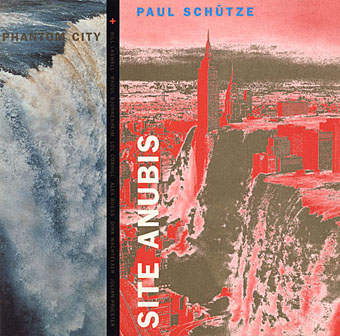
Design by Anne-Louise Falson & Paul Schütze.

I was first startled by Waterfall in 1996 when Paul Schütze released his Site Anubis album, the product of a “virtual group” comprised of musicians recording in different studios around the world:

The musicians comprising Phantom City—the name, incidentally, originating from the book title Topology of a Phantom City by French novelist Alain Robbe-Grillet—never met for the recording of Site Anubis, as each one recorded in a different studio in a different country: guitarist Raoul Björkenheim in Helsinki, bass- and contra-bass clarinetist Alex Buess in a Basel studio, soprano saxophonist Lol Coxhill in London, bassist Bill Laswell at Green Point Studio in Brooklyn, New York, trombonist Julian Priester in Seattle, drummer Dirk Wachtelaer in Brussels, and Schütze himself in London and Basel. Incredibly, Laswell had only Schütze’s electronic backing track to respond to. Wachtelaer had Laswell and Schütze to play against, Björkenheim had drums and bass,—in short, certain players had more information than others.

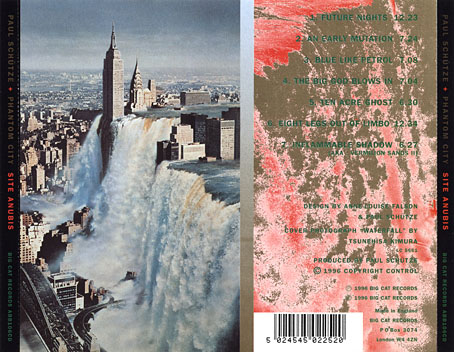
schutze2.jpg

Kimura’s picture is an ideal accompaniment to this excellent album, especially when you note a Ballard reference in the titles (not the first in Schütze’s oevre), and read the scene-setting piece of fiction on the CD insert, an explanation of the album title:

That morning a report came in from an unmarked helicopter somewhere over the city. The waters were subsiding and the smoke from a thousand fires had begun to drift inland revealing an impossible new structure. Towering some eight hundred feet over the gleaming devastation of the streets, its base occupying an entire city block, was a colossal black basalt figure. The body was male and human, – the head, which stared expectantly toward the boiling western horizon, was the head of a jackal. From the air it was clear that the pattern of destruction on the ground was radial and that the massive figure was sited precisely at its centre.

Continue reading “Design as virus 13: Tsunehisa Kimura”

Weekend links: the Halloween edition

goddem.jpg

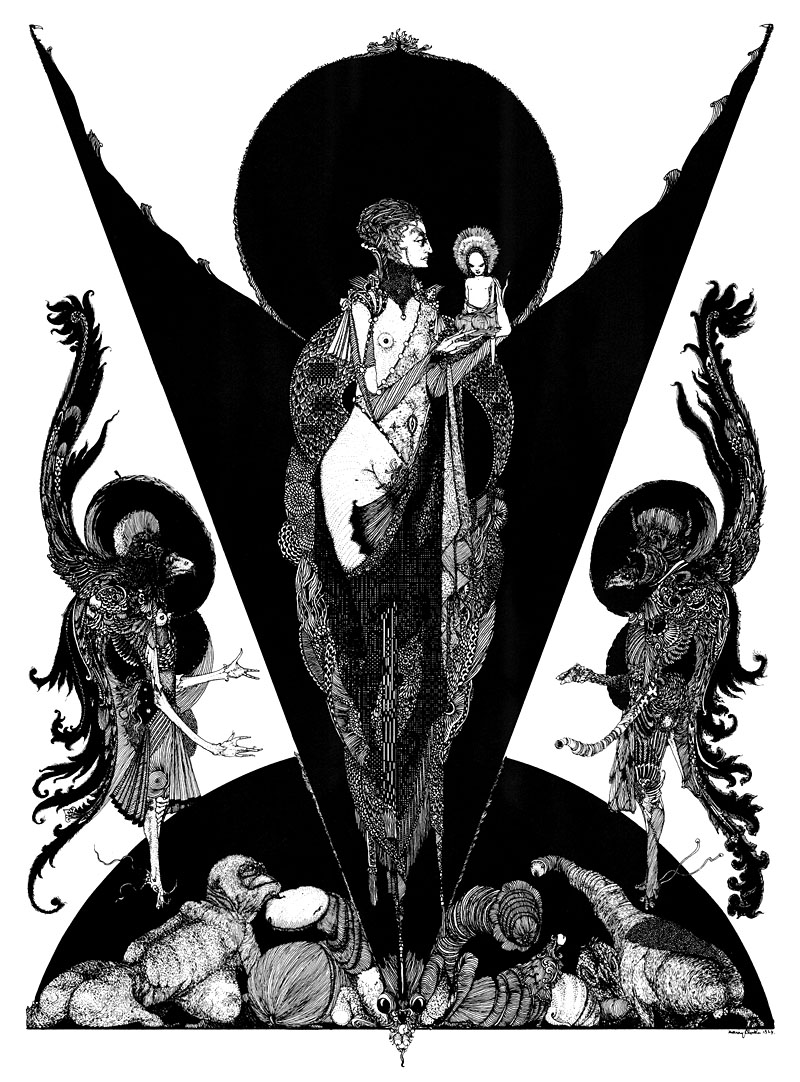
Goddem with Attendants (1924) by Harry Clarke.

• Some of Harry Clarke’s extraordinary illustrations from Goethe’s Faust can be seen at A Journey Round My Skull. And a reminder for anyone who missed them, Clarke’s Poe illustrations at Golden Age Comic Book Stories.

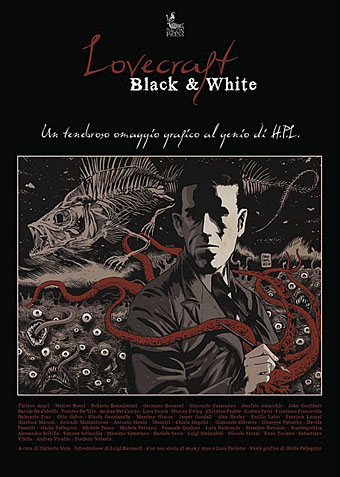
HP Lovecraft – Audio Books, Radio Plays, & Audio Documentaries. Out-of-print recordings and (no doubt) pirate copies of more recent things. I found this page by accident so it was a surprise to see my 1999 Lovecraft portrait used there. I used to own the David McCallum Dunwich Horror, an album with a singularly appalling sleeve illustration.

• Better album sleeves can be found here: Prospective 21e Siècle, a collection of foil designs from 1967. Some of the very challenging music within can be downloaded at the Avant Garde Project archive. Related: Have an electroacoustic Halloween with İlhan Mimaroğlu’s Le Tombeau d’Edgar Poe (1964) and Wings of the Delirious Demon (1969).

startrails.jpg

Star Trails and the Captain’s Ghost, a photo by Chris Kotsiopoulos at Astronomy Picture of the Day.

• “The horror industry is totally male dominated from its directors to its slashers, and even its bloggers…and I think that needs to change.” Day of the Woman, a blog for the feminine side of fear.

6 of the Scariest Queer Horror Books Ever. I think I’d agree with the commenter in picking The Haunting of Hill House by Shirley Jackson.

• Designer Jonathan Barnbrook (pictured in a graveyard by the looks of things) is interviewed at MyFonts.

A Weird and Scratching Beauty: The Art of John Coulthart and Call of Cthulhu.

Is the Royal Masonic School for Boys the scariest building in Britain?

50-million-year-old insect trove found in Indian amber.

The Café Kaput Samhain 2010 mixtape.

The Groovy Age of Horror.

Monster Mash (1962) by Bobby “Boris” Pickett & The Crypt-Kickers.

A playlist for Halloween: Drones and atmospheres

zeit.jpg

Cover painting by Edgar Froese.

I have seen the dark universe yawning
Where the black planets roll without aim,
Where they roll in their horror unheeded,
Without knowledge or lustre or name.

HP Lovecraft, The Haunter of the Dark, 1935.

It’s become traditional to do this each Halloween so here we go again with another music list, ten releases to soundtrack your way into another world. Should you be curious, a number of these works are probably difficult to find but a couple of the Discogs links have YouTube clips on the pages. Some of the selections were featured on an earlier list but this time they’re grouped with similar recordings.

Zeit (1972) by Tangerine Dream
All you need is Zeit. I was tempted to write an entire post extolling the virtues of my favourite Tangerine Dream album, to note how I’ve been listening to it for thirty years and will never tire of it, to mention how much I love Edgar Froese’s Black Sun cover painting (which ties it to another pet obsession of mine), how much I relish its pretentious subtitle “A largo in four movements” and the cello drones which open Birth Of Liquid Plejades then grade to Moog doodles by Popol Vuh’s Florian Fricke; the endless rumbling, howling minimalism of the whole enterprise… This was an enormously audacious album for its time which predicts many of the subsequent recordings on this list. One of the Kosmische masterworks, and so far out there that every move made by the group thereafter could only be a retreat.

Nature Unveiled (1984) by Current 93
Much as I respect David Tibet for his championing of esoteric culture I’ve never much liked the music he produces. The first Current 93 album was an interesting collage work, however, created by a kind of supergroup from the Industrial music scene of the time which included members of Coil, Nurse With Wound and 23 Skidoo. The second side provides an ideal Halloween piece with The Mystical Body of Christ in Chorazaim, a blending of Gregorian loops and guitar feedback over which Annie Anxiety rants in Spanish about…penises? I still don’t know. The whole thing sounds like something you’d expect to be playing over the landscapes in Wayne Barlowe’s Inferno.

Soliloquy For Lilith (1988) by Nurse With Wound
As for Nurse With Wound, this collection of eight electronic (?) drones achieves the typical NWW state of being simultaneously fascinating and irritating in equal measure.

Nunatak Gongamur (1990) by Thomas Köner
The master of what he calls “grey noise” made his first album by “miking-up gongs, then rubbing, scraping and electronically treating the sounds to the point where their origin is unrecognisable.” (More.) The result very effectively conjures the icy wastes alluded to by its title, and would make a perfect soundtrack for reading Lovecraft’s At the Mountains of Madness or The Terror by Dan Simmons.

angels.jpg

How To Destroy Angels. Cover painting by Derek Jarman.

How To Destroy Angels (Remixes and Re-Recordings) (1992) by Coil
Coil created a similar effect to Köner by treating the sounds of their first 12″ release from 1984 to electronic processing, stretching metallic noises into reverberant shudders. One of the remixes is by Steven Stapleton of Nurse With Wound, while track title Dismal Orb will always make me think of the cover of Zeit.

The Monstrous Soul (1992) by Lustmord
Almost everything released by Lustmord could be labelled “drones and atmospheres” and choosing one doom-laden work over another is a difficult matter. I opted for this one on account of its occult track titles and the well-chosen dialogue samples from The Night of the Demon.

Treetop Drive (1994) by Deathprod
One from the 2006 list. I couldn’t say it any better than I did four years ago: Helge Sten is a Norwegian electronic experimentalist whose solo work is released under the Deathprod name. “Electronic” these days often means using laptops and the latest keyboard and sampling equipment. Deathprod music is created on old equipment which renders its provenance opaque leaving the listener to concentrate on the sounds rather than be troubled by how they might have been created. The noises on the deceptively-titled Treetop Drive are a disturbing series of slow loops with squalling chords, anguished shrieks and some massive foghorn rumble that seems to emanate from the depths of Davy Jones’ Locker. Play it in the dark and feel the world ending.

Night Passage (1998) by Alan Lamb
Not music at all but treated sounds made from recordings of a length of telegraph wire vibrated by the wind somewhere in Western Australia. Night Passage Demixed was a collection of remixes by artists including Thomas Köner and Lustmord’s Brian Williams.

ouroborindra.jpg

Design by Julian House.

Ouroborindra (2006) by Eric Zann
Another from the 2006 list and the most deliberately horror-oriented work on the Ghost Box label. An artist name borrowed from HP Lovecraft and track titles from Arthur Machen.

The Air Is On Fire (2007) by David Lynch
David Lynch’s friend and genius of a sound designer Alan Splet created the template for many of the works listed here with his groundbreaking soundtrack for Eraserhead in 1976. Following his death in 1994 Lynch’s films have never had quite the same feel of visceral menace despite their considerable qualities in other areas. This CD was created by Lynch himself for an exhibition of his paintings and other artwork, and if it doesn’t possess the uncanny otherness of Splet’s rumblings it still makes for some very disturbing listening. Far better than recent Lynchian musical excursions like the Blue Bob album, and well worth seeking out.

Previously on { feuilleton }
A playlist for Halloween: Voodoo!
Dead on the Dancefloor
Another playlist for Halloween
White Noise: Electric Storms, Radiophonics and the Delian Mode
The Séance at Hobs Lane
Thomas Köner
A playlist for Halloween
Ghost Box

Weekend links 33

andrews1.jpg

Blue Sky Noise (2010) by Esao Andrews.

Franz Xaver Messerschmidt is the first exhibition in the United States devoted exclusively to the 18th-century sculptor. Related: an earlier post about the artist’s work.

• How are the team behind War Horse planning to follow up their smash hit? With a gay love story performed by puppets. Related: Achilles (1995) by Barry JC Purves.

• More great posts at A Journey Round My Skull: Czechoslovakian Expose VI and Black Cradle of Bright Life, fifteen works by the Macedonian artist Vangel Naumovski (1924–2006).

Top 10 Anti-Gay Activists Caught Being Gay. Related: “Fuck your feelings,” in which columnist Dan Savage gets righteously impatient when a correspondent complains. As Savage says, people who use their faith as a stick to beat gay people contribute to an atmosphere of intolerance in which kids are bullied for being gay (or appearing to be), or transgender, or merely different, and kill themselves as a result. Over the past couple of weeks there’s been an upsurge of US media attention to the most recent suicides; Savage inaugurated the It Gets Better project in order to help. Also related: God Loves Poetry.

andrews2.jpg

Meigh (2010) by Esao Andrews.

Antony Hegarty enthuses about Shoot Yer Load, one of the scurrilous 12″ singles released by my Savoy colleagues in the 1980s. Antony and the Johnsons have a new album out, Swanlights, on Secretly Canadian.

When the future of music was a rainbow hued parabola: book designer John Gall collects old synthesizer manuals.

Fantastic Memories (1944) by Maurice Sandoz, illustrated by Salvador Dalí.

Urban optometry: life as a London crane operator at BLDGBLOG.

• Today is 10/10/10 which means it’s Powers of Ten Day.

These New Puritans: a band like no other.

Art Nouveau: a virtual exhibition.

Diaghilev: Lord of the dance.

Flaming Telepaths (1974) by Blue Öyster Cult; Flaming Telepaths (2005) by Espers.

Circadian by Jack Sparrow

sparrow.jpg

I’m still (still!) playing catch-up posting all the things I’ve been working on this year. Here’s one of the more high-profile releases in the music sphere, Jack Sparrow‘s debut album, Circadian, which is unleashed this week on the Tectonic label. This is another dubstep production and I don’t have to try and describe the music this time when you can hear a stream of it at FACT.

sparrow2.jpg

Vinyl sleeve.

Design-wise, this is another release in CD and vinyl editions, and like all the work I’ve done for Tectonic it comes wrapped in Liz Eve’s wonderful photos. The pictures this time are some kind of industrial detritus which she’s turned into abstract landscapes. The vinyl was a three-disc set and the way the labels have turned out is probably my favourite part of this particular job.

sparrow3.jpg

Vinyl labels.

Elsewhere on { feuilleton }
The album covers archive

Previously on { feuilleton }
New work: Two forms of darkness
The Thorns of Love by Antoni Maiovvi
New music and design
Plates: Volume 2
Aerial by 2562