Weekend links 105

klikovac.jpg

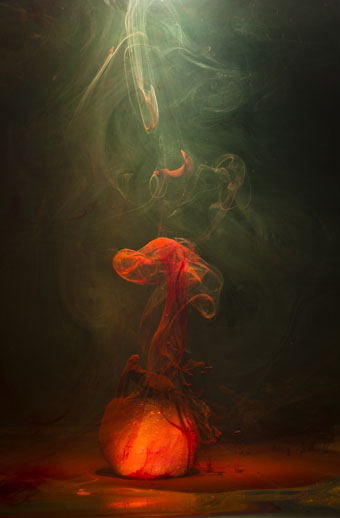
A suspended fluid photograph from Demersal, a series by Luka Klikovac.

• “Soon, Mr. Lachman was writing occult music. His song “(I’m Always Touched by Your) Presence, Dear,” which appeared on Blondie’s 1977 album Plastic Letters, was an example.” Gary Lachman: from Blondie to Swedenborg.

Neil Krug’s cover art for the new Scissor Sisters album, Magic Hour, channels the cloudless skies and photographic surrealism of Storm Thorgerson.

Implicate Explicate, a multiple 16mm film installation by Rose Kallal. Sound by Rose Kallal & Mark Pilkington using modular synthesizers.

Despite conservative queerdom’s best efforts to hide its “otherness” behind a velvet wall of “same as you” Tom and Hank and Jill and Janes, Mattilda and her like will not be ignored. As parades of neo-nuclear same sex families mug for the cameras on courthouse steps, queer body boys parade and flex impossibly taut muscles across our nation’s gym runways and circuit parties, and far, far too many proudly proclaim in knee-jerk defensiveness how “straight-acting” they are across the net, Sycamore blows raspberries at the forced mirage and holds up faded pictures of yesteryear boys and girls whose one claim to fame once was their difference.

Mattilda Bernstein Sycamore is interviewed at Lambda Literary

Paul Oestreicher, an Anglican priest, sets the cat squarely among the pigeons with the question (and answer) “Was Jesus gay? Probably.”

Andromeon, video by Alexander Tucker and Serena Korda for a new song by Alexander Tucker.

• Museums of Melancholy: Iain Sinclair on London’s memorials. An LRB essay from 2005.

FACT mix 325 is by Battles: from Boredoms to Cluster and The Alchemist.

The glass hills of Mars, “a region the size of Europe”.

Labyrinths and clues, an essay by Alan Wall.

The Alchemy of Emptiness.

Drop (1972) by Soft Machine | Drop (2002) by Hope Sandoval & The Warm Inventions | Airdrop (2006) by Kashiwa Daisuke.

Weekend links 104

cummings.jpg

Prettiest Star (2004) by Timothy Cummings.

I Want Your Love, a feature film directed by Travis Mathews catches my attention for having been described as “the gay Shortbus” even though (as the director notes) Shortbus was pretty gay to begin with.

• I’ve always found Hans Christian Andersen’s story of The Tinderbox—a tale of spectral dogs with enormous eyes—to be rather weird. But these illustrations by Heinrich Strub for a 1956 edition beat everything.

• “From an early age, however, I became in secret the slave of certain appetites.” The line that Robert Louis Stevenson deleted from The Strange Case of Dr Jekyll and Mr Hyde.

Scientific American: Homophobes might be hidden homosexuals. Not exactly fresh news but always worth bearing in mind when someone starts ranting about those evil gays.

Minimal Wave: The 80s synth-pop underground. The Minimal Wave label releases a vinyl compilation by Hard Corps this month.

• “Blame the Victorians for making menswear boring.” Alex Jung on the endless tyranny of the suit-and-tie combination.

• Women, Vaginas and Blood: Breaking menstrual taboos with artist Sarah Maple.

London’s lost rivers (again): the hidden history of the city’s buried waterways.

Vincenzo Pacelli says the Knights of Malta murdered Caravaggio.

Street style 1906: Edward Linley Sambourne’s fashion blog.

Architectural Stationery Vignettes at BibliOdyssey.

Hans Bellmer & Unica Zürn at Ubu Gallery, NYC.

Pam Grossman admits to being a “candle hooch”.

Dirty (1986) by Hard Corps | Lost Rivers Of London (1996) by Coil | The Tinderbox (2009) by Patrick Wolf.

Weekend links 103

fripp.jpg

Robert Fripp photographed by Chris Stein. Video posterization by Michael Schiess.

Scans of Synapse, “The electronic music magazine”, are posted here. Issues range from 1976 to 1979, and include interviews with the more notable synthesists of the period, Kraftwerk included. Brian Eno was regularly interviewed by synth mags despite always being reluctant to talk about what equipment he might be using; sure enough he’s featured here. Far more interesting is a longer interview with Robert Fripp that catches the guitarist as he emerged from his self-imposed retirement in the mid-70s with the extraordinary Exposure album. (See a 1979 promo video for that here.) Related: TR-808 drum sequences in poster form by Rob Ricketts.

• More electronic music from the 1970s: “[Don Buchla] showed me that the idea of playing a black-and-white keyboard with one of these instruments was completely ridiculous. It was inappropriate and had nothing to do with the way you would use an electronic instrument.” Suzanne Ciani talks to John Doran about electronic music composition. A collection of her early recordings, Lixiviation, is released by Finders Keepers. Related: The Attack of the Radiophonic Women: How synthesizers cracked music’s glass ceiling.

• “Her writing—full of immigrants, circus animals, freaks, socialists, hipsters, servants, and suffragettes—revels in the atmosphere of the ‘Yellow Nineties,’ a period characterized by Wildean decadence and art for art’s sake.” Jenny Hendrix on Djuna Barnes.

brunovsky.jpg

More etchings by Albin Brunovsky at But Does It Float.

• More scanned magazines: the Fuck You Press archive at Reality Studio. A trove of rare publications produced by Ed Sanders in the 1960s with contributions from world-class writers, William Burroughs included.

• “[My parents] were horrified by what I did, but they encouraged me to keep doing it because I was obsessed, and what else could I do?” John Waters writing in (of all places) the Wall Street Journal.

• A time-lapse assembly of Alfred Hitchcock’s Rear Window (1954) by Jeff Desom who explains how he did it here.

The Occult Experience: a 95-minute documentary on the international occult scene, filmed in 1984–85.

• Compost and Height re-post A Gold Thunder, a song by Julia Holter first sent to them in 2010.

• Drawings by Bette Burgoyne.

Schroeter’s Salomés

Cats are liquids

Fade Away And Radiate (1978) by Blondie (featuring Robert Fripp) | Exposure (1978) by Peter Gabriel (produced by and featuring Robert Fripp) | Exposure (1979) by Robert Fripp | Babs And Babs (1980) by Daryl Hall (produced by and featuring Robert Fripp) | Losing True (1982) by The Roches (produced by and featuring Robert Fripp).

Val Denham album covers

denham01.jpg

Funeral In Berlin (1981) by Throbbing Gristle.

British artist and musician Val Denham was mentioned in yesterday’s post so I thought it worthwhile following up with a selection of the painter’s record sleeves. Denham’s art stood out for me when I first saw the cover of Throbbing Gristle’s Funeral In Berlin album, and for its visceral immediacy this is still a big favourite. The early 1980s were the perfect time for Denham’s paintings to appear on record sleeves, the diminished area of CD packages providing a poor stage for work that’s this vivid and dramatic. Her associations with Throbbing Gristle extended to work with Marc Almond, a cover for the Some Bizzare compilation If You Can’t Please Yourself You Can’t, Please Your Soul which featured ex-TG members Coil and Psychic TV, and further associations with Coil via allies Black Sun Productions. Many of these connections can be explored at Denham’s detailed website which has a great gallery section showing work in a variety of media from the past thirty years. Her art is surreal, intense, often disturbing, and deeply personal in its exploration of shifting gender boundaries. Isn’t it time someone published a Val Denham book?

Some cover samples follow. More can be seen at the artist’s website.

denham02.jpg

Untitled (1982) by Marc and The Mambas. Design by Huw Feather.

denham03.jpg

Torment And Toreros (front, 1983) by Marc and The Mambas. Design by Huw Feather.

denham04.jpg

Torment And Toreros (back, 1983) by Marc and The Mambas. Design by Huw Feather.

Continue reading “Val Denham album covers”

A Moment of Inspiration, 1983

marc.jpg

Marc Almond (1983) by John Coulthart.

This, girls and boys, is how we occupied ourselves in the long nights before the advent of 24-hour television: we sat up drawing portraits of Marc Almond. A conversation on Twitter reminded me of this, a drawing that’s never before appeared in public but which is now added to the web collection. For a quick piece of art it’s actually a lot more successful than many of the more laboured things of mine that were printed far and wide at this time. The portrait was copied from a magazine photo, I forget which one, possibly Flexipop if it was still going, an increasingly wayward title that had a soft spot (so to speak) for Soft Cell. The Spanish hat identifies it as being from the Torment and Toreros period while the lettering was taken from Val Denham and Huw Feather’s cover design for the first Marc and The Mambas album, Untitled (1982). The padded-cell background refers, of course, to Marc’s former group, and was copied from the back of the Bedsitter 12″. Most of the drawing is done in black Biro pen with the hat and shirt in gouache. On the back I happened to make a note of the date, something I seldom bother with.

moment.jpg

The Twitter conversation was prompted by the appearance of Soft Cell’s notorious Sex Dwarf video at Dangerous Minds; Flexipop enjoyed the scurrilous side of Soft Cell so much they printed a still from this Bacchanal as a centre-spread in one of their issues. Meanwhile Marc himself was writing in the Guardian this week about Bowie manqué Jobriath, one of the real-life inspirations for the Brian Slade character in Todd Haynes’ Velvet Goldmine, and the subject of a feature-length documentary, Jobriath A.D., by Kieran Turner, currently showing at the BFI’s London Lesbian & Gay Film Festival.

Previously on { feuilleton }
Derek Jarman’s music videos