Subterranean Modern: The Residents, Chrome, MX-80 Sound and Tuxedomoon

submod0.jpg

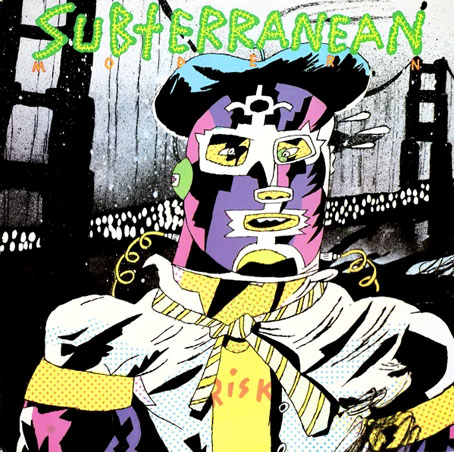
Subterranean Modern (1979). Sleeve art by Gary Panter.

As often happens, one post leads to another and the next thing you know there’s a themed week happening, so here’s something more about Tuxedomoon. Subterranean Modern was a compilation album released by The Residents on their Ralph Records label in 1979. The idea was to showcase The Residents along with three other groups from contemporary San Francisco, all of whom were underground acts, hence the “subterranean” title. (Just to confuse matters, Subterranean was also a San Francisco record label.) Three of those groups—Chrome, Tuxedomoon, The Residents themselves—have since developed cult followings; hard-rock outfit MX-80 Sound seem a little ordinary and out-of-place in this unique company but such is the nature of the compilation album. The Residents wanted each group to provide an interpretation of I Left My Heart In San Francisco but none of the others were very interested; Chrome’s offering, which lasts all of 27 seconds, is hilariously contemptuous of the idea, a squall of riff and vocals that fades in then quickly fades away. Cartoonist Gary Panter illustrated the cover which is also given the Rozz Tox seal of approval. For more about Rozz Tox, whose enigmatic presence can be found on other Ralph Records releases, see this.

I’d already heard Chrome and The Residents when I bought Subterranean Modern but this was first place I encountered Tuxedomoon’s music. Chrome, who appear on the back cover wearing their Clockwork Orange droog outfits, contribute two tracks that are as good as anything on their early records, Anti-Fade and the chugging Meet You In The Subway, for which they made a video filmed on the city’s BART platforms. I listened to those tracks, and the Tuxedomoon ones, much more than the rest of the album. With the exception of the pieces by MX-80 Sound, everything on the album has since been reissued on other compilations (Tuxedomoon’s tracks are on the Pinheads On The Move collection).

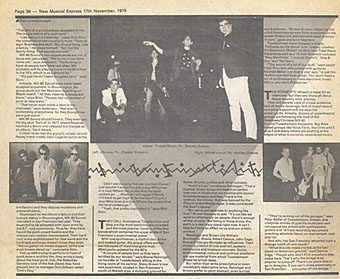
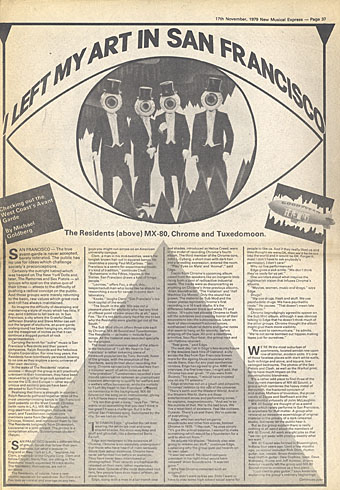
The following is a two-page feature from the NME for 17th November, 1979, profiling the album and the people who made the music. I don’t know whether this was Tuxedomoon’s first UK interview but it says it’s the first interview given by Chrome which gives it some vague contemporary relevance. Helios Creed recently re-formed Chrome, and played a show in London earlier this month. There’s also a new Chrome album, although for me Chrome proper requires Damon Edge, and he died in 1995. (Thanks to Gav for saving the pages!)

* * *
submod5.jpg

submod6.jpg

I LEFT MY ART IN SAN FRANCISCO

Checking out the West Coast’s Avant Garde by Michael Goldberg
ralph.jpgSAN FRANCISCO—The true avant-garde is never accepted, barely tolerated. The public has no use for ideas which challenge society’s preconceptions.

Certainly the outright hatred which was heaped on The New York Dolls and, later, The Ramones and Sex Pistols—all groups who spat on the status quo of their times—attests to the difficulty of pushing a radical concept on the public. And those groups were merely returning to the basic, raw values which great rock and roll has always maintained.

So imagine the difficulty of developing and maintaining a style of music which has little, if any, solid tradition to fall back on. In San Francisco, a city where the Grateful Dead, Jefferson Starship and Steve Miller can sell out the largest of stadiums, an avant-garde underground has been hanging on, etching out the meagrest of niches so that it can continue a dogged pursuit of rock experimentation.

Carrying the torch for “outre” music is San Francisco’s Residents and their parent companies, Ralph Records and the nebulous Cryptic Corporation. For nine long years, the Residents have relentlessly persisted, bowing to no one as they explore a sonic universe of their own devising.

In the wake of The Residents’ relative success—though the group is still practically unknown in their hometown, they have been received by a rather large cult spread out across the U.S. and Europe—other equally unique and esoteric groups have been attracted to San Francisco.

Realising that there is strength in numbers, Ralph Records gathered together three of the most uncompromising bands in San Francisco (and possibly on the West Coast): Chrome (with roots in L.A.), MX-80 Sound (who migrated from Bloomington, Indiana, last year), and Tuxedomoon (whose core members came from Denver, Colorado and Chicago, Illinois), and convinced them to join The Residents (originally from Shreveport, Louisiana) in a joint project. The project is a compilation album, Subterranean Modern (Ralph).

Continue reading “Subterranean Modern: The Residents, Chrome, MX-80 Sound and Tuxedomoon”
Weekend links 213

munro.jpg

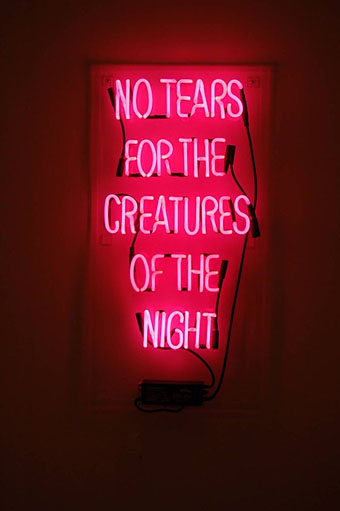
No Tears for the Creatures of the Night (2005) by Will Munro.

• Steve Barker’s On The Wire show on BBC Radio Lancashire is one of the longest-running music shows on British radio but it’s not broadcast in London so you seldom hear it mentioned at all. (It’s also the only radio show I’ve appeared on, oddly enough.) Some of Barker’s shows, which predominantly feature dub and reggae artists, can now be heard at Mixcloud.

• “As protagonist after protagonist is undone by temptation and lust, one can’t help but divine a sinister double entendre in the book’s title – something nocturnal and obscene.” James Lovegrove on the reissue of Robert Aickman’s 1964 collection of “strange stories”, Dark Entries.

Coil vs. Kenny Loggins sounds like no contest, and so it proved in 1988 at the Mike Tyson/Michael Spinks fight. There’s another surprising connection between Tyson and Industrial culture with the poster that Neville Brody designed for the boxer’s Tokyo bout.

Ventriloquism: Unheimlich manoeuvres: Sarah Angliss (who performs as Spacedog) on the history of ventriloquist dummies. With a bonus appearance from the great Ray Alan and Lord Charles. Related: the Vent Haven Museum.

• I’ve been wanting to read Proust’s À la recherche du temps perdu for years but always hesitate over which translation to choose. As Leland de la Durantaye shows, the arguments about translating Proust into English are still unresolved.

Music For A Good Home 3: a collection of 31 rare or unique tracks by a variety of artists including Belbury Poly, Pye Corner Audio, and Grumbling Fur. All proceeds go to Shelter.

David Cronenberg – The Exhibition is running throughout the summer at the EYE Film Institute in Amsterdam showing props and other materials from the director’s films.

• “’I’m in pictures,’ John Wayne explained when Nabokov cordially inquired about his line of work.” Blake Bailey on Vladimir Nabokov’s unpublished Lolita screenplay notes.

• Original artwork for the Linweave Tarot (1967) at Sweet Jane’s Pop Boutique. As noted before, the full set of cards is probably the grooviest ever created.

• Mixes of the week: Secret Thirteen Mix 118 by Ensemble Economique, and a Wyrd Daze Solstice mix from The Ephemeral Man.

• At One With Chaos & Abandonment: The Irrepressibles’ Jamie McDermott talks to Joseph Burnett about his music.

From the Zodiacal Light, a new track from Earth with vocals by Rabia Shaheen Qazi.

• The Ultimate Chinatown Filming Location Map of Los Angeles.

Tuxedomoon at Pinterest.

Dark Companion (1980) by Tuxedomoon | Dark River (1990) by Coil | Dark Turn Of Mind (2011) by Gillian Welch

Weekend links 212

non-format.jpg

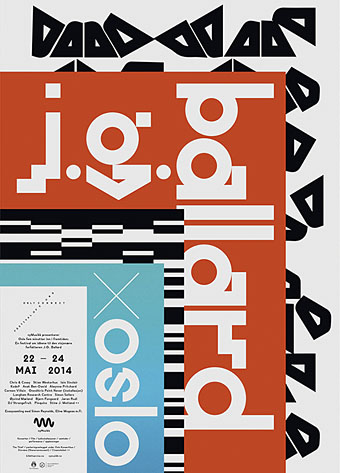
Poster for the recent Ballard-themed Only Connect Festival of Sound in Oslo. Design by Non-Format.

Bulldozer by Laird Barron was my favourite piece in Lovecraft’s Monsters, the recent Tachyon anthology edited by Ellen Datlow that I designed and illustrated. So it’s good to hear that Nic Pizzolato, writer of the justly-acclaimed HBO series True Detective, is among Barron’s readers. True Detective, of course, created a stir for referencing Robert Chambers’ weird fiction in a police procedural. The series is out now on DVD and Blu-ray, and I can’t recommend it too highly.

• Citation-obsessed Wikipedians don’t believe Hauntology is a genuine musical genre, a sentiment which will probably surprise some of its practitioners. Whatever the merits of the argument, I rather like the idea of a musical form that resists strict definition.

• “This year, in order to do things differently, I will make a conscious effort to separate the man from his writing.” Giovanna Calvino, daughter of Italo Calvino, remembers her father.

With ideology masquerading as pragmatism, profit is now the sole yardstick against which all our institutions must be measured, a policy that comes not from experience but from assumptions – false assumptions – about human nature, with greed and self-interest taken to be its only reliable attributes. In pursuit of profit, the state and all that goes with it is sold from under us who are its rightful owners and with a frenzy and dedication that call up memories of an earlier iconoclasm.

Alan Bennett delivers a sermon.

Zarina Rimbaud-Kadirbaks, aka Dutch Girl In London, reviews the Chris Marker exhibition that’s currently running at the Whitechapel Gallery, London.

• Exteriorizing the Inner Realms: Christopher Laursen talks to Phantasmaphile and Abraxas magazine‘s Pam Grossman about occult art, past and present.

• The Beast is back: Erik Davis talks to Gary Lachman about his new book, Aleister Crowley: Magick, Rock and Roll, and the Wickedest Man in the World.

• The body as factory: anatomy of a New Scientist cover image. Rick Poynor on the recurrent use of a familiar visual metaphor.

• Mix of the week without a doubt is FACT Mix 445 by Stephen O’Malley, a three-hour behemoth.

• Jennifer in paradise: Photoshop developer John Knoll on the story of the first Photoshopped image.

• The trailer for Grandfather of Gay Porn, a documentary about Peter de Rome by Ethan Reid.

Giorgio’s Theme is a new piece of electronic music by Giorgio Moroder.

Agender, a series of androgynous photo-portraits by Chloe Aftel.

• RIP Little Jimmy Scott

Evil Spirits

Chase (1978) by Giorgio Moroder | Call Me (1980) by Blondie | The Apartment (1980) by Giorgio Moroder

Recent signals

signals1.jpg

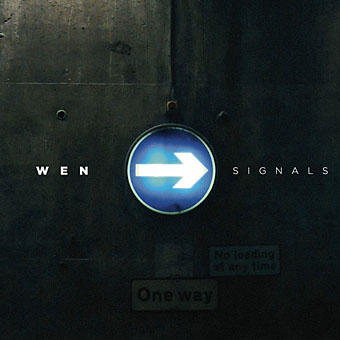
Signals (2014): vinyl front cover. Photo by Nico Hogg.

Seeing as my design for the recent Signals album by Wen has been deemed one of the best covers of the year so far I thought I ought to mention some of the other albums I’ve worked on over the past few months. I tend to give the most attention here to my book designs and illustrations but I’m still working on music releases, albeit with less regularity.

One reason the book work receives more attention is that there’s more of my input involved. Almost all these recent releases have begun as picture selections from the artist which it’s been my job to work into a printable form then place the relevant information in a suitable typeface. This isn’t to downplay the work involved: the careful placing of type becomes more critical the more the design tends to minimalism, and even the best photo can be ruined by clumsy typesetting or an unsympathetic typeface. The challenge of working in a more minimal direction can be a refreshing one when much of the work I do tends to visual excess.

signals2.jpg

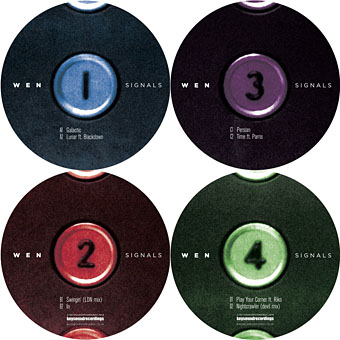
Signals (2014): vinyl labels. Photos by Nico Hogg.

Wen’s album for Keysound Recordings is a collection of dark urban rhythms for which Nico Hogg provided some suitable views of nighttime London. The numbers on the vinyl labels are lift buttons from a high-rise block, while the abstract scene below is a photo of the Thamesmead housing estate.

signals3.jpg

Signals (2014): CD interior. Photo by Nico Hogg.

Continue reading “Recent signals”

Weekend links 211

shau.jpg

Secret Bloom (2014) by Natalie Shau.

Bloomsday approachs. “Reading Ulysses changed everything I thought about language, and everything I understood about what a book could do,” says Eimear McBride whose debut novel, A Girl Is a Half-formed Thing, recently won the first Bailey’s women’s prize for fiction. McBride was interviewed by Susanna Rustin last month, shortly before the award was announced, and her novel has now become one of those minor causes célèbres for being rejected so often it was eventually published by a new imprint set up by a bookseller. “If the publishing industry doesn’t take a risk then who will?” asks Henry Layte, the bookseller in question.

Speaking of risk, David Hebblethwaite coincidentally wrote a post earlier this week asking where the formal challenge has gone in science-fiction writing. (He mentions McBride in passing.) Nina Allen followed up with a post of her own. I suspect the books are still being written but they’re no longer being accepted by editors and publishers who want even more adventure stories, “sympathetic” characters, and easy reads. Novels that only aspire to be written equivalents of action films or computer games are doomed to be less exciting than their more kinetic competitors. The struggle between the values of art and the values of entertainment is an old one but it shouldn’t be an either/or proposition. “Difficulty is subjective,” says Eimear McBride, “the demands a writer makes on a reader can be perceived as a compliment.”

Related: the following from Geoffrey Hill on “difficulty”:

We are difficult. Human beings are difficult. We’re difficult to ourselves, we’re difficult to each other. And we are mysteries to ourselves, we are mysteries to each other. One encounters in any ordinary day far more real difficulty than one confronts in the most “intellectual” piece of work.

• The Quietus pulled out all the stops this week, interviewing Annette Peacock, Iain Sinclair (again), Alan Moore (again), and asking Peter Strickland, the director of Berberian Sound Studio, for a list of his favourite albums. Given the above, it’s worth noting that all those people have produced challenging work of their own in different media.

• “The Satyrs Motorcycle Club was founded in 1954 with seven members, but little did anyone know it would become the oldest running LGBT organization (and oldest gay motorcycle club) in the world.”

Trunk TV posted another great selection of television title sequences. The previous selection has been taken down for the usual tiresome copyright reasons so watch this one while you can.

• “Detroit techno and black metal have so much in common,” say Wolves In The Throne Room whose new album, Celestite, is predominantly a product of synthesizer technology.

• “Houghton Library’s copy of Arsène Houssaye’s Des destinées de l’ame (FC8.H8177.879dc) is without a doubt bound in human skin.”

• The secret of Nabokov’s sexual style: David Lodge reviews Nabokov’s Eros and the Poetics of Desire by Maurice Couturier.

• How long can you hold your breath? 2 models, 7 divers in an underwater shipwreck by photographer Von Wong.

• At Dangerous Minds: Paul Gallagher on The fantastic world of Sharmanka Kinetic Theatre.

• Wizards of the Coast: Benjamin Breen on John Dee and the occult in California.

• More photography: Peter Guenzel captures strange lights in forests.

• Mix of the week: Bleep podcast 121 presented by Margot Didsbury.

I’m The One (1972) by Annette Peacock | Eros Arriving (1982) by Bill Nelson | The Dire And Ever Circling Wolves (2005) by Earth