Gay slang from the 1970s

gay1.jpg

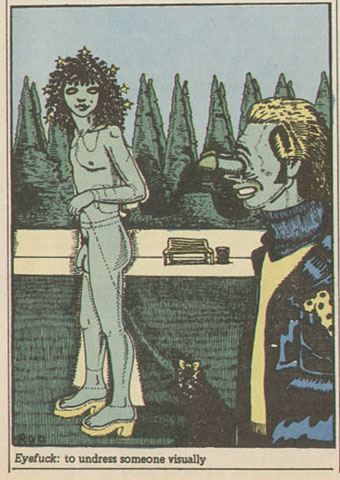
While browsing recently through the available back issues of Oz magazine I noticed a guide to gay slang that I didn’t recall seeing before. The underground magazines and newspapers of the 60s and 70s were a lot more tolerant of the nascent gay rights movement than their “straight” (ie: non-freak) counterparts. Oz magazine published pieces about gay rights, notably so in issue 23 which ran an extract from The Homosexual Handbook (1969) by Angelo d’Arcangelo among a couple of other features; the UK’s first gay magazine, Jeremy, advertised regularly in Oz and IT; later issues of Oz carried ads for another gay mag, Follow Up, and there’s a letter in one issue from a gay freak complaining about the state of the few gay pubs in London where the clientele was apparently not freaky enough. (His solution was to try and persuade them all to drop acid.) Arguments which still circulate today, between those who want to assimilate and those who prefer to remain separate from general society, go back a long way.

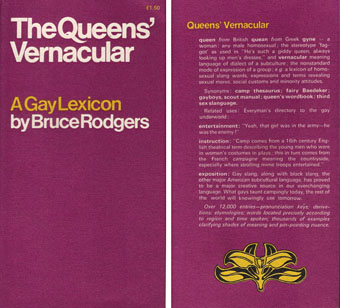
The gay slang guide was extracted from The Queens’ Vernacular: A Gay Lexicon by Bruce Rodgers (1942–2009), published in the US by Straight Arrow Books in 1972. Straight Arrow was affiliated with Rolling Stone magazine, later publishing two volumes of Wilfried Sätty’s art, and Kenneth Anger’s Hollywood Babylon. Rodgers’ book was reissued in 1979 as Gay Talk: A (Sometimes Outrageous) Dictionary of Gay Slang (Formerly entitled The Queens’ Vernacular) but has been out-of-print ever since, unsurprisingly since so much of it is now completely outmoded. That doesn’t make the content uninteresting, however. The phraseology may be ribald, obscene and offensive (misogynist, especially) but the book has been described as “the first serious dictionary of gay slang and the definitive gay American jargon resource”. Rodgers was a serious researcher with an interest in all forms of slang. Just as the Dictionary of the Vulgar Tongue (1811) by Francis Grose gives a more-or-less unmediated insight into the lives of the working and criminal classes of 18th-century London, so Rodgers’ dictionary tells us something about the way gay people, especially gay men in the US, were talking to each other for much of the 20th century. What’s striking now about this truncated list is the degree to which so much of the language is obsolete—nobody under the age of 60 would use the term “queen” with such frequency—while the wider acceptance of porn has made once-esoteric terms like “golden shower” much more common. Notable by its absence is “queer” as a purely positive description (not reclaimed until the 1980s), and no mention of “twink” (which goes back to the early 60s) or “bear” (another term from the 80s).

There’s a tendency when looking at lists such as this to imagine a group of people using most of the terms all the time, but as with any form of slang this would be unlikely. The same goes for Polari or the handkerchief codes of the 1970s. As you’d expect from a document that’s 42 years old, some of the language that Rodgers collected tramples over many current sensitivities.

gay2.jpg

Illustration by Rod Beddall.

THE QUEEN’S VERNACULAR, Oz 46, Jan–Feb 1973

Gay slang has been coined and used by those within the gay subculture who themselves feel the most oppressed—the flagrant wrist benders, the screaming queens, the men who look like women, the women who don’t shave their moustaches.

It is a form of social protest, aimed at the establishment; it is also self-protective and self-defeating. Gay militants would like to see it go, and argue rightly that gay jargon is yet another link in the chain which holds the homosexual enslaved and oppressed—yet its widespread use and complex vocabulary indicate that gay liberation has still along battle in front of it. The selections which follow are taken from a Straight Arrow publication, The Queens’ Vernacular by Bruce Rodgers. The words are mostly American. Even the classic English phrase, “queer basher” is not included.

* * *

advertising 1. to dress in a sexually provocative manner. Gay maxim: “It pays to advertise.” 2. (camp) to pluck and then paint the eyebrows.

army style (mid ’60s) beating the cocksucker after the act.

bumping pussies the embarrassment of two homosexual men who find themselves too passive, active, or in other ways too similar to create a sexual situation. “He thought you and I were carrying on together—what would we do, bump pussies?”

cash-ass (from cautious) cynically applied to hustler who feigns coyness until assured of material gain. “He’s not shy, he’s cash-ash. Mention money and watch his cheeks light up.”

catalogue queen homosexual who collects physique magazines for masturbation purposes.

cheesy having the foreskin lined with smegma. Stale and musky smelling. “The sailor was so cheesy that I felt like asking him where be hid his crackers.”

chic the latest craze. Cruising the busy streets after the bars close is chic. Getting invited to an orgy is chic. Sucking men off in a public lavatory is not chic. Wearing pearls with grey flannel is not chic either, unless one is serving tea in a closet.
Continue reading “Gay slang from the 1970s”

Moorcock: Faith, Hope and Anxiety

moorcock.jpg

Photo of the author by Linda Moorcock.

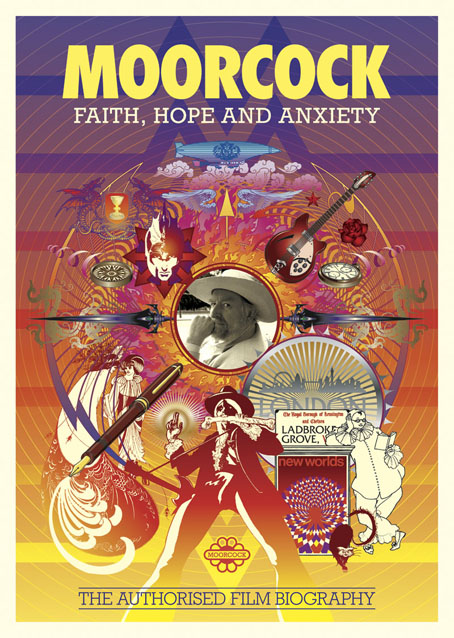
I mentioned a few days ago that I had another new piece of work to reveal, and this is it, a poster/promotional piece for Russell Wall’s forthcoming documentary about Michael Moorcock. The main challenge with one was to create something that would give a sense of Moorcock’s extensive career and the genre-spanning content of his many books.

mm1.jpg

I took the 1970s as the starting point, since this was the period when his reputation as a writer was established worldwide. The decade began with Britain’s bookshelves being colonised by Moorcock’s SF and fantasy novels published by Mayflower with vivid covers; it saw a cult feature film—The Final Programme—made from his first Jerry Cornelius novel, and it ended with the fourth Jerry Cornelius novel, The Condition of Muzak, winning a serious literary award, the Guardian Fiction Prize.

mm2.jpg

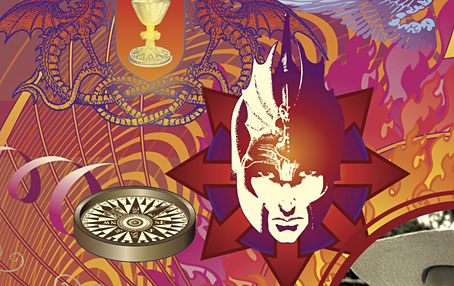
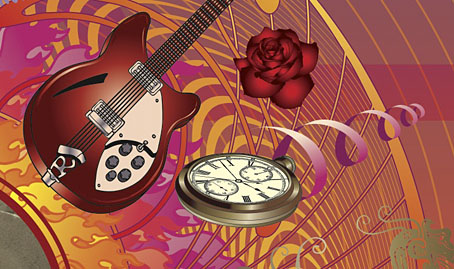
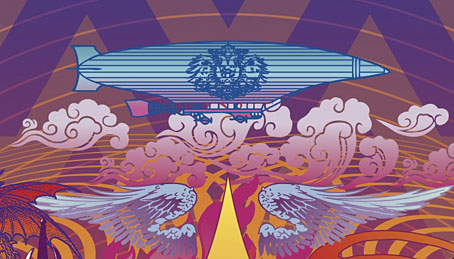
So the general appearance of the design, the headline typography, and the colour scheme are a nod to the Mayflower covers and especially to Bob Haberfield’s artwork which often used a similar style of Tibetan flames and clouds. The rest of the type is set in Rockwell, a preferred typeface of the Hipgnosis design team for much of the 1970s. Early on I had the idea of filling the design with stylised graphics like those used by some of the Hipgnosis illustrators, chiefly George Hardie, but that idea receded once the composition began to arrange itself. The fountain pen is the main hangover from this, a hard-edged graphic tilted at an angle like many of Hardie’s illustrations. The pen is a little inappropriate given that Moorcock is famous for knocking out novels at speed on a typewriter but it made a good visual rhyme with the guitar, a Rickenbacker like the one the author played in his Deep Fix band.

mm3.jpg

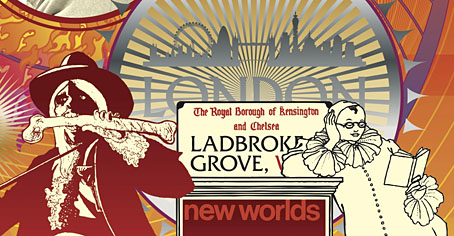
Elsewhere there are many specific references competing for attention: the Elric head is Jim Cawthorn’s illustration from the first edition of Stormbringer (1965); the Jerry Cornelius figure (straddling a repurposed Mayflower logo) is one of Mal Dean’s best, as seen on the cover of issue 191 of New Worlds magazine; the sorcerous blades are my own designs from 1985 as seen on the sleeve of Hawkwind’s Chronicle of the Black Sword album; the Beardsley figures from Salomé were a vague gesture to the 1890s but the Pierrot figure happens to be one Moorcock used for a while as a bookplate, something I didn’t know until I’d placed it in the design; the cat at Pierrot’s feet is another Beardsley from one of the Bon-Mots books; the London skyline is a contemporary one, London past and present having been a continual feature of Moorcock’s writing throughout his career. Lastly, all these details are contained by a graphic based on Abram Games’ BBC TV ident from the 1950s. When Russell and I began talking about this project the words “television biography” were being used so this would have connected to that idea, and to the decade when Moorcock’s career began.

mm4.jpg

I don’t know when the documentary will be released but any news will be posted here in due course. There’s also talk of making copies of the poster available for purchase but nothing concrete has been decided yet.

Previously on { feuilleton }
Eduardo Paolozzi at New Worlds
Elric 1: Le trône de rubis
Into the Media Web by Michael Moorcock
The Best of Michael Moorcock
Revenant volumes: Bob Haberfield, New Worlds and others

Atmospherics

jamoul1.jpg

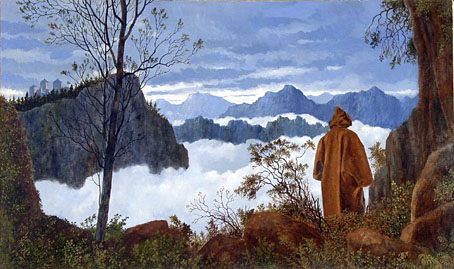
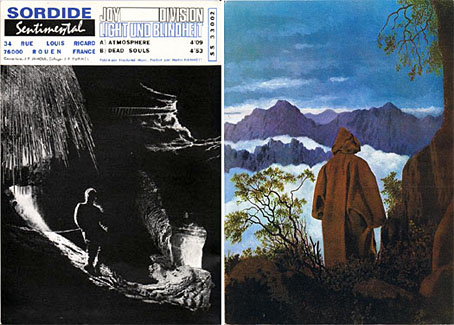
Listening to Joy Division over the weekend prompted another of those idle speculations that are immediately answered these days (so to speak…) by a few seconds of web searching. While Atmosphere was playing I’d remembered a conversation with a friend about the identity of the painting of a cowled figure that appears on the original Atmosphere/Dead Souls single for the Sordide Sentimental label. Neither of us had a copy of the Holy Grail of JD collectors, nor did we know anybody who owned one, so the discussion wasn’t very fruitful.

jd.jpg

Licht Und Blindheit (1980) by Joy Division.

Sordide Sentimental were (and still are) a French company run by Jean-Pierre Turmel and Yves von Bontee whose speciality was limited releases of exclusive material often by bands with a cult following. The typical Sordide Sentimental release would be a 7-inch single in a numbered edition, packaged in an A4-sized sleeve with inserts and an idiosyncratic essay by Monsieur Turmel. Licht Und Blindheit, as the Atmosphere single was called, sold out immediately, and since 1980 has been one of the most collectible (and costly) releases of the era: the cheapest of two copies currently for sale at Discogs is over £1,500. (Many bootleg copies also exist: beware.)

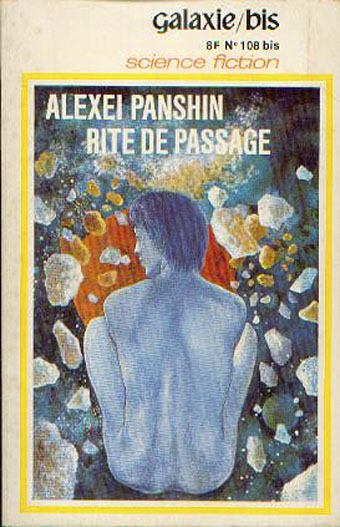
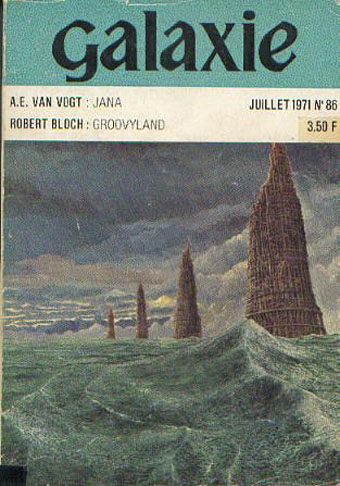
As to the Licht Und Blindheit packaging, the cover collage was by Jean-Pierre Turmel while the enigmatic painting on the back turns out to be an untitled work by Jean-François Jamoul (1925–2002), not Caspar David Friedrich as my friend suspected, although it is very Friedrich-like. Jamoul was evidently a friend of Turmel who used more of his paintings on other Sordide Sentimental releases. During the 1970s Jamoul had been a regular contributor to French SF magazines, both as cover artist and essayist. In 2006 Sordide Sentimental released Temps Incertains, a DVD/book devoted to Jamoul’s art and writings.

jamoul2.jpg

Rite de Passage (1968) by Alexei Panshin.

It’s interesting looking at some of Jamoul’s other art in light of all this: one painting on the cover of Galaxie magazine looks distinctly Lovecraftian while another piece was used by a publication named Nyarlathotep. Back in 2008 journalist Jon Savage was corresponding with my colleagues at Savoy Books prior to writing a piece for the Guardian about Ian Curtis’s reading material. (The Savoy bookshops in Manchester during the 1970s and 80s were notable for their comprehensive stock of Burroughs, Ballard and other essential material.) One of the questions was whether Curtis had read (or bought) any HP Lovecraft, something that neither Dave nor Mike could answer. These French magazines at least show one very tenuous connection (which Curtis wouldn’t have known about, of course) via Jamoul’s paintings. Savage’s Guardian piece has since been expanded into an introduction for the recent Faber book of Ian Curtis lyrics; HP Lovecraft receives a passing mention there during discussion of Licht Und Blindheit‘s B-side, Dead Souls.

jamoul4.jpg

Continue reading “Atmospherics”

Weekend links 229

drongelen.jpg

Untitled (2007) by Remko van Drongelen.

• Another week, another Kickstarter project: Frank Woodward’s 2008 documentary, Lovecraft: Fear of the Unknown, was an excellent study of HP Lovecraft’s life and work featuring interviews with John Carpenter, Neil Gaiman, Caitlín R. Kiernan, Peter Straub, Guillermo Del Toro and leading Lovecraft scholar ST Joshi; the film also included a few examples of my Cthulhoid artwork. Disc copies of the film have been out-of-print for a while so Frank’s fund is hoping to raise money for a new Blu-ray edition featuring extended interviews and other extras.

• David Cronenberg’s debut novel, Consumed, “reads somewhat like a mashup of William Gibson, the king of near-future SF cool, and 1970s horror maestro James Herbert,” says Steven Poole. I’d have thought a more obvious analogy would be with JG Ballard; descriptions of Cronenberg’s narrative make it sound like Ballard’s concerns repurposed for our current era of electronically-mediated everything. Related: Crash by Sanyú, “adaptación de un fragmento de la novela de J. Ballard”.

• “To commune with the music of Cyclobe is to enter not just a strange world, but strange constellations – interdimensional, atemporal zones of carefully cultivated auras bordering wild, unstable forces.” Russell Cuzner talks to Ossian Brown and Stephen Thrower about Derek Jarman, hurdy-gurdies and the deceptive nature of time.

…there are no rules in fiction even if creative writing programs everywhere have tried to make people believe there are. When I read fiction that has passed through the filter of too many workshops, I often get the feeling that I’m reading the same novel over and over again: the same way of being humorous, the same way of being candid, the same way of creating empathy.

Valeria Luiselli talking to Jennifer Kabat about fiction, cities and maps.

• The rationale behind Silent Partners: Artist & Mannequin from Function to Fetish is “to explore the way that the artificial human figure has routinely provided artists with the most direct and reliable route to visual realism. And then to work out why that makes us so upset.” Kathryn Hughes on a new exhibition.

• “It immediately throws up some interesting thoughts: Bowie as the young dandy and the obvious comparisons with Oscar Wilde and The Picture Of Dorian Gray, with the portrait that ages.” Designer Jonathan Barnbrook on the cover photos for David Bowie’s forthcoming album Nothing Has Changed.

• October brings all the music mixes. This week there’s a choice of FACT mix 463 by Dntel, Autumn’s Whirr by Café Kaput (aka Jon Brooks), and Suspected Rural Telephone Box Poltergeist by The Geography Trip.

• “…when you first go into the room it’s like entering a furnace… a furnace of sound.” Scott Walker talks to John Doran about recording with Sunn O))). The new album, Soused, is out on 20th October.

We are the Martians: the Legacy of Nigel Kneale, a new collection of Kneale-related essays and appreciations, edited by Neil Snowdon.

• Kim Newman is one of the contributors to the Kneale collection. Here he is on the main types of ghost story, and how to recognize them.

Issue 7 of Glitterwolf magazine is out on the 15th, and it’s a Halloween special.

Etai Rahmil makes mask-pipes from glass for weed smokers.

Accidental Cool Art

Hurdy Gurdy Man (1968) by Donovan | Hurdy Gurdy Man (1970) by Eartha Kitt | Hurdy Gurdy Man (2009) by Patrick Cowley & Jorge Socarras

Weekend links 225

mori.jpg

Still from The Shaman-Girl’s Prayer (1997), a video piece by Mariko Mori. This page has pictures of Mori’s futuristic/cosmic performances, films & environments.

Time Out of Mind (1979) was a BBC TV series about science fiction writers, five short films concentrating on Arthur C. Clarke, John Brunner, Michael Moorcock, Anne McCaffrey and an sf convention. I was only interested in the Moorcock film at the time, not least because it featured a short clip of Hawkwind playing Silver Machine, and inserted scenes from the film of The Final Programme (1973) between the interviews. The Moorcock episode is less about his books than about New Worlds magazine and the so-called New Wave of sf in general, so you also see rare footage of M. John Harrison in a Barney Bubbles “Blockhead” T-shirt talking then ascending a limestone cliff, and bits of interviews with Brian Aldiss and Thomas Disch. Ballard isn’t interviewed but is present via a scene from the Harley Cokeliss film Crash! (1971) in which Gabrielle Drake slides in and out of a car while someone reads Elements of an Orgasm from The Atrocity Exhibition.

• “…there happened to be a book on Ritual Magick that talked about John Dee and summonings and Dr. Faust and all that kind of stuff. So then obviously at that age, too, I read HP Lovecraft and then Michael Moorcock and what they call fantasy literature. Through HP Lovecraft I discovered Arthur Machen, and I think that sort of percolated down inside…” Dylan Carlson of Earth talking to Steel for Brains. The Wire has the vinyl-only track from the new Earth album, Primitive And Deadly, and a track from Carlson’s solo album, Gold. Related: Artwork by Samantha Muljat, designer/photographer for the new Earth album.

Phantasmaphile has details of the next two issues of deluxe occult magazine Abraxas. Issue 6 includes a major feature on Leonora Carrington while Luminous Screen is a special issue devoted to occult cinema.

• More Broadcast: Video of a performance at Teatro Comunale di Carpi, March 2010 (part 2 here), and “constellators and artifacts” at A Year In The Country.

• “Petition demands return of ‘Penis Satan’ statue to Vancouver.” There’s an uncensored photo of the contentious statue here.

• Literary Alchemy and Graphic Design: Adrian Shaughnessy on James Joyce’s writings among graphic designers.

• Frank Pizzoli talks to John Rechy about “the gay sensibility”, melding truth and fiction, and his literary legacy.

• Mixes of the week: Secret Thirteen Mix 127 by Roberto Crippa, and FACT Mix 459 by Craig Leon.

Alan Moore has finished the first draft of his million-word novel, Jerusalem.

• Crazy pavings: Alex Bellos on Craig Kaplan’s parquet deformations.

Noise Not Music: “Live recordings, obscure cassettes and more…”

Pylon of the Month

Zoot Kook (1980) by Sandii | Rose Garden (1981) by Akiko Yano | Telstar (1997) by Takako Minekawa