The South Bank Show: Dracula

sbs1.jpg

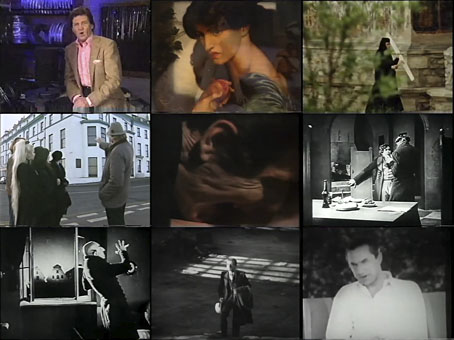
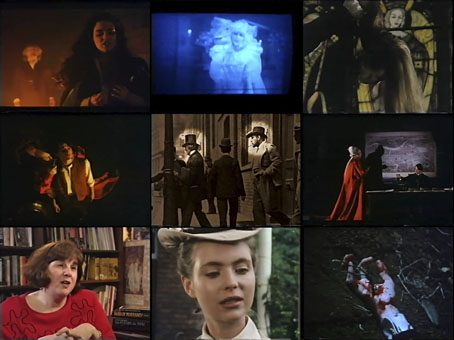
While illustrating Dracula earlier this year I was listening to Wojciech Kilar’s soundtrack to Francis Coppola’s Dracula to sustain the vampiric mood. I also watched Coppola’s film again, it’s an adaptation I enjoy a great deal despite its flaws. (This post detailed some of the plus points.) The South Bank Show‘s programme devoted to Dracula on page and screen was broadcast in early 1993, timed for the opening of Coppola’s film in the UK. I watched this when it was first shown, and remembered it being a good one but neglected to go searching for it back in January. I also remembered it being more about Coppola’s film than it is, although there’s still enough to make it a substantial promo piece.

sbs2.jpg

The territory here may be familiar but the evolution of Stoker’s novel is contextualised by some expert commentators—Leonard Wolf, Elaine Showalter (with a copy of Bram Dijkstra’s Idols of Perversity at her side) and Christopher Frayling—while discussion of the film adaptations includes Christopher Lee, Francis Coppola, James V. Hart (the screenwriter of Coppola’s film), Gary Oldman, Winona Ryder and others. Among the film clips there are several scenes from Count Dracula, Gerald Savory’s 1977 adaptation for the BBC. This is surprising since The South Bank Show was screened by the BBC’s rival, ITV. But Savory’s Count Dracula is still the most faithful screen adaptation that I’ve seen (and possibly the most faithful to date) so it’s a worthwhile choice, and one whose naturalism makes a sober contrast to Coppola’s Sturm und Drang.

Previously on { feuilleton }
Illustrating Dracula
Illustrating Frankenstein
Dracula and I by Christopher Lee
The Dracula Annual
Nightmare: The Birth of Horror
Albin Grau’s Nosferatu
Count Dracula
Symbolist cinema

Illustrating Dracula

holloway.jpg

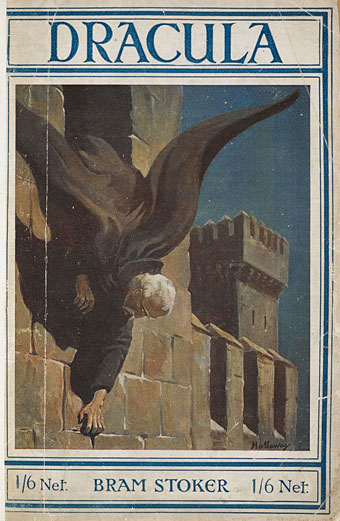
Cover art by Edgar Alfred Holloway for the Rider edition of Bram Stoker’s novel, an edition reprinted many times during the early 20th century. Holloway’s Count is shown as Stoker describes him in the early chapters of the book, white-haired and bearded.

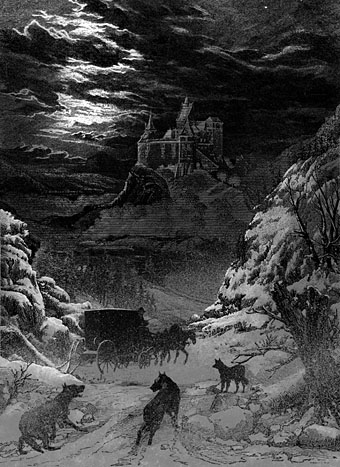
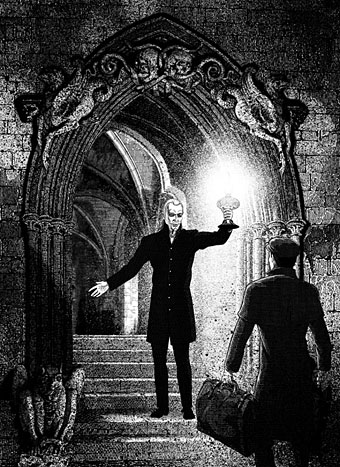
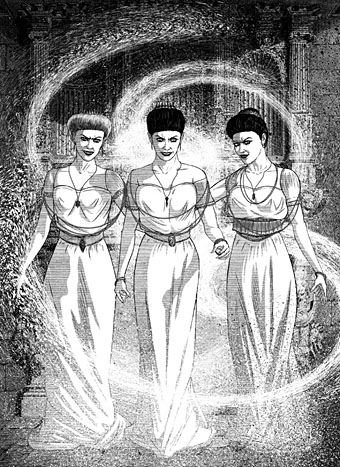
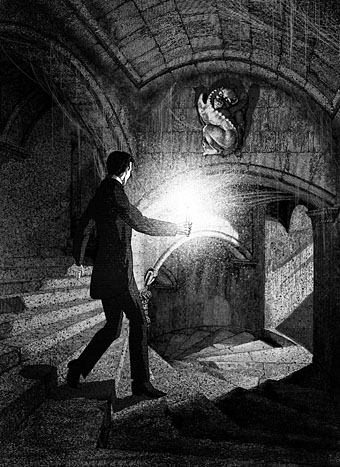
Last year I illustrated a number of stories by Edgar Allan Poe, and the entirety of Mary Shelley’s Frankenstein for Spanish publisher Editorial Alma. Earlier this year I was illustrating Dracula for the same publisher; now the book is in print I can show the results here. This was another difficult task since I had a few weeks to illustrate all 27 chapters of the novel while trying to do something new (or at least slightly different) with a very familiar story.

As with Frankenstein, I opted for fidelity to the text and period details. Despite its epistolary form, Dracula is much more readable (in a contemporary sense) than Frankenstein, so more people will have read Stoker than Shelley; but the sheer scale of cultural mauling that Dracula has been subject to means that—as with Frankenstein—even the allegedly faithful adaptations often deviate from the novel. The lounge-lizard vampire that everyone knows was a creation of Hamilton Deane’s 1924 stage adaptation, the success of which led to Tod Browning’s film and Bela Lugosi’s performance (which I’ve never liked); film and theatre may have made Dracula universally popular but the Lugosi stereotype has overshadowed the more powerful and violent character that Stoker gives us, with his bearded face, hairy palms and glowing eyes. So that’s who you see here, although the restrictions of time and brief (one picture per chapter) meant that some of the moments I’d have liked to illustrate had to be forfeit. Poor old Renfield gets short shrift, and some of the minor male characters are out of the picture altogether.

dracula01.jpg

On the plus side (I hope), many of the background details are well-researched even if they’re not at all obvious. The castle in the first picture (above) is Bran Castle, known today as “Dracula’s Castle” even though the building in the novel is Stoker’s invention; it certainly looks the part. As before, the full run of pictures follows below. All may be seen at a larger size here.

dracula02.jpg

dracula03.jpg

dracula04.jpg

Continue reading “Illustrating Dracula”

Weekend links 414

polackova-vyletalova.jpg

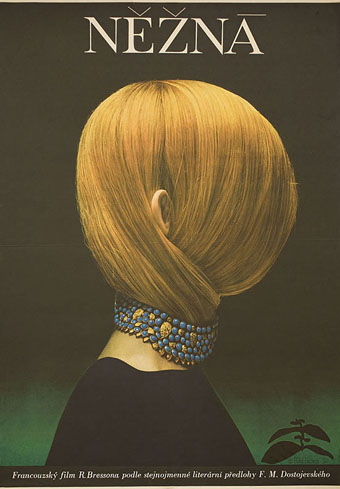
Czech poster for Robert Bresson’s Une Femme Douce (1969) by Olga Polácková-Vyletalová. There’s more about Polácková-Vyletalová’s striking poster designs (and this one in particular) at Mubi. See also the Polácková-Vyletalová collection at Terry Posters.

• “I heard that in Japan the tendency is to hammer down the nails that stick out. I think that Haruomi Hosono is a nail that sticks out. And has maintained that.” Van Dyke Parks on Haruomi Hosono, best known in the West for being one third of Yellow Magic Orchestra but a prolific artist in his own right. Hosono’s early solo albums are being reissued by Light In The Attic later this year.

Hua Hsu on The Spectacular Personal Mythology of Rammellzee. “Rammellzee will always feel like part of the underground,” says Geeta Dayal in a review of the Rammellzee exhibition currently showing in New York.

• Mixes of the week: Hassell’s Children, a Fourth World mix by Ban Ban Ton Ton, The Island of Bright Tombs by SeraphicManta, and a Radio Belbury mix by The Advisory Circle.

• More Robert Aickman: The Fully-Conducted Tour, a complete short story. Related: Matthew Cheney reviews the new Aickman collection, Compulsory Games.

• Another Kickstarter bid, this time for a reprint of Art Nouveau designs and illustrations by Carl Otto Czeschka.

Oliver Burkeman reviews How to Change Your Mind: The New Science of Psychedelics by Michael Pollan.

Art/design/architecture magazines online at the International Advertising & Design Database.

• Tonedeaf in our nose: Gerri Kimber on the musicality of James Joyce’s writing.

• More William Hope Hodgson: Greydogtales examines Hodgson’s poetry.

• The Art of Elsewhere: Jed Perl on the world of Edward Gorey.

• At Dennis Cooper’s: Records.

Beat Bop (1983) by Rammellzee vs. K-Rob | Equation (1989) by Material ft. Rammellzee | No Guts No Galaxy (1999) by Ramm Ell Zee & phonosycographDISK

Weekend links 412

maroto.jpg

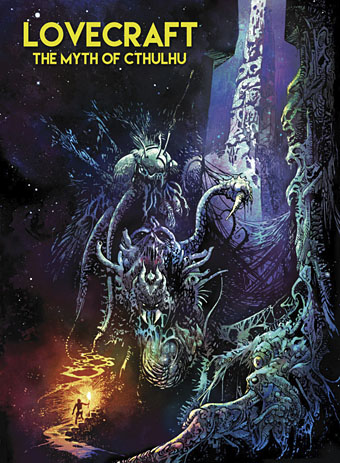
Lovecraft: The Myth of Cthulhu, an English-language edition of three comic-strip adaptations by Esteban Maroto, is now available from IDW.

The Coffin House, a short story by Robert Aickman that’s a taster for the new Aickman collection, Compulsory Games. Anwen Crawford wrote an introduction to Aickman’s world of “strange stories” for The New Yorker. Related: Victoria Nelson, editor of the new collection, chooses ten favourite horror stories.

• German music this week at The Quietus: Sean Kitching talks to Irmin Schmidt about his years with Can; and there’s an extract from Force Majeure, an autobiography by the late Edgar Froese, writing about the early days of Tangerine Dream.

• More German music at Carhartt WIP: a lengthy and revealing interview with guitarist Michael Rother about his time as one half of Neu!. There’s also a bonus Neu!-themed mix (and one of the mixes of the week) by Daniel Miller.

• From October last year, a Stereoklang interview with master synthesist Hideki Matsutake (Logic System, Yellow Magic Orchestra, et al).

• “When did you first get interested in esoteric studies?” Gary Lachman interviewed at The Astral Institute.

• At Sweet Jane: early illustrations by Wojtek Siudmak for Plexus magazine, 1969.

• 87 prints and drawings by MC Escher in zoomable high-resolution.

• Meet the Small Press: James Conway of Rixdorf Editions.

• Mix of the week: Goodbyes & Beginnings by Zach Cowie.

Derek Jarman on the trouble with shopping for clothes.

Person To Person (1981) by Logic System | Plan (1981) by Logic System | Prophet (1981) by Logic System

Weekend links 411

crowley.jpg

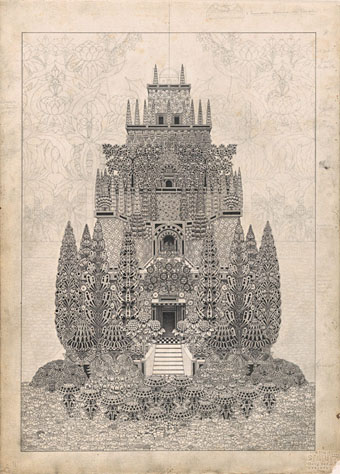
The Temple of Love (1911–24) by Herbert E. Crowley.

• My film viewing in the 1980s involved a considerable amount of backtracking: watching any film noir that turned up on the TV while chasing the early works of David Cronenberg, and various “New Hollywood” classics on television or at repertory cinemas (when such things were still plentiful). Contemporary fare by comparison was often a lot less attractive, although I’d be waiting for new work from David Lynch and Nicolas Roeg while pursuing obscurities (usually the banned or censored) on videotape. Popular films seldom generated actual loathing but throughout the decade I nurtured a persistent hatred for the works of John Hughes, an animus that can still return today when I read yet another nostalgic article about his oeuvre.

The monoculture of the 1980s was writ large on American cinema of the decade. From Arnold Schwarzenegger’s muscle-rippling actioners to John Hughes’s adolescent confections, bombastic, generally upbeat films characterised the decade of the yuppie.

Christina Newland offers a welcome riposte to the pastel-hued retrospectives in a piece entitled “Reagan’s bastard children: the lost teens of 1980s American indie films”. While not exclusively teen pictures, I’d have mentioned three low-budget films written by Eric Red: The Hitcher (1986), Near Dark (1987) and Cohen and Tate (1989).

The Temple of Silence: Forgotten Works & Worlds of Herbert Crowley is a lavish (and costly) study of the strange comic strips and incredibly detailed drawings of Herbert E. Crowley (1873–1937). Mark Newgarden interviewed Justin Duerr about rescuing Crowley’s art from undeserved neglect. I missed an earlier interview by Steven Heller with Temple of Silence publisher Josh O’Neill. There’s more: The Wiggle Much a Tumblr devoted to Crowley’s comic strips and other artwork. (Ta to Jay for the tip!)

Pandemic is an interactive film by John Bradburn for The Science Museum. “A pandemic is causing heart failure–how far will you go to create a pig/human hybrid to provide donor organs?” The multiple choice begins at YouTube; there’s also a behind the scenes feature at the Museum blog, and a trailer. Anyone who remembers a certain scene in Lindsay Anderson’s O Lucky Man! may hesitate before playing.

Given the plain palette of so much 1969–70 rock—jammed-out bluesy boogie in the Canned Heat and Allman Brothers mode, nasal pseudo-country harmony singing à la CSN&Y and their afterbirth—it is tempting to imagine an entirely alternative history for rock. It’s a parallel world where Fifty Foot Hose’s Cauldron, United States of America’s self-titled album and synthedelic oddities from Syrinx, Silver Apples, Beaver & Krause and Tonto’s Expanding Head Band were just the run-up to a giant leap into the electronic future.

Simon Reynolds in an excellent piece on one of my favourite musical sub-genres, electronic psychedelia

• The week in animated film: Emerald Rush, a video for an extract from Jon Hopkins’ new album, Singularity; Awaken Akira, a short homage to Katsuhiro Otomo’s graphic novel/film by Ash Thorp and Zaoeyo; Extra (1996), a video by one of the Akira animators, Koji Morimoto, for music by Ken Ishii.

Tenebrous Kate on The Powers of Darkness & The Powers of the Mind: The Legacy of Jacques Tourneur’s Night of the Demon. Related: a look at the film’s shooting script and pressbook.

• At Dangerous Minds: John Gray, the pre-Bosie lover of Oscar Wilde, and the man whose surname is memorialised in Wilde’s most famous creation, Dorian Gray.

• Skewing the Picture: China Miéville posts the full text of an essay from 2016 about the rural weird.

• Share a pastrami sandwich with TED Klein in Episode 65 of Eating the Fantastic.

• More Hodgsoniana: The Land of Lonesomeness, a short story by Sam Gafford.

• At The Quietus: Barry Miles on William Burroughs’ years in London.

• At Dennis Cooper’s: Curtis Harrington Day.

Night Of The Assassins (1977?) by Les Rallizes Dénudés | Night Of The Earth (1980) by Chrome | Night Of The Swallow (1982) by Kate Bush