Echoes of Aubrey

life2.jpg

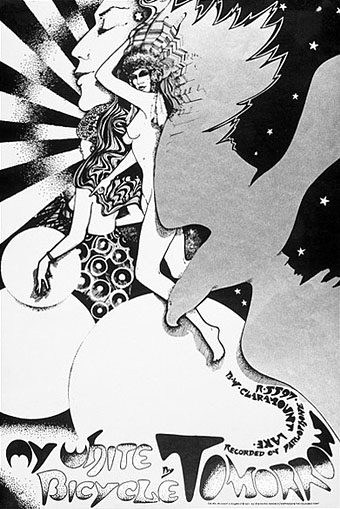
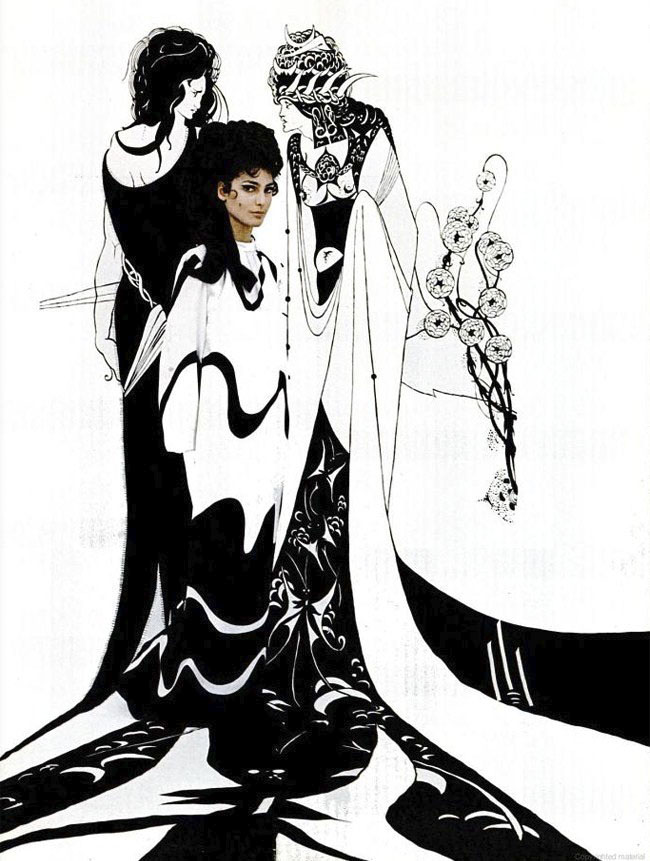
More of Aubrey Beardsley’s posthumous influence and more of the delightful collision between the 1890s and the 1960s. Monsieur Thombeau turned up this striking fashion shoot from LIFE magazine for 1967 showing a model posed against one of the Salomé drawings. A couple of days after this was posted, a reader wrote to point me to this list of films featuring Beardsley artwork. Most of those I knew about already but I certainly hadn’t heard of Death Bed: The Bed That Eats (1977), a low-budget horror film about which we’re told:

A large, black, four-poster bed, possessed by a demon, is passed from owner to owner. The demon was a tree, who became a breeze and seemingly fell in love with a woman he blew past. The demon then took human form and conjured up a bed. While he was making love with the woman she died and his eyes bled onto the bed, causing it to become possessed. Those who come into contact with the bed are frequently consumed by it (victims are pulled into what is apparently a large chamber of digestive fluids beneath the sheets). The bed demonstrates a malevolent intelligence as well as some psychokinetic and limited telepathic abilities to manipulate dreams. A running commentary or chorus is supplied by the ghost—if that is the correct word—of an artist (who would appear to be Aubrey Beardsley, though this is never stated directly) trapped behind a painting on the wall.

That’s a posthumous fame Aubrey never would have anticipated. If anyone has seen this, let us know what you thought.

carryon.jpg

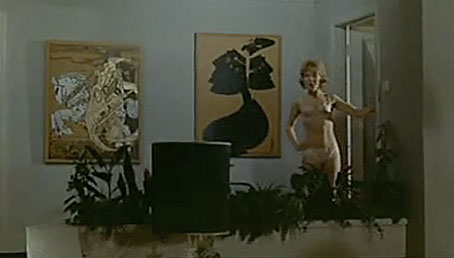
Carry On Loving (1970).

Absent from the list of films is Ken Russell’s Salome’s Last Dance, which features the Salomé pictures again in its title sequence, and Carry On Loving, one of the dreadful British sex comedies which has an entire scene set in a modish pad decorated with Beardsley prints. Watch the scene in question here, if you must.

galleryfive.jpg

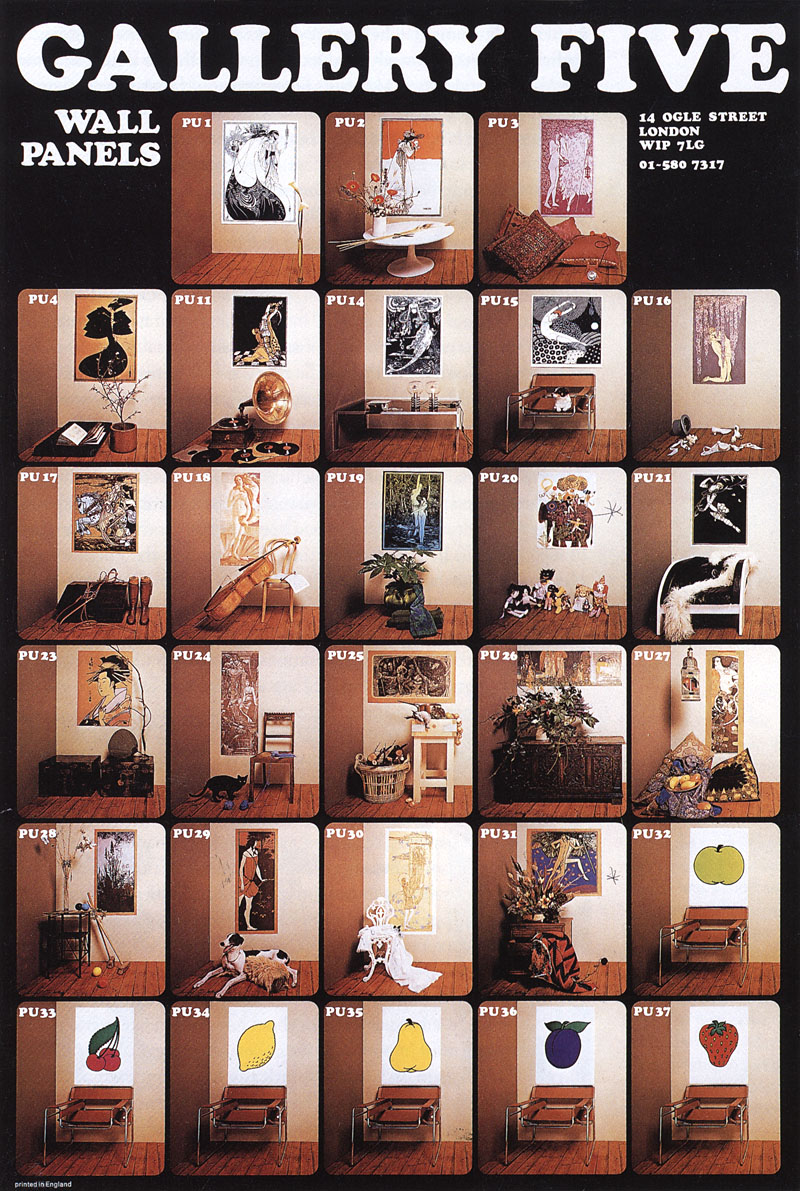
The prints were produced by a London company, Gallery Five, in the late 60s, and their ad shows they were also selling works by Kay Nielsen (seen in the Carry On clip), John Austen, Charles Ricketts, George Barbier, Jessie King and others. Gallery Five did much to popularise Beardsley’s art among people who might otherwise have never noticed his work, and their products turn up in many films and TV dramas of the period. Finally—although it’s by no means the last word on this subject—the V&A has two great Beardsley-derived ads for Elliott Boots by Paul Christodoulou here and here.

Elsewhere on { feuilleton }
The Aubrey Beardsley archive

Weekend links: New Year edition

olofsdotter1.jpg

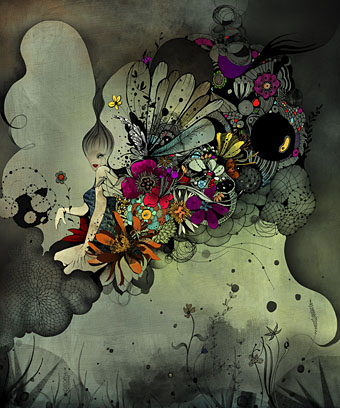
Flower Me Gently (2010) by Linn Olofsdotter.

• “Many of Moorcock’s editorials are published here, and they still make exhilarating reading. Then, as now, Moorcock set his face against a besetting English sin: a snobbish parochial weariness, an ironic superiority to the frightful oiks who have started filling up the streets. You can almost hear, behind the languorous flutter of the pages, Sir Whatsits sniggering to Lady Doo-Dah. It still goes on, and it’s usually the same flummery in different clothes. Moorcock not only would not go to the party: he threw the literary equivalent of explosive devices into the Hampstead living rooms.” Michael Moorcock’s Into the Media Web reviewed. And also here.

• “Beefheart channeled a secret history of America, the underbelly of a continent and a culture that has now all but vanished along with one of its greatest poets.” Jon Savage on the life and work of the late Captain.

Miniatures Blog, in which musician Morgan Fisher works his way through each of the fifty one-minute tracks on his extraordinary Miniatures compilation album, with details and anecdotes about the artists and the recording of each piece.

Look at Life: IN gear (1967). A Rank Organisation newsreel about Swinging London. Sardonic commentary and some great colour photography showing how the often shabby reality differs from the caricature. Many of the shots are familiar from documentaries about the era but this is the first time I’ve seen them all in one place.

olofsdotter2.jpg

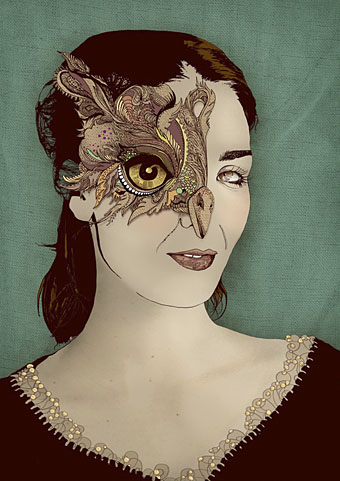
Predator (Self-portrait) by Linn Olofsdotter.

Lewis Carroll’s new story: The Guardian‘s review of Through the Looking-Glass from December, 1871. Related: My Through the Psychedelic Looking-Glass 2011 calendar is now reduced in price.

The United Kingdom and Ireland as seen from the International Space Station, December, 2010. Related: Spacelog, the stories of early space exploration from the original NASA transcripts.

The “Big Basket” Fraud, 1958: “…there seems to be a limited segment with a one-track mind interested in seeing an exaggerated masculine appendage.”

• “Ancient arena of discord”: a billboard for King’s Cross by Jonathan Barnbrook. Related: Vale Royal by Aidan Andrew Dun.

• The inevitable Ghost Box link, Jim Jupp is interviewed at Cardboard Cutout Sundown.

• Amazon is still playing the random moral guardian at the Kindle store.

Antwerpian Expressionists at A Journey Round My Skull.

Salami CD and vacuum packaging by Mother Eleganza.

Paris 1900: L’Architecture Art Nouveau à Paris.

Bill Sienkiewicz speaks about Big Numbers #3.

Philippe Druillet illustrates Dracula, 1968.

Aesthetic Peacocks at the V&A.

Well Did You Evah! (1990), Deborah Harry & Iggy Pop directed by Alex Cox.

“Who is this who is coming?”

whistle4.jpg

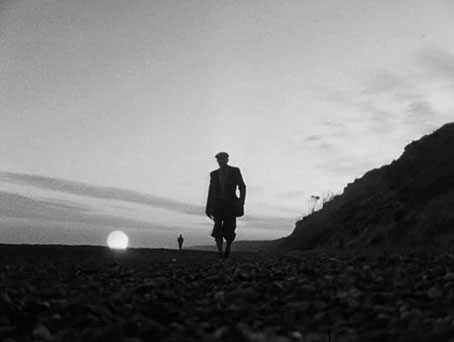
Whistle and I’ll Come to You (1968).

He blew tentatively and stopped suddenly, startled and yet pleased at the note he had elicited. It had a quality of infinite distance in it, and, soft as it was, he somehow felt it must be audible for miles round. It was a sound, too, that seemed to have the power (which many scents possess) of forming pictures in the brain. He saw quite clearly for a moment a vision of a wide, dark expanse at night, with a fresh wind blowing, and in the midst a lonely figure—how employed, he could not tell. Perhaps he would have seen more had not the picture been broken by the sudden surge of a gust of wind against his casement, so sudden that it made him look up, just in time to see the white glint of a sea-bird’s wing somewhere outside the dark panes.

MR James, Oh, Whistle, and I’ll Come to You, My Lad.

One of the alleged highlights of this year’s Christmas television from the BBC was a new adaptation of an MR James ghost story, Oh, Whistle, and I’ll Come to You, My Lad. The film starred John Hurt and came with the same truncated title, Whistle and I’ll Come to You, as was used for Jonathan Miller’s 1968 version, also a BBC production. The story title comes originally from a poem by Robert Burns. The new work was adapted by Neil Cross and directed by Andy de Emmony, and I describe it as an alleged highlight since I wasn’t impressed at all by the drama, the most recent attempt by the BBC to continue a generally creditable tradition of screening ghost stories at Christmas. Before I deal with my disgruntlement I’ll take the opportunity to point the way to some earlier derivations. (And if you don’t want the story spoiled, away and read it first.)

Continue reading ““Who is this who is coming?””

Weekend links 38

lovecraftbaw.jpg

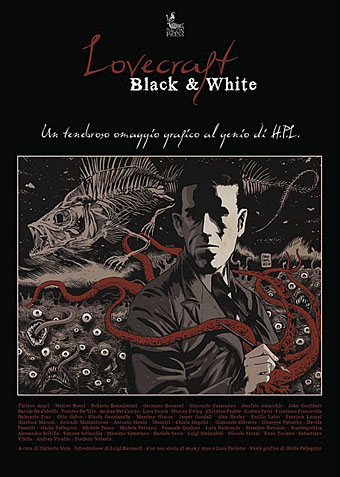
Arriving in the post this week was Lovecraft Black & White, an Italian book whose contents are spelled out in the title, black-and-white illustrations based on the work of the Providence master. Among the featured works is my 1999 rendering of Azathoth. There’s more about the book here and here.

Also on the work front, one of the books I designed interiors for a couple of months back was The Search for Philip K. Dick, a sombre biography and memoir by Anne R. Dick, the author’s third wife. Ms Dick discussed the book with the NYT a few days ago. The design was mostly straightforward layout but I did make a quick ASCII portrait of PKD from one of Anne Dick’s photos.

Farewell, the documentary film about Lady Grace Drummond-Hay’s flight around the world in the Graf Zeppelin, can be viewed here.

• “I personally think that the pages look better on the iPad than they do in real life.” Artist Tom Phillips again on the Humument iPad app.

The Birds Are Flying Elsewhere: singer/songwriter Linda Perhacs. Related: Parallelograms – A Short Film About Linda Perhacs.

St Eia, guitar improvisations by Zali Krishna, “Keywords: jazzgazing; entropy circus; st ives; cornwall; psychogeography”.

Moon Wiring Club and DD Denham: music for children, by children. Related: Moon Wiring Club’s Jayston Mix.

kirkland.jpg

The 1970s was another country, they did things differently there. One of a number of illustrations for science textbooks by Phil Kirkland at A Journey Round My Skull.

• “Fellatio has become a recurrent theme in your work hasn’t it, I say.” Alan Bennett sheds some inhibitions.

Talking To The Sci-Fi Lord: Regenerations & Ruminations With Michael Moorcock.

Time and the Gods (1906) by Lord Dunsany, illustrated by Sidney Sime.

City of Silence, a calendar for 2011 by Thom Ayres.

Scientists glimpse universe before the Big Bang.

• Photography by Josef Sudek (1896–1976).

Aurora photo gallery, November 2010.

The Last Tuesday Society.

Parallelograms (1970) by Linda Perhacs | Six AM (1979) by Thomas Leer & Robert Rental | Rockin’ Back Inside My Heart (1989) by Julee Cruise.

Weekend links 37

peeping.jpg

Michael Powell’s Peeping Tom is fifty-years old this year, an occasion celebrated with a limited UK cinema run and a reissue on Blu-ray and regular DVD. This was the film which famously ended Powell’s career as a director in Britain for reasons which have never been quite clear. Was the film’s critical vilification the culmination of an impatience with the director’s alleged excesses over the years? Was it an unarticulated discomfort at the way Powell and screenwriter Leo Marks implicated themselves and the audience in the sordid murders they (we) were watching in the dark? Or was the film withdrawn simply because producer Nat Cohen wanted a knighthood and was worried over his reputation as a peddler of “filth”? The bitterest blow for Powell would have been seeing his long-time rival Alfred Hitchcock have another success a few months later with Psycho, a film which allows its audience similar female-slaughtering thrills without questioning the role of the viewer in sustaining the drama. Hitchcock spent much of his career “punishing” women in a manner that verges on outright misogyny yet was indulged all along by audience and critics; Powell made a single film about a murderer and was himself punished for it. His other films often featured strong female characters, and I’ve long regarded him as the superior artist.

The Guardian this week celebrated Powell’s film with a number of articles: Peeping Tom may have been nasty but it didn’t deserve critics’ cold shoulder, Peeping Tom, pornography and the press, The Peeping Tom timebomb.

A Wizard of Earthsea: an unfilmed screenplay from 1983 by Michael Powell and Ursula K Le Guin based on Le Guin’s first two Earthsea novels.

1860.jpg

A boy in a dress with mother and sister, 1860. Yesterday was the 12th Annual Transgender Day of Remembrance.

Quaintance by Reed Massengill and Dian Hanson, in which the pioneer of 20th century beefcake art gets the heavyweight Taschen treatment. Expensive but they’re making these volumes for obsessives. Related: Hide/Seek: Difference and Desire in American Portraiture, an exhibition of gay and lesbian art at the Smithsonian’s National Portrait Gallery. The gallery has a preview of the exhibition here. On a more humble level, BUTT magazine has a recreation of Quentin Crisp’s inevitably messy New York City apartment.

• From gay art to gay song and dance: Queer To The Core!: Queer Rock From The Vaults! Super-rare novelty singles with titles like Queer Police by Billy Devroe and The Devilaires. Meanwhile Cleveland Street: The Musical is a forthcoming stage celebration of Victorian London’s notorious male brothel. By Glenn Chandler, creator of the popular TV detective series Taggart (!) whose earlier musicals have titles like Boys of the Empire and Scouts in Bondage.

pejic.jpg

Strikingly androgynous male model Andrej Pejic photographed by Armin Morbach. There’s a lot more Andrej Pejic at Homotography.

Thrilling Wonder Stories II, “eight hours of architectural futurism featuring an unbelievable line-up of novelists, game designers, animators, scientists, comic book artists, architects, and more”. At the Architectural Association, London, November 26.

• “The iPad is one of the oldest things in the world…a pad or a slate.” Artist Tom Phillips reworks A Humument for a new medium. Related: Creating new books from old, in which Jonathan Safran Foer follows Phillips’ lead by cutting words from Bruno Schulz’s Street of Crocodiles to create a new work, Tree of Codes.

• “Technology is turning us into switchboard operators in the communication networks of our own lives.” I know the feeling. Rick Poynor on the seductive tyranny of design technology.

• Comic artist Moebius gets the Tumblr treatment. And speaking of Tumblr, my thanks to everyone who’s been reblogging the Cephalopod Bride.

Skull Comics, 1970–72, at Golden Age Comic Book Stories. Underground artists excavate Lovecraftian horrors, among other things.

The lost town of Dunwich.

The Bells of Dunwich (1975) by Stone Angel | Dunwich Beach, Autumn, 1960 (1982) by Brian Eno.