The Incredible Robert Baldick

baldick1.jpg

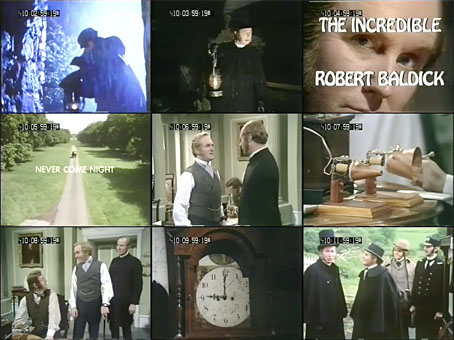
This is an odd one-off TV drama whose title I’ve known for years but which I hadn’t seen until this week. The Incredible Robert Baldick was broadcast in 1972 in a slot used by the BBC to test dramas that might later become series. The writer was Terry Nation, creator of Doctor Who and the dour post-apocalypse series, Survivors. Robert Hardy plays Robert Baldick, an aristocratic occult detective who we’re informed “cannot resist the inexplicable”. We’re also told he’s one of the finest scientific minds in 19th-century Britain. The exact period is vague but we first see Baldick and cohorts playing with an “electrical telepathy” communication device which would fix the time around the turn of the century. Baldick has a country estate, a bulletproof Russian train (“The Tsar”), a valet who is also an expert in Classics and ancient languages, a gamekeeper with preternatural senses, and a pet owl named Cosmo.
baldick2.jpg

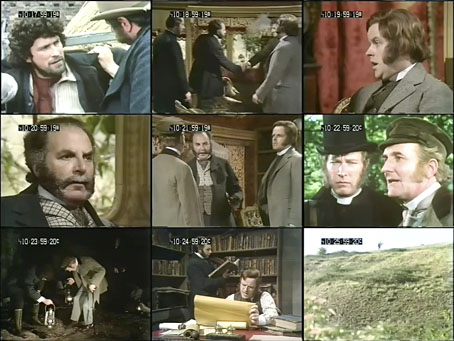
The one-and-only 50-minute episode is entitled Never Come Night, and plays like something Nigel Kneale might have written, a combination of supernatural horror, suspicious yokels and archaeology, with an abrupt swerve into outright science fiction at the end. The cast features many familiar faces from film and television of the period: James Cossins as a fearful clergyman, Barry Andrews playing the same type of rustic he also played in Blood on Satan’s Claw, Julian Holloway as Thomas the valet, and John Rhys-Davies (Gimli in The Lord of the Rings) as Caleb the gamekeeper. All the ingredients are in place for what might have been a promising series along the lines of The Rivals of Sherlock Holmes, the first season of which had been running on another channel the year before, and which may have been an inspiration. A shame that the only women in the cast are a couple of barely visible servants and a corpse; even Holmes and Watson had Mrs Hudson. The timecoded copy on YouTube has evidently been hijacked from the BBC archives but it’s watchable enough.

Previously on { feuilleton }
The Horse of the Invisible
“The game is afoot!”

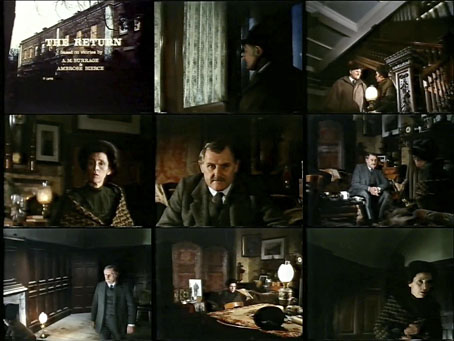
The Return: a ghost story

thereturn.jpg

Another obscure film, The Return (1973) isn’t a television drama, more a miniature for the cinema, and as such may have been produced as a double-feature short. Director and co-writer Sture Rydman only has one other film to his credit but the music for The Return is by film composer Marc Wilkinson while the photography is the work of the very distinguished Douglas Slocombe.

The story is a blend by Rydman and fellow writer Brian Scobie of two ghost stories: Nobody’s House by AM Burrage, and The Middle Toe of the Right Foot by Ambrose Bierce. Nobody’s House is surprisingly one of the few Burrage stories I have on the shelves, and it provides the bulk of the script, the Bierce story being a very different piece concerning a duel in an abandoned building. Rydman’s film is a two-handed affair for two very good actors: Rosalie Crutchley, here playing a less sinister housekeeper than she did in The Haunting, and Peter Vaughan who the year before had been the lead in one of the best of the BBC’s MR James adaptations, A Warning to the Curious. The Return runs for 30 minutes, and to say much more would be to spoil it. The copy at YouTube does Slocombe’s photography no favours but you can at least watch it here.

Previously on { feuilleton }
Nigel Kneale’s Woman in Black
“Who is this who is coming?”

Weekend links 239

crystal.jpg

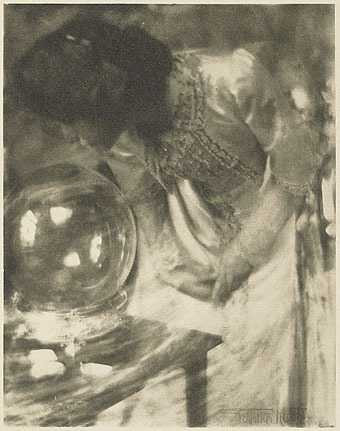
The Crystal Gazer (or The Magic Crystal, 1904) by Gertrude Käsebier.

• “I had to resort to extreme violence”: how Hipgnosis revolutionised the album sleeve. Aubrey Powell, last surviving member of the design team, talks to Joe Muggs.

• Mixes of the week: Radio Belbury: Programme 14; The Conjurer’s Hexmas by SeraphicManta; Secret Mix 139 by A Closer Listen.

• Social progress, high-speed transport and electricity everywhere: Iwan Rhys Morus on how the Victorians invented the future.

• At Cinephilia & Beyond: “The most complete investigation into the origins and making of Citizen Kane.”

Poor Souls’ Light: seven curious tales for the end of the year, and a dedication to Robert Aickman.

• Music and the Occult: Stuart Maconie and Rob Young spend an hour in the magick circle.

Alejandro Jodorowsky and Iain Sinclair in conversation at the British Library, July 2014.

• From 1972: An unpublished Victor Moscoso interview by Patrick Rosenkranz.

The Spooky Story Behind Hollywood’s Favourite Mansion.

The Lost World of British Tape Recording Clubs.

• 2014 was a year of outrage.

Wyrd Daze issue 11

Inspirograph

• Pepper-Tree (1984) by Cocteau Twins | Otterley (1984) by Cocteau Twins | Aikea-Guinea (1985) by Cocteau Twins

Weekend links 238

hinrichsen.jpg

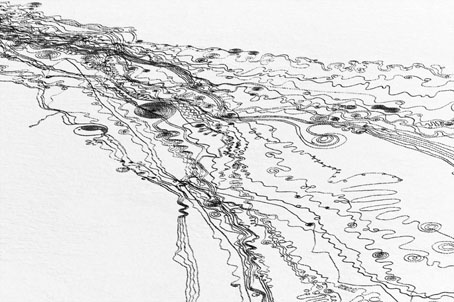
We Are The Water – Snow Drawings Project, Colorado (2014) by Sonja Hinrichsen with 50 volunteers.

• I don’t do end-of-year lists but Dennis Cooper does. My thanks to Dennis once more for including this blog among his selections. Also there is Jonathan Glazer’s film of Under the Skin, an adaptation of Michel Faber’s novel that impressed me as the most insidiously disturbing thing I’ve seen since Mulholland Drive. The Guardian‘s film critics agreed, making it their film of the year. I’d add to Peter Bradshaw’s appraisal by noting the superb score by Mica Levi, the refusal to spoon-feed the audience with explanations, and a refreshing absence of Hollywood gloss. Glazer’s film, like Kill List before it, shows that mundane British streets and interiors can still be a setting for serious horror.

• Related to the above: “I like Caravan, Coil—it’s very sad that they’re both dead now. In fact, Peter Christopherson, who was leader of Coil, contributed a song to a CD which I made for my wife for what we believed would be her last birthday.” Michel Faber talks to Hope Whitmore about Under the Skin and his new novel, The Book of Strange New Things. M. John Harrison recommends the latter on his own end-of-year list. In January Black Mass Rising will release a recording of The Art of Mirrors, Peter Christopherson’s homage to Derek Jarman from 2004.

David Bowie and band live on Musikladen in 1978: 40 minutes with Adrian Belew on squealing lead guitar, some Kurt Weill and an outstanding performance of “Heroes”.

• “Realism is a literary convention – no more, no less – and is therefore as laden with artifice as any other literary convention.” Tom McCarthy on realism and the real.

• Mixes of the week: The Best of the Best of the Best by TheCuriosityPipe, and Secret Thirteen Mix 138, a medley of post punk from Psyche.

• “We spent two weeks making the penises.” Livin’ Thing: An Oral History of Boogie Nights by Alex French and Howie Kahn.

• At Dangerous Minds: Seeing The Man Who Fell to Earth was one of the greatest experiences of Philip K. Dick’s life.

• Giving Voice to Our Pagan Past and Present: Pam Grossman on Witches, Women and Pop Occulture.

• Neglected last week (and linked everywhere but still a good one): The typography of Alien.

William Mortensen, the photographer who Ansel Adams called the Anti-Christ.

• Hear a track from analogue synthesizer virtuoso Kaitlyn Aurelia Smith.

Rick Poynor on illustrations by Bohumil Stepan for Crazy Fairy Tales.

12 excellent features from directors who never made another feature.

Werner Herzog Inspirationals

The Devil in the Hedgerow

New Warm Skin (1980) by Simple Minds | Rapture Of The Skin (1996) by Paul Schütze | Take Me Into Your Skin (2007) by Trentemøller

Weekend links 237

trouille.jpg

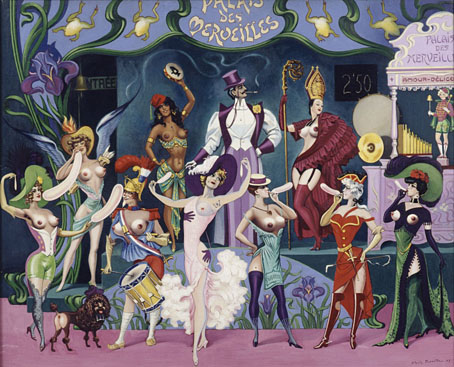
Le Palais des Merveilles, 1907 – 1927 – 1960 by Clovis Trouille.

• “Why is it OK to show a male ejaculation but not a female one? What are the qualifications of those who cobble together these rules?” Suzanne Moore on the latest batch of discriminatory restrictions against porn production in the UK. Porn laws in Britain have long been like the drug laws, sprouting fresh Hydra-heads of unwarranted bans and crackdowns after the previous bans and crackdowns have been discredited. Last month Zoe Williams talked to women who make niche porn for other women. This week she discovered that some of those she interviewed now find their work is illegal under the latest restrictions.

• “[Derek Jarman] considered In the Shadow of the Sun to be just as important as any of the feature films that he made in the 1970s.” Film producer and archivist James Mackay talking to Beatrix Rux about Derek Jarman’s Super-8 films. Related: Tilda Swinton is GQ’s Woman of the Year.

The Art of Big O by Michael Fishel (author) and Nigel Suckling (editor), a collection of the fantastic and psychedelic poster art published by Peter Ledeboer’s company in the 1970s. Good to see but at $67 (really?) I’d expect a better cover design.

• New electronica: More “confusing English electronic music” from Moon Wiring Club; Shut-Eyed Stories, an album by Jim Cheff; and Shapwick by Jon Brooks, previously vinyl-only and out-of-print, now has a digital edition.

JK Potter Mutates the Story: Christopher Burke & David Davis talk to the horror illustrator about his photographic work.

• Beth Maiden on The Fascinating Life of Pamela Colman Smith, artist of the Rider-Waite-Smith Tarot deck.

• Under the Influence: The Sexy, Sordid Surrealism of Clovis Trouille by Kirsten Anderson.

Geoff Manaugh on The Fiery Underground Oil Pit Eating LA.

• Mix of the week: Secret Thirteen Mix 137 by Teste.

The Wild Horny Goat

The Young People (2010) by Belbury Poly & Moon Wiring Club | Goat Foot (2012) by Belbury Poly | Walking Through Me (2014) by Moon Wiring Club