Weekend links 328

jamison.jpg

Feathers and Weights (2016) by Susan Jamison.

• The latest release from A Year In The Country is No More Unto The Dance, “a reflection of nightlife memories and the search for the perfect transportative electronic beat”.

Depero Futurista (1927), the bolted book showcasing the artistic work of Fortunato Depero, returns in a facsimile edition.

• This week in the occult: Sam Kean on 21st-century alchemists, and a second volume of The Occult Activity Book.

How could so many jazz critics have overlooked Davis’s powerful trumpet playing on Bitches Brew, and its continuities with his previous work? The reason for their bewilderment was, in large part, the brew, the music’s muddy electric bottom, which bore no resemblance to the jazz they knew. Davis had never been a pure bopper, but his music had always made allusion, however oblique, to the grammar of Parker and Gillespie. On Bitches Brew, Davis decisively broke with his roots in bop. As [George] Grella argues, building on the pivotal work of Greg Tate and Paul Tingen, the more revealing points of comparison were no longer to be found in jazz but in the psychedelic guitar of Jimi Hendrix, the warbled vocals of Sly Stone, and the bass lines of James Brown.

Adam Shatz on Miles Davis

Daniel Wenger on Bob Mizer, “the obsessive photographer behind America’s first gay magazine”.

The Hauntings at Tankerton Park, a book of words and very detailed drawings by Reggie Oliver.

• A 40-minute performance by Pentangle for Norwegian television in 1968.

Maisie Skidmore on ten things you may not know about René Magritte.

• Shirley Collins is the secret queen of England, says Nick Abrahams.

Eighth Climate: ethnographic recordings from the imaginal world.

Pasquale Iannone on five ways to recognise a Pasolini film.

The greatest record sleeves, as chosen by the designers.

Cosmic Horror, new comics work by Ibrahim R. Ineke.

• Mix of the week: FACT mix 569 by S U R V I V E.

• At Dennis Cooper’s: 47 unmade films.

Cosmic Dancer (1971) by T. Rex | Cosmic Slop (1973) by Funkadelic | Cosmic Tango (1973) by Ash Ra Tempel

Bikers and witches: Psychomania

psychomania1.jpg

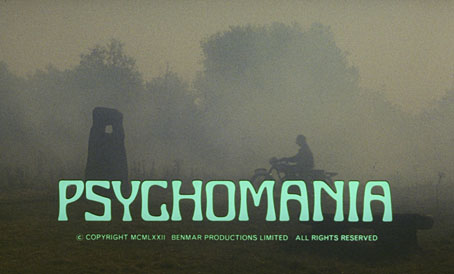
Among the film viewing this past week there was Psychomania (1973), another advance Blu-ray courtesy of the BFI. Americans may know this as The Death Wheelers, a more accurate (if clumsily literal) retitling, although Psychomania does a better job of grabbing the attention. In the micro-genres of the horror film the occult biker picture is a niche with few entries; offhand I can only think of Werewolves on Wheels (1971), a low-grade American production. Most biker films are American so Psychomania is unusual for being British (with an Australian director, Don Sharp), and with a pitch that’s memorable if nothing else: biker gang kill themselves then return from the dead so they can cause mayhem with impunity. The script was the work of Arnaud d’Usseau and Julian Zimet whose only other credit is for a curious chiller made the year before, Horror Express. This was a British/Spanish period piece with a good cast (Christopher Lee, Peter Cushing, Telly Savalas) that’s notable—and often overlooked—for being another film based on John W. Campbell’s SF story “Who Goes There?”.
psychomania2.jpg

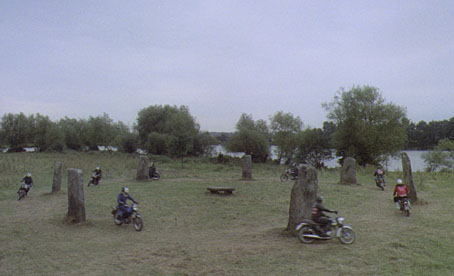
The Seven Witches and The Living Dead.

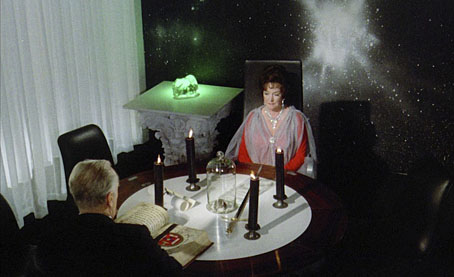
Psychomania also has a decent supporting cast despite its frequent swerves into absurdity. Since the subject is a Home Counties’ bike gang, the leader, Tom Latham (Nicky Henson), has a mother (Beryl Reid) who lives in a country house with a very modish interior: all abstract art, scatter cushions, leather furniture and Trimfones. Mrs Latham is the local table-tapper and may also be a witch, although it’s never clear whether the scene of her offering her son to the Devil is Tom’s hallucination or a replaying of past events. Tom’s father has died after some unspecified supernatural encounter in a mysterious locked room where Tom later has the vision of his being sold to the Devil. Then there’s Shadwell (George Sanders), ostensibly the butler of the household but devilish enough to shrink from a cross when it’s offered by grateful séance attendees. Reid and Sanders lend the proceedings some gravitas, even if Sanders (in his final role, and not well at the time) seems to have stooped far below his usual level. Nicky Henson makes a charismatic leader of bike gang The Living Dead, although his tight leather pants, and the shiny leather gear worn by the others, belong to an earlier decade. This is biker gear as imagined by people remembering The Wild One or The Leather Boys, and a long way from the reeking, never-washed denim “originals” favoured by Hell’s Angels and their ilk.
psychomania3.jpg

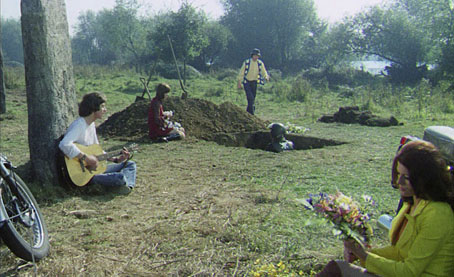
Chopped Meat (Harvey Andrews) sings Riding Free while Tom is being buried.

It’s probably too much to expect of a low-budget horror film, but watching Psychomania again had me thinking that an opportunity was missed to more accurately reflect the real bike gangs of Britain in the 1970s. Biker culture was a country-wide phenomenon at the time; boys I was at school with were too young to own motorbikes but many had brothers who did, and had picked up from them the fetishising of dying British manufacturers such as Triumph, Norton and BSA. (The Living Dead all ride Triumphs.) A few years later I was hanging around with the bikers who were always present among any group of metal-heads, many of whom were too poor to own British bikes but behaved as though they did. The bikerdom of the 70s had little to do with the bike groups of earlier decades even if the bike brands remained the same. The new model, of course, was California’s Hell’s Angels whose first British chapters appeared in London in the late 1960s, and whose legend was popularised by Hunter S. Thompson in Hell’s Angels: The Strange and Terrible Saga of the Outlaw Motorcycle Gangs (1967). Every biker seemed to have read to Thompson’s book, and the presence of Hell’s Angels on British soil led to the swift founding of many imitation groups, forbidden from using the name without Californian approval but grouping themselves under similar handles. A measure of the culture’s appeal to the popular British imagination may be found in the many biker exploitation novels published by New English Library through the mid-70s.

Given all this you’d expect biker culture to be more prevalent in British cinema of the period but the examples are so few there’s really only Psychomania and Sidney J. Furie’s The Leather Boys (1964). The latter documents the pre-Hell’s Angels biker scene via a pseudonymous gay novel that makes similar connections to Kenneth Anger’s almost contemporaneous Scorpio Rising. The gay content is diluted in the film but there’s enough there to make it seem surprisingly bold for the time. Furie’s bikers are a tame bunch compared to The Living Dead, they only want to ride their bikes, not play hogs of the road, and the film as a whole is kitchen-sink-on-wheels, with a link to A Taste of Honey (1961) via Rita Tushingham.
psychomania4.jpg

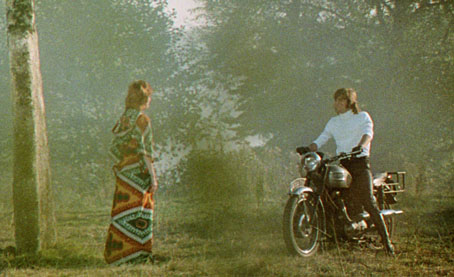
Abby meets dead Tom at the stone circle.

Psychomania is glossier—well, it’s in colour!—and aims for lurid AIP-style mayhem even if such antics seem out-of-place in leafy Surrey. When Tom’s mother inadvertently gives him the secret of bodily resurrection he goes out and kills himself; after his return from the grave (on a motorcycle!) his gang eagerly follow his example. The film runs out of steam when it becomes apparent that The Living Dead’s idea of making the most of their post-death freedom is the same harassing of pedestrians and other motorists as before. The only question is whether Tom’s girlfriend, Abby (Mary Larkin), will kill herself and join them in an eternity of trashing supermarkets. Abby’s equivocation is signalled by her being the only member of the gang who doesn’t wear leather. The film touches on folk horror with the location of “The Seven Witches”, a circle of standing stones which the gang use as their meeting place, and where they bury Tom after he plunges off a bridge. As with The Wicker Man, which was being filmed around the same time, there’s even an acoustic song interlude from one of the more hippyish bikers.
psychomania5.jpg

George Sanders and Beryl Reid indulge in some home Satanism.

Psychomania was always a welcome sight when it used to appear on late-night television. The combination of bikers and occult rites is unusual enough to sustain the attention even if the implications of the premise go unexplored. Unlike The Wicker Man, however, or the excellent Blood on Satan’s Claw (1970), Psychomania‘s disparate threads fail to cohere, and the film is held together largely by its sense of black humour. Don Sharp’s direction manages a couple of clever single-take sleights, and the soundtrack by John Cameron is very good. Cameron wrote a great deal of library music so was adept at capturing the essence of a style. Psychomania‘s soundtrack plays on the rock grooves of the period, and the theme was issued as a single credited to “Frog” (after the possibly supernatural amphibian that Tom finds in a graveyard).

The film looks excellent on Blu-ray albeit grainier in low-light scenes than other BFI transfers. The audio is also more noise-reduced than I’d prefer. The disc includes the usual wealth of BFI extras: interviews with the surviving cast members; a short interview with John Cameron; an amateur film, Roger Wonders Why (1965), about a pair of Christian (!) bikers; and a black-and-white short for Shell narrated by John Betjeman about the Avebury stone circle. George Sanders is absent from the extras since he killed himself shortly after finishing work on the film. As Michael Weldon notes with typical drollery in The Psychotronic Encyclopedia of Film, Sanders didn’t return from the dead on a motorcycle. A pity.

Psychomania is released on 19th September.
Weekend links 325

beeple.jpg

08-30-16 from the Everydays series by Beeple.

• “Monsieur de Bougrelon is a unique character: loquacious, proud, a leftover from an earlier age, wearing garish outfits and makeup that drips. To his speechless audience, he waxes nostalgic about his life as an exile in Holland, as well as what he calls “imaginary pleasures” – obsessions with incongruous people, animals, and objects. These obsessions are often sexual or border on the sexual, leading to shocking, surreal scenes. Monsieur de Bougrelon also enthuses over his beautiful friend Monsieur de Mortimer, making this novella one of the rare works of the nineteenth century to broach homosexuality in a meaningful way, years before Jean Cocteau and Jean Genet.” Monsieur de Bougrelon (1897) by Jean Lorrain will receive its first English publication by Spurl Editions in November.

• “…The Future seems in retrospect to have been no more than a spectacle, created by the optimistic few for the optimistic many, the readily gulled multitudes who had faith in technological seers just as an earlier generation had had faith in Great Men.” Jonathan Meades reviews Last Futures: Nature, Technology and the End of Architecture by Douglas Murphy.

In the Woods & On the Heath is a collection of 48 pieces of erotic prose and poetry by 24 writers, all of them illustrated by Van Rijn.

Borneman was widely read in European literature and, once settled in London, wasted no time bringing himself up to speed with developments in English-language writing, discovering a particular affinity with Hemingway and Joyce, not to mention American crime writers such as Carroll John Daly and Dashiell Hammett. This presumably explains the distinctive, sometimes highly eccentric style of The Face on the Cutting-Room Floor, which despite being set in an English film studio of the 1930s (which evokes images, perhaps, of genteel musical comedies performed in perfect RP accents), combines laconic, hardboiled dialogue with extended stream-of-consciousness passages, all filtered through the skewed phraseology of someone whose acquisition of English was still, to some extent, a work in progress.

Jonathan Coe on the mysteries of The Face on the Cutting-Room Floor, a novel by “Cameron McCabe” (Ernest Borneman)

• How Oscar Wilde paved the way for gay rights in the arts. Wilde will be honoured with a major exhibition in Paris later this month.

Noisy Rain is a free online publication dedicated to “artists working with the male figure and homo-eroticism”.

Dennis Cooper’s blog returns. The truth about Google’s deletion of the Blogspot account has finally emerged.

Peel Away The Ivy by The Pattern Forms will be release number 26 on the Ghost Box label in October.

• Glam Rock & Yorkshire Occult: Ben Myers on his novel Turning Blue.

• Mix of the week: Secret Thirteen Mix 195 by Jake Meginsky.

• At Phantasmaphile: Unarius: We Are Not Alone.

Blokdust is a browser-based musical instrument.

• Official trailer for David Lynch: The Art Life.

Future Dub (1994) by Mouse On Mars | Future Proof (2003) by Massive Attack | Future Past Perfect pt 01 by Carsten Nicolai

Weekend links 324

waliszewska.jpg

Untitled painting by Aleksandra Waliszewska. The artist is profiled by S. Elizabeth at Dirge Magazine.

• “…from my point of view, the only thing to do with any genre, any medium, is pretty much to break it, to transcend it, to find out what its limits are, and then go beyond them, and see what happens.” Alan Moore (again) talking to Heidi MacDonald about his novel, Jerusalem, which is out next month.

• A Monument to Outlast Humanity: Dana Goodyear gets the reclusive Michael Heizer to talk about his decade-spanning sculptural project, City, work on which is almost finished.

William Burroughs’ appearances in adult men’s magazines: a catalogue which includes some downloads of uncollected Burroughs essays and other writings.

• Mixes of the week: Homegirls & Handgrenades Mix by Moor Mother, Secret Thirteen Mix 194 by Kareem, and hieroglyphics #014 by Temples.

Remoteness of Light is a new album by The Stargazer’s Assistant inspired by the depths of the oceans and the vastness of space.

• RIP Gilli Smyth. “The silliness ran deep in Gong, but they could groove like mothers, too,” says Joe Muggs.

Guide to Computing: historic computers presented by James Ball as though they were new machines.

• “Oscar Wilde’s De Profundis is one of the greatest love letters ever written,” says Colm Tóibín.

• “Will You Dance With Me?” Derek Jarman films dancers in a gay club in 1984.

• Snapshots from an editor: Donald Weise on working with Edmund White.

Stupid by Wrangler (Stephen Mallinder, Phil Winter and Benge).

The Rutt-Etra-Izer

Dynamite/I Am Your Animal (1971) by Gong | Witch’s Song/I Am Your Pussy (1973) by Gong | Prostitute Poem (1973) by Gong

Weekend links 323

taylor.jpg

Mescaline Woods (1969) by Gage Taylor.

• The soundtrack to The Man Who Fell to Earth will be released for the first time next month in a double-disc set (CD & vinyl). This isn’t, as some people have hoped, David Bowie’s unheard music for the film, but a collection of the pre-existing songs and other pieces, plus the original compositions by John Phillips. Consequence of Sound has a track list.

• At Scream Addicts: Joe R. Lansdale talks about the only film adaptation of Shirley Jackson’s The Haunting of Hill House that you need to see: the 1963 version directed by Robert Wise.

• The new wave of new age: How music’s most maligned genre finally became cool by Adam Bychawski.

• Transmissions From The Abyss: Dark ambient music for the perfect headspace by S. Elizabeth.

Jason Farrago reviews Art Aids America, an exhibition at the Bronx Museum, New York.

Curse Go Back: a limited reissue of tape experiments by William Burroughs.

Samuel Wigley on Notorious at 70: toasting Hitchcock’s dark masterpiece.

Toyah Willcox remembers working with Derek Jarman on The Tempest.

• “Why are musicians so obsessed with David Lynch?” asks Selim Bulut.

• Read the original 32-page programme for Fritz Lang’s Metropolis.

David Parkinson chooses 10 essential films starring Oliver Reed.

• Mixes of the week: The Sounds of the Dawn NTS radio shows.

Keith Haring envisions Manhattan as a kingdom of penises.

Frank Guan on Massive Attack’s Blue Lines, 25 years on.

Honky Tonk Pts 1 & 2 (1956) by Bill Doggett | I’ve Told Every Little Star (1961) by Linda Scott | I’m Deranged (1995) by David Bowie