Weekend links 475

brooks.jpg

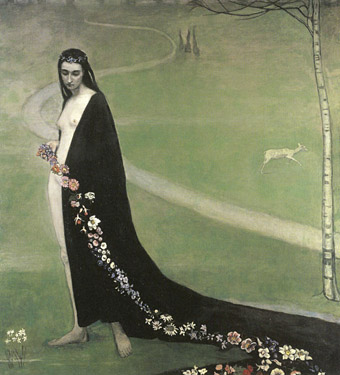
Femme avec des fleurs (c. 1912) by Romaine Brooks.

• “Boring people tend not to exile themselves to rocky islands, but even among the intriguing personalities we encounter in Capri, some individuals prove more extravagantly memorable than others.” Steve Susoyev reviews Pagan Light: Dreams of Freedom and Beauty in Capri by Jamie James.

• “The Mad “idiots” subverted the comic form into a mainstream ideological weapon, aimed at icons of the left and the right—attacking both McCarthyism and the Beat Generation, Nixon and Kennedy, Hollywood and Madison Avenue.” Jordan Orlando on a world without Mad Magazine.

• RIP Sam Gafford, Paul Krassner and Rutger Hauer. Related to the latter: Hauer’s first role as Floris, the hero of a Dutch TV series directed by Paul Verhoeven.

I cannot tell you what it does to me to hear pre-Stonewall. And even in our literature, even in the art, pre-Stonewall, post-Stonewall. I wrote three books pre-Stonewall and a dozen more post-Stonewall. There’s no demarcation. Gay history is centuries and centuries from the Romans to the Greeks to Oscar Wilde to all kinds of outrages. And those seem to be put back and pre-Stonewall is passive. Post-Stonewall is brave and dignified. I actually have heard things like that. I’ve talked, I’ve lectured and I’ve been invited all the way from Harvard to USC. And I talk about what it was like, what we had to survive.

Look, pre-Stonewall produced Allen Ginsberg, William Burroughs, Oscar Wilde, and I could go on. Post-Stonewall produced Bret Easton Ellis, who jumps out of the closet only now and then and then rushes back in, and Queer Eye for the Straight Guy, where we’re reduced to clowns for straight people. The husband of Mr. Buttigieg, he is so darling talking about the silver he’s going to be choosing for the White House. It embarrasses me, it embarrasses me very much because that’s what people expect a gay man to do, to be very precious, and that’s not what we are. A good solid queen I will protect forever, they are heroes.

A lot of people think that everything stopped, everything, all harassment stopped. Look, it’s still going on. It’s still going on, for god’s sake. The same tactics are often used in a different way.

John Rechy talking to Jason McGahan

• The genius of Barry Adamson: An exclusive interview by Paul Gallagher at Dangerous Minds.

Three hours of the Prophecy Theme from Dune (by Brian Eno with Daniel Lanois & Roger Eno).

Ed Sanders on why pop culture still can’t get enough of Charles Manson.

• Havelock Ellis takes a trip: Mike Jay on peyote among the Aesthetes.

Darren Anderson on why little works of architecture deserve respect.

• Mix of the week: Stephen O’Malley presents / Java / Apr 27 2017.

Phil Hine reviews Folk Horror Revival: Urban Wyrd 1 & 2.

John Waters revisits “The Golden Age of Monkey Art”.

I Must Be Mad (1966) by The Craig | The Day My Pad Went Mad (1982) by John Cooper Clarke | Yesterday, When I Was Mad (1993) by Pet Shop Boys

Weekend links 473

spectra.jpg

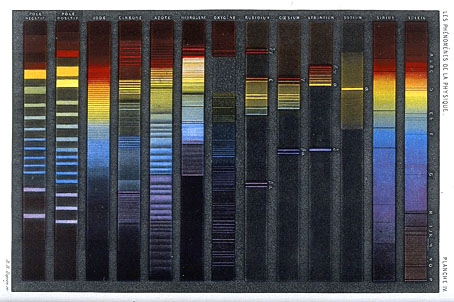
“Spectra of various light sources, solar, stellar, metallic, gaseous, electric”, print by René Henri Digeon; plate IV in Les phénomènes de la physique (1868).

• More polari: Thom Cuell this time with another review of Fabulosa!: The Story of Polari by Paul Baker. Good as it is to see these articles, one thing they all share is paying tribute to the polari-enriched radio series Round the Horne without crediting its writers, Barry Took and Marty Feldman.

• “…with its conspiracy theories, babbling demagogues and demonised minorities, Bahr’s investigation is sadly all too relevant today.” Antisemitism (1894) by Hermann Bahr, is the latest new translation from Rixdorf Editions.

Isao Tomita in 1978 showing a presenter from NHK around his tiny studio. Japanese-only but the discussion reveals that the words “synthesizer”, “tape recorder” and “mixer” sound the same as they do in English.

Ben Frost talks to Patrick Clarke about his music for German TV series, Dark.

• PYUR composes a guide through limbo with Oratorio For The Underworld.

• Steven Heller on Don Wall’s book design for a Paolo Soleri retrospective.

• Coming soon from Fulgur Press: Ira Cohen: Into the Mylar Chamber.

Will Harris compiles an oral history of Q: The Winged Serpent.

• Mix of the week: a mix for The Wire by Overlook.

• At Dennis Cooper’s: Magic Shop Internationale.

Shadow In Twilight by Pram.

The Feathered Serpent Of The Aztecs (1960) by Les Baxter | The Serpent (In Quicksilver) (1981) by Harold Budd | Black Jewelled Serpent Of Sound (1986) by The Dukes Of Stratosphear

Weekend links 472

isono.jpg

Poster art by Hiroo Isono.

• “[Divine] didn’t want to pass as a woman; he wanted to pass as a monster. He was thought up to scare hippies. And that’s what he wanted to do. He wanted to be Godzilla. Well, he wanted to be Elizabeth Taylor and Godzilla put together.” I can’t help linking to yet another John Waters interview when he always has things like this to say.

• Fifty shades of grey: great towers of the Eastern bloc photographed by David Navarro & Martyna Sobecka.

• Seeking Beastliness and Defining Beauty: Clive Hicks-Jenkins on visualisations of Beauty and the Beast.

Fire Temple by Bobby Krlic (The Haxan Cloak) from the Midsommar soundtrack.

Brad Jolliff & Mark Robinson on the scientific legacy of the Apollo programme.

John Boardley on Renaissance memes and the chemical pleasure garden.

• “It’s important to go out and feel the so-called reality,” says David Lynch.

Peter Strickland talks to Robert Barry about his new film, In Fabric.

Nico in Manchester: “She loved the architecture—and the heroin”.

• Mix of the week: Secret Thirteen Mix 292 by Paco Sala.

• Andrei Codrescu on the many lives of Lafcadio Hearn.

Hiroo Isono: Into the Depths of the Sacred Forest.

• At Dennis Cooper’s: Queer.

The Beast (1956) by Milt Buckner | The Beast (1989) by Rhythm Devils | Beast (1994) by Brian Eno

Weekend links 470

genso.jpg

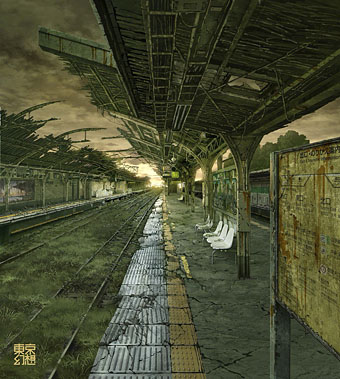
A rail station in ruins by Tokyo Genso. From a series of views of Tokyo showing a ruined and abandoned city.

• Old music technology of the week: The EKO ComputeRhythm, a programmable drum machine from 1972 used by Chris Franke (who didn’t like the sounds so he used it to trigger other instruments), Manuel Göttsching (the rhythms on New Age Of Earth), and Jean-Michel Jarre (on Equinoxe); and Yuri Suzuki‘s digital reconstruction of Raymond Scott’s Electronium.

• At Dennis Cooper’s: Spotlight on…Ishmael Reed Mumbo Jumbo (1972), and DC’s favourite fiction, poetry, non-fiction, film, art, and internet of the year so far. Thanks again for the link here!

• “Pauline told her to shove her shyckle up her khyber.” Philip Hensher on the origins and revival of Polari, the secret gay argot. Related: a Polari word list, plus other links.

In Star, Mishima fuses his major theme of the mask, the public role all humans are destined to play out, with the theme of suicide, an act which Mishima considered a work of art. All of his work is punctuated by suicide, and it is peopled with masks, with people knowing they are nothing but masks, who are aware that the center doesn’t hold because there is no center, that character is a flowing fixture, a paradoxical constancy and a definite variable, always.

Jan Wilm on Star, a novella by Yukio Mishima receiving its first publication in English

• “How have these places managed to transform from monuments to atrocity and resistance into concrete clickbait?” Owen Hatherley on the popularity of spomeniks.

• The late George Craig on translating the scrawl of Samuel Beckett’s letters (written in French) into coherent English.

• Outsider Literature, Part 1: a Wormwoodiana guide by RB Russell.

• Mix of the week: Secret Thirteen Mix 291 by Arturas Bumsteinas.

Symbiose, a split album by Prana Crafter and Tarotplane.

Robby Müller’s Polaroids

Apollo 11 in Real-time

Tokyo Shyness Boy (1976) by Haruomi Hosono | Tokyo (1979) by Jean-Claude Eloy | Tokyosaka Train (2002) by Funki Porcini

Weekend links 467

td.jpg

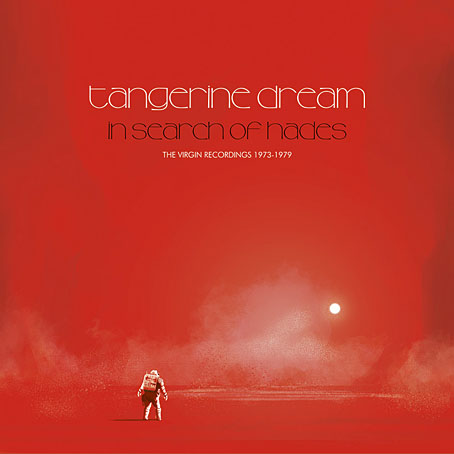
Artwork by Kuldar Leement (maybe…I’ve yet to see a credit for this). No, it’s the work of Rupert Lloyd.

In Search Of Hades: The Virgin Recordings 1973–1979, is a retrospective box set comprising 16 CDs and 2 blu-ray discs devoted to the first phase of Tangerine Dream’s output on the Virgin label. For enthusiasts of the group’s Virgin recordings (myself among them) this is very welcome, especially for the albums being given the Steven Wilson remix treatment, and the wealth of rare and unreleased material. In addition to several live concerts the box will include the complete Oedipus Tyrannus theatre soundtrack, the overture of which appeared on a compilation in 1975 but has since been unavailable outside bootlegs. Baroque 2 is a taster of the unheard soundtrack. The box itself will be released on 14th June. Related: Edgar Froese interviewed on a US radio station in 1974. Among the topics of discussion are German music of the time, Tangerine Dream’s dissatisfaction with Ohr Records, and their happiness at moving to Virgin.

• “As the witch-burning begins, the image gradually dissolves into a stroboscopic onslaught of neon colours accompanied by rapid, high-pitched ringing and a thundering drone.” Don’t come to Gaspar Noé for social realism. Lux Aeterna is his new thing.

• An ode to the ultimate camp film: Nathalie Atkinson on Boom!, Joseph Losey’s adaptation of a Tennessee Williams play, and (unsurprisingly) one of John Waters’ favourites.

“Adhesive,” a term borrowed from phrenology, was Whitman’s synonym for homosexuality. According to gay studies pioneer William A. Percy, “the term became part of the special vocabulary of the emerging homosexual subculture of the nineteenth century,” which Whitman and his coterie would have understood. Despite Whitman’s private vows to resist temptation, and to be more aloof, he continued to court young men until he died. One of the final photos of Whitman, taken at the Camden docks in 1890, shows the poet with his handsome male nurse Warren Fritzinger. “I like to look at him—he is health to look at: young, strong, lithe,” Whitman told Traubel.

Jeremy Lybarger on Walt Whitman’s boys

Psychedelic Promos & Radio Spots: 8 volumes, over 500 tracks, all free downloads. Hear many of the most popular groups of the late 60s shilling for commercial radio stations.

Hildur Guðnadóttir used only sounds from a nuclear plant in her score for Chernobyl.

• US museums of the week: Poster House, NYC, and The Moogseum, Asheville, NC.

• “Yes, witches are real,” says Pam Grossman, “I know because I am one.”

• Photos by Chas Gerretsen from the set of Apocalypse Now.

• Geeta Dayal on the brainwave music of David Rosenboom.

• Mix of the week: Self-Titled NE285 Mix by Kevin Martin.

• RIP Roky Erickson

Boom Boom (1961) by John Lee Hooker | Boom Stix (1962) by Curley & The Jades | Boom! (1992) by The Grid