Malicious Damage

orton.jpg

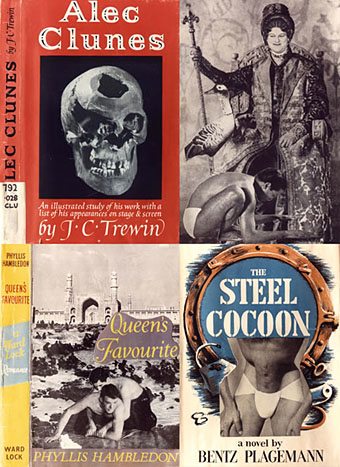
I was going to title this post “Fucked by Monty” but thought that might give the wrong impression. The phrase was one of several titles added to the cover of The Collected Plays of Emelyn Williams by Joe Orton and Kenneth Halliwell when they were happily defacing the books of Islington Library, London, in the early 1960s. Despite the outrage of the librarians at the vandalism most of the defaced books were put aside and are now prized items in Islington’s collection. This week the library announced an exhibition of the books, Malicious Damage: The crimes of Joe Orton and Kenneth Halliwell. The Guardian has a gallery of the covers here (and there’s more at Joe Orton central), rare examples of what might be called “guerilla collage”.

In addition to tarting up boring cover designs, Orton and Halliwell also typed their own descriptions of some the books’ contents. Gollancz volumes were apparently good for this since the publisher left the inside of their famous yellow dust jackets blank. John Lahr in Prick Up Your Ears gives an example from a Dorothy L Sayers novel which is also read out in the 1987 film adaptation:

When little Betty Macdree says that she has been interfered with, her mother at first laughs. It is only something the kiddy has picked up off television. But when sorting through the laundry, Mrs. Macdree discovers that a new pair of knickers are missing she thinks again. On being questioned, Betty bursts into tears. Mrs. Macdree takes her to the police station and to everyone’s surprise the little girl identifies P.C. Brenda Coolidge as her attacker. Brenda, a new recruit, denies the charge. A search is made of the Women’s Police Barracks. What is found there is a seven inch phallus and a pair of knickers of the kind used by Betty. All looks black for kindly P.C. Coolidge…. What can she do? This is one of the most enthralling stories ever written by Miss Sayers.

It is the only one in which the murder weapon is concealed, not for reasons of fear but for reasons of decency!

READ THIS BEHIND CLOSED DOORS. And have a good shit while you are reading!

Alan Bennett wrote the screenplay of Prick Up Your Ears and that line about “It is only something the kiddy has picked up off television” could well have been one of his own. Orton said that when the pair ended up in court the greatest outrage was shown not towards their obscene amendments but to simple bits of Surrealism such as the adding of a monkey’s face to the cover of Collins Guide to Roses. Schoolboy humour is understandable but don’t dare do something that makes no apparent sense.

Malicious Damage is a free exhibition and runs until January, 2012.

Previously on { feuilleton }
Joe Orton Online
Joe Orton

Weekend links 79

brody-va.jpg

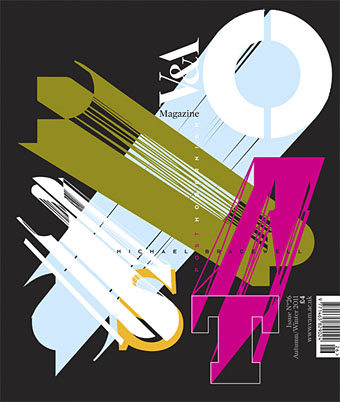
Neville Brody creates a cover design for an issue of the V&A magazine tied to the museum’s current exhibition, Postmodernism: Style and Subversion 1970–1990. Brody’s comment amused me for the way he smartly explained the thinking behind the design whilst also distancing himself from its theme:

For me, Post Modernism felt like a kind of facade built to cover over the cracks of a divided world, a surface of plucked effects and stylistic devices emptied of meaning, an extrusion of hollow traces and flat outlines forcing 2D into apparent depth. I was never a Post Modernist, rather a Modernist exploring humanist lines of enquiry in the collapsing world behind a wall of decoration.

• It’s a common thing today to give images from the past a queer reappraisal, finding homoerotic qualities in pictures which, when they were made, would have seemed free of any sexual subtext. This post finds such a subtext in recruitment posters for US armed forces although none of the examples are as overt as this wartime magazine ad. Over at Front Free Endpaper Callum notes that many vintage photos which people regard today as evidence of gay relationships are unlikely to be quite that. The photo he posts, however, really does appear to show a pair of men who were more than just good friends.

• A play by Ororo Productions of HP Lovecraft’s The Dunwich Horror will be staged at the London Horror Festival from October 25th. Related: Horror Made Delightful: The Strange Stories of Sheridan Le Fanu, MR James, and Robert Aickman. “Aickman never spells out his meaning,” says Greer Mansfield, “His stories end abruptly and inconclusively, and in fact the ‘meaning’ is less important than the utter mysteriousness of what happens.” Which is just what some of us enjoy.

deville.jpg

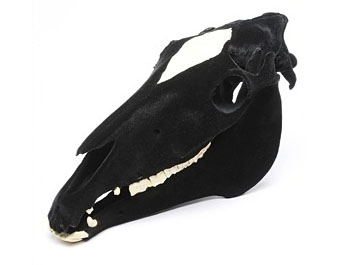
Black Beauty, a decorated horse skull by Julia deVille.

• “Jackpot is a comedic short film about a 14-year-old gay boy in 1994 who sets off on a quest to find a stash of gay porn and get it home before anyone finds out.” Director Adam Baran is requesting completion funds at Kickstarter.

Gendai Shogyo Bijutsu Zenshu (The Complete Commercial Artist), published in Tokyo from 1927 to 1930.

Ishac Bertran tries some analogue sampling by chopping up vinyl discs with a laser cutter.

Steve Jobs does LSD and The Residents pay tribute to Steve Jobs.

• A rare post at Ballardian: Outpost 13: The Atrocity Exhibition.

• It’s all fun and games until Charles Manson turns up…again.

The Edgar Allan Poe Portfolio (1976) by Berni Wrightson.

• RIP David Bedford and Bert Jansch.

John Waters: Roles of a Lifetime.

Octopi Wall Street!

Homocomix.

Poison (1969) by Bert Jansch | Pentangle at the BBC (1970): Train Song | House Carpenter | Hunting Song | Light Flight

Seminal art and design

fountain.jpg

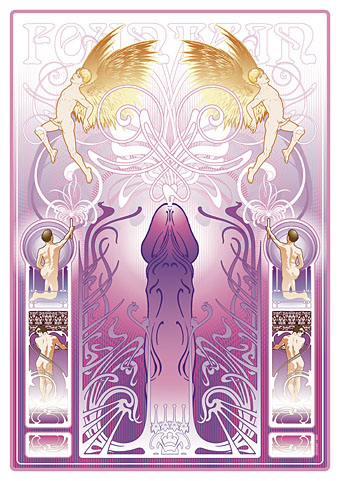
Fountain (2011) by John Coulthart.

seminal, a. and n.

A. adj. Of or pertaining to seed; of the nature of seed.

1. a. Of or pertaining to the seed or semen of men and animals (applied Phys. and Anat. to structures adapted to contain or convey semen); of the nature of semen.

Oxford English Dictionary

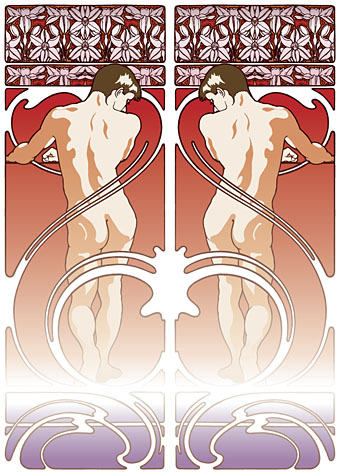
The Dirty Comics exhibition curated by Jon Macy opens today in San Francisco so here at last is my non-comics contribution to Jon’s erotic art show. This is something I’d had in mind for a while so it was good to have the opportunity to actually tackle the thing, and also have an outlet for it outside this website. Below I explore some of the intent and inspiration which led to the piece.

Creating some sort of gay erotica was an idea I’d had in mind for a while but it suffered from the usual syndrome whereby work with no immediate outlet gets shunted aside by the pressure of paid commissions and ongoing personal projects. It’s also the case that pieces of work I create for myself I tend to want to sell or see reproduced via a service such as CafePress. The trouble is that most of those services are based in the US which means they’re subject to that tiresome puritan attitude towards sexual content: anything other than “artistic” nudity is forbidden at CafePress, and the same applies to many other self-publishing services. There are outlets for gay erotica but I’ve not had chance to explore the best options. If anyone has any tips then please leave a comment.

closeup.jpg

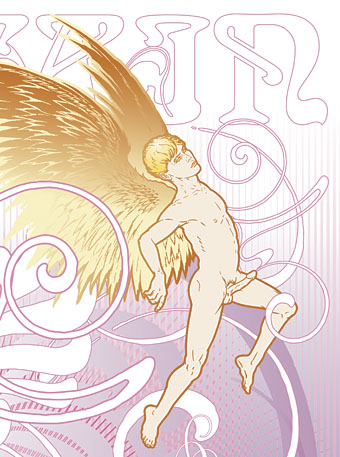
This angel figure was something I’d drawn back to 2008 when I’d made a start on a similar work which fell by the wayside. One of the great things about computer graphics is being able to work on part of something which can then be picked up later and dropped into a new composition.

figures.jpg

So the intention was to produce a follow-up to the Dodgem Logic cover I created last year which presented a same-sex take on various Art Nouveau stylisations. The figures above are from one of the early drafts which takes a border design from Alphonse Mucha’s Documents Decoratifs (below), a series of sample borders and frames Mucha produced for the use of artists and designers.

Continue reading “Seminal art and design”

Weekend links 78

carr.jpg

Struggle (2009) by Lindsey Carr.

• “Twilight Science is an imprint for sound, music and DVD editions initiated by artist Paul Schütze. We will progressively publish all back catalogue, new projects and collaborations. These will include works by Phantom City, NAPE, Schütze-Hopkins and others.” Related (because Paul Schütze remixed Main): Main Feed The Collapse, Neil Kulkarni talks to Robert Hampson.

• “You can’t really narrate or display this situation, you can only, endlessly, contemplate it. When the writer or director gets tired of the iterations, he tells us who the mole is.” Michael Wood on the novel, (superb) television series and recent film of Tinker, Tailor, Soldier, Spy.

• “Havin’ a dick is pretty fuckin’ awesome” says Horst, a new gay magazine limited to 1000 copies. Related (well, there’s a guy in and out of his underwear): Naked Lunch, a fashion shoot very tenuously based on David Cronenberg’s film.

“At first, I tried fighting bullies one-on-one, but they don’t fight fair; they fight two and three on one,” Bennett said. So the youths got together and “started carrying mace, knives, brass knuckles and stun guns, and if somebody messed with one of us then all of us would gang up on them.”

 “Gay black youths go from attacked to attackers” says the headline. A group of genuine Wild Boys; William Burroughs would have approved.

• Tor.com reminded me of Sally Cruikshank‘s amazing animated film Face Like a Frog (1987) which features a score and Cab Calloway-style song by Danny Elfman.

• It’s 1969, OK? Pádraig Ó Méalóid talks with Kevin O’Neill about the Swinging League of Extraordinary Gentlemen.

• In the Tumblr labyrinth this week: Fuck Yeah St Sebastian and Gender is Irrelevant.

• For when you need some motherfucking placeholder text: Samuel L Ipsum.

• “Study finds ‘magic mushrooms’ may improve personality long-term.”

Solar Megalomania: paintings by Leonora Carrington.

• It’s all fun and games until Charles Manson turns up.

Firmament II (1993) by Main | Firmament IV (1993) by Main | Reformation (1994) by Main.

Brion Gysin’s walk, 1966

gysin.jpg

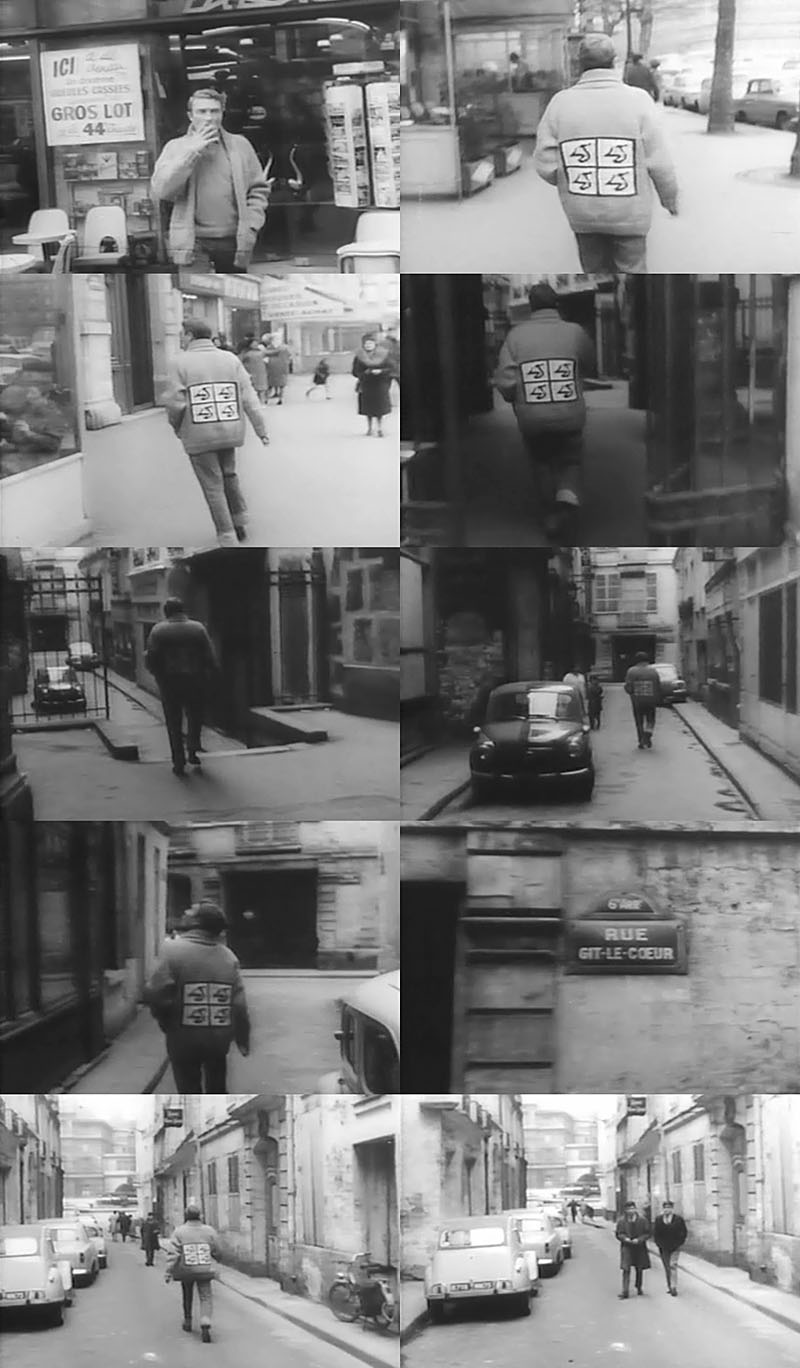
The Cut-Ups (1966).

More of the present preoccupation. Choosing Brion Gysin as a subject seems like a detour but the shots above are from Antony Balch’s 1966 film The Cut-Ups which also features William Burroughs, Ian Sommerville and someone-or-other’s cute boyfriend of the time who’s only ever credited as “Baby Zen”, a person about whom I know nothing at all.

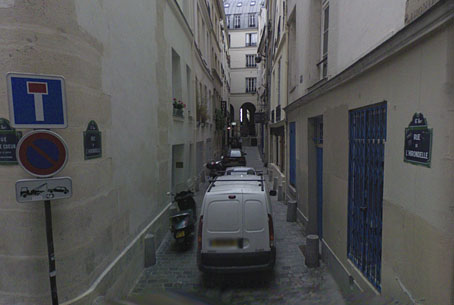
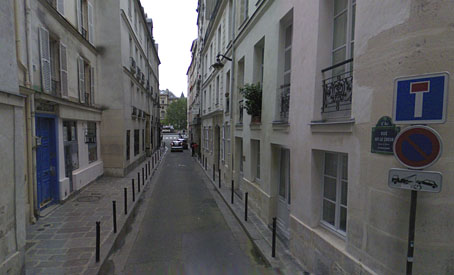
I first saw The Cut-Ups in video form projected on the screens of the Haçienda nightclub in Manchester during their Final Academy evening in 1982, an event at which Burroughs and John Giorno both gave readings. The film on that occasion was mixed with some of the other Antony Balch shorts including Towers Open Fire, and together they made a strong (and bewildering) impression. The Cut-Ups, as noted a few days ago, may have inspired some of the flash edits in Performance, although Nicolas Roeg had been cinematographer on Petulia for Richard Lester the year before, a film which uses similar Resnais-like flashbacks and flash-forwards. In Balch’s film several sequences each a foot in length are cut together at random, a process which was a lot more radical in 1966 than it looks today. The opening sequence shows Brion Gysin walking out of a shop, along a street, down an alley and into the Rue Git le Coeur where the Beat Hotel was located at no. 9, and into whose door he disappears. I visited the street the last time I was in Paris, and took a few snaps whilst there, but it wasn’t until I rewatched The Cut-Ups a couple of years later that I realised I’d made the same walk as Gysin, having inadvertently discovered the narrow passage (the Rue de L’Hirondelle) which connects Git le Coeur with the Boulevard Saint-Michel.

saintmichel1.jpg

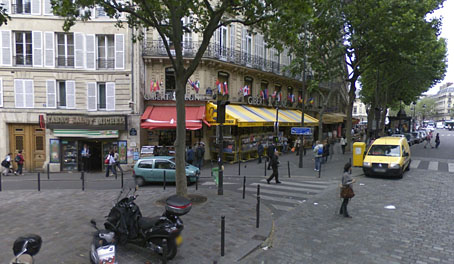
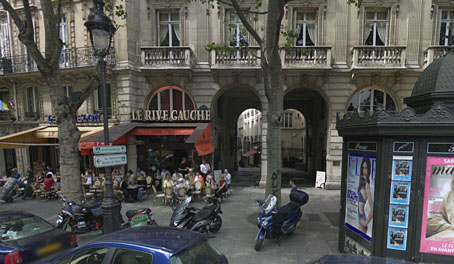
The corner of the Boulevard Saint-Michel where Gysin’s walk begins.

The route can be traced (after a fashion) using Google’s Street View where the photos have the usual drawbacks of being positioned high in the air and with a field-of-view which makes narrow spaces look a lot more cramped than they seem when you’re there. For those who can’t visit Paris, however, you at least get a sense of the Latin Quarter, even though the area is a lot more gentrified today than it was in 1966. The Beat Hotel, as I’ve noted before, is now the expensive Hotel du Vieux Paris whose website makes no mention of their establishment having once been cheap lodgings for depraved writers, artists and junkies. As for the Gysin film, I still wonder where he began his walk: was it at the Tabac Saint-Michel or elsewhere? You can judge for yourself at Ubuweb which has a copy of The Cut-Ups in its Burroughs film collection.

saintmichel2.jpg

Rue de L’Hirondelle from the Boulevard Saint-Michel.

saintmichel3.jpg

Rue de L’Hirondelle from Rue Git le Coeur.

saintmichel4.jpg

Rue Git le Coeur looking towards the Seine. The former Beat Hotel is down the street on the right.

Elsewhere on { feuilleton }
The William Burroughs archive