Weekend links 619

schulze.jpg

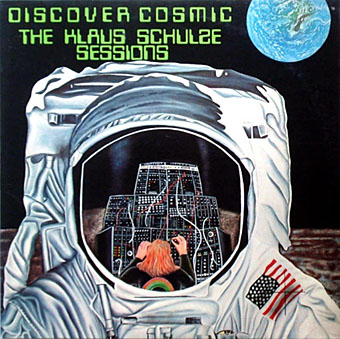
A Moog on the Moon by P. Praquin, 1977. And a space helmet reflection to add to the list being accumulated by 70s Sci-Fi Art.

• RIP Klaus “Quadro” Schulze. I’ve owned many of his solo albums over the years, and while they’re historically important for the part they played in developing the kosmische sound in the 1970s I’ve never been very enthusiastic about the music. The albums I prefer are the ones where he was working with others, whether as a drummer in Ash Ra Tempel, an inadvertent member of the fake Cosmic Jokers supergroup, or part of the genuine Cosmic Couriers supergroup that made Tarot. The Tonwelle album credited to “Richard Wahnfried” benefits considerably from the presence of Manuel Göttsching and Michael Schrieve (also a rumoured Carlos Santana); I recommend it. For a taste of the synth-doodling Schulze, here he is in analogue heaven.

• Next month, Luminous Procuress, a film by Steven Arnold (previously), is released for the first time on blu-ray by Second Run: “Exploding out of San Francisco’s vibrant late-60s counter-culture, Luminous Procuress is a psychedelic odyssey of unabashed hedonism. The only feature film by artist, mystic and polymath Steven Arnold, the film celebrates gender-fluidity and pan-sexuality in a voyeuristic phantasmagorical journey towards spiritual ecstasy.”

• “Whereas [Bernard] Herrmann worked predominantly with strings and [John] Carpenter with synths, Anderson wanted to evoke a similar atmosphere with guitars.” Greg “The Lord” Anderson talks to Dan Franklin about making an album of night music.

I am troubled by how often people talk about likability when they talk about art.

I am troubled by how often our protagonists are supposed to live impeccable, sin-free lives, extolling the right virtues in the right order—when we, the audience, do not and never have, no matter what we perform for those around us.

I am troubled by the word “problematic,” mostly because of how fundamentally undescriptive it is. Tell me that something is xenophobic, condescending, clichéd, unspeakably stupid, or some other constellation of descriptors. Then I will decide whether I agree, based on the intersection of that thing with my particular set of values and aesthetics. But by saying it is problematic you are saying that it constitutes or presents a problem, to which my first instinct is to reply: I hope so.

Art is the realm of the problem. Art chews on problems, turns them over, examines them, breaks them open, breaks us open against them. Art contains a myriad of problems, dislocations, uncertainties. Doesn’t it? If not, then what?

Jen Silverman on the new moralisers

• “The website is colorful and anarchic, evoking the chaotic sensory experience of exploring a crammed, dusty shop.” Geeta Dayal explores the Syrian Cassette Archives.

• New music: The Last One, 1970 by Les Rallizes Dénudés; Untitled 3 by Final; Blinking In Time (full version) by Scanner.

• Why was erotic art so popular in ancient Pompeii? Meilan Solly investigates.

• You’ve been reframed: Anne Billson explores the history of split-screen cinema.

• At Spoon & Tamago: Japanese era names illustrated as logos.

• Mix of the week: XLR8R Podcast 745 by Wilted Woman.

Fun type

Split, Pt. 4 (1971) by The Groundhogs | Split Second Feeling (1981) by Cabaret Voltaire | Splitting The Atom (2010) by Massive Attack
Weekend links 618

anderson.jpg

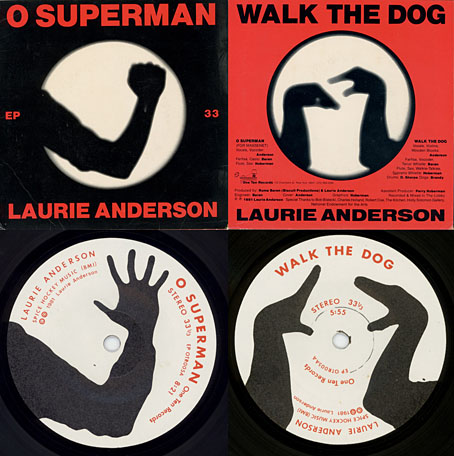
O Superman (1981), a seven-inch single on One Ten Records. Design by Laurie Anderson and Perry Hoberman.

• “…I was painting a picture of a garden at night. It had a lot of black and this green kind of coming out of the black, and I sat back, probably to take a smoke, looking at this painting, and I suddenly heard a wind coming from the painting, and the green started to move. And I thought, ‘Oh, a moving painting.’ And that experience led to cinema.” David Lynch talking to Josh Hitchens about living in Philadelphia.

• “This is the time and this is the record of the time.” Big Science, the album that propelled Laurie Anderson from performance artist to pop star, is 40 years old this month. Mat Colegate recalls his confused impression that the album was the work of a West Country folk singer, while Studs Terkel talked to Laurie Anderson about the album shortly after its release.

• At Public Domain Review: Kensy Cooperrider explores a millennium of “hand mnemonics”, “the variety of techniques practised by Buddhist monks, Latin linguists, and Renaissance musicians for remembering what might otherwise elude the mind.”

Ghosts in the Machine is an exhibition being hosted by Bower Ashton Library, Bristol, for World Book Night, 2022. 93 participants contributed ghost-related images for an accompanying artist’s book [PDF].

• “Sixty years after Seattle’s Century 21 Exposition, world’s fairs have largely fallen out of fashion in the US.” Grant Wong charts the rise and fall of world’s fairs.

• A trailer for Ennio: The Maestro, a feature-length documentary about Ennio Morricone by Giuseppe Tornatore.

• “The film Putin doesn’t want the world to see: Firebird, a gay love story about fighter pilots.”

• At Dennis Cooper’s: Andrei Tarkovsky Day.

• New music: Intersections by Specimens.

Schöne Hände (1977) by Cluster & Eno | Hands 2 Take (1981) by The Flying Lizards | Red Hand (1996) by Paul Schütze

Weekend links 616

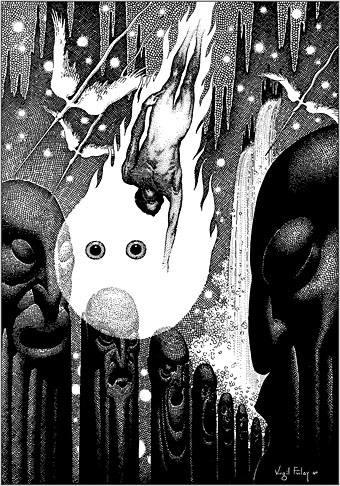
finlay.jpg

Illustration by Virgil Finlay for The Face in the Abyss by A. Merritt; Famous Fantastic Mysteries, October 1940.

• “The pier was completely outside of the gallery system, which David loved of course. People were just working on the walls, nothing was for sale, nothing could really be bought, although people were coming in and trying to chip things off the walls.” Cynthia Carr on the love letters and legacy of David Wojnarowicz.

• “In pursuit of Pure Form, the Polish artist known as “Witkacy” would consume peyote, cocaine, and other intoxicants before creating pastel portraits.” Juliette Bretan on the artful intoxications of Stanisław Ignacy Witkiewicz.

• Kino Kyiv: Christopher Silvester compiles a list of notable Ukrainian films. I’ve not seen all of these but Shadows of Our Forgotten Ancestors is a great favourite.

Onscreen for nearly the entire runtime, [Laura Dern] pulls off the remarkable feat of being in total control of a scenario organized by undermining her identity, obliterating her characterization, and so scrambling the distinction between Nikki and Susan that one eventually comes to view Inland Empire not as a maze to exit, a puzzle to solve, an ouroboros to gawk at, but rather as both a generalized treatise on the enigma of acting and a very specific, exquisitely perverse mash note to one of Lynch’s most formidable collaborators.

Nathan Lee on Laura Dern, David Lynch and Inland Empire. I’ve always thought Dern’s exceptional performance might have been recognised more widely if Lynch hadn’t filmed most of it on low-grade video.

• New music: Golden Air by Sun’s Signature, a new project from Elizabeth Fraser and Damon Reece.

• Miranda Remington explores The Strange World of…Stomu Yamash’ta.

• Steven Heller’s font of the month is Boucan.

• At Dennis Cooper’s: Labyrinthine.

Labyrinth (2010) by Chrome Hoof | Labyrinths (2018) by Jonathan Fitoussi / Clemens Hourrière | The Seventh Labyrinth (2019) by Pye Corner Audio

Splendid Suns

suns.jpg

I answered a few interview questions recently for Shunga Gallery, a site concerned with the erotic side of Japanese prints, and with contemporary practitioners who work in a similar areas. (All NSFW, needless to say.) I’m not really an erotic artist but Marijn has selected a few examples of my artwork that contain prominent erections, going back to the badly-proportioned drawing of the Great God Pan that I did in 1986 for my late friend, Ed, when he was part of a Dutch music & performance group, Abrahadabra. The drawing appeared in the zine of the same name, and later provoked mild disapproval from the organisers of a video festival in Den Haag where Ed and friends were using it as a flyer to promote their activities. Also at Shunga Gallery are a few pages from the rebarbative Reverbstorm, a book that’s the darkest and nastiest thing I’ll ever do. Some of that artwork provoked a rather more serious form of disapproval, as I explain in the interview.

Continue reading “Splendid Suns”

Weekend links 613

custos.jpg

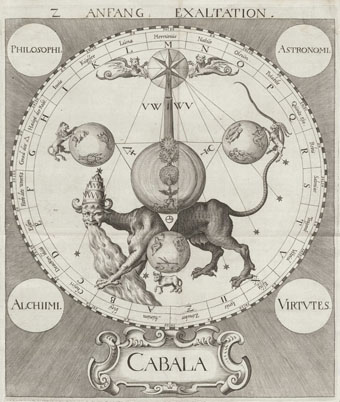
An engraving by Rafael Custos from Cabala, Spiegel der Kunst und Natur, In Alchymia (1615) by “Father C.R.C.”.

• “Writing is very subconscious and the last thing I want to do is think about it.” Cormac McCarthy responded to a handful of questions from a couple of lucky high-school students. Lithub’s list of McCarthy’s rare public manifestations missed this chatty encounter with the Coen Brothers from 2007.

• Strange Flowers celebrates Rosa Bonheur, “the most famous and successful woman artist of the 19th century, dressing in men’s clothing, smoking cigars, riding astride and living openly with female partners.”

A Secret Between Gentlemen by Peter Jordaan “details a British Government coverup of a gay scandal involving great names. Hidden for 120 years, it is a history that has never been told, and until recently could not be told.”

[Mark E. Smith] liked HP Lovecraft, whose monster of The Call of Cthulhu and The Dunwich Horror appears in the song N.W.R.A., “Body a tentacle mess”. He quite liked MR James’ Ghost Stories. He liked the more recent, seemingly disgraced, and by then unfashionable, occult fiction of Colin Wilson: The Black Room and Ritual in the Dark. But He LOVED the writing of early twentieth century Arthur Machen. “Machen’s fucking brilliant.” In his autobiography Renegade he comments, “He lives in this alternative world: the real occult’s not in Egypt, but in the pubs of the East End and the stinking boats of the Thames—on your doorstep, basically.”

Woebot goes deep into the grotesque and esoteric worlds of Mark E. Smith and The Fall

• “It sometimes seems as though inn signs are the symbols and the focus of some great alchemical experiment in the landscape of England.” Mark Valentine on inn signs and some of the theories about their origins.

• “…we’re going back into this shipwreck and, you know, pulling out the gold pieces”. Dennis Bovell on reworking the Pop Group’s incendiary debut album as Y in Dub.

• Mixes of the week: A Wendy Carlos mix by Erik DeLuca for The Wire, and a psychedelic/post-punk mix by Robert Hampson for NTS.

Landscapes is an exhibition of torn-paper collages by Jordan Belson at Matthew Marks Gallery, New York.

• “A force entirely of itself”: Robert Fripp on the difficult legacy of King Crimson.

White Landscape I (1971) by Douglas Leedy | John Cage: In A Landscape (1994) performed by Stephen Drury | Primordial Landscape (2013) by Patrick Cowley