Genet in the Arena

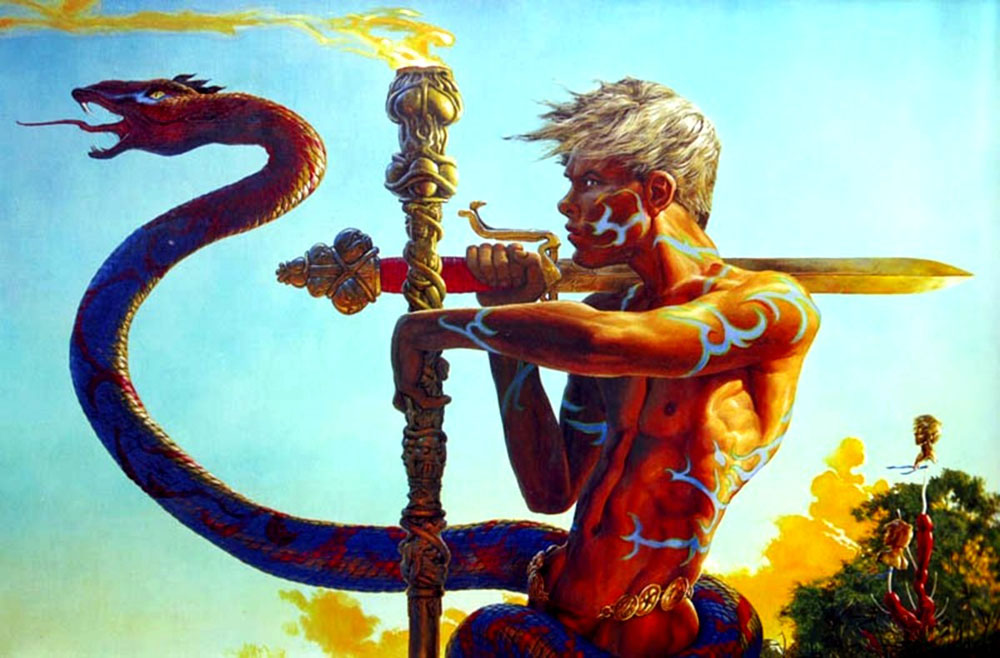
genet1.jpg

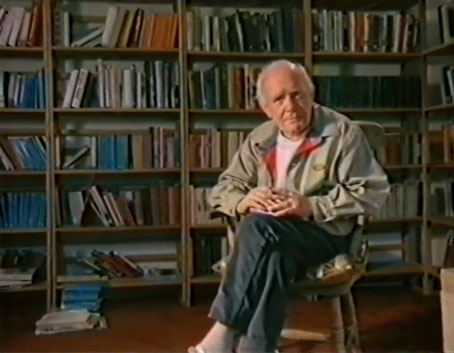
In the summer of 1985 he also gave a televised interview to the BBC. It was to be his last public statement. Genet demanded £10,000 in advance and in cash. In return he agreed to be filmed for two days in the house of Nigel Williams, a young novelist, television presenter and the translator of Deathwatch. At the time of the student uprising in May 1968, Genet had been very critical of the form the students’ debates took, especially during the occupation of the Théâtre de l’Odèon. As an experienced playwright he knew that the form is more communicative in a live or filmed event than what anyone manages to say. Accordingly, he constantly interrupted the formula of the television interview. He genuinely believed that he was no more interesting or important than the camera crew and insisted on asking the technicians questions. This reversal of the ordinary television format infuriated many viewers, but none forgot the show.

Edmund White, from Genet: A Biography (1993)

I didn’t forget the show. In fact this particular programme, Saint Genet, has been in the top five of those I wanted to see again ever since copies of old TV recordings started circulating on the internet. The film is another from the BBC’s Arena arts series, and one the corporation is proud of judging by their inclusion of clips in celebrations of Arena‘s history. This pride hasn’t extended to repeat screenings of the entire interview, however, apart from a single occasion a few weeks after Genet’s death in 1986. The days are long passed when the BBC would devote 50 minutes of its evening air-time to a writer who didn’t have a book to plug or some attachment to a popular film or TV drama. In 1985 you could expect as much while also being offered a programme that countered the reactionary tenor of the time: an author whose novels were filled with gay sex, and populated by all manner of social outcasts, from male prostitutes to thieves, murderers and the like.
genet2.jpg

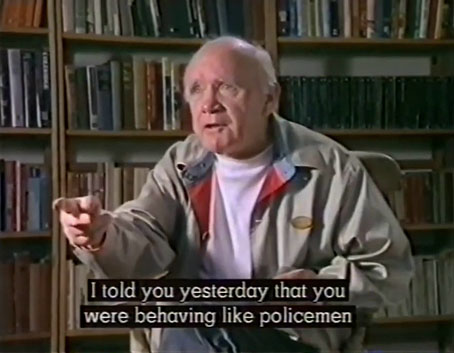
Genet in later years refused to discuss his novels or plays so co-director/interviewer Nigel Williams oriented the discussion around the author’s life (many details of which informed his fiction) while augmenting this with readings from the novels along with extracts from films and plays. I didn’t remember the extracts at all even though this would have been my first glimpse of scenes from the only film that Genet directed (and which he typically disowned), Un Chant d’Amour. More memorable was the sight of Genet himself sitting there for the best part of an hour, rolling cigarettes and verbally jousting with a pair of nervous interviewers in a mood of mingled amusement and exasperation. In the past I’ve been uncharitable about Williams’ handling of the situation but he ought to be congratulated for having inadvertently given us a film that’s so typical of its subject. Genet spent most of his life biting the hand that fed him, and always chaffed at the attention he received from the educated middle classes, even though these were the people who were most interested in (and paid for) his novels and plays. Edmund White’s biography tells us that Genet was unimpressed with Williams’ home (which he compared to something out of a Miss Marple story), and was annoyed when he saw the technical crew eating at a separate table to the producers. This annoyance was translated to the second half of the interview which he described as being like a police interrogation.

In his introductory comments Williams says that this was the first interview Genet had given to a major TV network, but it wasn’t Genet’s first filmed interview. The 52-minute film made by Antoine Bourseiller in 1981 contrasts strikingly with the Arena programme, demonstrating that Genet could talk with ease and at length before a camera. The reason, as White once again explains, is that Genet had planned the film in advance with Bourseiller, selecting the topics for conversation and even helping to edit the footage later. So the difference in attitude was all about control, or the lack of it. Wresting control from the BBC meant directing the questions back at the interviewers while drawing attention to the power relations and the intimidating nature of the interview process.

All of this begs the question as to why Genet agreed to place himself in a situation that he found so uncomfortable when he could easily have refused. We’re left to guess but he certainly didn’t do it for the money; he continued to live frugally despite the international success of his literary works. Large sums such as the £10,000 he extracted from the BBC he regularly passed on to needy friends or to political groups who he felt could put the funds to better use. Whatever the reason behind Genet’s participation, I think Williams and co. would agree that their money was well spent.

Previously on { feuilleton }
Covering Genet
Notre Dame des Fleurs: Variations on a Genet Classic
Genet art
Flowers: A Pantomime for Jean Genet
Querelle de Brest
Jean Genet, 1981
Un Chant d’Amour (nouveau)
Jean Genet… ‘The Courtesy of Objects’
Querelle again
Saint Genet
Emil Cadoo
Exterface
Penguin Labyrinths and the Thief’s Journal
Un Chant d’Amour by Jean Genet
The art of Paul Binnie

binnie03.jpg

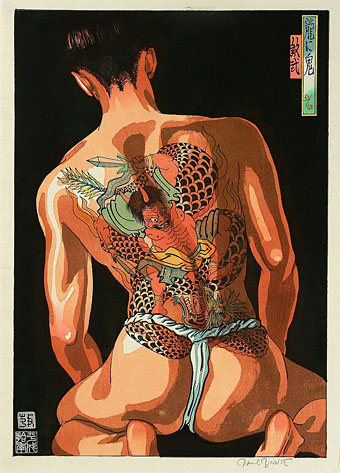
Dragon and Demon (1997).

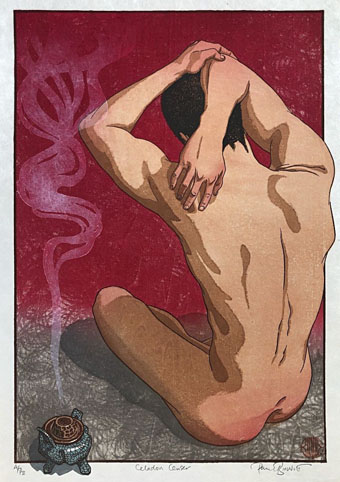
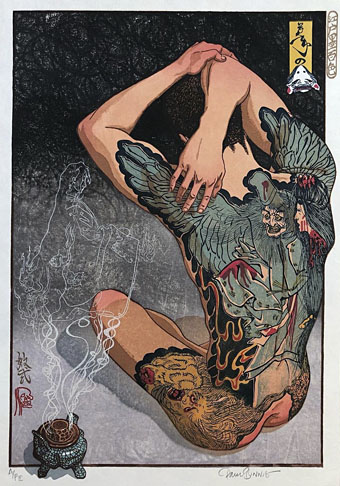
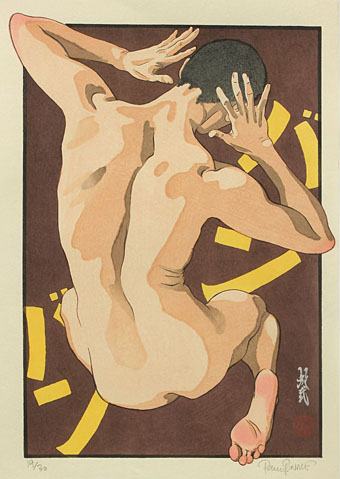
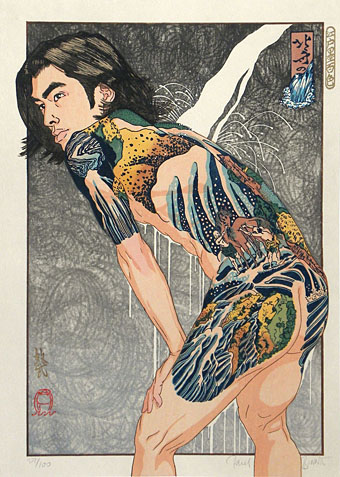
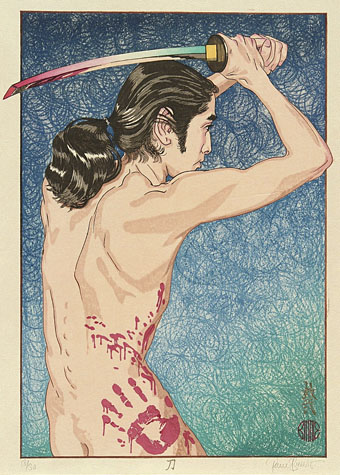
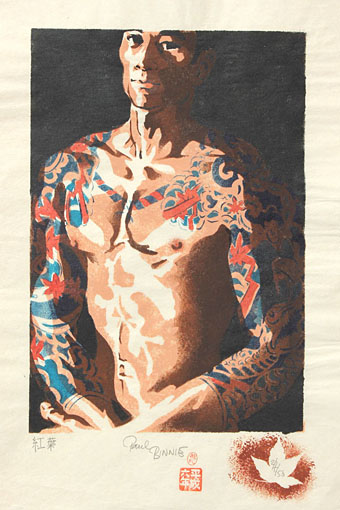
More Japanese art, although the artist responsible happens to be Scottish. One of Paul Binnie’s prints appeared here in January in a post about the Itsukushima Shrine together with ukiyo-e views by other artists. Binnie studied print-making with a Japanese master of the medium in the 1990s, and many of his prints that follow traditional ukiyo-e subjects are now valued by collectors. He also has a nice line in homoerotic portraiture, which is what you see here, a few examples from this collectors’ site. Most of my selections are those styled like his traditional prints but you’ll find plenty of paintings and drawings in the “Handsome Men (Bidanshi)” section.

binnie02.jpg

Celadon Censer (2004).

binnie07.jpg

Yoshitoshi’s Ghosts (2004).

binnie01.jpg

Bang Bang (2011).

binnie04.jpg

Hokusai’s Waterfalls (2006).

binnie05.jpg

Katana (2007).

binnie06.jpg

Maple Leaves (1994).

Elsewhere on { feuilleton }
The gay artists archive

Fresh BUTT

butt31.jpg

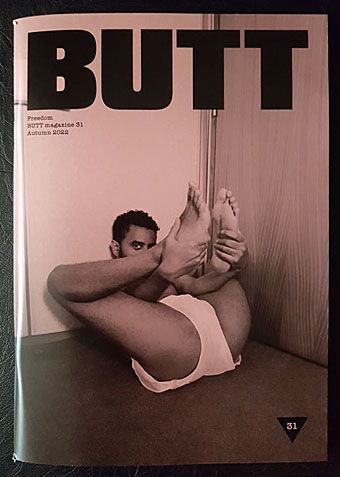
Yoni by Kuba Ryniewicz.

My favourite gay mag, BUTT, resurrected itself in September by publishing a new issue, something I only discovered by accident and might easily have missed altogether. I ordered a copy as soon as I saw the news. The BUTT brand (for want of a better term) has been continually active via the magazine’s website but with ten years having elapsed since the appearance of the 29th issue I really didn’t expect to see another one. The new issue of the self-styled “Fantastic Magazine for Homosexuals” is no. 31 which leaves us to ponder the question of the missing 30th issue.

Whatever the reason for the numbering it’s good to see BUTT continuing as before, as though it hadn’t been dormant for such a long time. The new issue is almost exactly the same as previous numbers: slightly taller, slightly longer (100 pages) and with its first glossy cover. Under the covers the formula remains the same, all pink paper (with a familiar fresh-paint aroma), minimal design, sporadic nudity and informative interviews. The egalitarian nature of the latter has always been one of the attractions of the magazine, which in this issue features those with public profiles—Hilton Als, Arca, Durk Dehner of the Tom of Finland Foundation—and those without, like cover star Yoni (an Ethiopian currently living in Newcastle) and Stas, a Ukrainian DJ.

• Distribution: UK | EU | US/World

Previously on { feuilleton }
BUTT covered

Weekend links 643

wittdorf.jpg

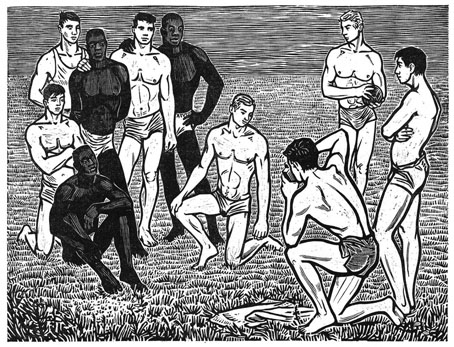
Freundschaftsfoto (1964) by Jürgen Wittdorf.

• “It’s truly astonishing how Laswell collided with vastly divergent musicians and genres while somehow still representing complementary musical spheres.” Yes, indeed. Mixes of the week: Bill Laswell Research Institute: Vol I & II, two 90-minute collections at Aquarium Drunkard dedicated to the career of the indefatigable musician/producer/catalyst.

• “These pieces are created using custom developed software and laser specialised machines resulting in highly detailed laser cut works on layered paper with some works comprising over a thousand individual parts.” Works in paper at Studio Ibbini.

• “The visual history of polyhedra is littered with false starts, poignant failures, and allegories unable to convey the weight of their subject matter.” Noam Andrews explores the history of rendering polyhedral objects in art.

• “When it came to homosexuality, the east was as bourgeois as the west.” Homoerotic art from the communist era by Jürgen Wittdorf (1932–2018) receives a reappraisal.

• More MR James: All of James’ ghost stories in a single volume at Standard Ebooks, the home of free, high-quality, public-domain texts.

• More mixes: A mix for The Wire by NikNak, and XLR8R Podcast 769 by The Sun Ra Arkestra.

• At Spoon & Tamago: Tracing the history of railways in Japan through art.

• At Dennis Cooper’s: Marie Menken Day.

Angeline Morrison‘s favourite albums.

Ghost Train (1961) by Virgil Holmes | Ghost Train (1961) by Electro-Tones | Ghost Train (1962) by The Partners

Weekend links 636

frey.jpg

Untitled painting by Oliver Frey based on The Wild Boys by William Burroughs.

• RIP Oliver Frey, a prolific illustrator and comic artist whose art for UK computer magazines in the 1980s made a lasting impression on a generation of games players, hence this obituary at Eurogamer. On this site, however, Frey is also remembered for his artistic alter-ego “Zack” (previously), an equally prolific creator of comic-strip erotica for Britain’s few gay-porn mags at a time when any such material being sold in the UK ran the risk of police seizure or even a court appearance. For a while, Zack’s Rogue and Tom of Finland’s Kake were rare examples of assertive, unashamedly lustful gay characters with strips of their own, which makes Oliver Frey something of a pioneer, and a daring one at that.

• “The title characters were a trio of boys named Jupiter Jones, Pete Crenshaw, and Bob Andrews, who live in the fictional California town of Rocky Beach, not far from Hollywood, on the coast…” Colin Fleming on the satisfyingly spooky adventures of Robert Arthur Jr’s Three Investigators. I was never as obsessive as Fleming was but I read all of the books about the trio that I could find in our local library.

• “Though its inimitable visual style has safeguarded it as a quintessential cult film most at home behind a shroud of pot smoke, the influence of Koyaanisqatsi has been sweeping.” Josef Steen on 40 years of Godfrey Reggio’s Koyaanisqatsi.

• “Putting it simply, coincidences and curiosities and chance encounters happen when people go looking for zodiacs.” Mark Valentine on Britain’s terrestrial zodiacs.

• At Literary Hub: Marguerite Duras on writing the screenplay for Alain Resnais’s Hiroshima Mon Amour.

• New/old music: a reissue of Solar Maximum by Majeure.

• New music: Kerber Remixes by Yann Tiersen.

• At Dennis Cooper’s: Ingrid Caven Day.

• Threnody To The Victims Of Hiroshima (1959-61) by Krzysztof Penderecki | Memory Of Hiroshima (1973) by Stomu Yamash’ta | Hiroshima Mon Amour (1977) by Ultravox!