Weekend links 634

chaffee.jpg

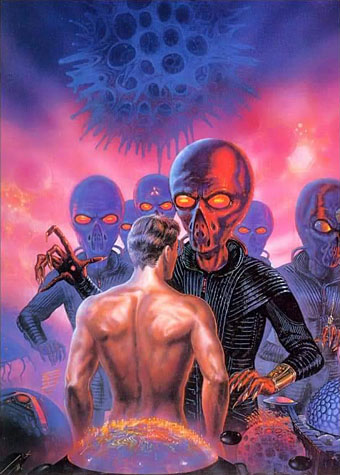
Cover for Amazing Stories, October 1992, by Douglas Chaffee. A delightfully strange painting that suggests a no doubt unintentional homoerotic scenario when divorced from its original context. Via.

• “The most curious aspect of Buckminster Fuller’s arc is that he became a counterculture icon while entrenched in the very things that betrayed its spirit.” Pradeep Niroula on Buckminster Fuller (again) whose self-importance is deflated in a new biography, Inventor of the Future: The Visionary Life of Buckminster Fuller by Alec Nevala-Lee.

• “I love both King Diamond and Weird Al. Lana del Rey and Anna von Hausswolff. Golden age illustrations of elegantly levitating fairies in a lush vibrant summer garden and the gothic charcoal rendering of melancholy moth singed by a candle’s flame.” S. Elizabeth talking to Luna Luna Magazine about inspirations and The Art of Darkness.

• “I’m writing this from my office which has a record player, currently about eight thousand records, and just one CD.” Vinyl-head Jonny Trunk talking to Norman Records about the finding and releasing of rare music.

A painter’s brilliant achievements, the unique traits of his particular style, rest on an abiding substratum of coordinated specialized crafts, a body of knowledge and practice safeguarded by a tradition upheld by the guilds. Beneath the glimmer and foreground of art history, like a powerful underground river, flow the patterns of training and production developed in the crafts. Art history is centred on individual talents romantically bringing forth their creations on their own, out of nothing. Craft is collective and anonymous. Someone had to weave the pieces of cloth that form the giant canvas of Las Meninas. Someone had to sew them together so that the stitching would show as little as possible. Someone had to cut and to assemble the struts for its support and then nail to them a canvas which in fact is not of the highest quality. It seems that Velázquez enjoyed the roughness of a surface that favoured his subtle veils and ambiguities. The loose manner of painting developed in Venice is linked to the quality of the pigments that could be purchased there, as well as to the oil medium and the thick, porous quality of a cloth that allowed subtle veils and ambiguities that are impossible to achieve on the surface of a wood panel.

Antonio Muñoz Molina on the materiality of painting, and its highest expression in the art of Diego Velázquez

• The films of Japanese director Kinuyo Tanaka are criminally overlooked, says James Balmont.

Winners of the Nature TTL Photographer of the Year 2022.

• From 2012: The Disappeared by Salman Rushdie.

• At Dennis Cooper’s: Standish Lawder Day.

• New music: Octopus by Sunfear.

Come Sta, La Luna (1974) by Can | Fontana Di Luna (1978) by Michael Rother | La Luna En Tu Mirada (2003) by Ry Cooder & Manuel Galbán
Weekend links 630

mishima.jpg

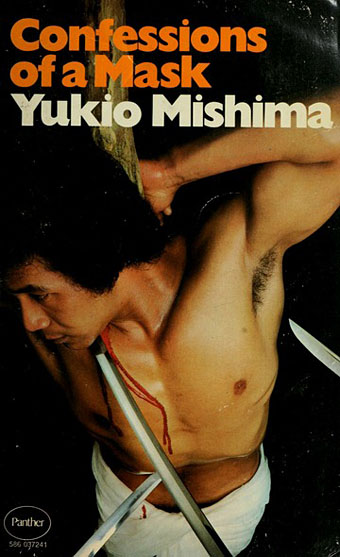
Photo by Roger Phillips, 1977.

• “…these films seem decidedly more modern than the films that followed close behind them.” Pamela Hutchinson on pre-code Hollywood.

• Space travel is time travel: NASA shows us galaxies as they were billions of years ago.

• Reverb Machine explains how Brian Eno created Ambient 1: Music For Airports.

• At Dennis Cooper’s: Spotlight on…Yukio Mishima Confessions of a Mask (1949).

• Mix of the week: The Chill Out Tent Kosmische Mix by Tarotplane.

• Old music: The Glastonbury Experience (Live 1979) by Steve Hillage.

• Deep Space 13: Stephen Mallinder’s favourite soundtracks.

• Sex and pathology: David Robb on 80 years of Cat People.

• New music: Expo Botanica by Cosmic Analog Ensemble.

Behind The Mask (1979) by Yellow Magic Orchestra | Red Mask (1981) by Cabaret Voltaire | A Ritual Mask (1983) by Peter Hammill

Weekend links 629

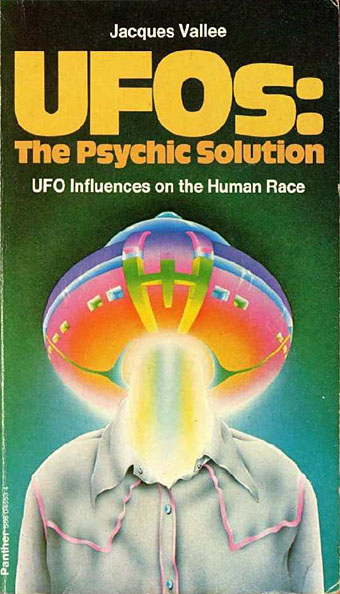
vallee.jpg

UFOs: The Psychic Solution (1977) by Jacques Vallée. A retitled reprint of The Invisible College (1975) with cover art by Peter Tybus.

• “In the summer of 1992…a curious experimental interstellar ambient-house album, made it to number one in the UK charts, promoted by a top ten single that was almost forty minutes long.” Darran Anderson navigates the noösphere with my favourite Orb album, U.F.Orb.

• Among the recent arrivals at Standard Ebooks, the home of free, high-quality, public-domain texts: Hope Mirrlees’ strange fantasy novel, Lud-in-the-Mist (1926).

• James Balmont’s guide to the intricate cinema of Hong Kong’s crime auteur, Johnnie To.

Shortlisted photos from the Astronomy Photographer of the Year Contest.

• At Dennis Cooper’s: Spotlight on…Jean Genet Miracle of the Rose.

• Steven Heller’s font of the month is Ambicase.

• New music: Two Sisters by Sarah Davachi.

• RIP Peter Brook and James Caan.

Unidentified Flying Object (1970) by UFO | Psychic And UFO Revelations In The Last Days (1994) by Bill Laswell & Pete Namlook | UFOnic (1995) by Sabalon Glitz

Weekend links 628

eckman-lawn.jpg

Collage art by Alex Eckman-Lawn at Unquiet Things.

• “…I love those niches and fringes in the creative world. I believe they deserve our support. But in most instances, this support must be driven by our generosity, philanthropy, and commitment to our core values—and not merely by profit seeking. Because as soon as profit maximization enters the picture, these outliers on the distribution curve don’t make the cut.” Ted Gioia explores the myth of “the Long Tail”.

• “Here we were, an Italian, an Englishman and an American in Munich, three foreigners in a foreign land—it was an accident we got together in the first place.” Pete Bellotte talking to Jude Rogers about the recording of I Feel Love by Donna Summer, a cult item in these quarters. Most of the history is very familiar but I didn’t know that Bellotte is a Mervyn Peake obsessive.

The radical, revolutionary homoerotic art of Sadao Hasegawa. Writing about the artist in 2007 I said that “a decent collection of his work for a western audience is long overdue”; we finally have such a thing courtesy of Baron Books.

• At Wormwoodiana: Undefined Boundary: The Journal of Psychick Albion, a magazine by the creators of the Coil zine, Man is the Animal, that “aims to celebrate the visionary, psychedelic and numinous in Britain”.

Dennis Cooper’s favourite fiction, poetry, non-fiction, film, art, and internet of 2022 so far. Thanks again for the link here!

• New music: Devotional by The Lord + Petra Haden, Dreamtides by Field Lines Cartographer.

Fall Into Sleep by K Of Arc.

Psychic Fire (1975) by Master Wilburn Burchette | The Psychic (1995) by David Toop | Psychic Wounds (2020) by Trees Speak

Luminous Procuress

luminous01.jpg

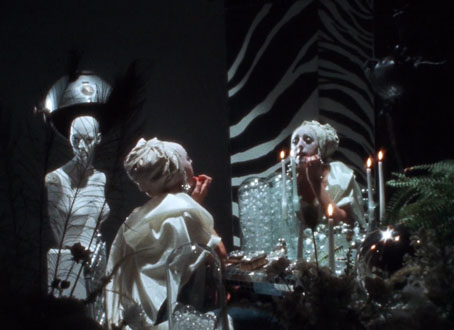
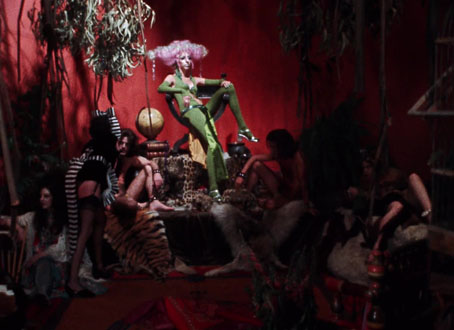
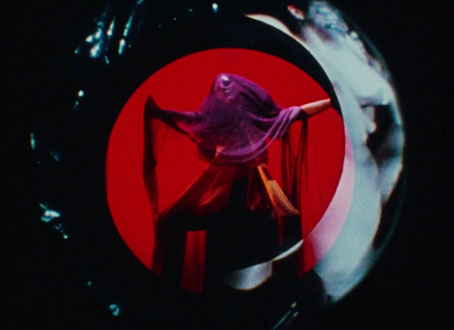
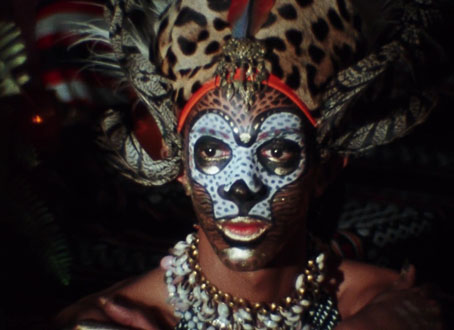
How to describe this one? Inauguration of the Pleasure Dome, pt 2? Bargain-basement Satyricon? The latter is probably more apt, Kenneth Anger’s longer films are more formal than Luminous Procuress. Steven Arnold’s only feature film resembles something made by the extras from a Fellini extravaganza after they’ve stayed overnight at Cinecittà; a series of artfully-arranged tableaux (artful arrangement being Arnold’s forte), together with a hardcore sex-scene (hetero) that seems out of place beside the relatively chaste antics elsewhere:

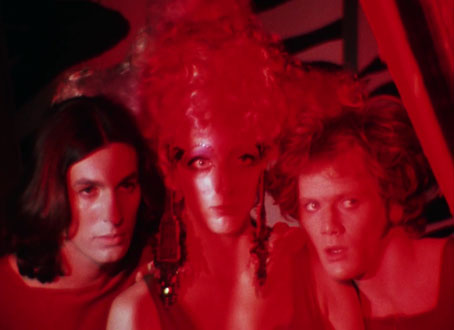
Luminous Procuress is an altogether extraordinary, individualistic phantasmagoria. It was filmed entirely in San Francisco over a two-year period, and describes the adventures of two wandering youths in San Francisco who visit the home of a mysterious woman, the Procuress. She is an elegant emblem of sorcery, her vivid features glowing under bizarre, striking maquillage, and one is not certain who she is or where she intends to lead the protagonists. Although the language she speaks is vaguely Russian, it appears that the Procuress has psychic powers. She discerns a sympathetic response to her on the part of the youths, and by magical means, conducts them through fantastic rooms, on a psychic journey. Through strange passageways, one voyages with the Procuress and her charges, glimpsing hidden nightmares and panoplied chambers of revelry, where celebrants, ornately festooned, dance and make love before unseen gods… (more)

luminous02.jpg

Arnold’s film follows the low-budget form by being shot without synchronised sound, so the dialogue, such as it is, has been dubbed on later. Rather than try and match words to the improvised scenes Arnold instead gives his characters foreign voices, most of which are mumbling and may not even be saying anything intelligible in their own language. This spares us any Warhol-like amateur theatricals while augmenting the dream-like atmosphere. The music by Warner Jepson is the icing on a very unusual cake. Jepson was a serious electronic composer whose rather abrasive debut album, Totentanz, was included in the Creel Pone catalogue of electronic obscurities in 2005. For the film Jepson provides swathes of synthesizer doodling interspersed with arrangements for keyboards and voices. All this and the Cockettes too. Salvador Dalí loved it.

luminous03.jpg

luminous04.jpg

luminous05.jpg

Continue reading “Luminous Procuress”