Weekend links 756

crane.jpg

A Diver (no date) by Walter Crane.

• At Worldbuilding Agency: The first part of a long interview with Bruce Sterling concerning “the pursuit of deliberate oxymorons as a creative strategy, worldbuilding in the context of history and futurity, Berlusconi on the moon and more”. With questions from Paul Graham Raven, and my cover art for Bruce’s Robot Artists and Black Swans.

• “With its focus on the 1970s career of Leonard Rossiter and its mordant metaphysics of the moist, Sophie-Sleigh Johnson’s Code: Damp might just be the most original book yet to emerge from Repeater publishing,” says Tim Burrows.

• “A definitive guide to the work of William S Burroughs’ on screen.” It’s a guide but it’s hardly definitive when there’s no mention of the four films Burroughs made with Anthony Balch.

• A catalogue of lots at the forthcoming After Dark: Gay Art and Culture online auction. Homoerotic art, photos, etc, also historic porn and a few garments worn by Divine.

• New music: Jay recommends the high-grade motorik en espanol dance-rock of Sgt Papers; Topology Of A Quantum City by Paul Schütze; Overtones by Everyday Dust.

• This week’s obligatory Bumper Book of Magic entry: Ben Wickey at Alan Moore World talks about his work on the book’s Great Enchanters comic strips.

• At Dennis Cooper’s it’s Malcolm Le Grice’s Day. Le Grice’s death was announced earlier this month.

• At The Wire: The magazine’s contributors’ charts showing their favourite music of the past year.

• A new website for the Sanborn Fire Maps and their decorated title pages.

• Mix of the week: DreamScenes – December 2024 at Ambientblog.

• At Public Domain Review: Albert Kahn’s autochromes.

Burroughs Called The Law (1960s) by William S. Burroughs | Language Is A Virus From Outer Space (Live) (1984) by Laurie Anderson | Burroughs Don’t Play Guitar (1996) by Islamic Diggers

Weekend links 755

emsh.jpg

A painting by Ed Emshwiller for the cover of Fantastic Stories of Imagination, July 1962, illustrating The Singing Statues by JG Ballard .

• This week in the Bumper Book of Magic: my comments about the creation of the book’s cover and magical alphabet have been posted at Alan Moore World. At (Quasi), Smoky Man (in Italian) looks at other parts of the book, and includes my answers to his questions about the creation of The Soul, a character originally planned for a comic strip that Alan Moore and I were working on. I’ve been trying recently to find the first sketches I made of The Soul back in 2000 or 2001, without success. If I do find any of them I’ll post them here.

• New music: Juk-Shabb by Cryo Chamber Collaboration is this year’s installment in the Lovecraft-themed album series (previously) from Cryo Chamber. Also this week: Xerrox Vol. 5 by Alva Noto; Nocturne (Soundtrack for an Invisible Film) by Avi C. Engel; and Cat Location Conundrum by Moon Wiring Club.

Code: Damp: An Esoteric Guide to British Sitcoms by Sophie Sleigh-Johnson, being “an alternative occult and esoteric history of England told through one of its most popular cultural forms: the comedy sitcom”.

…the joy of art isn’t only the pleasure of an end result but also the experience of going through the process of having made it. When you go out for a walk it isn’t just (or even primarily) for the pleasure of reaching a destination, but for the process of doing the walking. For me, using AI all too often feels like I’m engaging in a socially useless process, in which I learn almost nothing and then pass on my non-learning to others. It’s like getting the postcard instead of the holiday.

Brian Eno at Boston Review

• “The typographic choices that Godard made were thematic and not only chosen for their stylistic properties.” Arijana Zeric looks inside the design world of Jean-Luc Godard.

• Coming soon from Strange Attractor: The Stammering Librarian: Essays by Timothy D’Arch Smith, edited by Edwin Pouncey & Sandy Robertson.

• At Public Domain Review: Fantastic Planet: The Microscopy Album of Marinus Pieter Filbri (1887–88).

• At the BFI: Michael Brooke offers suggestions for where to begin with Guy Maddin.

• At The Quietus: The Strange World of…Dennis Bovell.

• Mix of the week: A mix for The Wire by KMRU.

• Steven Heller’s font of the month is Gigafly.

Fantastic Cat (1996) by Takako Minekawa | Fantastic Analysis (2001) by Mouse On Mars | Fantastic Mass (2016) by Time Attendant

Weekend links 754

picasso.jpg

The Remains of Minotaur in a Harlequin Costume (1936) by Pablo Picasso. Via.

• At Rarefilmm: Long Live the New Flesh: The Films of David Cronenberg, a TV documentary from 1987 which includes contributions from Martin Scorsese and Stephen King. I wrote about this one years ago but at the time the only available copy was chopped into 10-minute segments.

• Coming soon from Strange Attractor: Delinquent Elementals: A Pagan News Anthology, edited by Phil Hine & Rodney Orpheus.

• At Wormwoodiana: Mark Valentine explores the possible influence of the Sherlock Holmes stories on Arthur Machen’s early fiction.

Perhaps there was a Super-Sargasso Sea in the upper atmosphere into which were carried objects from earth—frogs, fish, leaves—and from which they later rained. Perhaps the universe was a living thing, rains of blood its bleeding. Perhaps in 1903 the earth, in its orbit about the sun, passed through the remains of a world destroyed in an interplanetary dispute, the particles falling as rains of dust and redness. Perhaps humanity was controlled. “I think we’re property”, Fort wrote. Or, perhaps not; so skeptical he could not accept even his own authority, he had given up theorizing. “We have expressions: we don’t call them explanations: we’ve discarded explanations with beliefs.”

Joshua Blu Buhs on how Charles Fort came to write The Book of the Damned

• More Alan Moore: “Magic is not this big, spooky, dark thing that’s full of nightmares,” he tells Séamas O’Reilly at the Irish Times.

High-resolution images of 14,000 woodblock illustrations and letterforms free to use at the Plantin-Moretus Museum, Antwerp.

• New music: Music For Bus Stations by Rod Modell; and Between Soil And Sky by Tarotplane.

• At Dennis Cooper’s: Spotlight on…Denton Welch In Youth is Pleasure (1945).

• At the Quietus: The Strange World of…Irena and Vojtech Havlovi.

Apollo Explorer

Pagan Love Song (1959) by Martin Denny | Pagan Lovesong (Vibeakimbo) (1982) by Virgin Prunes | Pagan Sun Temple (2022) by Hawksmoor

The Magic Shop, a film by Ian Emes

magic1.jpg

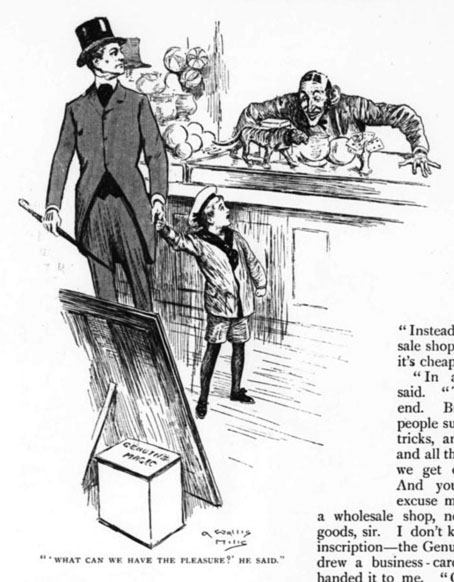
An illustration by Arthur Wallis Mills from The Strand Magazine, June, 1903.

I had not thought the place was there, to tell the truth—a modest-sized frontage in Regent Street, between the picture shop and the place where the chicks run about just out of patent incubators—but there it was sure enough. I had fancied it was down nearer the Circus, or round the corner in Oxford Street, or even in Holborn; always over the way and a little inaccessible it had been, with something of the mirage in its position…

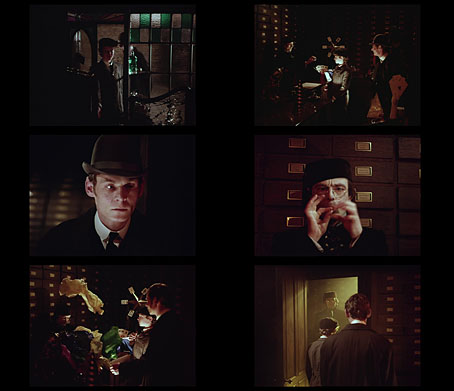
Despite writing about an HG Wells adaptation only a week ago I hadn’t gone searching for more of them when this one turned up anyway, rather like Wells’ mysterious shop. I’d actually been looking at the filmography of the late Ian Emes, a director best known for the short animations he made for Pink Floyd’s concerts, although his career encompassed animated shorts like The Beard as well as longer films for television and the cinema. The Magic Shop, which was made in 1982, looks as though it might have been another of those shorts that used to be programmed as supporting titles for first-run features in British cinemas. Andrew Birkin’s Sredni Vashtar was one of these, a film which is also under 30 minutes in length and an adaptation of a popular piece of Edwardian fiction.
magic2.jpg

HG Wells’ story was first published in The Strand Magazine in June 1903 then collected in Wells’ Twelve Stories and a Dream a few months later. It’s been one of my favourite Wells stories since I first read it at the age of 11, as I mentioned in this review of the 1964 TV version. Wells’ fantasy reached me just as I was beginning to get very interested in conjuring tricks. I’d also been reading Victorian ghost stories in the reprint collections being published by Puffin and Lion, so a story about a shop that sold magic tricks, where the premises and proprietor had a slightly sinister quality, was exactly the kind of thing I wanted to read.
magic3.jpg

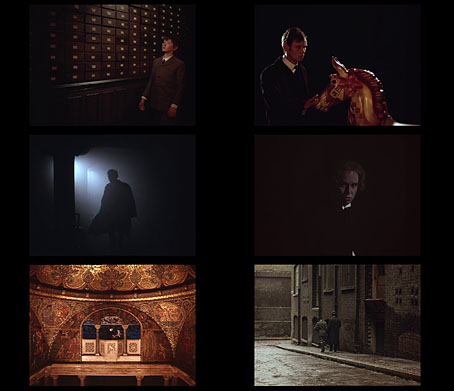
Ian Emes’ adaptation is a more successful Wells film than The Door in the Wall, and a much better adaptation of the story itself than the attempt to update the tale for The Alfred Hitchcock Hour, but Emes still doesn’t really capture the spirit of the story. The main flaw is that the actor playing the boy who wants to explore the shop is too old for the role. The narrator’s son in the story is around five or six years old, and much of the tension in the telling comes from the way that the boy sees everything that’s happening as delightful and magical while the father experiences rising alarm at the unfolding events and the situation in which the pair find themselves. The second half of the story, in which father and son are led by the shopowner into the labyrinthine warehouse behind the shop, is also lacking. Emes’ production may have been compromised by its budget but there’s no sign of the surprises that you might have expected to be filmed by a former animator. Derek Jarman regular Karl Johnson plays the father, Ron Cook is the shopowner, and there’s a cameo near the beginning from William Rushton as the man whose whining son is denied admittance to the shop. (Rushton had earlier provided the voice of the afflicted shaver in The Beard.) At the end of Emes’ film father and son find themselves teleported to what looks like a back street somewhere near the river instead of being returned to a busy London street. This reminds me that the first time I visited Regent Street myself at the age of 13 I had half a mind to go looking for the “Genuine Magic Shop”—or to try and identify the place where it might have been. The elusive nature of Wells’ establishment makes it the forerunner of the chemist shop owned by the malevolent Grail-seekers in Charles Williams’ War in Heaven, which makes me wonder now whether Williams borrowed the idea from Wells.

Ian Emes’ film may be seen at his Vimeo channel (log-in required, or you can use the Vimeo app). The story can be found in a collection of fifty-four of Wells’ short stories at Standard Ebooks, the home of free, high-quality, public-domain texts.

Previously on { feuilleton }
The Door in the Wall, 1956
Claude Shepperson’s First Men in the Moon
The Beard, a film by Ian Emes
Uncharted islands and lost souls
Doctor Moreau book covers
The Island of Doctor Moreau
Harry Willock book covers
The Time Machine
The Magic Shop by HG Wells
HG Wells in Classics Illustrated
The night that panicked America
The Door in the Wall
War of the Worlds book covers

Weekend links 752

nemo.jpg

Captain Nemo by Alphonse de Neuville, from Twenty Thousand Leagues Under the Seas (1875) by Jules Verne.

• “…physical remoteness is a category of its own. It is an enhancer: It can make the glorious better and the terrible worse. The oceanic pole of inaccessibility distills physical remoteness on our planet into a pure and absolute form. […] Point Nemo is nearly impossible to get to and offers nothing when you arrive, not even a place to stand. It is the anti-Everest: It beckons because nothing is there.” Cullen Murphy explores the remotest place on Earth. A long and fascinating read, but no mention of Point Nemo’s dreaming tenant.

• More Bumper Book business: Smoky Man has posted the second part of his analysis of the book for (Quasi) (in Italian) which includes some comments from myself about the origin of the Moon and Serpent Magical Alphabet, and why the letter Q in the alphabet is assigned to Cthulhu. Elsewhere, Panini have announced an Italian edition of the Bumper Book for May next year, while at The Beat Steve Baxi reviewed the book from a philosophical perspective.

• At the BFI: David Parkinson on where to begin with Louis Feuillade. I’d suggest starting with Fantômas rather than Les Vampires but then I’m biased.

The combination of magic(k)al, ceremonial action, vivid colour and paradoxically serious camp in Jarman’s Super 8 films of the ’70s bears the influence of Kenneth Anger, but the differences between Jarman’s sensibility and Anger’s are more striking than the resemblances. Jarman’s vision is more materialist, austere and hermetic, and less sociological; where Anger identifies the glamour of American popular culture with the Will of the Crowleyan magician, Jarman situates the discovery of the cinematographic mechanism imaginatively within the history of alchemy. Anger cast rock stars as gods and adepts with the intention of harnessing the energy of their recognition; Jarman casts Fire Island, then in its heyday as a gay resort, as a desert defined by sculptural details and occupied by a single masked figure, in scenes that both recall his landscape paintings of the ’60s and ’70s and anticipate the design of his garden at Dungeness.

Luke Aspell on Derek Jarman’s hermetic film/painting, In the Shadow of the Sun

• At Smithsonian Magazine: “Visions of nuclear-powered cars captivated Cold War America, but the technology never really worked”.

• At The Spectator podcast: host Sam Leith talks to Michael Moorcock about 60 years of New Worlds magazine.

• At Public Domain Review: “Light from the Darkness” — Paul Nash’s Genesis (1924).

• At Bandcamp: “Disco godfather Cerrone’s enduring influence on dance music”.

• At Unquiet Things: The Art of Survival: Eyeball Fodder in Dark Times.

• Mix of the week: DreamScenes – November 2024 at Ambientblog.

• New music: The Laugh Is In The Eyes by Julia Holter.

• At The Daily Heller: The College of Collage.

• RIP jazz drummer Roy Haynes.

Thermonuclear Sweat (1980) by Defunkt | Nuclear Drive (1982) by Hawkwind | Nuclear Substation (2005) by The Advisory Circle