Weekend links 419

ellison.jpg

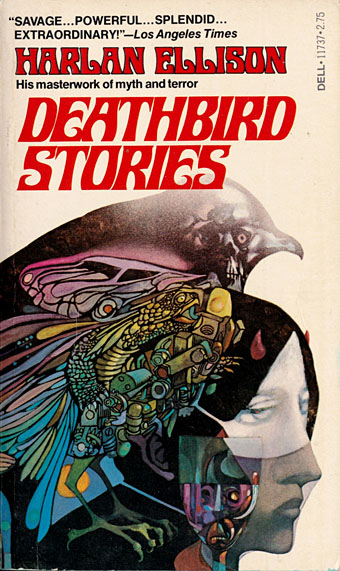
Cover art by Leo & Diane Dillon, 1975.

Art is not supposed to be easier! There are a lot of things in life that are supposed to be easier. Ridding the world of heart attacks, making the roads smoother, making old people more comfortable in the winter, but not Art. Art should always be tough. Art should demand something of you. Art should involve foot-pounds of energy being expended. It’s not supposed to be easier, and those who want it easier should not be artists. They should be out selling public relations copy.

Typical of the late Harlan Ellison to describe his vocation in terms of difficulty and struggle even when his prolific output made writing seem effortless. When my colleagues at Savoy Books published a Savoy issue of New Worlds magazine in 1979 one of the features they ran was an introduction by Michael Moorcock to an Ellison story collection. (They also published two books of Ellison’s around this time.) A copy of the magazine was duly sent to the subject of the essay since Ellison always liked to keep track of his print appearances. The back page of that particular issue is blank but for a few words in bold type from singer PJ Proby: “I am an artist; and should be exempt from shit.” Ellison cut this slogan from the magazine then glued it to his typewriter, no doubt transferring it to later models since it was still visible in the 2008 Ellison documentary, Dreams With Sharp Teeth.

My first encounter with Ellison’s work was also my first encounter with what became labelled the new wave of science fiction, via a reprint of I Have No Mouth, and I Must Scream in a book in the school library. I was only about 12 or 13 at the time, and found Ellison’s story so shocking and disturbing that it overpowered everything else in the collection. The only other story that made an equivalent impression at the time was The Colour Out of Space by HP Lovecraft, so it’s perhaps fitting that Ellison gave my work a favourable mention in his introduction to the huge Centipede Press collection of Lovecraft artwork, A Lovecraft Retrospective: Artists Inspired by HP Lovecraft. I still haven’t got over that one. After the initial encounter, the Ellison-edited Dangerous Visions and Again, Dangerous Visions were just as important for me as the paperback reprints of stories from the Moorcock-edited New Worlds: a handful of books that showed science fiction to be a literary form of limitless possibilities, as opposed to the stereotype of space adventure and future technology. The Ellison and Moorcock anthologies led me to William Burroughs, James Joyce and all points beyond; they also soured for me the preoccupation with space adventure and future technology which persists today.

My final connection with Ellison replayed his compliment in a small way, when editor Jill Roberts and I took extra care with the typesetting of Jeffty is Five for The Very Best of Fantasy & Science Fiction, Volume 2. Ellison was the only author I’ve encountered in the digital age whose corrections were still handwritten comments on printed sheets; these had to be faxed to San Francisco then scanned and emailed to me (to this day I still don’t know why the oft-reprinted story required so many adjustments). It was awkward but amusingly so, a benign taste of a legendary bloody-mindedness and insistence on precision.

• “Laughing about an acid trip with members of Can and opening up about some of the ‘scars’ left from his association with Brian Eno and David Byrne’s My Life In the Bush of Ghosts, [Jon] Hassell is candid in a way that comes naturally to those who’ve lived life on their own terms.”

• Drone Metal Mysticism: Erik Davis talks with music scholar and ethnographer Owen Coggins about amplifier worship, sonic pilgrimage, “as if” listening, metal humour, and his new book Mysticism, Ritual and Religion in Drone Metal.

Psychedelic Prophets: The Letters of Aldous Huxley and Humphry Osmond; “Letters between the men who coined the term ‘psychedelic’ and opened doors to a different way of thinking about human consciousness.”

Artaud 1937 Apocalypse: Letters from Ireland by Antonin Artaud; translated and edited by Stephen Barber.

• “I thought female sexuality was an OK thing?” says writer and porn performer, Stoya.

• “How did a major label manage to lose a John Coltrane record?” asks Ted Gioia.

• Welcome to the dollhouse: Alex Denney on a century of cinematic cutaways.

• The trailer for Mandy, a new (and much-awaited) film by Panos Cosmatos.

• Rest in Anger, Harlan Ellison (1934–2018) by Nick Mamatas.

• Mix of the week: FACT Mix 659 by BD1982.

Emily Gosling on library music design.

Record Label Logos

The Deathbird Song (1997) by The Forbidden Dimension | Eidolons (2017) by Deathbird Stories | Deathbird (2017) by Tempos De Morte
Weekend links 414

polackova-vyletalova.jpg

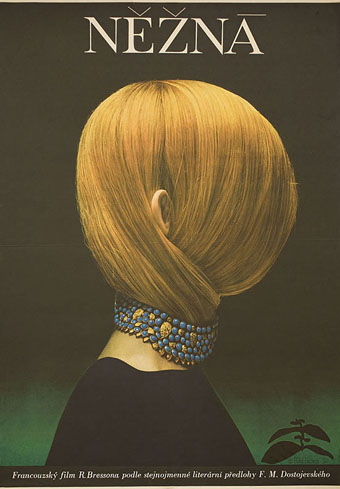
Czech poster for Robert Bresson’s Une Femme Douce (1969) by Olga Polácková-Vyletalová. There’s more about Polácková-Vyletalová’s striking poster designs (and this one in particular) at Mubi. See also the Polácková-Vyletalová collection at Terry Posters.

• “I heard that in Japan the tendency is to hammer down the nails that stick out. I think that Haruomi Hosono is a nail that sticks out. And has maintained that.” Van Dyke Parks on Haruomi Hosono, best known in the West for being one third of Yellow Magic Orchestra but a prolific artist in his own right. Hosono’s early solo albums are being reissued by Light In The Attic later this year.

Hua Hsu on The Spectacular Personal Mythology of Rammellzee. “Rammellzee will always feel like part of the underground,” says Geeta Dayal in a review of the Rammellzee exhibition currently showing in New York.

• Mixes of the week: Hassell’s Children, a Fourth World mix by Ban Ban Ton Ton, The Island of Bright Tombs by SeraphicManta, and a Radio Belbury mix by The Advisory Circle.

• More Robert Aickman: The Fully-Conducted Tour, a complete short story. Related: Matthew Cheney reviews the new Aickman collection, Compulsory Games.

• Another Kickstarter bid, this time for a reprint of Art Nouveau designs and illustrations by Carl Otto Czeschka.

Oliver Burkeman reviews How to Change Your Mind: The New Science of Psychedelics by Michael Pollan.

Art/design/architecture magazines online at the International Advertising & Design Database.

• Tonedeaf in our nose: Gerri Kimber on the musicality of James Joyce’s writing.

• More William Hope Hodgson: Greydogtales examines Hodgson’s poetry.

• The Art of Elsewhere: Jed Perl on the world of Edward Gorey.

• At Dennis Cooper’s: Records.

Beat Bop (1983) by Rammellzee vs. K-Rob | Equation (1989) by Material ft. Rammellzee | No Guts No Galaxy (1999) by Ramm Ell Zee & phonosycographDISK

Weekend links 400

bernard.jpg

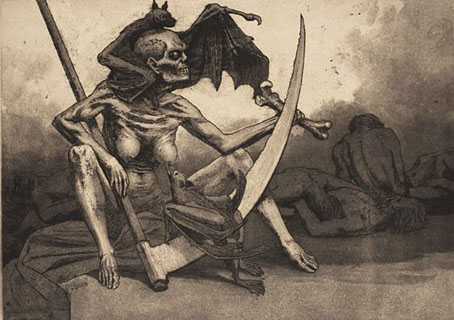
Le Répit (La Mort allaitant une chauve-souris) (1895) by Valère Bernard.

Playhouse 90 presents Heart of Darkness by Joseph Conrad. An American TV production from 1957 starring Boris Karloff, Roddy McDowall, Eartha Kitt and others; introduced by Sterling Hayden. It’s bizarre. Acidemic goes into the detail.

• Erik Davis talks to occult writer and drug geek Julian Vayne about Baphomet, the (sur)reality of spirits, evolution, ritualizing entheogens, and his new book Getting Higher: The Manual of Psychedelic Ceremony.

• “Unsurprisingly, 1. Outside was the record that the #BowieBookClub readers most readily associated with Hawksmoor.” Anna Aslanyan revisits Peter Ackroyd’s architectural mystery.

The Flowers of Dorian Gray: part one of a series of posts examining one of Oscar Wilde’s favourite symbols.

• At Haute Macabre, an interview with Michael Locascio & Heather Jean Skawold of Dellamorte & Co.

One Minute Art History, an animated film by Cao Shu.

Film posters at the Harry Ransom Center, UT-Austin.

• Mix of the week: FACT mix 639 by Black Milk.

Susanna‘s favourite albums.

• Welcome to The Spoodoir.

• Flowers Of Evil (1983) by Cortex | Baphomet (1989) by Foetus Inc. | Heart Of Darkness (1989) by Syd Straw

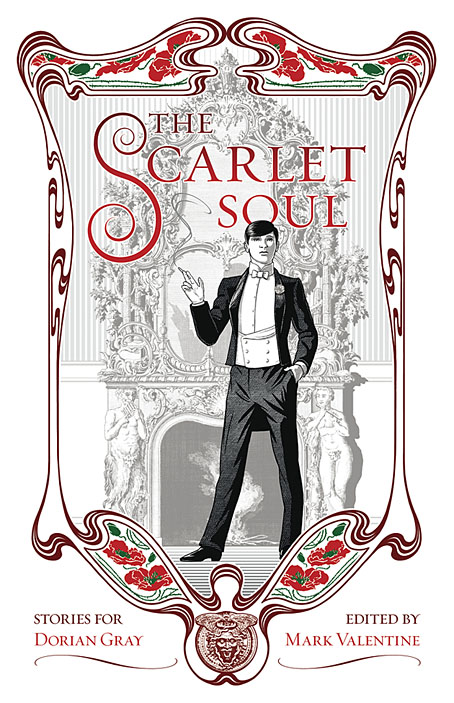
The Scarlet Soul: Stories for Dorian Gray

scarlet.jpg

With the running out of the year it’s time to start posting some of the things I’ve been working on for the past few months. This year has been an incredibly busy one with little breathing space between projects. Last month I mentioned not having enough time to put together a decent mix for Halloween; I also haven’t had enough time to prepare a calendar for next year. The latter isn’t a great loss since last year’s effort was a particularly bad seller but I still like doing them when I have the opportunity.

Before I get to one of the big illustration projects, here’s a cover I put together last month for Dublin’s Swan River Press. The theme should be self-evident, and this marks my second entry into Dorian Gray territory. It’s also the second thing that I’ve worked on this year with a connection to Mark Valentine (see this post for details of the first). Swan River publish a range of elegant hardback editions so I’m looking forward to seeing this one in print. As to the artwork, the frame is adapted from a 1900 calendar design by one Oscar Ziemann which I found in an issue of Deutsche Kunst und Dekoration. There’s next to nothing about Herr Ziemann on the web so his design may have been a one-off. The poppies are my own replacement for Ziemann’s floral designs; they relate to the hints that Oscar Wilde gives to Dorian Gray’s opium indulgence, and they’re scarlet flowers, of course.

The Scarlet Soul will be published next month but it’s available for pre-order here. My next work for Swan River Press will be a major edition of William Hope Hodgson’s weird masterwork, The House on the Borderland. More about that later.

Previously on { feuilleton }
Picturing Dorian Gray

Weekend links 374

vasconcelos.jpg

Le Chasseur by Lupe Vasconcelos who was profiled this week at Unquiet Things, and whose work may also be seen at the Ars Necronomica art show in Providence, RI, until the end of the month.

• “After a morning’s writing, Stevenson would entertain himself with music, particularly the flageolet, which he played so badly ‘people fled from the sound’.” Peter Moore reviewing Robert Louis Stevenson in Samoa by Joseph Farrell.

• Jon Hassell’s 1981 album, Dream Theory in Malaya: Fourth World Volume Two, will be reissued next month.

• Mixes of the week: Secret Thirteen Mix 228 by Arma Agharta, FACT Mix 614 by Do Make Say Think.

Yet, entertaining as all this is, in a macabre key, the dead are hard to think about—and, in many ways, to read about. Unlike animals, which Lévi-Strauss declared were not only good to eat but bon à penser, too, I found that I averted my eyes, so to speak, several times as I was reading this book. Not because of the infinite and irreversible sadness of mortality, or because of the grue, the fetor, the decay, the pervasive morbidity—though Laqueur’s gallows humour about scientific successes in the calcination of corpses can be a bit strong—but because the dead present an enigma that can’t be grasped: they are always there in mind, they come back in dreams, live in memory, and if they don’t, if they’re forgotten as so many millions of them must be, that is even more disturbing, somehow reprehensible. The disappeared are the unquietest ghosts. Simone Weil writes that the Iliad is a poem that shows how “force…turns man into a thing in the most literal sense: it makes a corpse out of him.” But Laqueur is surely right to inquire why that thing, the “disenchanted corpse…bereft, vulnerable, abject”, is a very different kind of thing from the cushion I am sitting on or even my iPad (which keeps giving signs of a mind of its own). I have always liked Mme du Deffand’s comment, when asked if she believed in ghosts. A philosopher and a free thinker, she even so replied: “Non, mais j’en ai peur.” (“No, but I am frightened of them.”)

Marina Warner reviewing The Work of the Dead: A Cultural History of Mortal Remains by Thomas Laqueur

New Worlds magazine at the Internet Archive. Not a complete run but it’s a start.

Brigit Katz on breakthroughs in the scientific search to replicate psilocybin.

• The relaunched (and slightly renamed) Manchester Digital Music Archive.

• At Dennis Cooper’s: Robert Altman Day (restored/expanded).

• RM Rhodes presents the art of Philippe Druillet.

Fragile Self

Dream Lover (1964) by The Paris Sisters | Dream Street (1966) by Henry Mancini | Dream Letter (1969) by Tim Buckley